
From the Travely-Family archive · Cape Horn
Cape of Good Hope. Approaches. Day 53.
An original publication from the former Travely-Family website. This English translation was preserved from the technical-site archive without editorial rewriting.
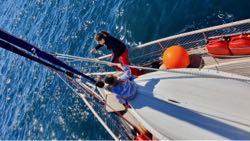
Cape of Good Hope. Approaches. Day 53. We have 100 miles to go, and when the display shows 99, the children and I will definitely shout, “Hooray!”
After all, we’ve been waiting for this moment for almost two months. We’ll open the celebratory pickles, some peaches perhaps—what else do we have left? Incidentally, this time we have about three times as many supplies remaining as we did after our passage across the South Pacific. Fearing death by starvation, we stocked up on enough powdered milk, jam and assorted tins for three months of self-sufficient voyaging. We also have a substantial stock of grains and beans. Only fresh fruit is in short supply. At first, the oranges and lemons spoiled rapidly despite the low temperatures in our makeshift storeroom.
Then the springtime warming in these latitudes allowed us to open the forehatch, and everything that hadn’t spoiled by then never did. Because we ate it all. We still have about fifteen lemons; the young sailor and I chop them up finely and drown them in sugar to have with tea.
This morning, the last apple and orange were cut up. Each into four wedges—the entire crew’s daily ration. For the previous two weeks, the fruit ration had remained unchanged; only yesterday there wasn’t enough apple to go around. We’ve started brewing hibiscus tea and diluting chlorophyll solution as an imitation of something fresh. For tomorrow morning, in honour of our arrival, we have four little mandarins. And then, God willing, there’ll be a market or a shop. With fruit and cheese, buns and fried chicken, ice cream and tomatoes. And most importantly, people—and the chance to run about and breathe in the scents of land.
The wind follows the forecast one moment, then dies away to 3 metres per second, then builds to 20 knots. The sails we set for the lull are very surprised when the forecast wind returns. The boat is forced bow into the wind. And Lady Mary, hands on hips, flies not towards Cape Town but straight for the Cape of Good Hope, 30 miles to the south.
Overcast and raining. What does the coming day have in store for us? What will the approach to the Cape of Storms be like? Will we be lucky or not? We rounded Cape Horn for the first time in a Force 8–9 storm, which is nothing unusual in those latitudes.
The second time, the wind off the Horn reached 40 knots.
This present passage from Cape Horn to the Cape of Good Hope across the South Atlantic has been harder than the South Pacific.
Five storms, one of them severe, and another five near-storms in the first 40 days. Only after Tristan da Cunha did two relatively quiet weeks begin. And we’ve got a little out of the habit of storms. We’d rather not have to get used to them again close to a dangerous coast. Poseidon, let us through quietly, all right?
We’re tired now. The boat is tired too. The safety netting along the sides is battered, the panels on the starboard side have been torn out, the main shroud is lashed with rope, the mainsail’s cringles have been ripped out, and even the new genoa has suffered. Inside, too, everything is in ruins after the long subantarctic winter. And our brave pets, the plants Alejandro and the Mad Hatter, are now disabled: they have lost their usual place and almost all their leaves. A 60-knot storm near the Falkland Islands flung them around the saloon along with the books and a heap of other things. We gathered up the roots and soil and, through trial and error, found them new places in the sun. Now it would take the boat doing a full 360-degree roll to knock them out of their nests. But better not—let them live.
Neighbouring Capes
Should I go and put the kettle on before it really starts blowing? The black clouds dead ahead leave little hope of an easy approach to the Cape of Good Hope. We had thought that just before Cape Town we would nip across its meridian. In other words, round the Great Cape properly, right now, crossing not only its latitude but its longitude as well. But the weather isn’t conducive to fooling around. We’ll cross the longitude later. Yes, the coordinates of the Cape of Good Hope are 34.36 S, 18.48 E.
By the way, you do know that the Cape of Good Hope is not Africa’s southernmost point at all, don’t you? It is, in fact, its south-westernmost point. The southernmost is Cape Agulhas. But after the Cape of Good Hope, the coastline turns decisively east for the first time, revealing an open expanse of the neighbouring ocean. Where the two oceans meet, conflicting currents arise, along with enormous waves whenever a storm wind blows against the current. That is why ships perished here by the hundred. That is why history remembers this particular Cape of Storms, also known—thanks to the light touch of the Portuguese king Juan, that is, João II—as the Cape of Good Hope. Meanwhile, the aggrieved Cape Agulhas waits for public recognition 150 kilometres to the south-east.
The Useless Lighthouse
In 1857, a towering lighthouse was erected on the cliffs of the famous cape. It stood 238 metres above sea level. Everyone rejoiced, thinking that ships would no longer perish so relentlessly amid the treacherous coastal currents and rocks. But no such luck. The lighthouse proved too high, and during the very stormy hours when it was needed most, it was hidden by cloud. Ships continued to founder. After yet another disaster in 1911, they decided to move the lighthouse and make it lower. The new lighthouse, 87 metres above the ocean, was built at a different location between 1913 and 1919.
It turned out to be the most powerful on the entire African coast; they say its light can be seen from 60 miles away. Since then, there have been fewer shipwrecks. Then satellite navigation, electronic charts, AIS and GPS were invented, and life became cheerful and carefree. Just like aboard the Russian yacht Lady Mary.
And with that, I bid you farewell—I’m off to boil water for tea. It will be tea with Crimean herbs, a gift from the captain of Arctic Wolf. We embrace you, friends. Thank you for being with us: even at a distance, in both calms and storms, we feel your helping hand and shoulder to lean on. Without your support, this great voyage would have been harder for us. Special greetings from the sleepy young sailor—there she is, peering out of her nest beneath the chart table....The barometer is creeping down.
Sent via satellite. You can follow the progress of the First Russian Three Great Capes Round-the-World Expedition with Children on our website, under the Route tab, where the track from IRIDIUM is plotted. The same map with the track and weather is available at bit.ly/iridium360. Our thanks to MVS Telecom JSC for plotting our track and weather conditions, and for making it possible for us to communicate with our family from the heart of the ocean and from any storm—by text message through the tracker.
May everything be well with you. You’re the very best!