
From the Travely-Family archive · Cape Horn
The Third Storm. Taking the Hit
An original publication from the former Travely-Family website. This English translation was preserved from the technical-site archive without editorial rewriting.
The third storm. Taking the hit. “Andryukh, shall we heave to, maybe? This is getting pretty grim.”
The captain is having his evening sleep before the night watch. The children and I are watching a cartoon before bed, but we don’t finish it. It is getting harder and harder to catch the laptop and keep our balance on the settee. Nastya keeps leaping up to the helm to correct first a luff, then a bear-away. The first is when the boat turns her bow into the wind; the second is the opposite. The yacht yaws all over the course, while the wind behaves roughly like this: 20–25 knots for 3 minutes, 40–45 knots for 3 minutes, then back to 25 for another 3 minutes. For 20 knots, the scrap of headsail—the genoa—is too little; for 45, it is too much, and the windvane self-steering cannot cope. The waves are the size of a three-storey building, and we fly from wall to wall.
“How much wind?” the captain asks.
“45 in the gusts.”
“Why aren’t you reefing the genoa?”
“Well, Andryukh, I’m scared to do it without you.”
So by now you’ve realised that I’m no Jessica Watson, just a mum who is wary of going out on deck in the blackness of night on a 9-metre wave with only her daughter. I’m afraid Nastya might be too slow on the furler and... something might go wrong.
“Why didn’t you wake me?”
“I’m waking you now.”
The moment the almighty captain stepped onto the deck, a wave broke right over his head. That was when I suggested we heave to while waiting for it to strengthen. In other words, stop the boat under sail so we would not have to keep wrestling with the helm all night. The forecast wind is 25 knots, but our instruments are already showing more than 40. The overnight forecast says 35 knots. In reality, it blew 48–54 all night—up to 27 metres per second, Force 10 on the Beaufort scale. This is our third storm in 3 weeks. The true wind is always 15–20 knots stronger than the forecast says. It’s a good thing we were prepared for the Southern Ocean’s temperament after our voyage through the Drake Passage to Antarctica.
We hove to before it really started blowing. That did not stop the captain and me from staying awake all night, but it spared us from standing at the helm and going out on deck.
I crawl out of my den after a particularly fierce gust, when the howling and bucking become downright terrifying, and see 48 knots of sustained wind. Andrei is half-reclining on the watch settee.
“Why aren’t you asleep?”
“Why aren’t you?”
And I crawl back into my den to wait for the next gust.
At least the sailor and our young crew member got some sleep, and that’s something. For the second week running, I get up feeling like I’ve been run over by a cart; my body seizes up from trying to stay in the bunk without crushing Nastya or Andryukha. When we reach Cape Town, we’ll definitely come up with a removable partition down the middle of the double bed. Then you can just lie against the wall and be OK. For now, two sofa back cushions laid pile-side down on the sheet between the notional sleepers help a little. If you cling tightly to that sofa cushion, friction keeps you from crushing your neighbour in moderate seas. And in heavy seas, your neighbour would still rather get a cushion in the ribs than a knee.
By morning, the sun and we slowly crawl out to breakfast. As usual, we sit like spiders so we won’t go flying. You clamp the sugar bowl, jam jar or plate between your heels or knees; the hand holding your mug compensates for every wave; something is bound to spill. This time, it was hot tea on the captain’s leg. In short, to eat in these conditions, you need to be a proper four-armed monkey. Nastya sighs, “Why can’t the weather be like it was yesterday morning? We could even do things, walk around, tidy up. The food keeps sliding away in this swell!”
Even Poseidon heard that cry from the heart. By lunchtime, the weather had improved enough for us to walk around again. Well, “walk around”... get up from the settee without risking our health.
Nastya made a delicious dinner. “Today is Thursday, and in prison they serve pasta.” With cheese. The cheese needs rescuing—it won’t survive a fourth week in the locker. The pasta also comes with beans in a sauce made by the cook. For a snack, the first mate whipped up a Mexican fish-and-vegetable salsa to have with crackers. Our young sailor alternates between doing three-digit subtraction in columns, climbing up under the deckhead and ecstatically retelling the new adventure book to us, and reading that same book under the table.
Since the Falklands, we have not encountered a single ship. The whales and dolphins are adept at hiding, while several different kinds of birds follow the boat. The black lightning bolts of petrels, grey-and-white don’t-know-whats, and mighty albatrosses. When they hover over the cockpit for a look, you can appreciate their wingspan. Three metres, definitely! Tristan da Cunha is home to an entire colony of yellow-nosed albatrosses that are not afraid of people. If we’re lucky, we’ll see them. We have not given up hope that, even if we cannot land, we might at least spend a couple of days at anchor off the most isolated island on Earth, given that it has no airport. With some of the world’s wildest waves and strongest winds.
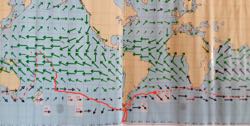
Yes! We’ve had a breakthrough: for the second day running, we’ve been sailing with the hatch cracked open, and we only run the heater for about 40 minutes in the evening. Can you imagine the heat wave we’re having! True, we still have to put up the sails wearing hats, but soon we’ll be able to take those off too. We are knocking about on the boundary between the forties and the thirties in latitude. The wind map in the picture shows that we are right in the deadliest spot. Since December, we have been travelling through the black zone; arrows of that colour indicate storm-force winds with only occasional lulls.
No storms are forecast for the next couple of days, and that’s something. One thing is clear: there will be no easy ride on this route.
People ask whether we will call at Saint Helena. Not this time. It is two and a half thousand kilometres from Tristan to St Helena—a two-week voyage each way. For all the historical appeal of Napoleon’s final place of exile, it would mean one hell of a detour, especially when everyone is already tired. Oh yes! During the storm last night, we crossed the thousand-mile-to-go mark for Tristan. We have 950 miles left on the rhumb-line course. We should get there in about 10 days.
In our next report, we’ll tell the stories of this archipelago, from Jules Verne and his successors. This is Day 21. Sent via satellite.
You can follow the expedition in real time on our website under the Route tab, thanks to MVS Telecom JSC and IRIDIUM. The same map, with our track and details, is available at bit.ly/iridium360.
A huge thank-you to Nikita and Nastya from Soundaroundme and to Alexei I. for supporting the ship’s budget through Yasobe.ru/na/TravelyFamily! Dear friends, even if indirectly, you are now important participants in our round-the-world expedition. And that inspires us enormously!
Friends, readers and subscribers—our support team—we are still eagerly awaiting your comments, news and greetings. You bring us so much joy! Thank you for being so wonderful. The whole crew sends you a huge hug from the Southern Ocean. Wishing you warmth and good health!