
From the Travely-Family archive · Pacific Ocean
Cape Horn
An original publication from the former Travely-Family website. This English translation was preserved from the technical-site archive without editorial rewriting.
Cape Horn
5:30 a.m. Eleven miles to Cape Horn.
It is already visible on the radar, and in clear weather we would be able to see it with our own eyes. The sun is trying to break through the milky-grey veil. I must say, it is succeeding, and we can pinpoint exactly where our star is in the sky. For now, only the chartplotter can pinpoint Cape Horn. The depths are behaving strangely. The navigator says 80–150 metres. But with enviable regularity the echo sounder shows both 5.5 metres and 18. Either underwater rocks are sticking up, or shoals of fish are darting back and forth, from the Pacific to the Atlantic and back again through the Drake Passage.
Meanwhile, on port tack, we are being carried straight towards the cape. We cannot point high enough, so we have put the helm over and are now bearing slightly south. The sun keeps stubbornly peering through; perhaps it will disperse the clouds, and then we will see with our own eyes the famous rock where hundreds of ships perished battling storms. Cook and La Pérouse sailed here, as did Krusenstern and Bellingshausen; the heroes of our favourite books passed this way, and Captain Bligh tried unsuccessfully to break through aboard the legendary Bounty....
And our captain is already up on deck. He will have an easier time of it than those who sailed from east to west in the old days. I urgently put the kettle on. We opened a chocolate bar. We cannot sit below at a moment like this; we will drink our tea outside. In a Force 8 wind and a temperature of plus 6. Oh, I also need to get the young sailor’s clothes ready. I’ll finish writing later. I’m calling the girls up on deck, all hands.
And now, out of the mist, HE emerges
Behind it are many shores, sloping and angular. There is no fog, only low grey clouds that have been covering the sky for a month now. The forecast 30–35-knot wind is whistling away just as promised. Gusting to 45. The greenish water is frothing into crests, but barely comes aboard; it is following us. The prevailing winds in these latitudes blow hard from west to east. Their direction is governed by the Earth’s rotation. That is why the tropical trade winds blow west, while the Roaring Forties and Furious Fifties roar from west to east.
In the past, the overwhelming majority of ships rounded the stormiest place on the planet westbound. Without stopping at any Ushuaias, because there were none, and without weather forecasts, because there were none of those either, they headed straight for the neighbouring ocean, not always arriving in the right season. The outcome was grim: they perished by the hundred or battled headwinds for months. And what does it mean to beat against even 30 knots of wind under square rig? To exhaust yourself to death without making an inch of headway.
Occasionally, there are easterly weather windows—not even windows, little weather vents. Then cyclones turn the westerly wind around in the opposite direction. That is what yachts rounding the Great Cape from the Atlantic side wait for.
About a month and a half ago, while we were still in the subtropical latitudes, I suggested to the captain that we go down to the Horn through the Patagonian fjords. You know, to avoid the risks, wait for suitable weather among the skerries and all that, and then slip into the Atlantic. The cap said that would not be sporting. Actually, he was right: it would not be sporting. So we are heading straight from the open Pacific into the Atlantic. Along the way, we skilfully waited out or skirted bad weather several times. And now it is the morning of 19 January, 35 knots of wind, and Cape Horn is emerging from the mist.
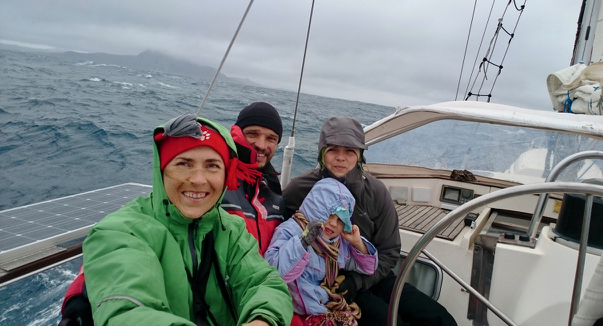
The whole crew went out into the cockpit, dressed in the latest subpolar fashion: three pairs of trousers and three sweatshirts each beneath our foul-weather gear. The young sailor was the first to get cold, but she still drank her Cape Horn tea. We took photos and video, video and photos. But damn it, our cutting-edge equipment conveys neither the height of the waves nor the force of the wind. It does convey the emotions, though, and they are off the scale. The children yell, “Laaaand!”, I join in at the top of my lungs with something about Cape Horn, and we finish with something like: “Guys!!! Aaaah!!! We did iiiit!”
The photo of Cape Horn is from our second rounding—9 May 2019. The weather was better.
There is no sign of anyone else at sea; all the vessel activity begins around the ports
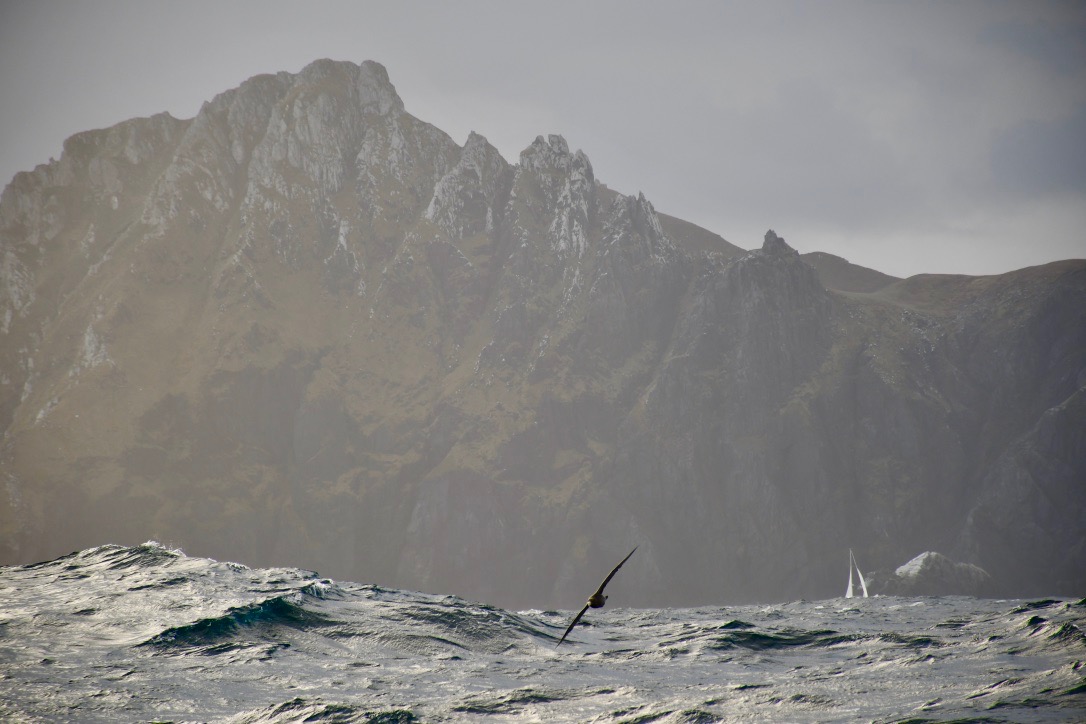
We are alone here on AIS. Someone passed 15 miles away during the night, and that was it. Just half a mile before the Horn, the Armada de Chile was unspeakably delighted to hear from us over the radio. The young sailor happened to be warming up in the wheelhouse and reported that someone was calling Lady Mary on Channel 16. The captain vanished through the hatch. Meanwhile, Nastya and I are breaking up chocolate turned glass-hard by the frost, washing it down with tea from a thermos, and devouring the coastline with our eyes. Fifty-one days non-stop, without land, people, voices on the radio or blips on AIS.
Sixty-two days on passage from Bora Bora. The track for this passage totalled 6,047 nautical miles; our distance made good along the great-circle route was 5,200 nautical miles, leaving 847 miles of running around in vain.... It is an insane feeling when you are bounding over the waves along a deserted shore and realise that this is not just a shore on the 62nd day of a passage, but one hell of a shore at that! For more than 30 years, Cape Horn had been the sort of impossible dream akin to flying to Alpha Centauri.... As a child, I thought the name Horn was somehow connected with mountains. But now, looking at the chart, I realised that with a vivid imagination you could see an old-fashioned horn—or, more precisely, a hunting horn—in the island’s outline. Well, how about that.
We pass quite close, two miles offshore
Meanwhile, the maritime police tirelessly try to establish who is aboard the yacht: crew or passengers. A strange time to ask—what if the cap is alone and needs to steer?.... “They’re my family,” the cap says, “my wife and two daughters.” The officer beamed through the radio and wished us all the best. Half an hour later, he missed us again, and another hour after that he called once more, saying, “I’ve probably become a nuisance.” A good guy, all in all. From that moment on, he kept a watchful eye on us right to the very end. And the end came by evening.
For now, though, it was only the beginning. “Where did you depart from?” “Tahiti,” Andrey replies, though he later had to clarify that it was not exactly Tahiti. “And where are you bound?” The cap told him about Puerto Williams, and that after rounding Cape Horn we needed to shelter in the lee of Lennox Island to repair the steering. Our windvane really had conked out before the Horn—the long-suffering cable had snapped. The captain decided that, in an 18-metre-per-second wind, he was not quite ready to soak his backside hanging over the stern, given the abundance of rocks, currents and the fact that around 800 ships already lay on the seabed beneath us.
We had no intention of becoming number 801. We had to switch on the electric autopilot, and when it beeped helplessly that it could not cope, we assisted at the wheel. Tomorrow we will repair the cable on our Iron Felix, and we must pour him some rum in honour of the rounding. What would we do without him? It is best not to attempt a circumnavigation or voyage into the far beyond without a windvane self-steering system—there is simply no alternative. Unless, of course, your plan is to keep watch at the wheel around the clock.
By the grandest moment, the captain and the young sailor had reappeared on deck. “Hurrraaaah!” the four of us bellowed, and drank from our silver cups of tea, because, in honour of this pivotal moment, all the stainless-steel crockery had once again been declared silver. With all the bounding and rolling, our mugs did not meet on the first attempt, but we managed. The kettle we had set beside the mainsheet winch toppled over on a wave, flooding the wave-washed cockpit with a litre of tea. There is water all around—wash all you like—yet Lady Mary had become a filthy little pig again.
Oh well, she wants some tea too; she is tired after the journey. As soon as the young sailor had finished her tea, she crawled back into the wheelhouse to monitor Channel 16. A flock of birds flapped its wings welcomingly dead ahead, which meant there was a shoal of fish there. But we are sticking to our post-ciguatera rule, and the fishing rod remains sheathed until better times.
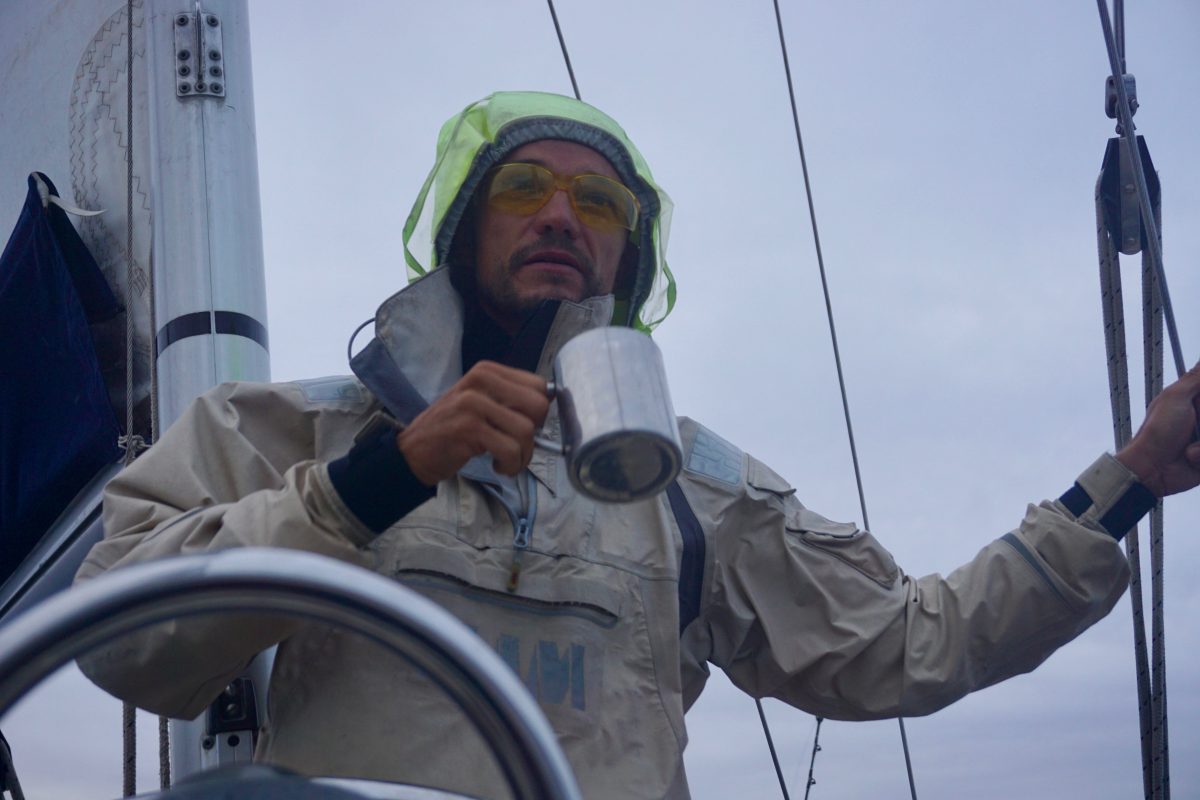
And so, on 19 January 2019 at 7:50 a.m. ship’s time, we rounded Cape Horn!
It seems we have become the first family with children from the entire post-Soviet world to be carried here under sail. This landmark event coincided with Epiphany and the full moon, as we discovered only after nightfall, when for the first time in a month and a half we saw a real moon. And by lunchtime, the sun rewarded all of us with brilliant rays. Near the mainland, the clouds suddenly parted and, so far, have not closed in again. This gives us hope that the batteries will finally begin charging, that we will be able to air out the yacht and even—touch wood—dry her out a little....
Cape Horn, the southernmost point of any non-Antarctic land in the world, was left astern. It was only an hour after that moment, when we were starting to get thoroughly chilled, that the remaining crew went below into our little home. For a long time afterward, I watched the shores drifting past, trying to understand where on earth we had sailed to and how it had happened, while tears ran down my cheeks. Tears of happiness, it seems...
To be continued!
Friends, dear readers, thank you for being with us! Your support in letters and comments means a great deal. We are especially grateful to you for fuelling our expeditionary enthusiasm via PayPal.me/TravelyFamily. Thank you to Yuri L. from Volgograd, Leonid U. from Odesa, Anna M. from Petropavlovsk-Kamchatsky, Nikita Kh. from Moscow, and Vladimir T. from Novosibirsk! Hugs to all of you from 55.18 S 66.50 W