
From the Travely-Family archive · Cape Horn
Tristan da Cunha: 500 Years of Solitude
An original publication from the former Travely-Family website. This English translation was preserved from the technical-site archive without editorial rewriting.
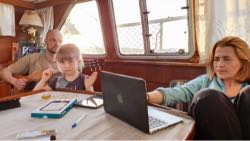
Tristan da Cunha: 500 Years of Solitude. Until the very end of the 15th century, south of 35 degrees south latitude, the Atlantic was as quiet as paradise. Well, in the sense that no one from Europe had poked their nose down here. A Phoenician ship seems to have called at the Cape of Good Hope a thousand years earlier, but nothing remained to bear witness to it except a worm-eaten cedar plank and a couple of rusty nails. And there was no reason to drag oneself all the way down here until people began searching for a sea route to India.
Had it not been for the desire to stock up on spices there and finally start living like civilised people, the Age of Discovery would have been put off for a hundred years or so. By 1506, Columbus had already popped over to the Caribbean, while Vasco da Gama had found a passage around the Cape of Good Hope. We can only wonder which way the unfortunate Portuguese navigator Tristão da Cunha was heading when, that year, he found himself fifteen hundred miles from Cape Town on the 37th parallel, so beloved by Jules Verne—and by us. He managed not to run into the three volcanic islands sticking up alone in the middle of the ocean, and even made it home with the news.
For more than a hundred years after Tristão da Cunha, no one else was blown this way. Because of the violent storms, places so remote from any land had a bad reputation—as they still do today. In 1697, the Dutch landed on the archipelago and were the first to determine its more or less precise coordinates. Throughout the following century, the French took a keen interest in uninhabited Tristan da Cunha. Well, how keen? Once every 30 years or so, someone would land here out of necessity or curiosity. The famous La Pérouse was among them. And it was not until 1811 that an American, Jonathan Lambert, had the idea of colonising this unclaimed end of the earth. Together with two companions, an old Italian and a Portuguese mulatto, they set about cultivating their miniature paradise in the Roaring Forties.
“What a blunder I’ve made!” said the British Governor of the Cape of Good Hope when he heard about it. And off he went to negotiate with the colonists. “Jonathan,” says the Governor, “why stay here all alone in the middle of the ocean like an idiot? Anyone could come along and hurt you. How about old Mother England and I protect you?”
Lambert was delighted and raised the British flag over the islands. And the three colonists began to live better than before. But then Jonathan accidentally drowned. The other two would have wasted away from loneliness had Bonaparte not lost the war at that point—and France along with it. In 1816, Napoleon won himself a trip to Saint Helena, 1,343 miles north of Tristan, thereby relieving the two Tristanians of their solitude. Not all the security assigned by the British to Bonaparte could fit on the little island of Saint Helena, so two more garrisons were set up nearby.
One ended up on Tristan da Cunha. Five years later, Napoleon died, and with the garrison on Tristan no longer needed, it was sent back to the Cape of Good Hope. Only a Scottish corporal remained on the island with his wife and two Hottentots. Later, by some mysterious means, they were joined by a sailor and a fisherman, either from the Thames or from an Argentinian garrison, and then by a married couple from the wrecked ship Blenden Hall. That made six men and two women altogether. Eight years later, another man, four women and 14 children appeared from somewhere.
Some had been cast ashore by shipwreck, some had simply been forgotten by passing ships, and the children had presumably been born there. What else was there for people to do for entertainment? There weren’t any pubs around. Over time, what Paganel described as the exceptional ugliness of Hottentot women was softened by the infusion of other blood, producing a hardy British community descended from Dutch, English, American, Italian and African stock.
You won’t believe it—and we can hardly believe it ourselves—but exactly 155 years ago, these same waters now lapping against Lady Mary’s hull on the 37th parallel were being parted by the stem of the yacht Duncan from In Search of the Castaways. No wonder that, as a child, I dreamed of being aboard her: a crew of 22, interesting company, and Duncan was three times as fast as us. They flew from America to Tristan in nine days. Then another six days to Cape Town. Sailing the seas was a breeze! So, in 1864, Captain John Mangles from our sort-of sailing directions took Duncan into Falmouth Harbour on the island of Tristan da Cunha, sheltered from the westerly winds—a harbour there is no point searching for today. It was probably destroyed by the volcanic eruption of 1961.
The islanders were upset by the volcano and moved to the mother country for a couple of years. But then they grew homesick for their native birch trees and, taking a dozen barrels of whisky with them, set off back home. They spruced up their settlement with the sonorous name Edinburgh of the Seven Seas. And along the way, it seems, they arranged regular whisky deliveries. In short, life became even merrier than before. They protect themselves from the winds with special scrubby bushes and stone walls, grow potatoes, fish, receive the occasional stray tourist and rare yacht, and make most of their money... from the Japanese. For the gourmets of the Land of the Rising Sun, the Tristanians catch, clean and freeze lobsters on an industrial scale, then ship them to Japan. Apparently Japan has already eaten all its own lobsters.
The distance from Edinburgh to the nearest inhabited place, the island of Saint Helena, is 2,488 kilometres—roughly the same as from St Petersburg to the Urals. And the nearest city with a regular connection once every couple of months is Cape Town, 1,511 miles or 2,800 km away.
“How could we manage without whisky out here in the back of beyond?” think the islanders, all 270 of them. And in their calloused fingers they proudly bear the world championship crown for alcohol consumption. Probably.
Meanwhile, Lady Mary is skimming across the blue waves in a light breeze and, judging by the forecast, will continue that way for another couple of days. Blissful, you think? Not a chance. It would be better if it were blowing a gale now and died away in three days’ time. But it will be the other way round, and a cyclone approaching Tristan da Cunha will reduce the chances of our meeting the Tristanian recluses to zero. At best, we might manage to glimpse the summit of the main volcano. Fingers crossed that the stupid storm changes its mind about ruining our holiday.
That was Day 27. Transmitted by satellite link.
Guys, thank you so much for being there for us! Your letters, greetings and brilliant comments make us sooo happy. Thank you to our expanding shore support team! Thank you for contributing to the expedition budget via Yasobe.ru/na/TravelyFamily and Paypal.Me/TravelyFamily. The whole crew sends hugs from the 37th parallel!
You can follow the voyage of the First Russian Three Great Capes Round-the-World Expedition with Children on our website under the Route tab, where the IRIDIUM track is displayed. The same map with the track and weather is available at bit.ly/iridium360.