
From the Travely-Family archive · Cape Horn
Third Day of a Severe Storm. The Furious Fifties
An original publication from the former Travely-Family website. This English translation was preserved from the technical-site archive without editorial rewriting.
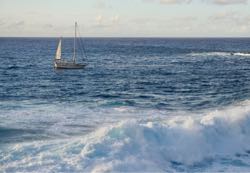
Third day of a severe storm. The Furious Fifties. “Here they don’t say storms like that, they say storms like this,” my inner voice sings in the darkness of the night. The deck drops away beneath my feet...
A scrap of baby staysail is pulling us forward at up to 7 knots. The captain appears beside me. “Andryukha, I want my mum.” “Take the helm! You’re a mum yourself now.” “Yeah, not much sympathy to be had here,” I laugh, turning the wheel.
The cyclone, from which nobody had expected more than 20 m/s of wind, hit one and a half times harder. The anemometer reads 55 knots; during the night it reached 62. This is our first storm of such force in the open ocean. But there is good news too. It turns out that in storms like these we can sail, rather than merely heave to. Both physically and psychologically. With our appetites and sense of humour intact. The small, sturdy staysail we acquired thanks to the support of Dmitry and Robertas has performed brilliantly under combat conditions.
Yesterday, a chain of low islands appeared to starboard. But it was too early to celebrate: the prospect of calling at the Falklands was in danger of falling through. A meeting with a family of Russian scientists awaits us there, arranged through Oscar Konyukhov. As an added bonus, there is the rich wildlife of the almost uninhabited archipelago, penguins and various other seals. That is why we want to call at the Falkland Islands on our way to the Cape of Good Hope, despite the unresolved visa question.
Some sources claim that no visa is required for the Falklands, even though they are a British Overseas Territory. Others state authoritatively that perhaps some people do not need one, but Russian citizens certainly do.
But the weather made its own adjustments. At point X, it turned out that with a southerly gale and a 2-knot tidal current, we could not lay Port Stanley, nor could we safely round the islands to the south: the storm was driving Lady Mary towards the rocky shore.
We changed tack, tracing a beautiful squiggle almost back the way we had come, towards the north-west. You can see it on the map under the Route tab. So much for the Falklands.
The captain remained on watch, while the crew dispersed to their bunks. The wind held steadily at 40 knots; a couple of hours later the heavy heel waved goodbye to any prospect of sleep, and the wind grew stronger still. Waves slammed into the side, the bottom and the coachroof, dropping the boat ten metres down and jerking her back up.
Our windvane self-steering, Iron Felix, could not cope with the gusts, so the captain spent the entire night at the wheel, steering by hand.
The children slept while the waves tossed the yacht so violently that ten kilos of tightly packed books and sailing directions flew from a shelf in the aft cabin. Even the 15-centimetre retaining rail could not stop the avalanche. On that tiny patch of floor, alongside the books, ended up a securely fastened giant bag of children’s books, all the clothes, the brand-new but already much-abused drone, and all sorts of small things from everywhere. Nastya was called up for all hands, and together we packed the books back even more tightly. Soon another wave proved that everything flying off the shelves had been no accident. In all six years of our life together with Lady Mary, nothing had ever fallen from that shelf. Today it happened twice.
Another wave knocked our botanical garden out of its corner too: the brave aloe, the Hatter, and Alejandro the agave. Ladin announced this with a mournful cry: “I’m asleep, and soil is falling all over me, right onto my pillow!”
At last, my pointless struggle for space in the bunk could be replaced by the meaningful struggle against a litre of soil scattered over the settees and the floor. We put our young sailor in my place; I would not be needing it any more.
The description of the Beaufort scale says that a Force 10 storm uproots trees. Well, everything here is going exactly by the book. Poor Hatter is lying on a settee cushion with broken leaves and her roots sticking down. Night-time, with 55 knots of wind. It took at least an hour to scrape the soil out of the corners. Once it calms down, I’ll have to go over everything with the vacuum cleaner.
The yacht is being hurled from one wave crest to the next. The heater gulps water through its air intake and cuts out, or starts pumping exhaust fumes inside. Thanks to its subversive activities, the wheelhouse is at plus 13°C. The engine, which we start to recharge the batteries, is angry too: it does the opposite, sucking in air instead of cooling water. The system became airlocked and the engine began to overheat. The heater will not start without the engine. The captain shut off the water until he could work out why the engine was overheating. Meanwhile, after my gardening work, I was covered in soil, with nothing to wash my hands in. Lovely—but what can you do?
A wave tore off a solar panel. One was ripped away completely, and the top layer of the second was shattered. One bucket, terrified out of its wits, was even left dangling overboard by a thin line. We rescued the buckets and brought them into the heads.
You cannot leave the wheel for even a moment: the yacht immediately rounds up or bears away. Fatigue has built up. I take the helm so Andryukha can doze for a while on the watch settee. The yacht yaws off course, thrown into confusion first by the crazed seas, then by the gusts. It is a mind-blowing sensation, steering while the anemometer numbers leap between 45 and 55 knots.
Many people ask whether a storm is frightening. The only frightening thing would be if the captain were washed overboard. But he has heeded my pleas and always clips on before going outside. There are no other fears; you just want it all to be over. And to sleep.
“Oh! What’s that?” Dead ahead, a mile and a half away, are the lights of a fishing vessel. We switched on the deck lights, restarted the AIS, and a vessel hove to appeared on the screen. The lads spotted us and got under way to give us room, since we were being driven by the wind. A couple of hours later, Lady Mary was called on the radio. “Hello,” they said. “Are you having any problems? Do you need any assistance?” “No,” replied the captain. “It’s blowing hard, of course, but for us it’s no problem; we’re sailing along downwind. Thank you for checking on us.”
And after saying goodbye, we went our separate ways, like ships passing at sea.
In the morning, Nastya takes the wheel. Ladunya settles down on the little settee to keep her company and have some fun. “And Dad and I,” I say, “might have a little nap.” “Why, Mum, didn’t you sleep last night?” “No, Ladunya, there’s a storm.” “A real storm?” “Yep, right now it’s a proper storm-storm, the real thing, Force 10–11. It should soon drop to Force 9, if the forecast is to be believed.” “Wow. And I slept really well. I thought it would be bad in a storm. Though I did bring a bit of soil in here from the plants for you...”
It’s good that everything is fun and games for our young sailor. And it’s brilliant that we have a wheel in the wheelhouse and don’t have to steer through this entire weather cataclysm out on deck. If only we could fit a chair opposite the wheel, it would be sheer bliss.
By noon, the wind had dropped to 35 knots. The windvane is holding the yacht on course again, so I can even write a post. Yesterday, when the eye of the cyclone passed over us, there was a respite too. True, waves are still hitting us so hard that water drips from the ceiling, but by now that is merely an appetiser. For lunch today, we have boiled corn, fresh vegetables and fruit, and the dish of the day: Doshirak noodles—that is, Rollton. The children have been asking for them for a month, and today the weather itself is whispering softly: “Have some Chinese noooodles—ooooh...”
The Southern Ocean changes your perception of time and the elements. Not long ago, a 36-knot wind was slightly frightening and felt like a storm. Now that kind of wind is a relief, an absolute joy. If only it stays like this, perhaps we will manage to sleep tomorrow night. True, there will be no film before bed, because it is not clear how we are going to charge the batteries. But the main thing is that the storm will end someday. And by morning we will pass from the Furious Fifties into the Roaring Forties. Perhaps it will begin to warm up there too. Our wintering has to end sometime. We have spent eight months in the Fifties and the near-polar Sixties of the Subantarctic and Antarctic, experienced all four seasons, including the whole of autumn and winter. Time to get out of here.
Course set for Cape Town. Estimated arrival: the end of October. Fingers crossed that peace and quiet will reign over the ocean when Lady Mary reaches the 37th parallel. There, the Tristan da Cunha archipelago stands alone, buffeted by the winds. We dream of a respite off its shores. Tristan da Cunha is about 2,400 miles, or 4,450 km, away. If only we can catch our breath there for a little while!
You can follow the expedition in real time on our website under the Route tab, where the Iridium track is displayed. The company JSC MVS Telecom makes sure the expedition can stay in touch everywhere, at all times. It is a miracle, but we can even send Mum a text message through the satellite tracker! Not to mention that you can see the whole brutal truth of the passage in real time at:
bit.ly/iridium360
Friends, thank you to everyone who follows us, worries about us and keeps our spirits up! Thank you for your comments and warmth.
Our heartfelt thanks to everyone who has helped replenish the ship’s kitty through Paypal.Me/TravelyFamily and Yasobe.ru/na/TravelyFamily. Thank you to Ivan R. from Moscow and Diana P. from Magadan! You bring us so much joy! It is so important to feel that you are doing something worthwhile, something other people need. Hugs to all of you from the stormy Southern Ocean, and we wish you kindness and warmth!