
From the Travely-Family archive · Pacific Ocean
The Crew Made Landfall in the Smallest Country in the World!
An original publication from the former Travely-Family website. This English translation was preserved from the technical-site archive without editorial rewriting.
The crew made landfall in the smallest country in the world! Pitcairn Island. How it happened and how it ended. Our first—and so far last—landing on Pitcairn. We wait for the weather, exchange kisses with the Minister of Home Affairs, and receive supplies and gifts It starts here:
We needed the hammer to knock loose the hook that attaches the snubber to the anchor chain—the snubber lines run to the bow cleats and are what actually secure the boat to the anchor (otherwise the chain would pull directly on the windlass and one day would definitely rip it out). (See the previous post). While I was writing the report, the captain managed to free part of the chain from the rocks, but now the anchor itself was stuck. We attached the chain to the snubber and gave it a couple of hard pulls. The steel hook, a centimetre in diameter, bent so badly that there was no getting it out without a hammer.
Next level: Andryukha dived in to admire the anchor from underwater, Nastya took the helm, and I took charge of the anchor. Heave-ho... The captain was right to signal the direction from the water: we got the anchor up, brought the cap back aboard, and once again bounced our way to Bounty Bay, wolfing down an omelette Nastya had made along the way. For once, the sun came out, and it seemed as if the swell might be smaller today. And here we were, opposite that longed-for landing place. The captain set off to reconnoitre while we packed rucksacks and cameras and stowed the crockery in the lockers.
“Pitcairn, Pitcairn! This is Lady Mary.”
“Lady Mary! Good morning. How did you sleep?”
“Wonderfully—so wonderfully that we decided to come ashore in half an hour.”
“Oh, and what are the ocean conditions like?”
“Not great, but we’re coming anyway.”
“Okay, go for it!”.
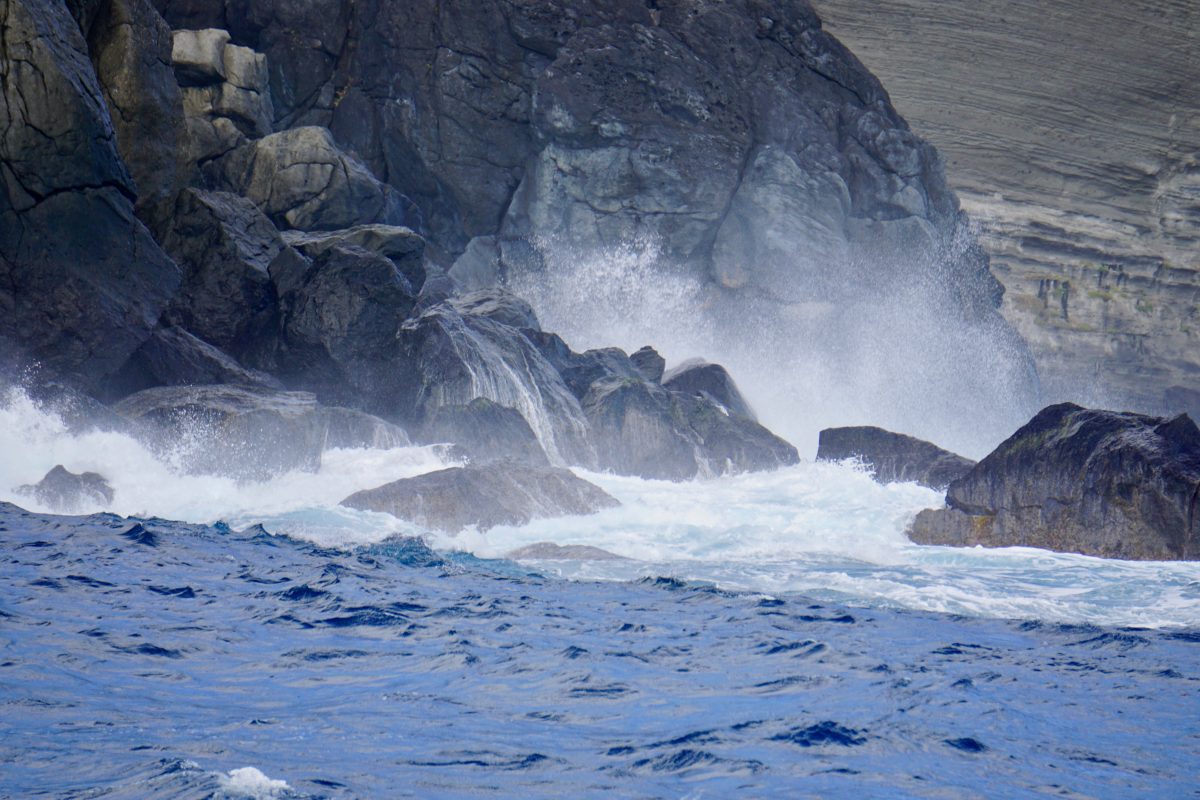
Landfall
We decided to do it in two runs after all: me first, then the children. The lighter the dinghy, the faster it would get through the surf. I clung to the tubes and floor with every limb, like someone being shoved into a car boot who has spread himself wide and is bracing against the sides.
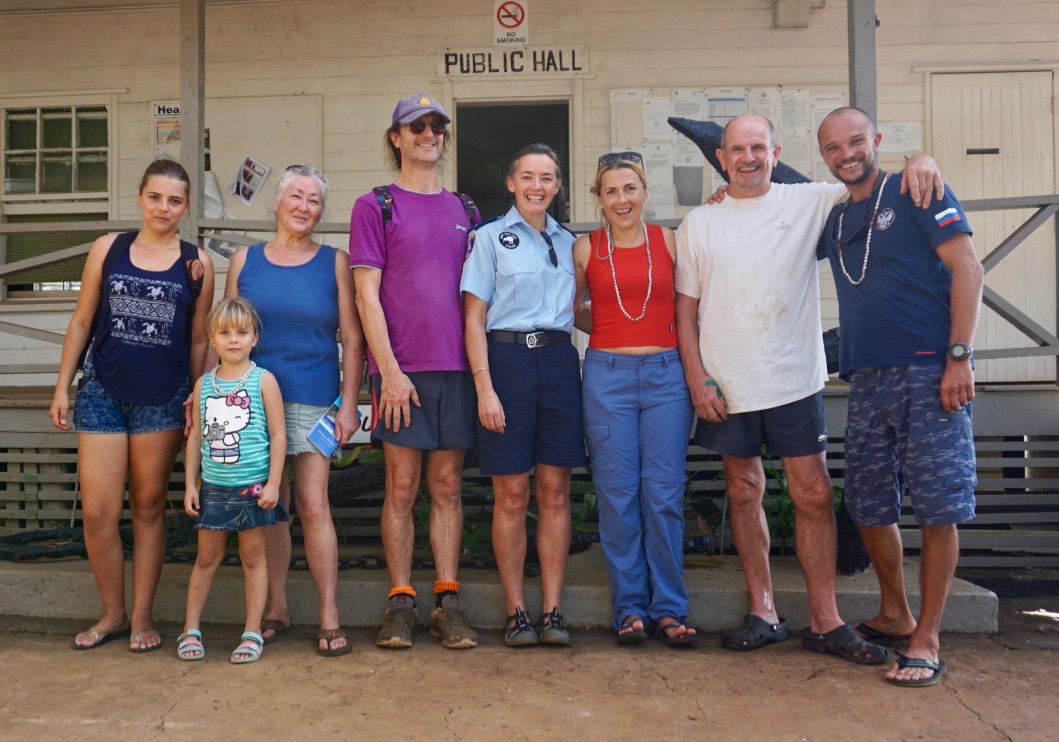
Three people met us ashore: Ki'Anna, the local police chief; her husband, Ian; and a local woman named Charlene. Once we had cleared the surf line, I actually crossed myself; the women laughed knowingly and took me gently by the arms.
“My dears!” And we hugged and even exchanged kisses with the Minister of Home Affairs of an entire country and her assistant.
“How lovely to meet you!”
They smiled happily. Not politely, but as if they had been waiting their whole lives for me right there on the pier. Not “nice to meet you,” but specifically “lovely to meet you”—I loved them at once.
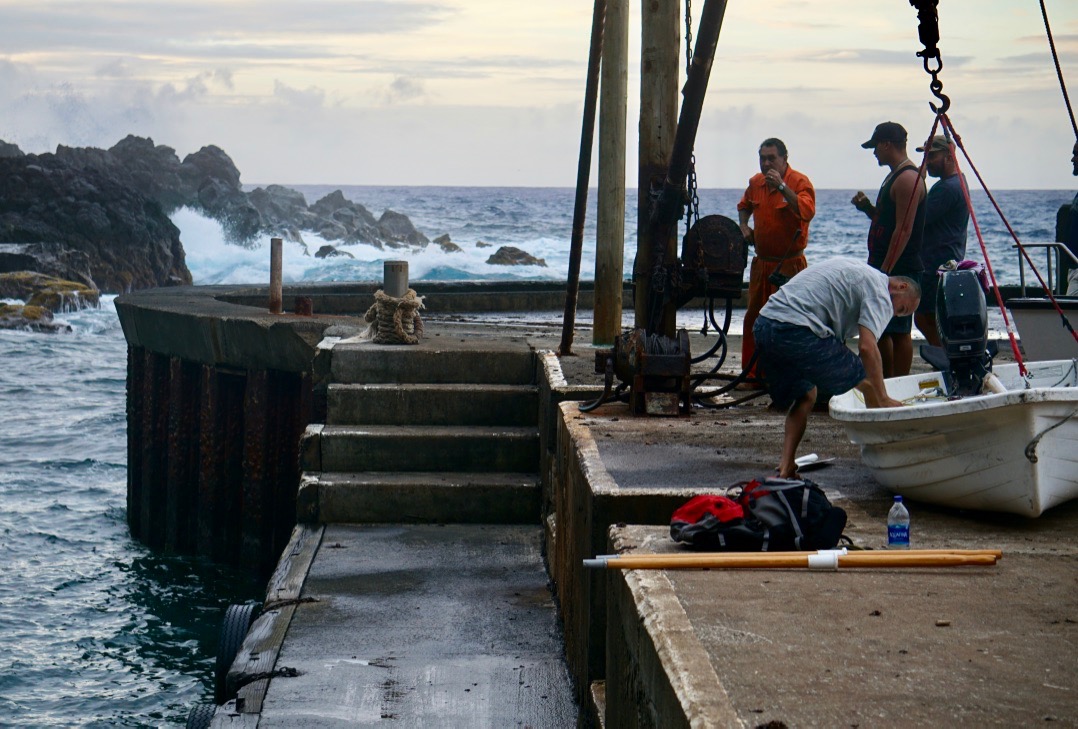
Meanwhile, Andrei went back for the children. The second run landed safely, and we saw how the local dinghy parking system worked: a crane lifted our tender onto the pontoon. Charlene operated the crane.
It turned out we would not have to walk to the village: all three had arrived on quad bikes, with room for another two people on the back. With a cheerful heave-ho, we flew up the hill. Several men were doing some kind of roadwork. We greeted them warmly and waved. Pitcairn currently has a population of 50. Of those, five or six are rotational workers from New Zealand.
A Visa for Pitcairn
The covered courtyard between the church and the L-shaped buildings is the country’s main square. Two rows of plastic tables, and in the middle the great, slender anchor of the legendary Bounty. The post office, administration and treasury are all here. Melva, a native Pitcairner, also came over; she appeared to be in charge of welcoming guests and tourists. She placed necklaces made of unusual white seeds and shells around each of our necks. The necklaces are made by local elders. Ki'Anna told us where we could go, Melva handed out maps with descriptions, and meanwhile Ian, Ki'Anna’s husband, brought us cold fruit-and-yoghurt smoothies. Simon, the treasurer and official handling our paperwork, gave us a bag of citrus fruit as a gift, and then the children were given homemade banana ice cream as well... And we wanted more and more to stay and live here.
In the main square.
Oh, about the formalities:
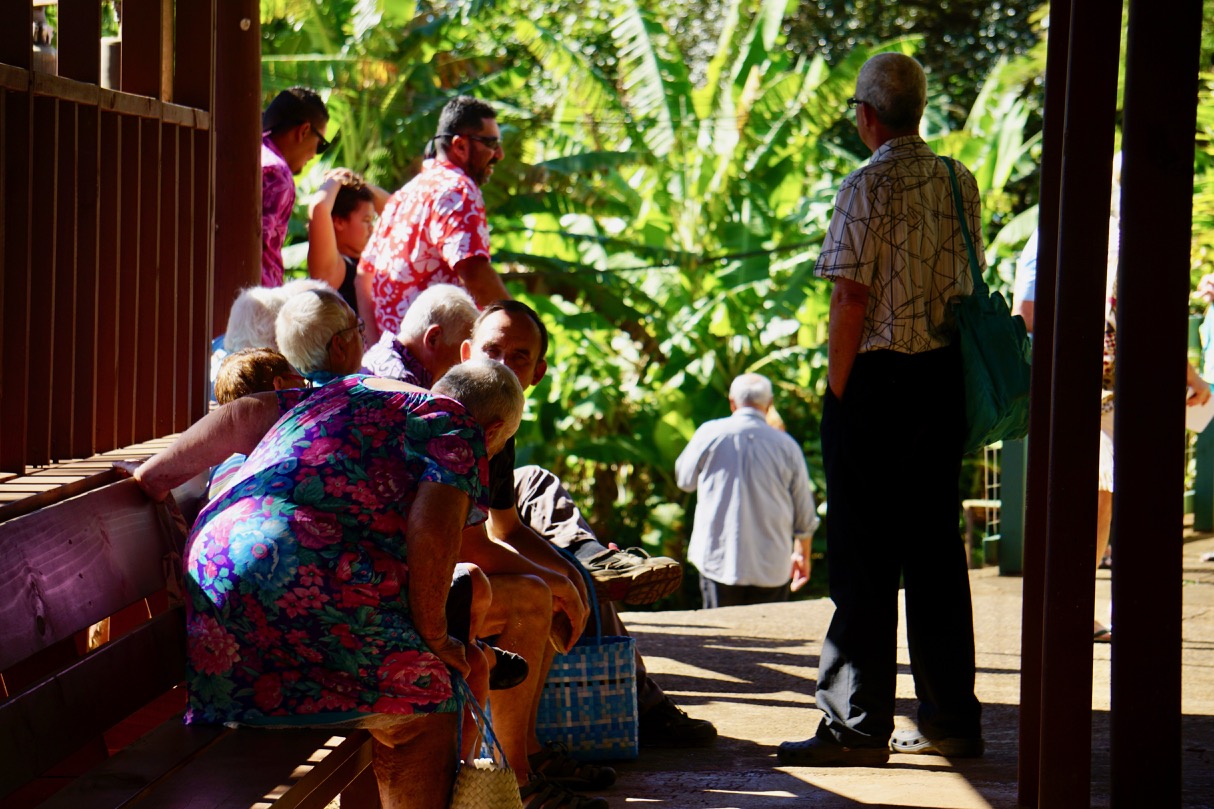
Right there in the square, while our young sailor played hopscotch, we filled in some special forms asking about currency, valuables, drugs, and whether we were suffering from any nasty diseases.
A visa costs 50 dollars per person; a child counts as a person too. That was it.
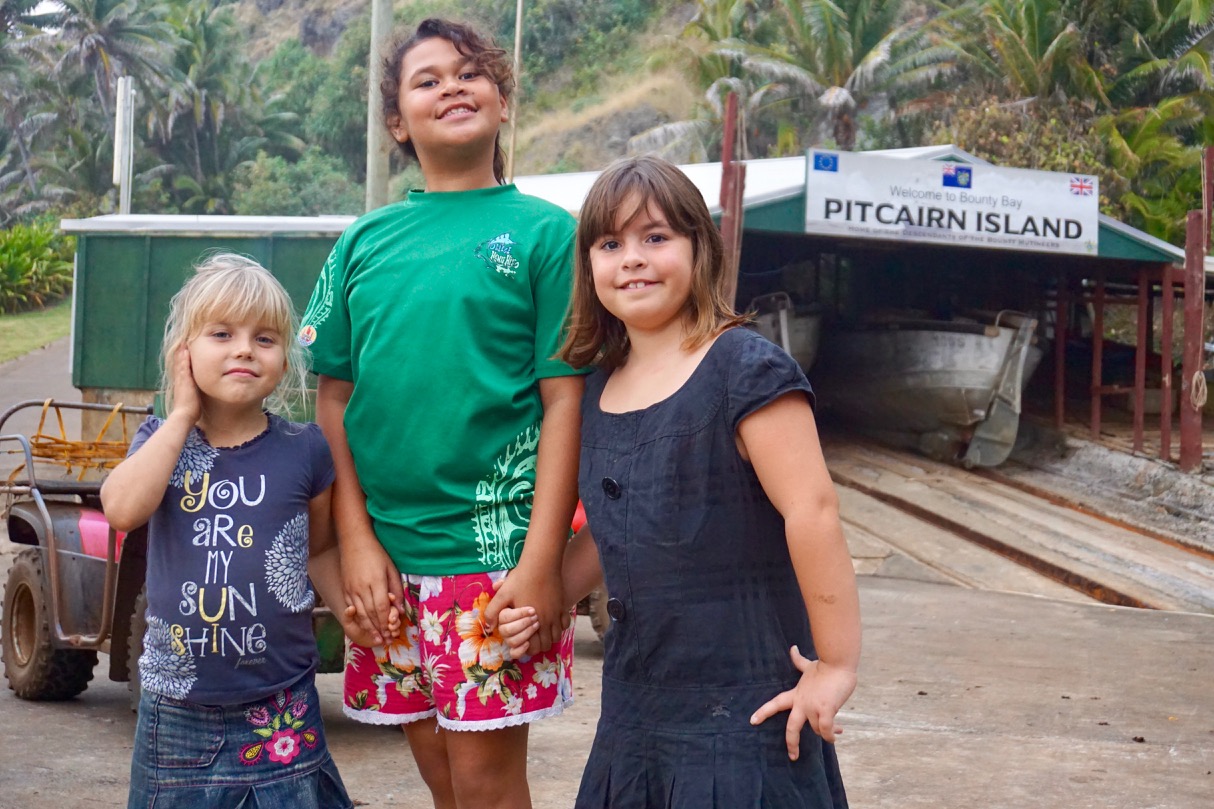
We walked around Adamstown until evening, found the founder’s grave, and visited the school. It has no fewer than three pupils, aged eight, ten and eleven. Two of the girls bear the famous surname Christian, while the third is also descended from the Bounty mutineers. Ladunya learned to bounce on the local trampoline, which, for safety’s sake, had been installed without legs over a pit dug in the ground. Along the way, we picked mangoes off the grass. Fruit falls straight onto people’s heads and, together with the bananas, ends up being eaten by ants.
That evening, the shop with the lowest prices in all Polynesia opened especially for us. Beside ourselves with joy, we stocked up on everything we could carry, while a queue formed outside the door on three quad bikes. One of them was already loaded with two large crates of fruit and vegetables for 35 dollars. On top of that, a girl named Kushana gave Ladunya an entire box of treats—crisps, gummy sweets, dried bananas, and a large jar of local honey labelled “For you. Enjoy!”
Two of Pitcairn’s three schoolgirls and our young sailor
Olive Christian, the shopkeeper, added yoghurts and a handful of local sweet passion fruit to the gifts.
“Do you welcome every visitor like this?” I asked Charlene.
“Yes,” she smiled.
“And how many yachts call here each year?”
“About fifteen.”
Returning to the Yacht
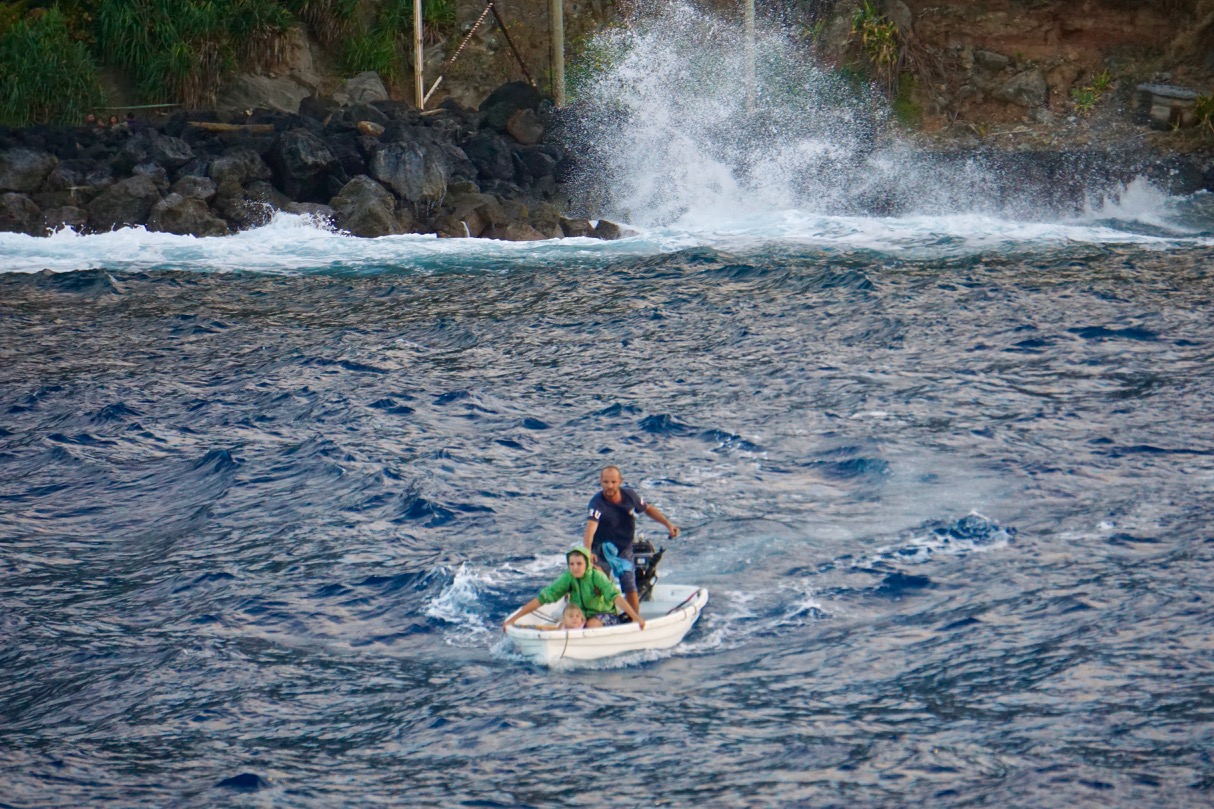
The waves had doubled in size over the course of the day. Twenty per cent of the country’s population had gathered to see us back to the yacht. The men helped unload our provisions onto the pier, lowered the tender, and lined up on the breakwater to signal when we could make our dash out of the little inlet. We waited about 15 minutes for our moment. Breaking waves soared five metres above the heads of those seeing us off. Once again I clung to the tubes and could hardly believe it was possible to get out of there alive. The children and provisions waited their turn on the platform.
“Go!” one of those seeing us off finally signalled. And we went. Honestly? I had not been that frightened in a long time, on that tender evening. And after we got back to the boat, my teeth kept chattering for a while longer—and I suspect it was not from the cold at all. We had to slip through between the largest waves. Usually the sequence is five or six smaller waves, then one or two big ones—meaning VERY big—and then another five or six, to make it easier to fish the floating corpses out. That was black humour.
Home to the Yacht
Our brave little tender pitched her bow up, heaved over the supposedly small waves and slammed down flat on her whole belly. My teeth clacked in time, and even my head began to ache. Slam, slam, slam—six slams. The next one was the killer wave )) hee-hee... I hoped we had already made it beyond the line where the crest curled over. Otherwise we would capsize. Phew. We got away with it. We bounced up to the yacht, which was rocking like a roly-poly toy. You could almost see the tender’s keel. The captain climbed onto the deck to secure our spirited steed, while I tried to use the tender’s upward bounce to jump onto the rubbing strake and scramble onto the deck. It did not work.
It spectacularly did not work: with a miserable howl, I ended up dangling by my arms, banged my front teeth against that very rubbing strake (damn, the only thing missing now was knocking my teeth out! ))), and tried in vain to catch the retreating tender with my feet.
“Andryukha, I’m scared!” I whimpered, thinking that the cap was probably less than thrilled to have such a silly squirrel instead of a wife. Charlene’s voice came over the radio:
“Are you all right? Shall we bring your children out on our big metal boat?”
“No,” said the captain. “We’ll manage ourselves. In a swell like this, your metal boat could punch a hole in our hull.”
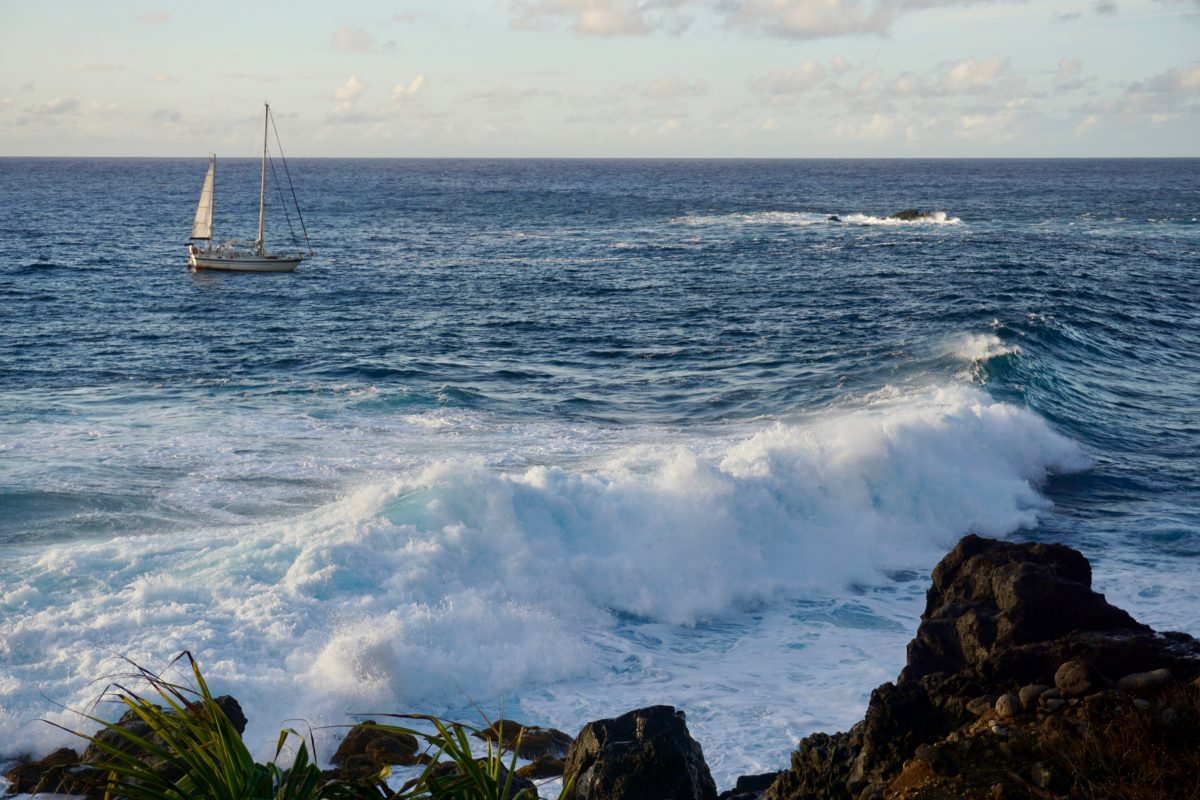
The yacht at anchor
After a little more anxious concern, the radio fell silent. I desperately tried to find the side of the bouncing tender with my feet, afraid of being trapped between it and the yacht. Then there really would be no putting my teeth back together. At last I managed to get back inside the dinghy. It felt as though I had no strength left for a second attempt.
“Wait, I’ll go first.”
And Andrei jumped into the tender. “Climb up!” Perhaps his roar gave me courage, because I flew onto the yacht’s deck with unprecedented ease, keeping all my teeth inside my mouth.
“Halyard!” The cap was stern and terse.
Oh my God, we still had to get the crate of fruit aboard. I handed him the halyard, and the cap secured the huge fruit crate with a rope prepared in advance. The yacht and the tender were bouncing in opposite phases. Trying to keep my balance, I pulled with all my might. The crate turned onto its side in mid-air (Lady Mary has very high topsides and substantial guardrails, so there was plenty of room for the crate to fly about between the dinghy and the deck). Fruit showered into the tender and overboard, while I tried to haul in at least half the crate. Andrei caught the rest out of the water with his hands—one, two, ten; only one drifting mandarin was out of luck.
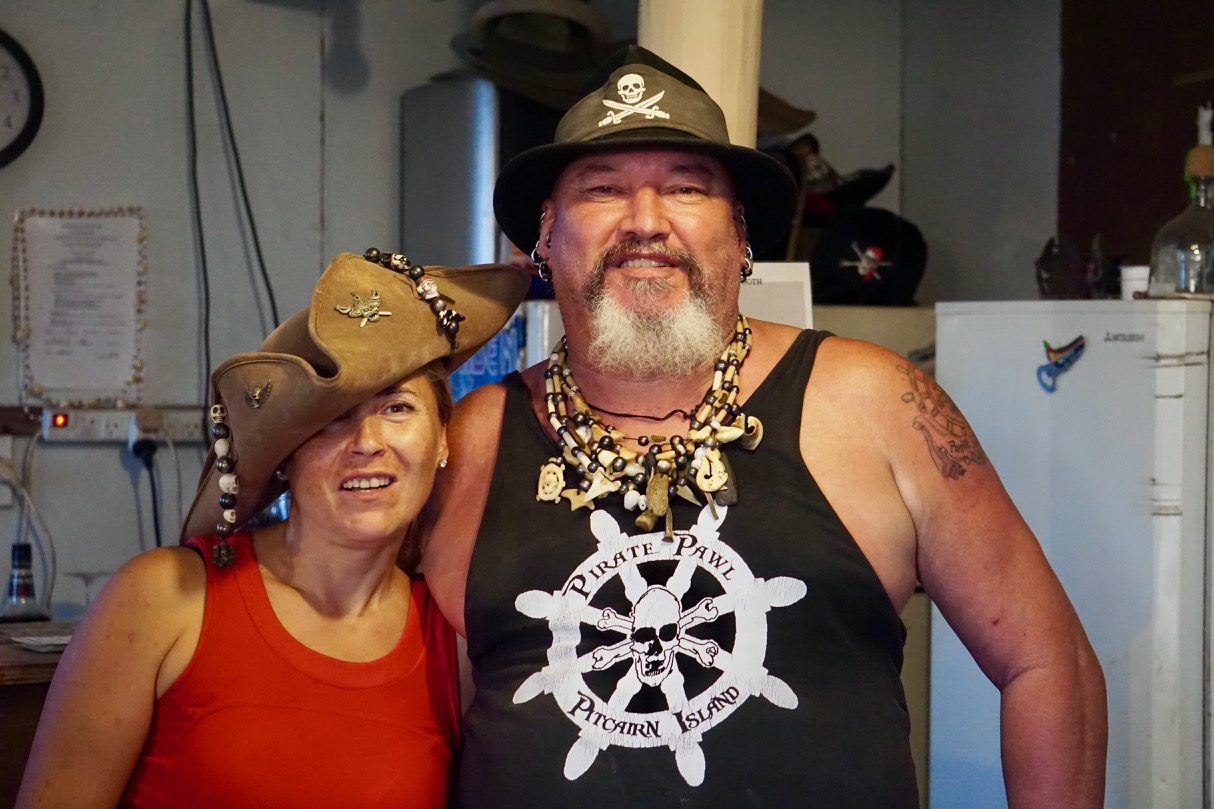
Fletcher Christian’s Descendants
Dusk was falling. We once wrote that Easter Island is an adventure for a yachtsman. Now we can state with confidence: for a yachtsman, Easter Island is a holiday resort. Pitcairn, on the other hand—yes indeed, that is an adventure. While I practised affirmations about safe flying and the kindness of the Universe, the captain went ashore to fetch the children.
Next report: