
From the Travely-Family archive · Pacific Ocean
Pitcairn. The Truly Crazy Ones Are Few and Far Between
An original publication from the former Travely-Family website. This English translation was preserved from the technical-site archive without editorial rewriting.
Pitcairn. The truly crazy ones really are few and far between—not everyone who makes it this far is crazy enough. How one superyacht dealt a blow to the economy of an entire country, while our attempt to get ashore came to nothing. The continuing story of getting the children and provisions back aboard. And anchoring on the crest of a wave.
Teleporting the children from shore
We wrote somewhere that Easter Island is an adventure for a yachtsman. Now we can state with confidence: for a yachtsman, Easter Island is a holiday resort. Pitcairn, though—yes, that really is an adventure (see the previous report).
While I practise a bit of autosuggestion about safe flying and the kindness of the Universe, the captain heads ashore to fetch the children. Nastya and Lada are waiting for Dad on the pier, surrounded by hospitable Pitcairners.
“Maybe you could spend the night ashore?”
“Nah,” Nastya laughs. “I really love sleeping in my own cabin.”
“Are you a good swimmer, just in case?”
“Well, not bad.”
“What about with sharks?”
“Hmm—with sharks?”
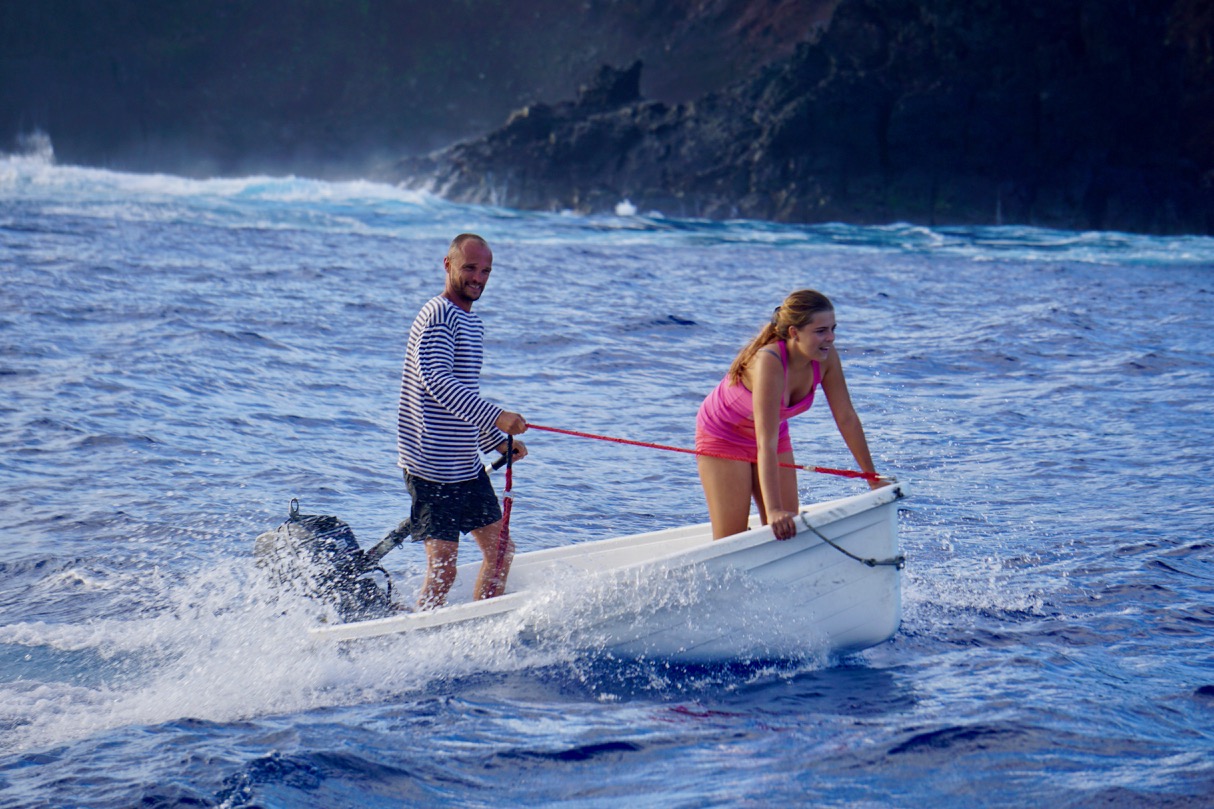
The people seeing them off chuckle as they wait for Lady Mary’s dinghy. The captain nimbly shoots through the surf zone, and the children clamber down into the dinghy. Little Lada presses herself to the floor by the forward thwart, while Nastya pretends to be a spider and clings to the sides. Foaming spray breaks over the heads of those standing on the high pier, and off they go. Time to move!
Smack, smack, smack—every belly-flop as the dinghy plunges from the crest of a wave reverberates inside our heads. Hooray! They’ve made it through. All three of mine are already heading towards the pot-bellied swing proudly named Lady Mary, alternately crawling and planing over the waves. Aboard the yacht, swinging like a pendulum, I roll up my sleeves and summon all my strength to fish the children out of the dinghy.
“Nastya, go!” the cap commands, and our sailor scrambles aboard with a line. She ties up the dinghy, and together we lean over the rail to receive our young sailor. Up, down, up. Now! The captain passes little Lada up to us, and we haul her by the arms like a kitten by the scruff of its neck. Our young sailor swings her legs over the rail and half-crawls into the cockpit.
“Can I have a shower? The mosquitoes bit me, and now the salt is making everything sting,” says little Lada, heading off to wash.
Nastya and I take the heavy rucksack of provisions from the cap, then hurriedly move the food off the flying deck and below.
“Get an empty rucksack ready!” Andrey shouts, and bounds off towards shore again.
Tins and fruit are already flying around inside the yacht when the cap brings back the rest of the provisions. At first, the tins from the box go into a sack, but then a very merry Andrey decides not to bother and starts tossing the supplies straight into my hands. That is how we end up playing a game of extreme conditions pioneerball. Strangely enough, I manage to catch everything, from tins to plump papayas. A box of nature’s bounty stands in the stern, noodles are scattered across the floor, and a head of cabbage is wedged against the mainsheet winch.
“Up anchor!”
It is almost dark, and we still need to skirt the reefs and anchor south of the island. We are hardly going to get any sleep here in the wild northerly waves. We retrace our track. The beam of the torch cannot penetrate 18 metres of water, so we cannot see whether the anchor lands on sand or rock. But we seem to set it on the first attempt. We breathe out. Nastya makes potatoes baked with cheese, while I prepare a salad with lots of greens, of which we have acquired plenty on this blessed island. And we make a wish that tomorrow we will manage to get ashore again.
A blow to the economy
Today the whole country is waiting for a superyacht from Easter Island. We suspect it is that same two-masted schooner Wind Rose from Amsterdam, which spent a couple of days anchored off Hanga Roa—the one whose dinghy the fishermen brought back from shore aboard their fishing boat. There seem to be 14 people aboard. Since the yacht is expected on Saturday, the entire daily routine of Pitcairn’s citizens, including the time of the church service, depends on her arrival. The residents have been excited for three days, preparing to welcome the visitors, making souvenirs and meals, and adjusting the life of an entire nation around this event.
We wake at the southern anchorage in the half-light. A high swell has risen, and Lady Mary is lying almost on the very edge of its crest. More precisely, the crest is curling just a few boat lengths from us. Well, there goes our quiet paradise here in the south as well, and once again everything that had been standing upright is rolling around the floors and tables. White masts appear from the direction of Bounty Bay. The superyacht creeps slowly closer but stays well offshore. And now the radio comes to life:
“Pitcairn, Pitcairn! This is the yacht Wind Rose you are expecting.” “Good morning! Channel 14.”
Yesterday we arranged that when Pitcairn’s big steel boat went to collect the visitors, it would take us along as well. So we are not particularly worried about how we are going to get ashore. Andrey therefore follows the conversation on Channel 14. And that is when we and the Pitcairners are both bitterly disappointed.
“Andryukha, what did they say?” I shout from the deck.
“They said something like, ‘We’re too chicken to anchor off your shores’” (the cap’s interpretation). “‘To our shame, we won’t be going ashore; we’ll carry on. Come over to our yacht to sort out the paperwork.’”
“Okay. We’ll be there soon,” Pitcairn replied, and a disappointed sigh rolled across the entire country. Well, how about that.
“Damn, one stroke and they’ve undermined the economy of the whole country. Everyone was waiting for them, and then they...” I even felt upset on behalf of the most hospitable people in the world.
“Why bother coming all the way here at all, then? On Easter Island the fishermen have to bring their dinghy back from shore; same here... They should have cruised around Polynesia instead—it’s peak season now.”
“The truly crazy ones are few and far between. Even here. That’s how it turns out,” says Andryukha.
“But why are they afraid to anchor? They can see us lying here and we’re fine.”
“No idea. Maybe they’ve got the wrong type of anchor.”
While we are pondering all this, a powerful steel boat approaches the schooner, large enough to seat every resident of Pitcairn at once. Half of them are aboard it:). After visiting the superyacht, the boat heads towards us.
“Lady Mary! Lady Mary!” comes over VHF Channel 16.
We are more or less ready, just in case—what if they want to give us a lift ashore? But they do not. They simply ask how we are, wave, and advise us to move farther away from the surf line because watching us is frightening them too. We reply that we are just about to do that. The boat leaves. In fact, a trip ashore aboard their vessel costs 50 bucks. If they had been ferrying tourists back and forth from the big yacht, they would have taken us too. But everyone aboard is local and travelling one way only; now they will put the boat into the shed.
Landing impossible. Hello, chores
Breakfast is a proper feast: cocoa, yoghurt, cheese, and fruit and vegetables. We grew tired of biscuits and pancakes during the passage. After a substantial meal, we raise anchor and go to try our luck at the western pier—the second and final landing place on Pitcairn Island. We circle between the reefs, and Andryukha announces optimistically:
“Excellent, we can land without any trouble!”
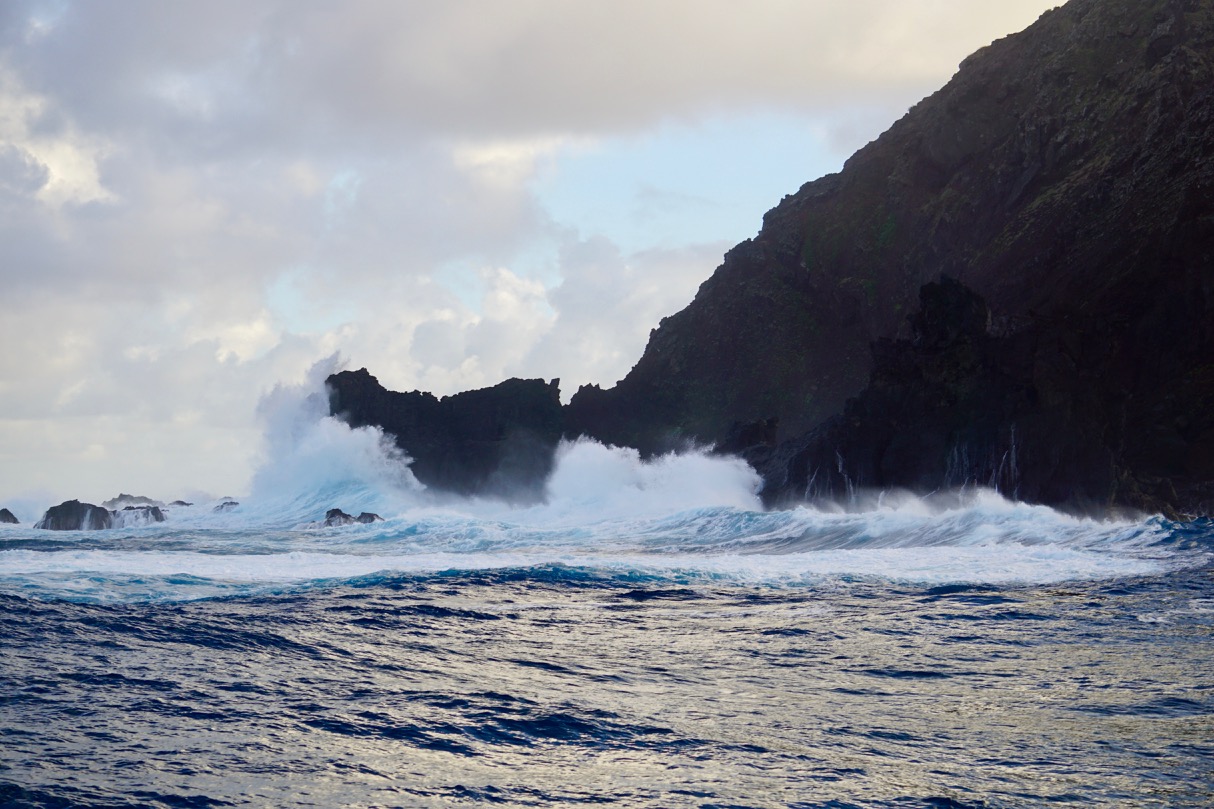
As if to confirm his words, the waves begin pounding the shore with such force that Niagara Falls pour continuously across the concrete pier. Foam floods even the rocks behind the quay. Meanwhile, I am wondering where I might find helmets for the entire crew. There will be no landfall today. We opt for a day of boat chores instead. We head south and anchor farther away from the cresting waves. Our young sailor settles down to paint an oil picture as a gift for a local girl named Kushana, Nastya busies herself with the laundry, and I sort through the photo and video archives. It seems they will never be sorted out in this lifetime. I make a solemn vow not to press the camera button more often than once every 10 minutes )).
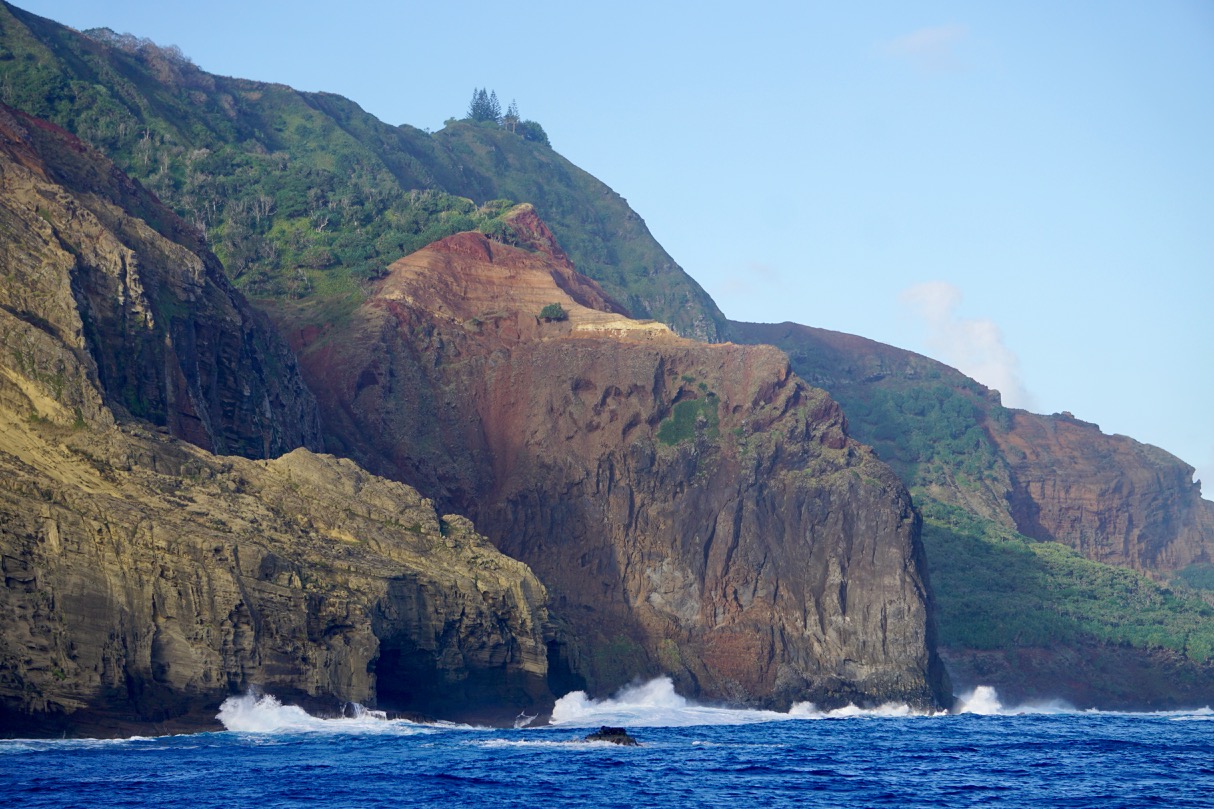
The coastal cliffs are 50 metres high
But the following morning... It was a little nerve-racking landing the next morning, but we went for it. We returned to the western pier, where landing is supposedly easier. And while we were coming alongside, our dinghy—outboard and all—was finally swamped by a breaking wave.
P.S. Guys, thank you! We read your comments with happy faces—they are balm to a soul weary from all this wild bucking around. To be continued.
The coastal cliffs are 50 metres high