
From the Travely-Family archive · Pacific Ocean
At Anchor off the “Bounty” Island
An original publication from the former Travely-Family website. This English translation was preserved from the technical-site archive without editorial rewriting.
Hooray, we made it! Chronicles via satellite. The story of a mutiny and the failure of Bounty’s great mission. Why we’ve spent three days going round and round without setting foot ashore.
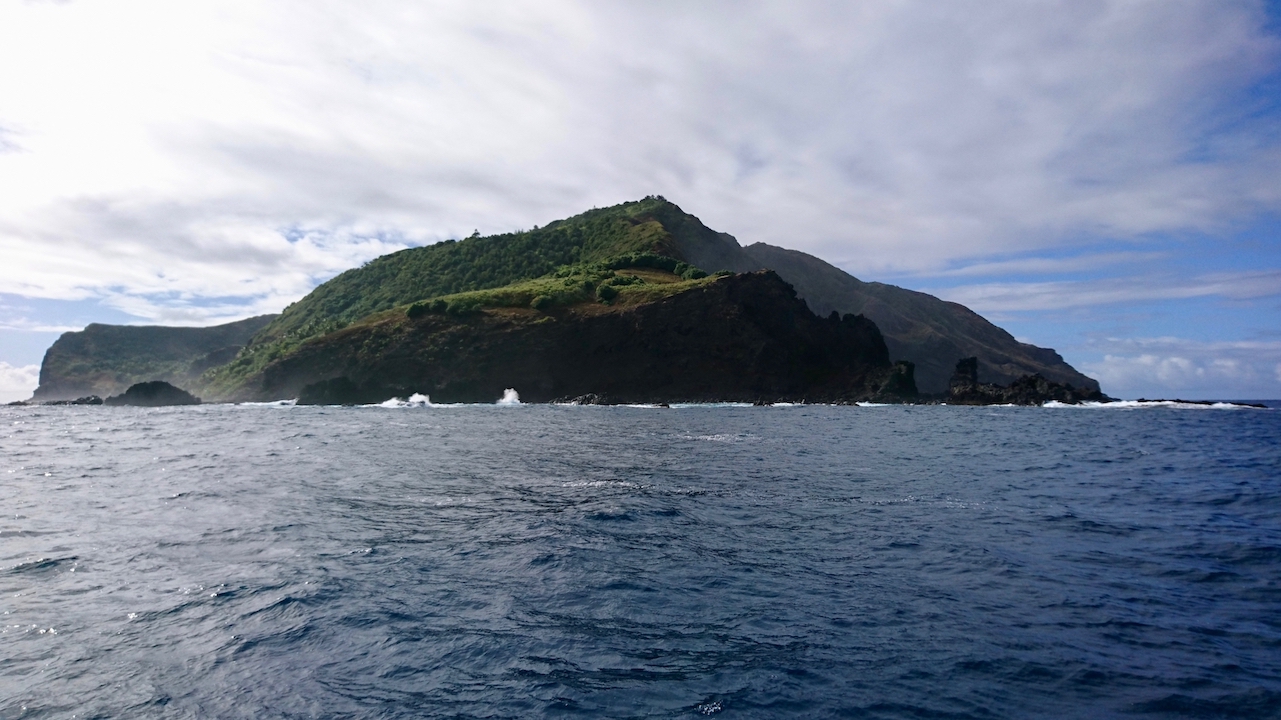
On the night of June 20, the captain and I were exhausted. I was tired of rolling across the bed from wall to wall throughout the entire passage from Easter Island; he was tired of going without sleep and working the sails so we wouldn’t hit the reefs if we reached Pitcairn before dawn. The Bounty island rose out of the ocean just like in the pictures: tall, reddish and rocky, with dark greenery. At the very top, it isn’t an antenna but a Christmas tree sticking up into the sky! Did they decorate it for our arrival?
This is how it looked on July 2, 1767, to a 15-year-old midshipman, the son of Major Pitcairn, aboard Swallow. That was 12 years before the island’s extraordinary story began
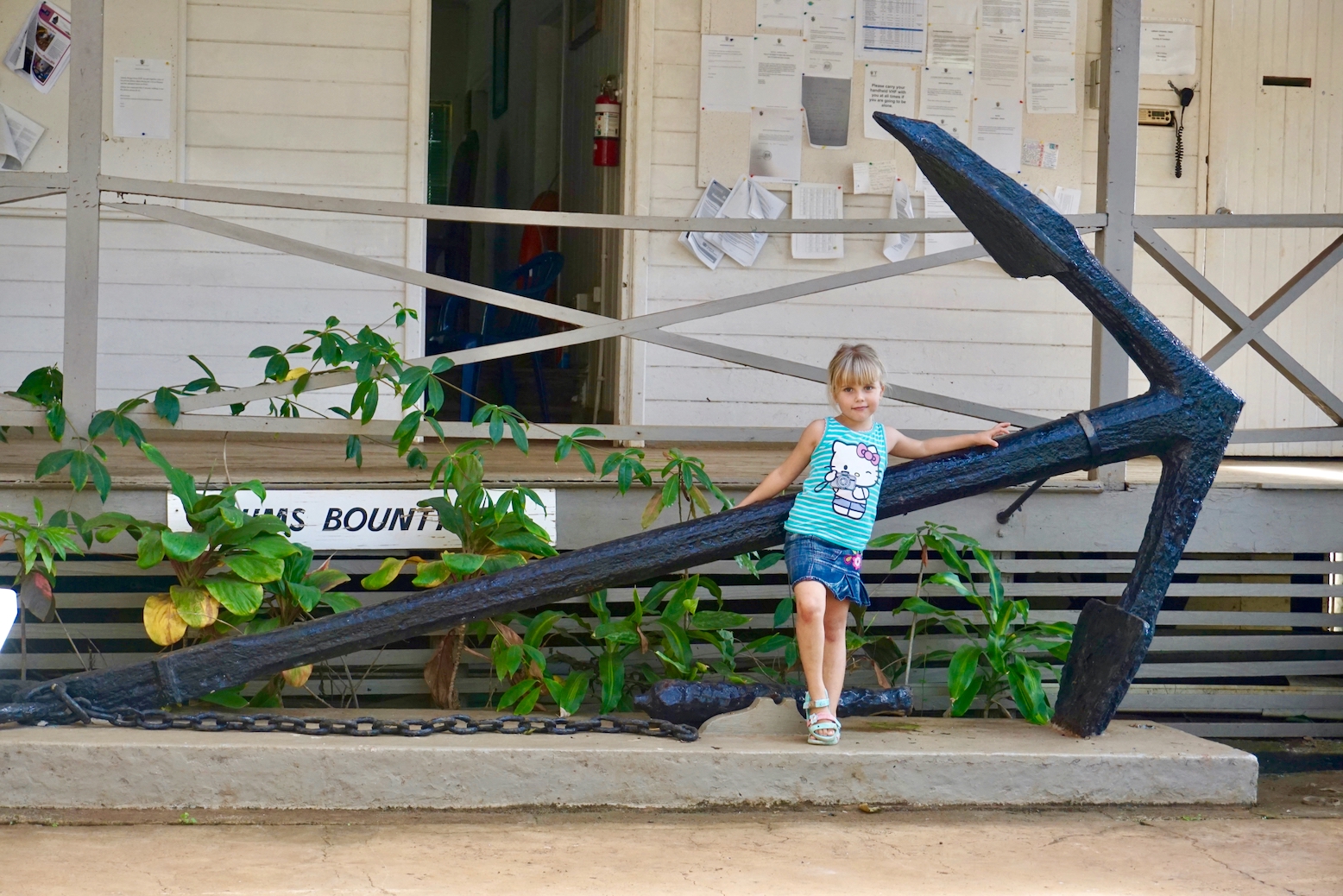
Approaching from the north, we see almost the same thing as the crew of His Majesty’s Ship Bounty did nearly 230 years ago. We try to anchor in the bay of the same name—in those days, if there was any point in anchoring at all, this was the only place. Pitcairn is so inaccessible around its entire perimeter that landing is possible in only a couple of places, and even there you can’t get beyond the fringe of rocks—the cliffs are almost perpendicular to the ocean’s surface. East of the main jetty there is another landing place, with a dirt road running from it to the island’s only settlement.
The ocean to the north is rough, and at anchor Lady Mary keeps bucking just as she did in the open sea.
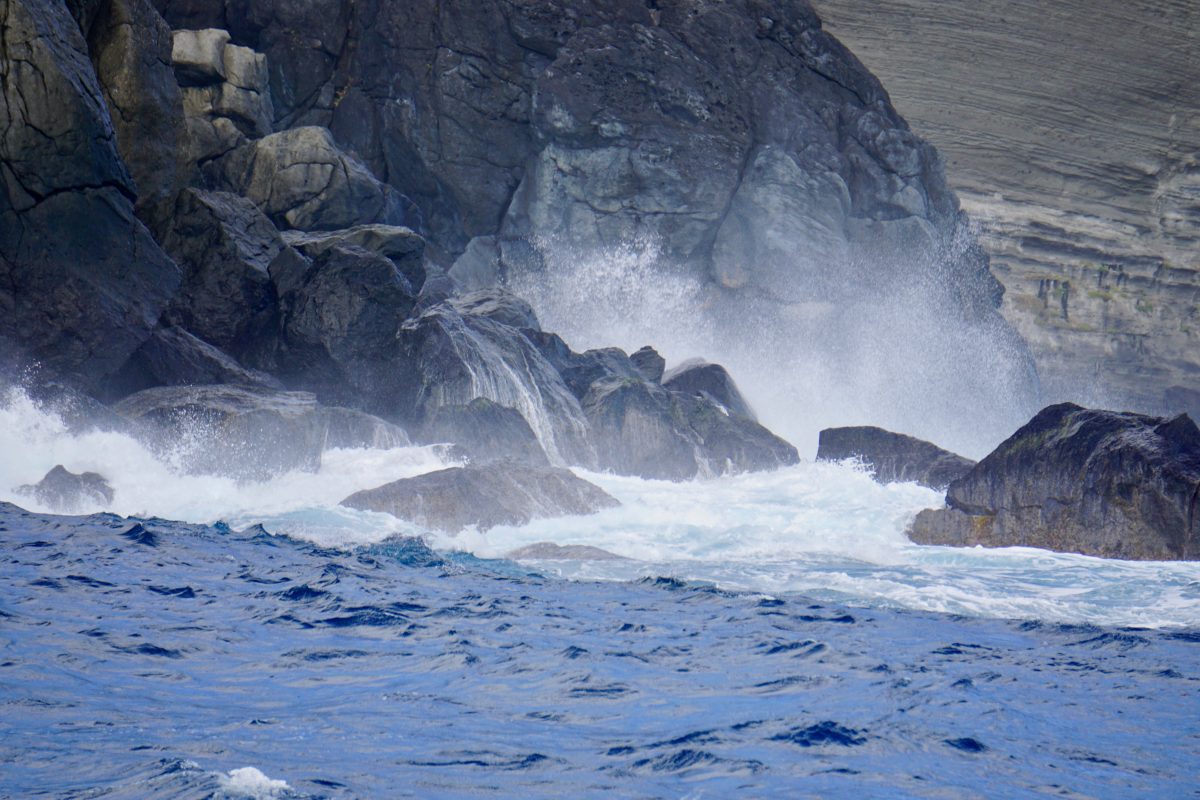
The coastal cliffs are 50 metres high
First contact with the “Bounty” island
“Pitcairn. Pitcairn. This is the sailing yacht Lady Mary!” the captain calls the shore.
“Lady Mary! This is Pitcairn. Welcome. Switch to Channel 14.”
“So,” the radio says in a pleasant female voice, “when are you coming ashore to clear in?”
“Looks like we won’t be coming just yet,” the captain replies.
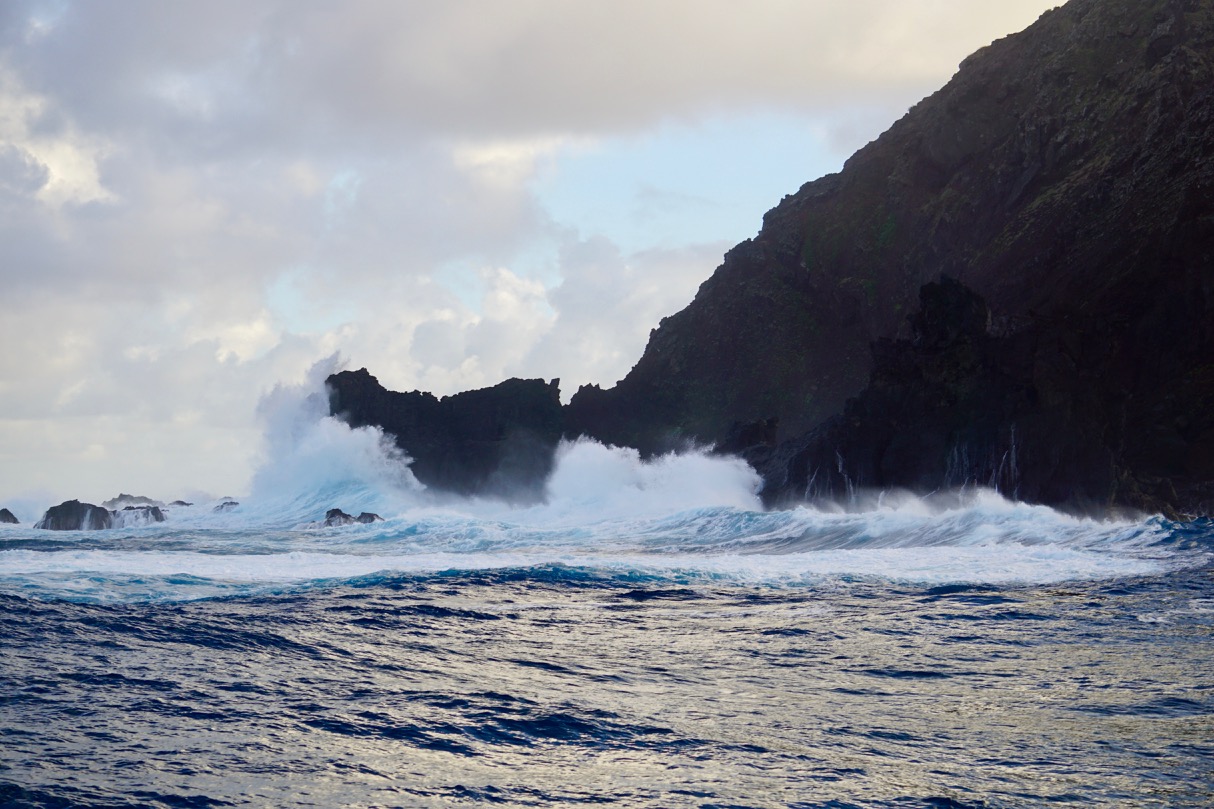
Meanwhile, the waves break beautifully against the little jetty in five-metre plumes of foam—the very jetty where we’re supposed to land. We giggle that this is very convenient: when a wave hurls the dinghy and us waaaay up onto the shore, there’ll be no need to bother tying it up or trudging uphill. There’s a hangar on shore, presumably with boats inside. A dirt road climbs the steep slope, disappearing into the dense greenery of Adamstown—about 20 compact houses scattered among the foliage.
“Yes, perhaps you’d better stay aboard for now,” the radio agrees, asking us to remain on Channel 16. Perhaps this is Brenda Christian, whom I’ve read about many times—the great-great-...-granddaughter of the sadly legendary Fletcher Christian.
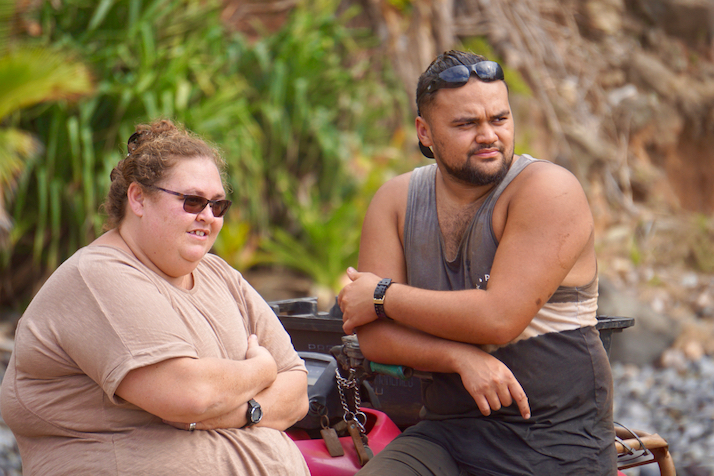
In fact, it was Charlene Warren-Peu, the great-great-...-granddaughter of the legendary Christian—and Warren too 🙂 This is Charlene with her younger son
The Mutiny on the Bounty
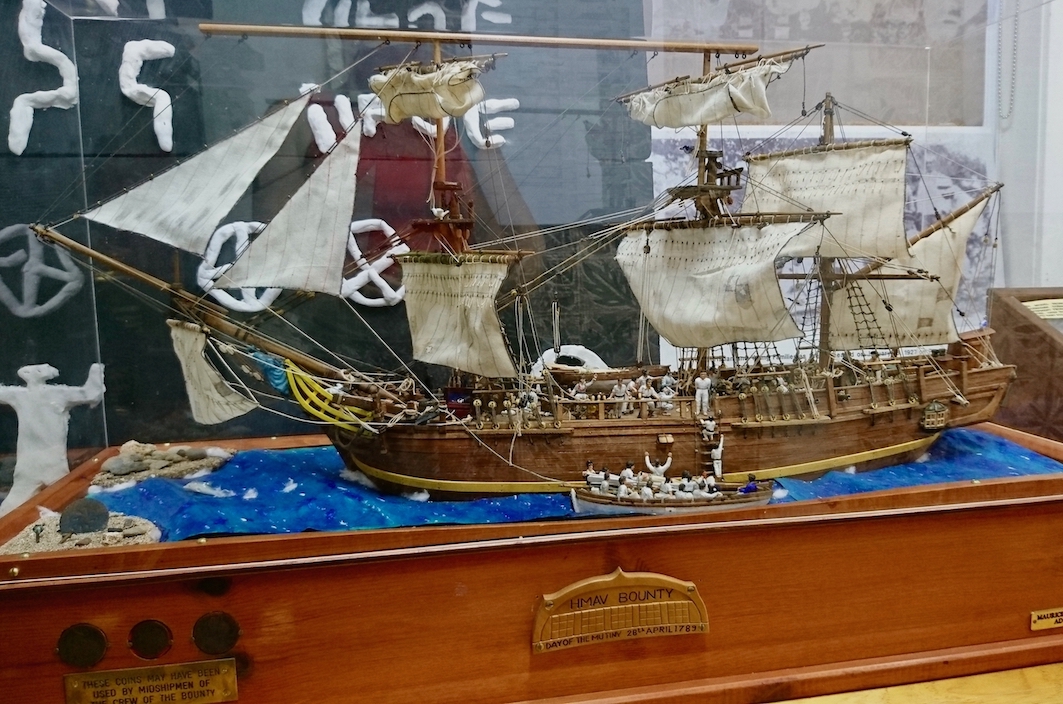
The Bounty island isn’t about chocolate and coconuts. It’s about how, in 1787, Her Majesty the Queen of England’s ship Bounty sailed to Tahiti for breadfruit saplings. Their fruit was supposed to solve a major economic problem: feeding the slaves on Caribbean plantations. The vessel was commanded by Captain Bligh, who had visited Tahiti with Cook ten years earlier.
Bounty remained in Tahiti for five months. Breadfruit plants were being raised into saplings capable of crossing half the world, while the crew went to seed under the tropical sun. Officers and sailors languished in the embraces of voluptuous sirens, had pagan tattoos inked on their backsides and gave no thought whatsoever to the mission entrusted to them.
Captain Bligh realised too late and tightened the screws in earnest. But he overdid it. Part of the crew took the departure from Tahiti as a personal insult. And on April 28, 1790, en route to the Kingdom of Tonga, mutiny broke out aboard Bounty. Handsome Lieutenant Fletcher Christian and his companions threw two thousand breadfruit saplings overboard, and then the captain himself, along with 18 men loyal to him. The men were given a launch, though, in which they miraculously made it to the Dutch colonies.
How Pitcairn Was Settled
The mutineers, meanwhile, stumbled upon Pitcairn Island. It had been charted incorrectly (with an error of 170 miles), which meant the chances of the rebels being found anytime soon were close to zero. The former sailors burned the ship and began dividing up the land and the women, 11 of whom they had brought along from Tahiti. They had also brought 6 Polynesian men from there. There were 9 mutineers left. So, let’s do the maths: because someone hadn’t paid attention at school, a scrap of land measuring 1 by 2 miles ended up with 15 gentlemen and 11 ladies.
I suspect the Tahitian men had actually come with partners, whom the mutineers began taking from them while oppressing them into the bargain. The outcome was grim: Christian lasted only four years on the island. And by 1808, there was only one man left on Pitcairn—a certain John Adams—along with 9 Polynesian women and 23 children. Their descendants are alive and well to this day. They bear the surnames Christian, Adams and Young. And the village is called Adamstown.
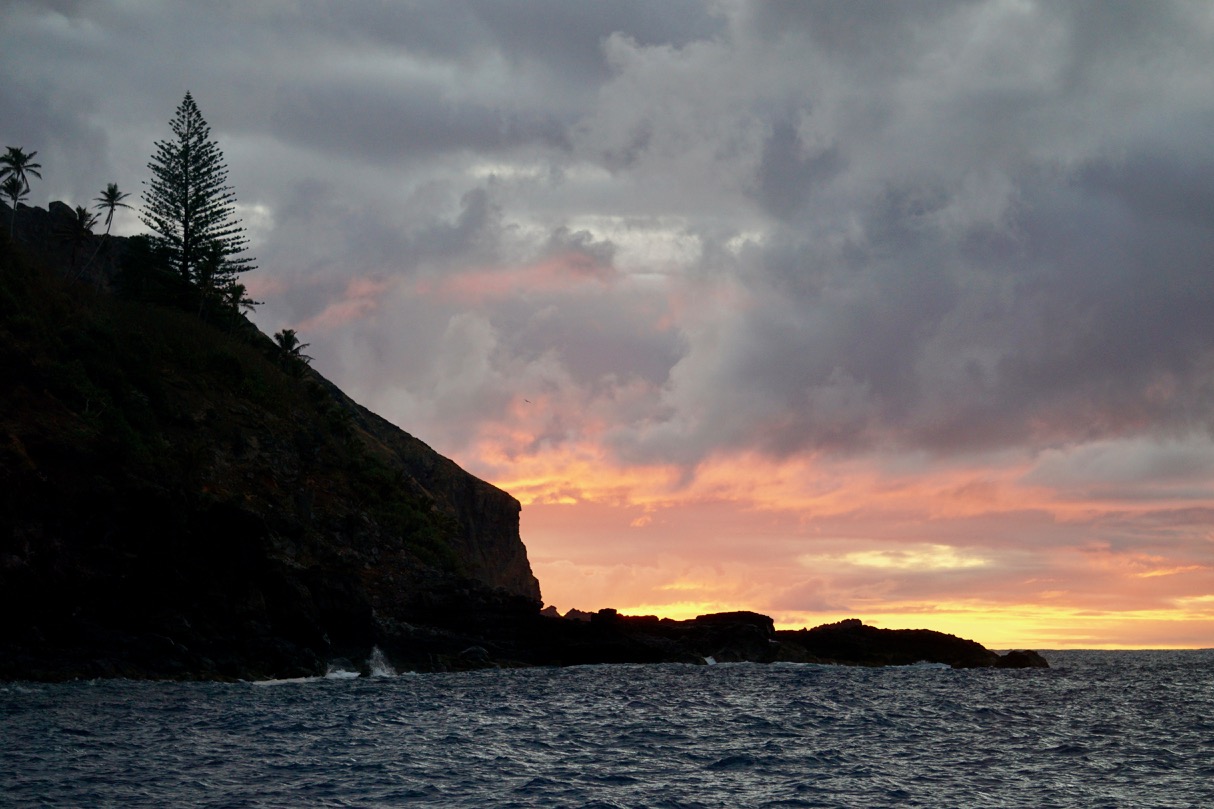
sunset from Bounty Bay. Adamstown is on the hill
A couple of hours later, the radio came to life and advised us to head to the south of the island:
“I’ve checked—it’ll be better for you to anchor there.”
“Thank you!”
And we began weighing anchor. The swell proved livelier than expected, and it took at least half an hour to haul in 100 metres of chain. The bow rears vertically into the sky and then crashes down into the waves. As I retrieve the chain, I go through every level of extreme spa treatment, from a face wash to being blasted from above and below with a fire hose. We’ll put together a video from whatever we managed to film—it came out inspiring.
Unsuccessful Attempts to Get Ashore
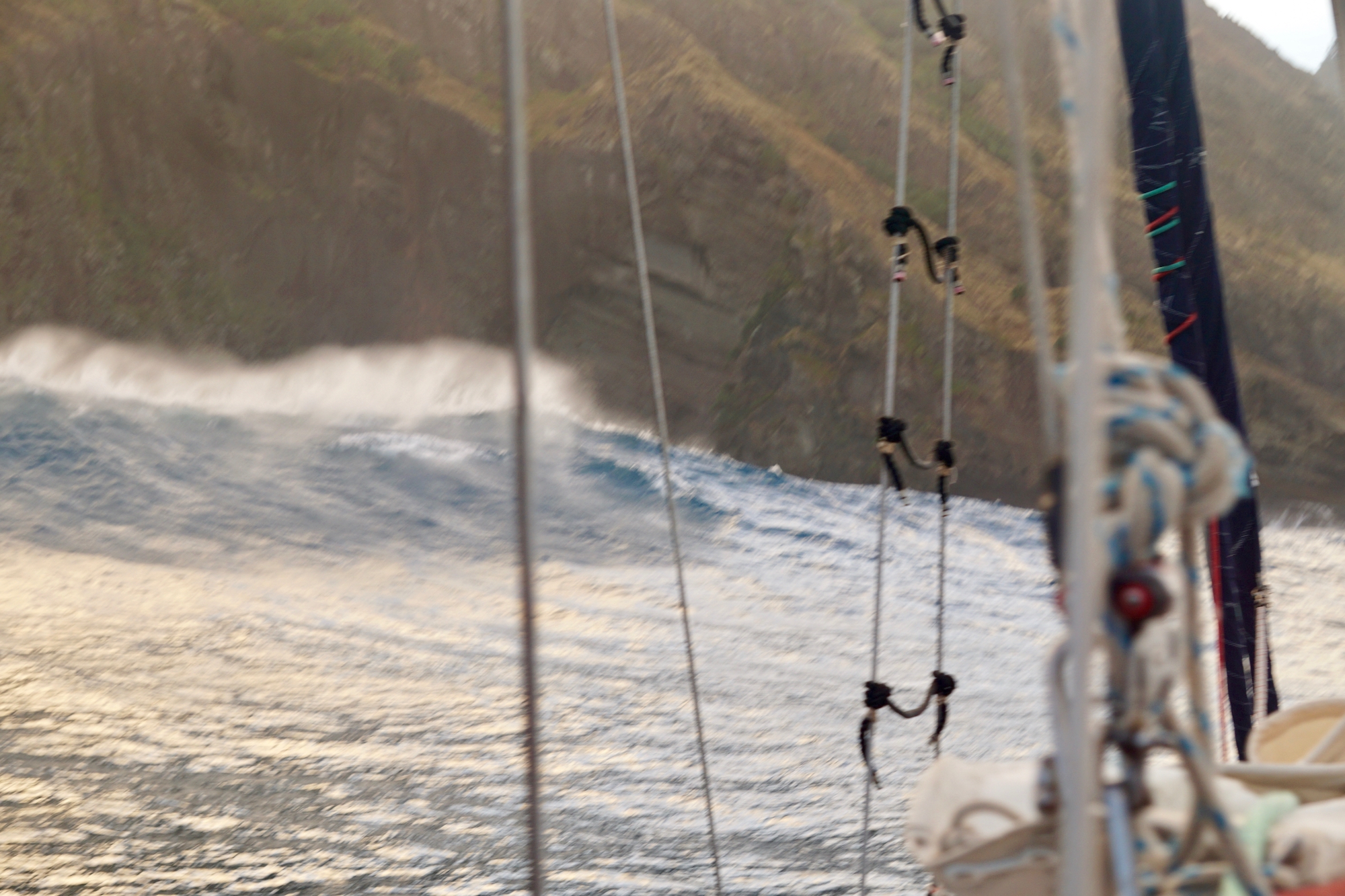
The next day, despite the radio operator’s warning, we again tried to approach Bounty Bay. But the swell, which is hardly a nuisance on the south side, rages in breakers on the north. We decided to count this outing as a yacht cruise around the island—we circumnavigated it and inspected possible landing sites. Yes, Andryukha flew off in the dinghy for a closer look while Lady Mary and I drifted among the reefs.
Surf on Pitcairn
Exactly two days after first dropping anchor, we weigh anchor again and plan to make our landing from another bay, which is also being pounded by the waves. But for some reason the captain is feeling optimistic. During all these days, we haven’t seen a single resident of Pitcairn, either close up or at a distance. Are they really here?
I’m off to weigh anchor. Our coordinates off Pitcairn Island are 25°04′S and 130°07′W. There’s no connection, folks. We can’t reply individually to every email and comment, but we read and reread them all with enormous pleasure. Thank you for being with us! And special hugs from the Pacific to everyone who has already managed to stay at our Gingerbread House in the Altai Mountains —we’re so happy to read your messages! If you go there, give our regards to the kind neighbours and the warm cedar walls! May you sleep soundly and breathe easily there! By the way, try sleeping on the balcony—it’s simply fantastic: there aren’t any mosquitoes!
Stuck?
Meanwhile, the anchor chain and anchor have become well and truly snagged around the coral. The yacht tries to stand on her toes and then on her heels, creaking ominously. The captain is manoeuvring Lady Mary with exquisite precision along the anchor track, trying to untangle the steel chain like a thread in a child’s embroidery... He’s just sent the junior crew member for a hammer. I’d better go too... What’s happened up there?
To be continued!
Sent via satellite. Photographs added two years later ).
This is how it looked on July 2, 1767, to a 15-year-old midshipman, the son of Major Pitcairn, aboard Swallow sunset from Bounty Bay
This is Charlene with her younger son