
From the Travely-Family archive · Other Entries
Road Trip to the Great Maya Pyramids — Chichén Itzá
An original publication from the former Travely-Family website. This English translation was preserved from the technical-site archive without editorial rewriting.
A road trip through Mexico, or how to become a headless captain—innocent amusements and sacrifices among the ancient Maya.
Mexico by Car
Mexico ranks second in the world for the number of historical attractions.
We had allowed about 10 days for our drive through Mexico, following this route: Puerto Aventuras — Valladolid — Chichén Itzá — Ik Kil Cenote — Uxmal — Campeche — Palenque — Agua Azul Waterfalls — San Cristóbal — Sumidero Canyon.
We booked accommodation mostly through Booking.com. We rented the car in Playa del Carmen, where it was one and a half times cheaper than in Puerto Aventuras.
The Dark Past of Chichén Itzá
In the Mayan languages, Chichén Itzá means “At the mouth of the well of the Itza.” According to various sources, the best-known and most accessible Maya pyramids were built sometime between the 400s and the 700s. Chichén Itzá saw times of prosperity and decline, while the end of the second (Classic) period—AD 317–987—saw the mysterious exodus of the population from the Maya cities of the Yucatán.
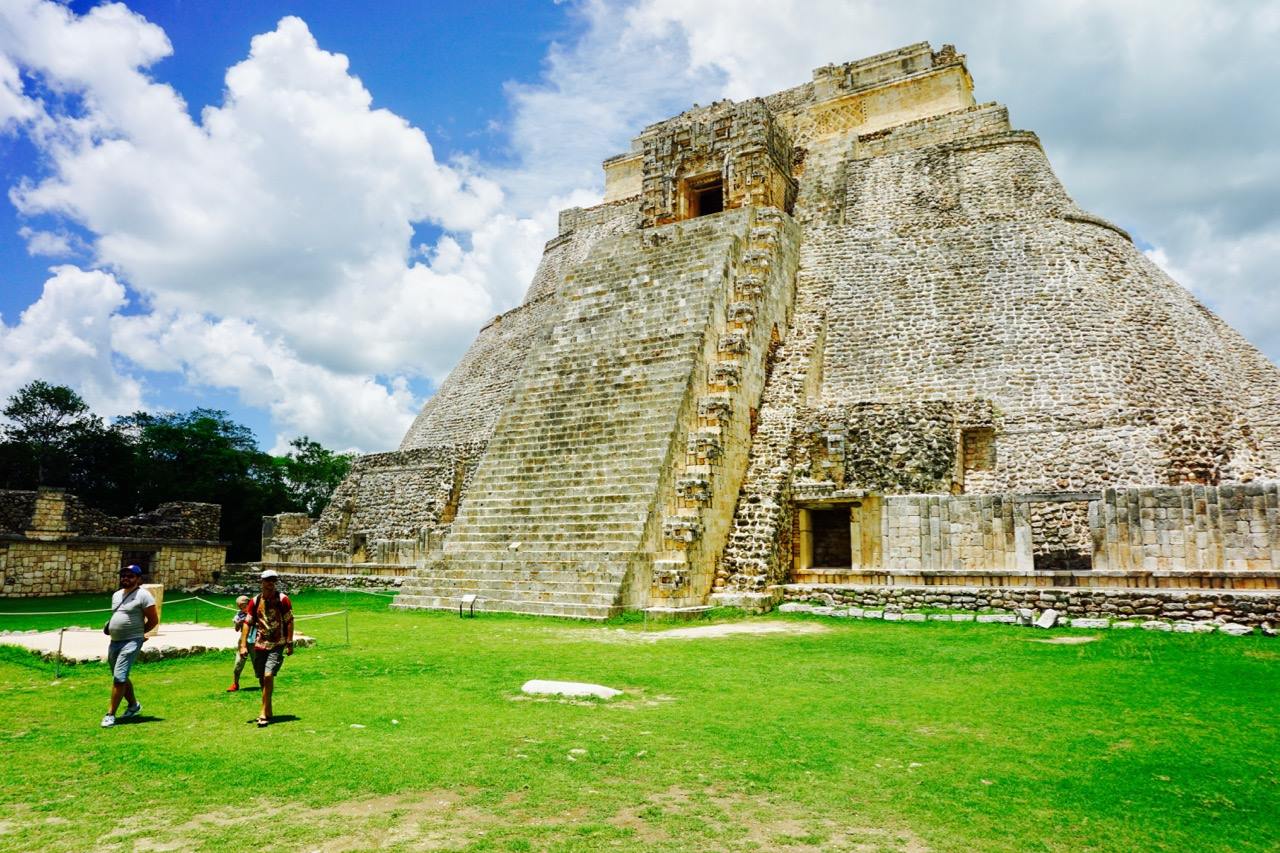
At the top of every pyramid stands a temple—the true purpose of the whole construction. The pyramid itself is a pedestal, built with surgical precision, aligned with the cardinal points and, as a rule, undergoing a magical transformation on the solstices and equinoxes.
During the height of Maya civilisation (AD 700–800), Chichén Itzá was its main centre; its rulers and high priests were based here.
Closer to the 10th century, the Toltecs attacked Chichén Itzá. They had made attempts before, but this time they attacked in earnest. The Maya were chopped to bits, and by the 11th century the Toltecs had established their capital here.
For around 200 years the Toltecs ruled Chichén Itzá, prayed to their own gods atop other people’s pyramids, and, so as not to look like complete underachievers, built a few things of their own during the 10th and 11th centuries.
Meanwhile, their disgruntled neighbours were gathering strength: “How come the Toltecs get everything and we get nothing?” Once they were ready, they began attacking Chichén Itzá. At first on the sly, and then they brought in other envious parties as well. In 1178, the united army of three states—Uxmal, Mayapán and Izamal—rose against the Toltecs.
Chichén Itzá was destroyed in a fit of “if we can’t have you, no one will.” By 1194—apparently the date of the last record of the ancient city—the people had abandoned the withered capital altogether, for mysterious reasons. Researchers are almost certain that a prolonged drought drove them out. After that, the Maya never again built monumental structures.
By the time the Spaniards arrived, at the very beginning of the 16th century, Chichén Itzá lay in ruins. The descendants of the great Maya, living modestly nearby, came from their villages to pray there.
Chichén Itzá Today
Any attraction is best seen in the morning, before the heat and before the main mass of tourists wakes up.
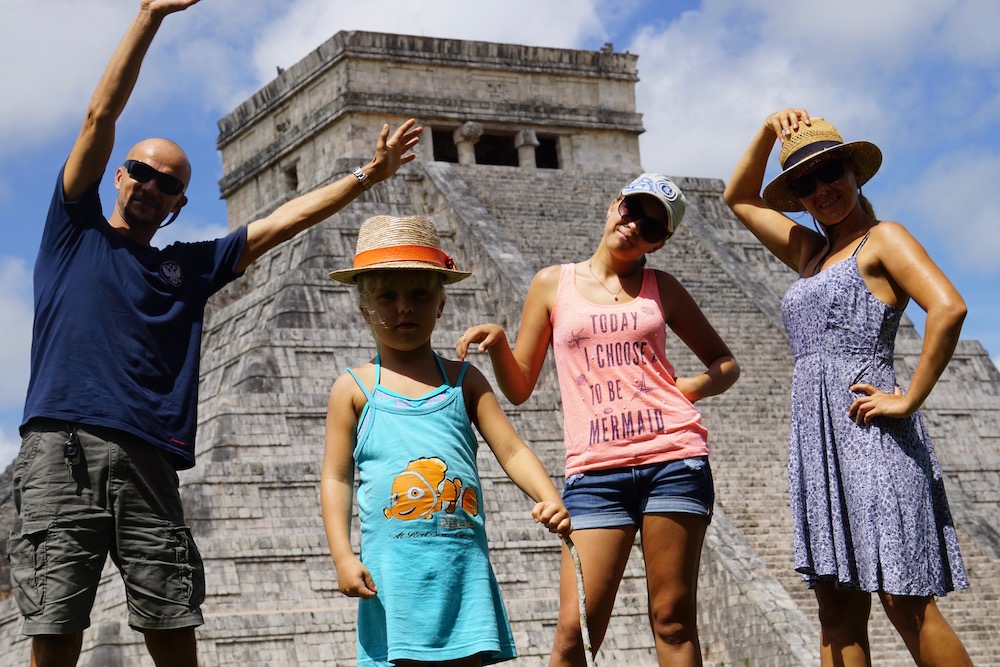
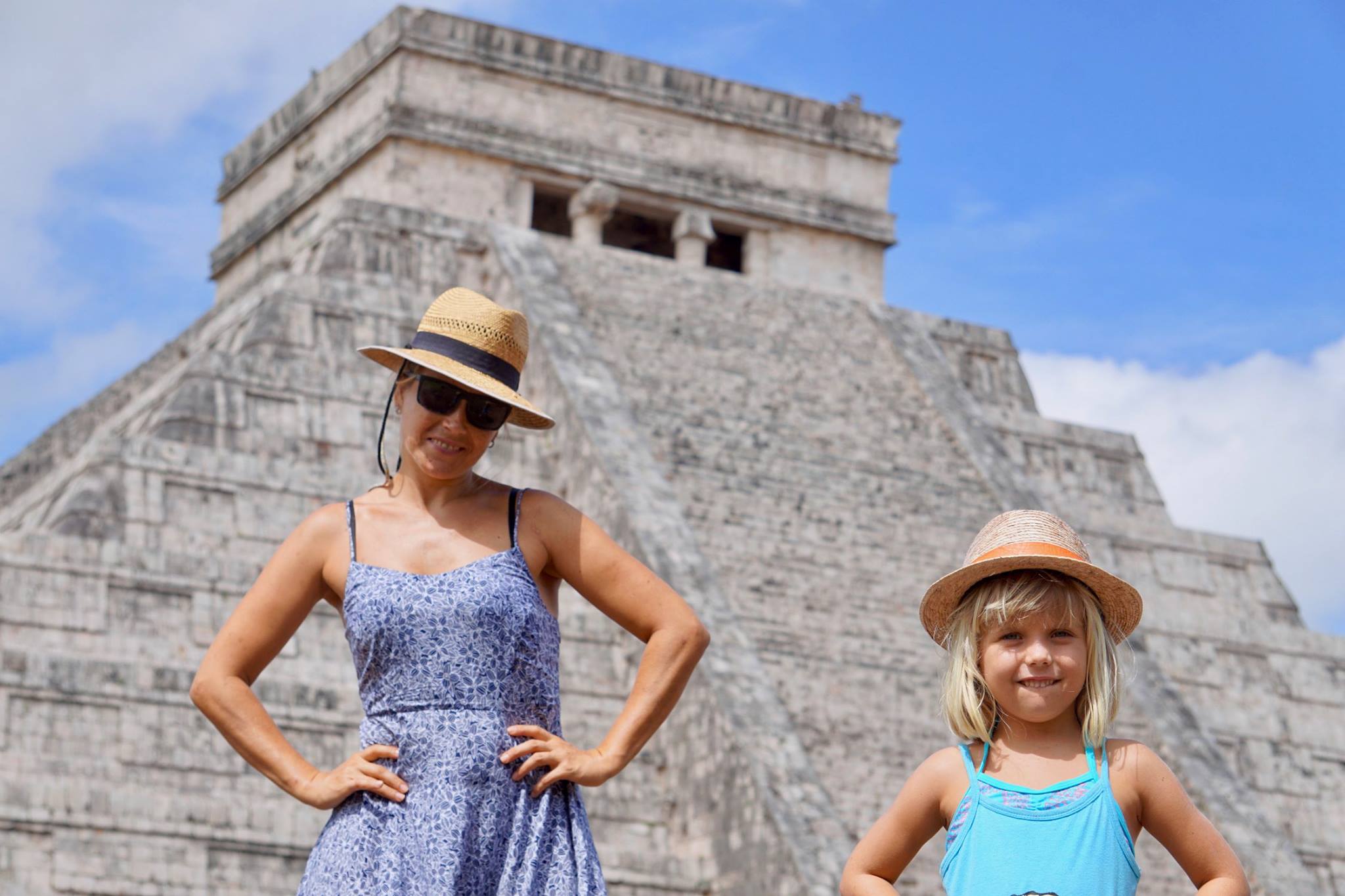
Of course, at 7 a.m. only half our crew had managed to get up, so we reached Chichén Itzá closer to nine. We missed sunrise among the pyramids, but at least we managed to wander around in relatively small crowds.
On the spring and autumn equinoxes, the great pyramid of the god Kukulkan—the feathered serpent—draws thousands of people eager to witness a miracle: the serpent itself descending from the top of the pyramid to its foot, where its head waits for its body.
The magical effect is created by the play of light and shadow at precisely that time. On the equinoxes, the sun illuminates the pyramid in such a way that the sacred serpent appears to be creeping slowly and ominously downwards, straight towards you as you stand at the foot of the pyramid.
The Maya were some kind of mystical architects! As if it were not enough that, if you clap your hands directly in front of one of the pyramid’s four stairways, the steps answer in the voice of the quetzal, a bird sacred to the Maya. A rather squeaky voice, it must be said—not magical at all. It is not even an echo; it is some sort of vibration. Don’t believe it? Try it.
There is entirely official talk that another pyramid is hidden inside the Pyramid of Kukulkan—a small and very ancient one. And there is another one inside that. Like a matryoshka doll. I’m no expert, of course, but it seems to me the pyramid may simply have been modernised over the centuries, acquiring more and more additions.
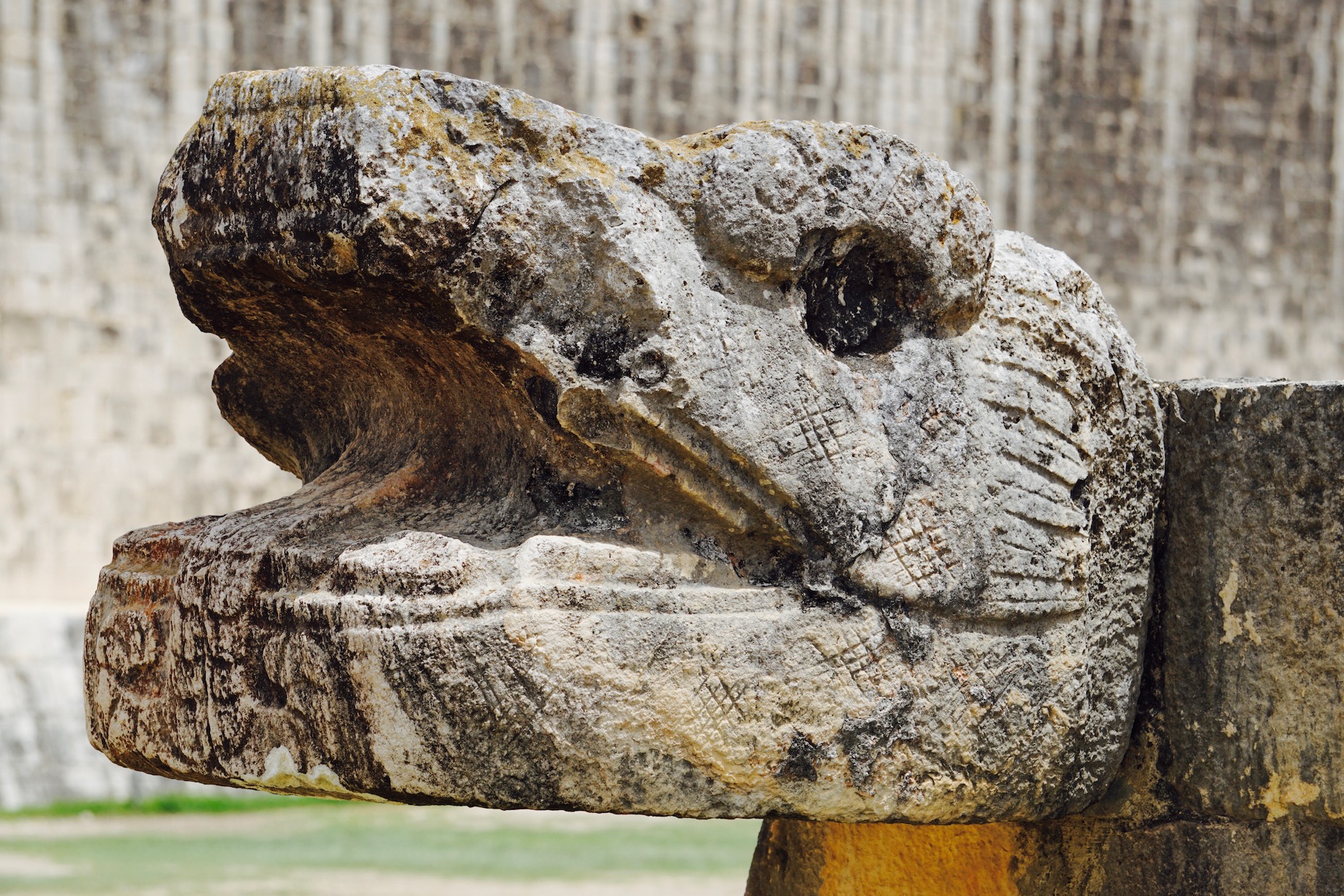
That very head of the serpent Kukulkan
Deadly Basketball
Judging by their rituals, ancient people must have descended from some very predatory and fearsome creatures—why else would they have surrounded even games and competitions with bloody sacrifices? There is also a ball court at Chichén Itzá. The game, known as “tlachtli” in the Aztec language and “pok-ta-pok” in the Mayan language, was inherited by both peoples from the Olmecs.
A rectangle about 150 by 50 metres—something like a cross between a football pitch and a Quidditch arena (hello, Harry Potter). A ring is set into each of the concrete side walls. Each ring hangs vertically at a height of about 5–6 metres. Did they really hurl the ball through those? The ball was made of rubber and weighed nearly 4 kg. They say it could kill you, and the players wore special protective gear, like in American football.
Ancient Maya Quidditch was more dangerous entertainment than Hogwarts Quidditch. The ball could be played only with elbows, hips and knees, while the head was saved for something else. The winners were those who scored more goals than their opponents—and this time I mean “goals,” not heads. The real drama began after victory.
The thing is, the game had a ritual character. They say the ancient Maya gods themselves enjoyed a game of pok-ta-pok. And they were very pleased when humans played it. To please them even more, at the end the captain of one of the teams was sacrificed to that very god Kukulkan from the previous pyramid, and to his fellow deities of equal rank. Off with his head, and adiós.
Some historians believe that, since the gods were offered not just any old thing but only the very best, it was the winner who was beheaded, and that this was an honour for his entire family. I wonder how they motivated a team to win, then? With the promise of eternal glory?
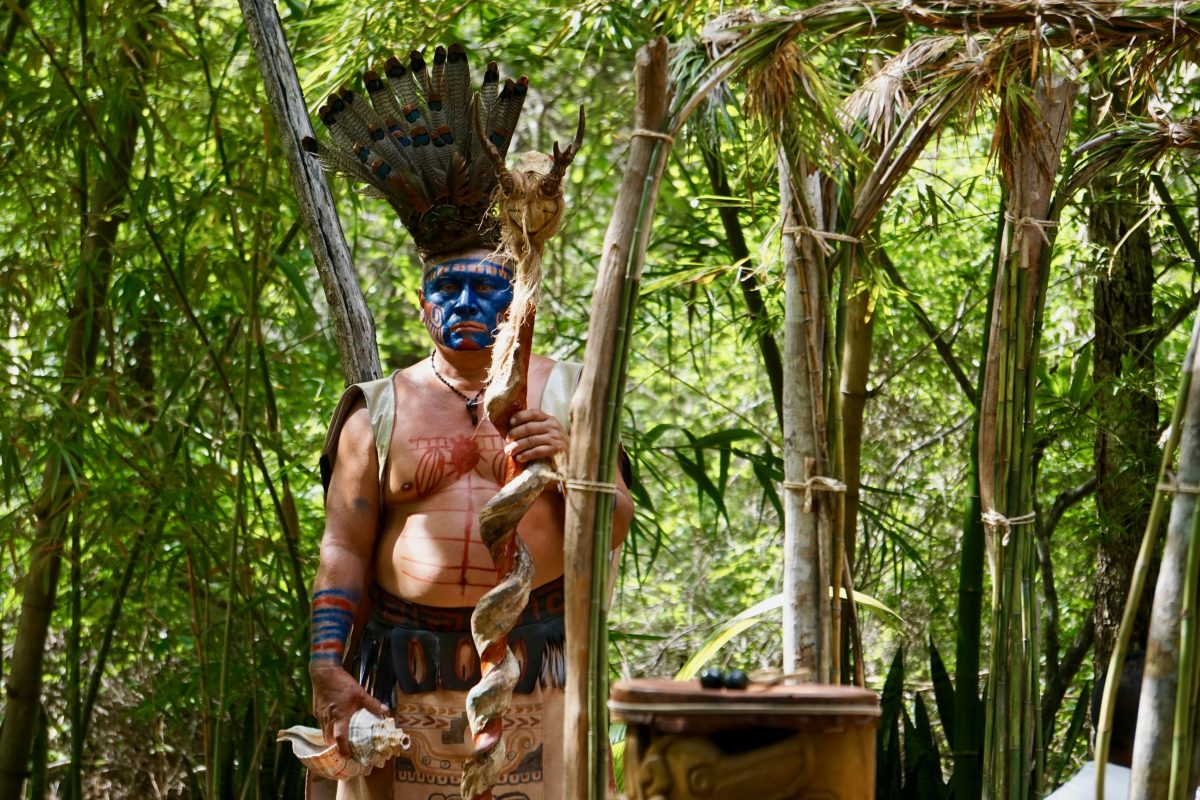
But not every game involved a sacrifice—only the most important ones. The rest of the time, when no one was being sacrificed, women and children played the game for fun as well.
What It’s Like There in General
A large area trampled by tourists and occupied by vendors. A circular path. You are not allowed to climb the structures, for obvious reasons: if all those millions of tourists stampeded up the pyramid, what would be left of it? And what would be left of the tourists themselves if they started tumbling off because it was overcrowded?
Only someone with a very powerful imagination can picture what it all looked like here a thousand years ago—and only early in the morning. As for the energy of the place, it is hard to tell whether there is any at all. The space between the pyramids feels more like a cross between Palace Square and a market square on a hot Saturday afternoon.
Ladunka had had her fill of walking among the pyramids after half an hour and took refuge in the shade beneath the spreading crowns of umbrella acacias.
The key to enjoying a visit to the pyramids:
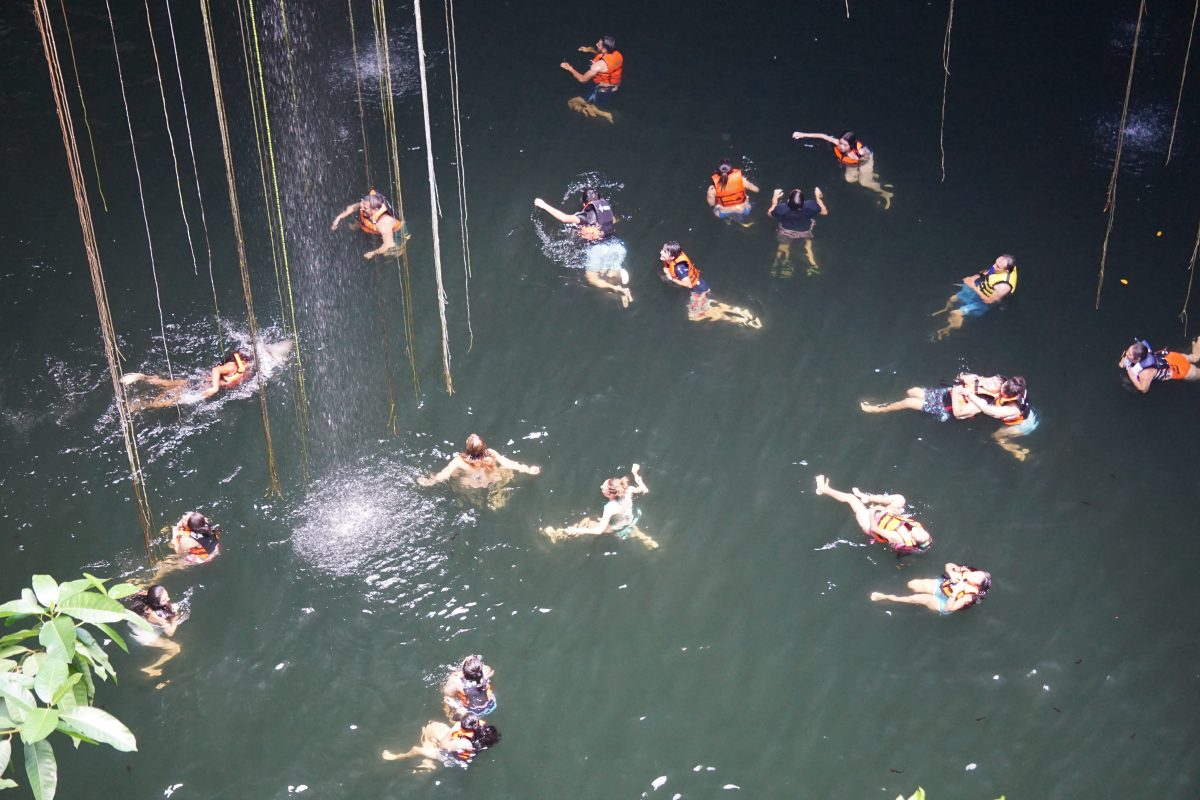
morning hours a weekday bring water sun protection, from creams to sun hats and umbrellas patience.
N.B.: Be sure to cool off at Ik Kil Cenote on the way back.
The farther you travel from the main tourist routes, the more interesting and mysterious the ancient cities look—and the fewer people they hold. So from Chichén Itzá we headed south, into the jungles of Maya civilisation and the city of Palenque.
P.S.: The photographs for this post ended up on a damaged hard drive. We’ll add them to the post as soon as we recover them.