
From the Travely-Family archive · Central and South America
The Horror of the Night Jungle
An original publication from the former Travely-Family website. This English translation was preserved from the technical-site archive without editorial rewriting.
The horror of the night jungle. Who frightens travellers in the jungles of Mexico. What Darwin, Freud, a booming bass voice and testicle size have to do with one another. Video and audio....Once again, no time for the pyramids.
The horror of the night jungle— is when you wake in the middle of the night to the long, soul-sucking howl of a Dementor (those monsters that look like Death with a scythe, from Harry Potter. This is the second time we’ve recalled the horrors of the Potterverse; the first was right here, after our Atlantic passage).
At three o’clock this morning, the crew’s sleep was torn apart by muffled, drawn-out howls. The first mate dreamt of the black funnel of a gigantic tornado roaring through her body, then coming round for a second pass. Had we been sleeping in the open forest, we wouldn’t have managed without valerian. Thank God, half an hour later the dreadful sounds subsided without bringing any calamity, and everyone fell asleep again. At dawn, the drawn-out roaring resumed. Coming from somewhere above, it filled the whole space. A line came to mind: “They say that’s how the Hound of the Baskervilles howls.”
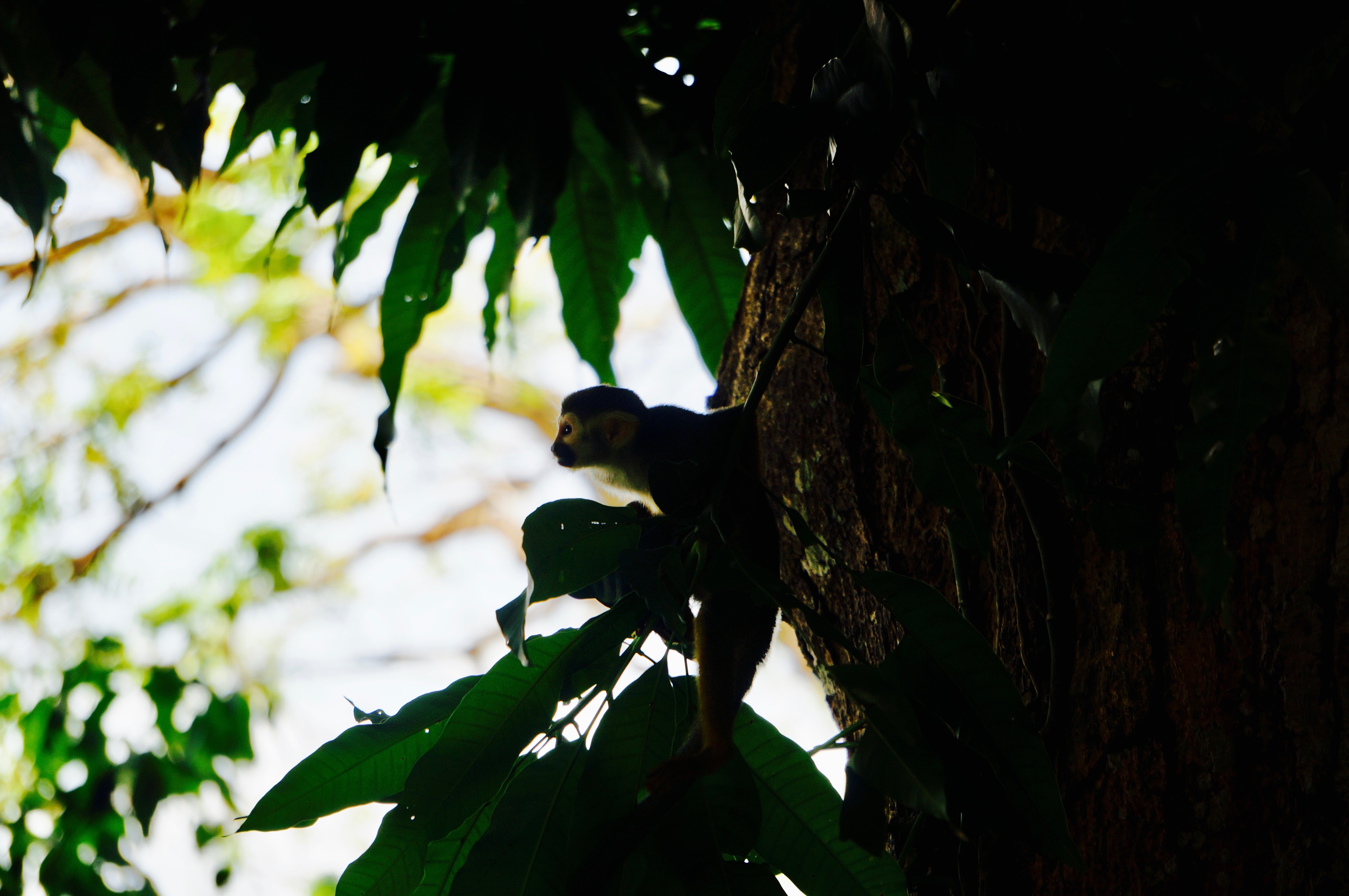
Secrets of the protected forest
The ancient city of Palenque lies 5 kilometres from the modern town of the same name, with its hilly streets. Palenque was the capital of the Baakul kingdom. The majestic ruins were once, in the 6th–7th centuries, grand religious structures. Life bustled here until the 9th century, but the city fell, presumably as a result of an invasion by tribes from the Gulf of Mexico coast. In 1906, Balmont dedicated the poem “In Palenque, Among the Ruins...” to the city lost in the jungle. This ancient city now tops our personal list of all Maya monuments.
A little practical detail—where to stay and how much it costs
The ruins of the ancient settlement are surrounded by protected forest and guarded against attempts by ticketless visitors to sneak in, though that has not prevented a small hotel-cum-campsite from being set up right by the entrance. Bungalows, a swimming pool deep in the thicket, a river and moss-covered footbridges. Modern conveniences are outside.
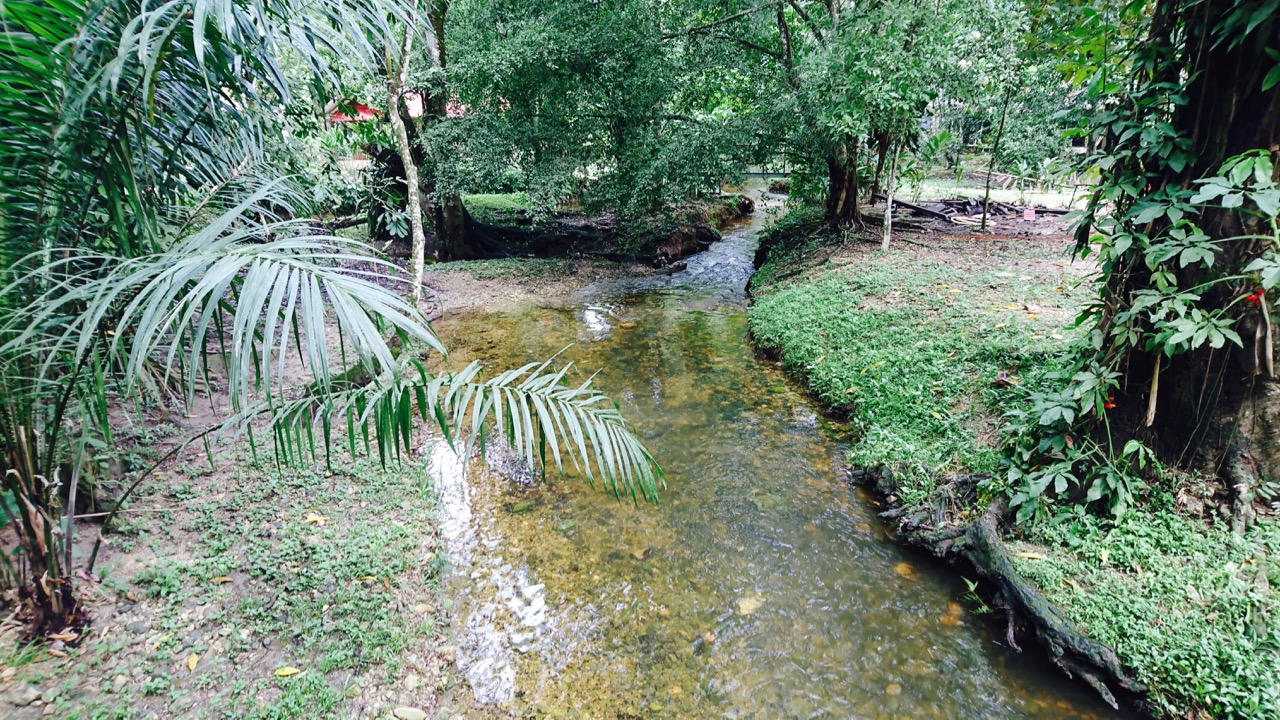
The river in our little village
A triple room costs 1,040 pesos for two nights and, fortunately, has its own bathroom, so the lucky occupants do not have to venture outside in the middle of the night. Three windows with mosquito screens and a fan save us from the heat. We are already about 80–100 metres above sea level here, which makes the nights cooler.
And this is where we settled, right in the protected forest, literally a kilometre from the ruins of the ancient city of Palenque. As we discovered at the cost of a couple of thousand nerve cells, howler monkeys live directly above the roof of our refuge, in the crowns of giant ceiba trees (kapok trees) overgrown with ferns and moss. They were the nocturnal terror of our little town.
Those poor early explorers and ancient Indians! No wonder they feared unknown creatures and endowed them with supernatural powers. Those sounds alone are enough—utterly terrifying.
Entrance to the ancient city of Lakam-Ha (the ruins of Palenque)
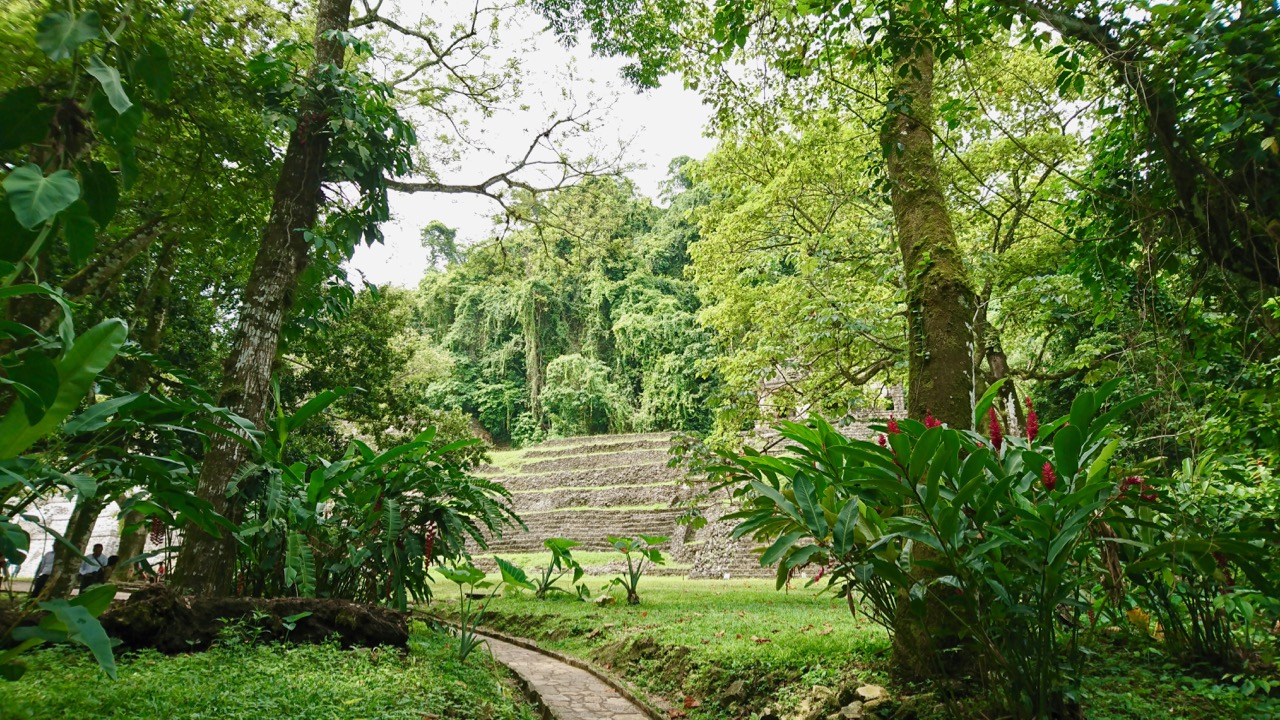
How the horror of the night jungle arrived
And yet the forest had behaved with deceptive propriety that evening—we went to bed to the soothing drumroll of the downpour. In the middle of the night, the crew’s innocent slumber began to take on some rather sinister audio forms: sound waves humming all around twisted into gigantic funnels and sucked the sleeper inside. You open your eyes and realise: nope, not a hallucination—they really are sucking you in. So loudly and mournfully that Andrei and Nastya also sprang up in bewilderment. Ladunka alone did not wake; apparently, the wild horror of the night jungle fitted perfectly into the plot of her dream.
It took a few seconds to realise there was no danger, and then I remembered a review of this place on Booking.com: “Only mosquito screens separate you from the jungle; you may be lucky enough to see a howler monkey, and at night you will certainly hear their blood-curdling cries.”
Thank you for that review, kind stranger! Otherwise we might have thought a pack of jaguars had come to devour us.
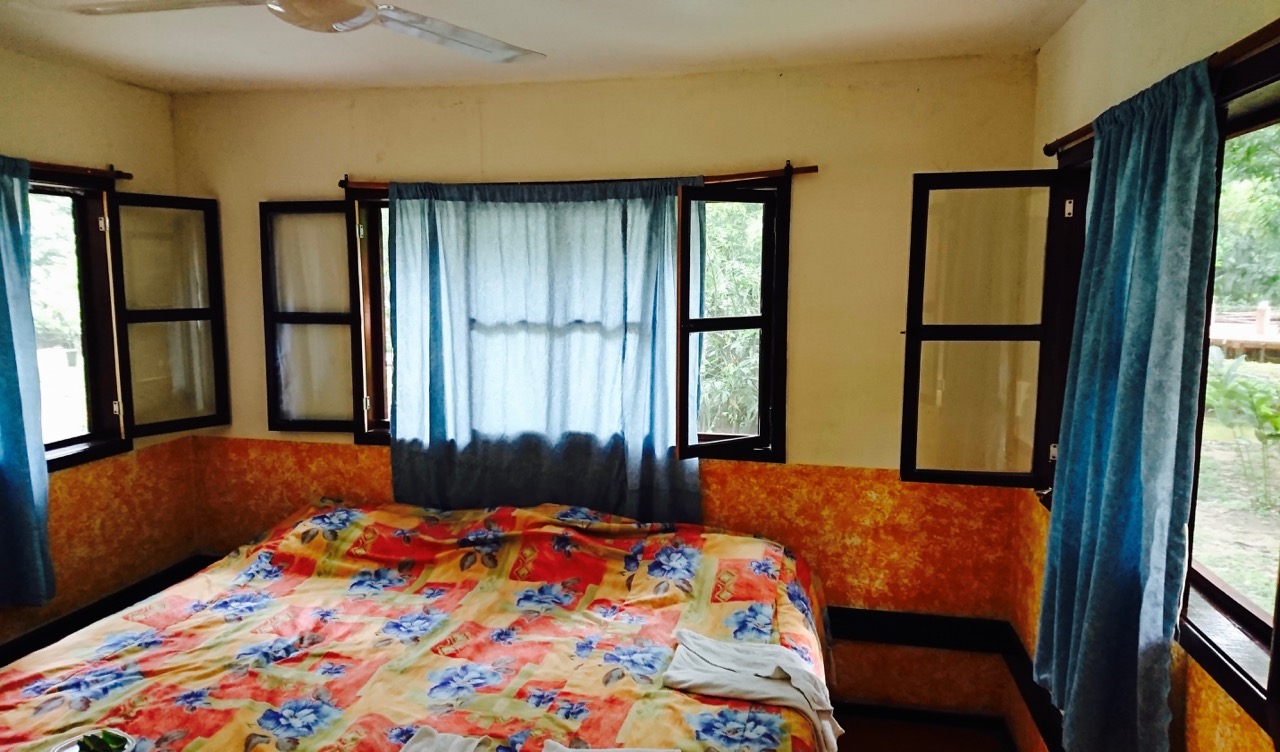
Our room in the forest hotel—the sounds of the jungle pour through the three wide-open windows Charles Darwin and anatomy lessons
So, the howler monkeys were howling at the tops of their lungs. Their roar is one of the most powerful sounds produced by any animal and resembles the growl of a tiger or jaguar. The howl can be heard several kilometres away and may last for up to 40 minutes.
Long ago, the famous Charles Darwin was delighted when he encountered howler monkeys in Central America. He was also the first to suggest that a loud voice helps males reproduce.
Not long ago, this fact was confirmed in an unexpected way. It turns out that the louder a male howler monkey roars, the smaller his... testicles. Scientists noticed this connection while observing nine species of howler monkey in South and Central America. Naturally, the researchers could not believe their eyes, so they continued their analysis.
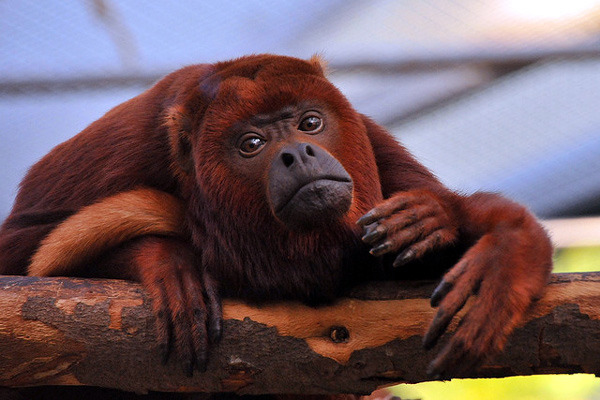
After studying the structure of the howlers’ vocal cords, their larynges and everything else, a team led by J. Dunn of the University of Cambridge discovered that testicle size is inversely proportional to the size of the hyoid bone, which is responsible for the booming bass voice. It seems that, having endowed some males with powerful voices, nature left the poor fellows no resources for developing large genitals.
Such a sad howler monkey:). Photo from the internet
What is a fellow to do if the hyoid bone is the only thing to have been blessed with impressive dimensions? Howl more menacingly. This fact is also reflected in the monkeys’ way of life: those who have something with which to impress the ladies without resorting to arias live in groups of several males and females. But those whom nature has endowed with modest manhood yet a booming bass voice reign alone over a harem. Having driven rivals away with a fearsome roar, the modestly endowed male need not fear competition and, for want of a better option, is loved by all the ladies. Such is nature’s balance. Old Freud would have been pleased too:).
I wonder what we would have done if we had been sleeping in a tent in the middle of the forest and woken up inside that sinister howl?
Once she had recovered by the window that night, the first mate heeded the captain’s question, “Why aren’t you recording it?” and recorded the sound on her phone. Enjoy! 🙂 (for maximum enjoyment, turn the volume all the way up, because it really was loud).
And the next morning Lada announced:
Do you know what I dreamt last night? It was incredible—what a wonderful dream! I was flying on a horse-shaped balloon. It was all inflated; you sat on it and flew. And Dad was flying too. Maybe you and Nastya were as well, but I simply didn’t get to the end of the dream.
There was not a trace of the horror of the night jungle in our young sailor’s dream:).... And then we went to finish exploring the ancient Maya city of Palenque. The Maya called it Lakam-Ha—“Big Water”; the city was the capital of the Baakul kingdom, the westernmost in the Maya Empire, in the 3rd–8th centuries AD. But that is another story.
More on the Maya pyramids—to be continued!
Other adventures in Mexico: how we reached the main Maya pyramids of Chichén Itzá— here >> and how we tore a sail during the passage— here >>
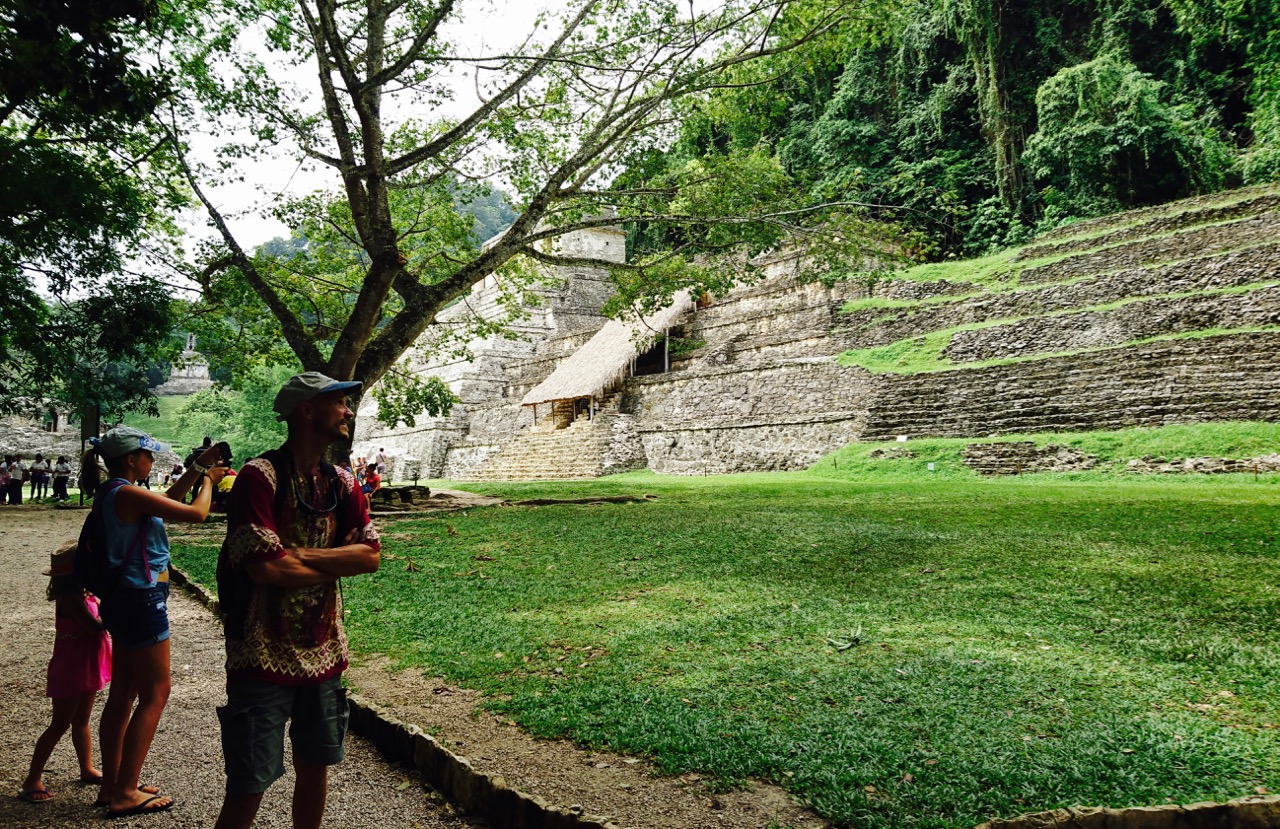
Beneath the thatched roof is the entrance to the “Tomb of the Red Macaw Woman.” Beyond it is the Temple of the Inscriptions. The inscriptions are Maya writings dating from 1000 BC to AD 4472. Not all have been deciphered, and those that have are open to differing interpretations.
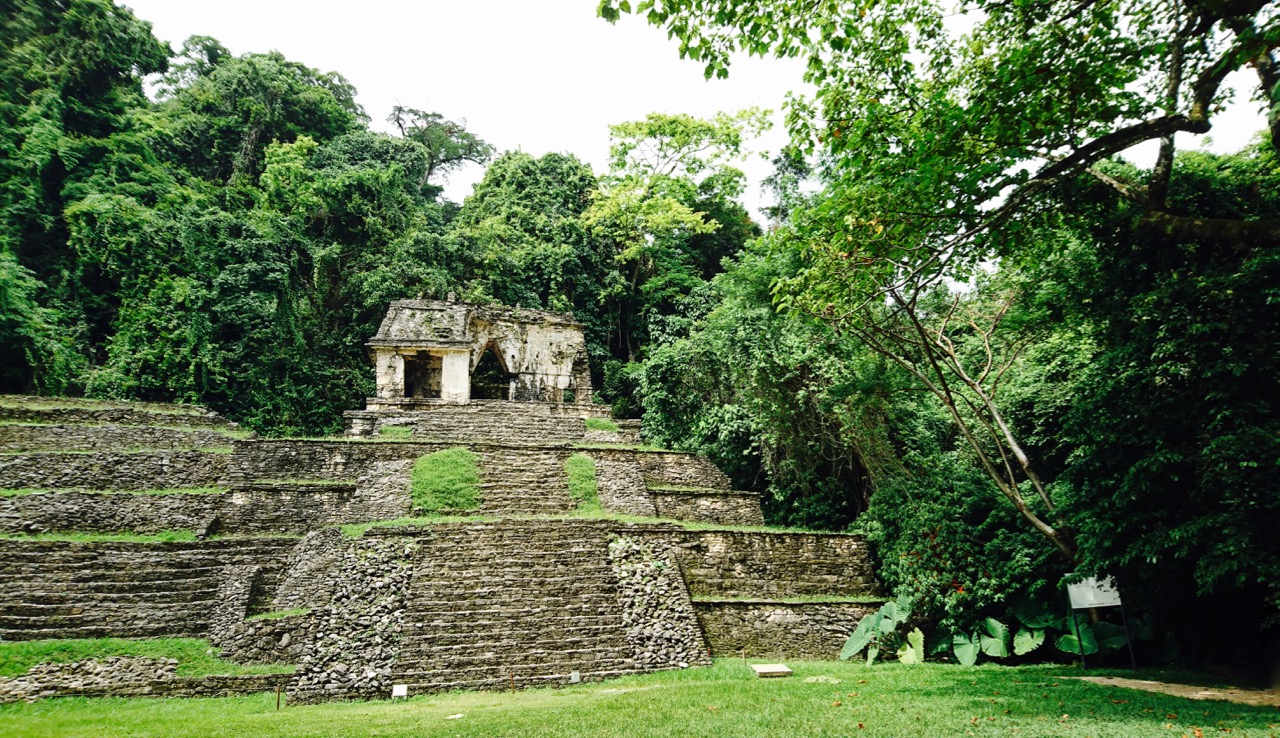
Temple of the Skulls. At the top of the façade, along its base, bas-relief skulls with ghastly grins have survived New discoveries to everyone!