
From the Travely-Family archive · Indian Ocean
Out of Range. Indian Ocean, Days 13–14
An original publication from the former Travely-Family website. This English translation was preserved from the technical-site archive without editorial rewriting.
“So, Andryush, how are we going to manage now without a weather forecast? With no contact with the outside world and, potentially, no navigation? And I have an article to send in four days, then another one...”
“Well, we’ll manage like Columbus and Magellan.”
Communication Problems
For twenty-four hours, our modem could not see the satellite, and the satellite could not see the modem.
For hours we changed cables and settings, the captain studied the manual, and we took out and put away the precious little case a hundred times. The post from the day before yesterday and a heap of emails sat in the outbox, while the modem screen said “ready.” And there it was, all ready and completely out of range. Only the brave Iridium satellite tracker kept sending our coordinates, the ocean wave height and the air temperature on our windowsill to the website. Our tracker can also send SMS messages, which we can forward to the shore team.
“So how are we supposed to send reports now, by text message?” I ask, bewildered. “All right, forget the reports. What about the articles for the editors? And how am I supposed to find out how Mum is?”
Since the modem looked perfectly alive after all our tinkering, we assumed that something like satellite maintenance was going on up in the celestial offices, and that sooner or later it was bound to end. And so it did. A night and a day passed, then suddenly the outgoing mail went through and new messages arrived. We’ll see what happens next.
The Cyclone and the French Southern and Antarctic Lands. 6 February
We are sailing through the middle of the cyclone. There is no storm, with winds up to 30 knots. It is foggy and rainy. It is getting colder. All day, the temperature inside has been no higher than 18°C, and outside it is around 14°C. The condensation is already streaming down the windows. We are talking about firing up the heater. Either it is just the cyclone, or we have already reached the cold latitudes.
We are now at 42 degrees and heading for 49. Somehow I am not keen on severe cold, condensation and three pairs of trousers. Brrr... Personally, I would rather stop at Amsterdam Island, which lies in the middle of the Indian Ocean on our beloved 37th parallel. But there is a better chance of anchoring at Kerguelen and catching our breath, whereas Amsterdam Island is shaped like an egg and has no bays whatsoever.
“Andryush, what is our reason for going to Kerguelen rather than Amsterdam Island—is it just the presence or absence of bays?”
“Yes, that’s the main thing.”
“Listen, we managed to stop at Tristan even though it’s just round too, so why not here?”
“The winds to Amsterdam aren’t favourable either. All the fair winds hang out in the forties.”
We are sailing with fair winds and preparing for winter quarters. Why did I pack all my warm trousers and socks right at the back of the cupboard? There is still time to empty the cupboard before we reach the subantarctic. And there is all sorts of stuff blocking the way to our socks—a sewing machine, a printer and a heap of rucksacks. I had hoped I would not need my fleece-lined trousers again until the next Antarctica. But I could already do with putting them on.
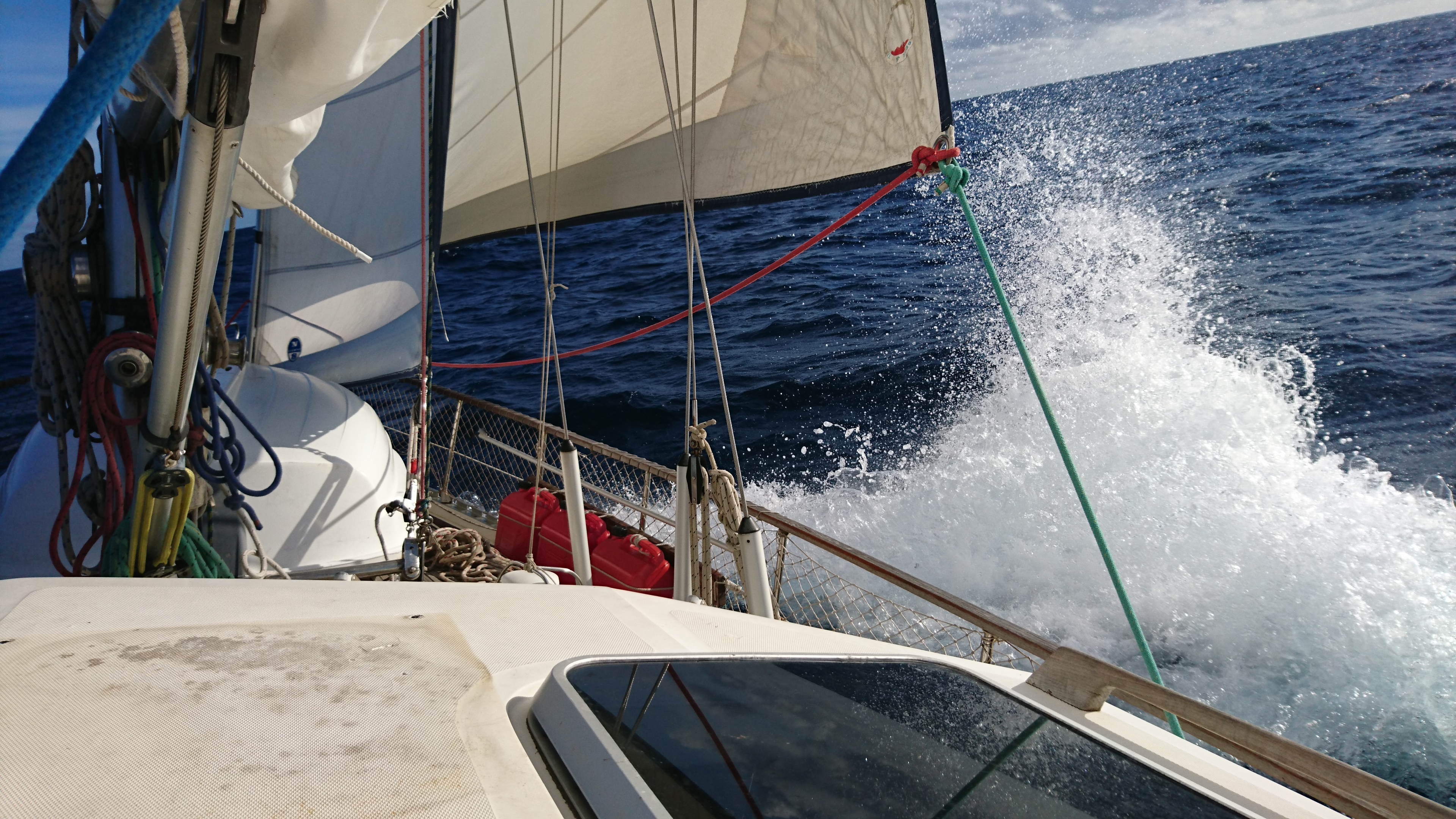
We are flying along at up to six knots under a reefed genoa. All this is happening around 42 degrees south. The wind-direction sensor has started reporting the weather on Mars; something must have fallen off up the mast. There are, of course, no ships at all. Broad-winged albatrosses and coal-black petrels enliven the horizon. It is the first time we have seen such black ones; before, they were sort of greyish. We made a big pot of borscht for dinner. Pouring it into bowls was impossible, so we ate from saucepans and tall containers. It is funny eating a serving of soup out of a three-litre box:). But at least none of it spilled onto the sofa.
Everyday Matters. 7 February
In the morning, the Prince Edward Islands are abeam, less than 300 miles away. We have no idea whether it is nice there, but we do not need to go there. Though there is hardly anywhere nice left along our route now. It is probably freezing cold, foggy and rainy there too. So we will hold out until Kerguelen. If we can, we will stop there; if not, we will follow the winds, possibly passing north of the archipelago. Incidentally, to stop at Kerguelen, part of the French Southern and Antarctic Lands, you have to pay some unimaginable sum amounting to hundreds of euros for the four of us.
We do not think we are prepared to spend a fortune for the pleasure of walking over bare rocks and shaking hands with French polar explorers. So the plan is a Tristan da Cunha-style stop—three days at anchor without going ashore, then onward. By the way, today is cheerier than yesterday—even the sun is winking through the clouds.
Delighted, the girls got down to business: Ladunya settled in to sew a teddy bear, while Nastya is doing her basic-training course—the theory for the next level of sailing qualification. She is brushing up her English at the same time; when we arrive in Australia, she will sit an exam at an RYA school. Her health is slowly improving, although she is still coughing more than we would like. I have no idea what to do aboard with no fewer than two captains, so naturally I shut down the household department and go off to cook dinner. Today we are having rice with ratatouille and tomato salad.
Apples and pears are ripening in the crates, and we still have a mountain of fresh vegetables and fruit. There are even two watermelons. So everything is shipshape when it comes to feeding our fleet. The only thing going wrong is the wind: it looks as if the centre of the high is catching up with us after all. We are bobbing about like you-know-what in the rays of the setting sun.
Hooray, Hooray!
As soon as the modem came back to life, we received a huge heap of your comments, forwarded by the shore team. Thank you to the team, and thank you, friends! It is wonderful to feel a helping hand and a shoulder to lean on, even across thousands of miles—sometimes it feels as if you are right beside us. No storms are forecast for now; the main thing is to slip away south before the belt of calms catches up with us. If we make it, we will race onwards with the westerlies of the Roaring Forties; if not, we will get stuck in the doldrums.
The high-pressure zone is sitting far too low at the moment, extending down to 42–43 degrees south. Hugs to you, friends! Thank you for being there for us. The route map and current conditions are still under the “Route” tab, from the Iridium satellite tracker supplied by MVS Telecom. Thank you for contributing to the expedition’s shipboard kitty via PayPal and Yandex Money.
Thank you to Ivan K., Oleg R. and Nikolai S.! You inspire us not to give in to temporary difficulties. Joy to everyone!