
From the Travely-Family archive · Indian Ocean
Storm and Mayhem. Southern Indian Ocean Passage, Day 25
An original publication from the former Travely-Family website. This English translation was preserved from the technical-site archive without editorial rewriting.
“Mum, why are we rolling so badly?”
“Because it’s a storm, sweetheart.”
11:00. We hove to yesterday before nightfall. We’re being tossed around in our bunks, and going anywhere on the boat means enduring serious G-forces. Fortunately, keeping watch doesn’t require going out on deck. It is enough to wake up once an hour and switch off Gorodnitsky’s song about the island of Guadeloupe. But the worst of it came in the morning.
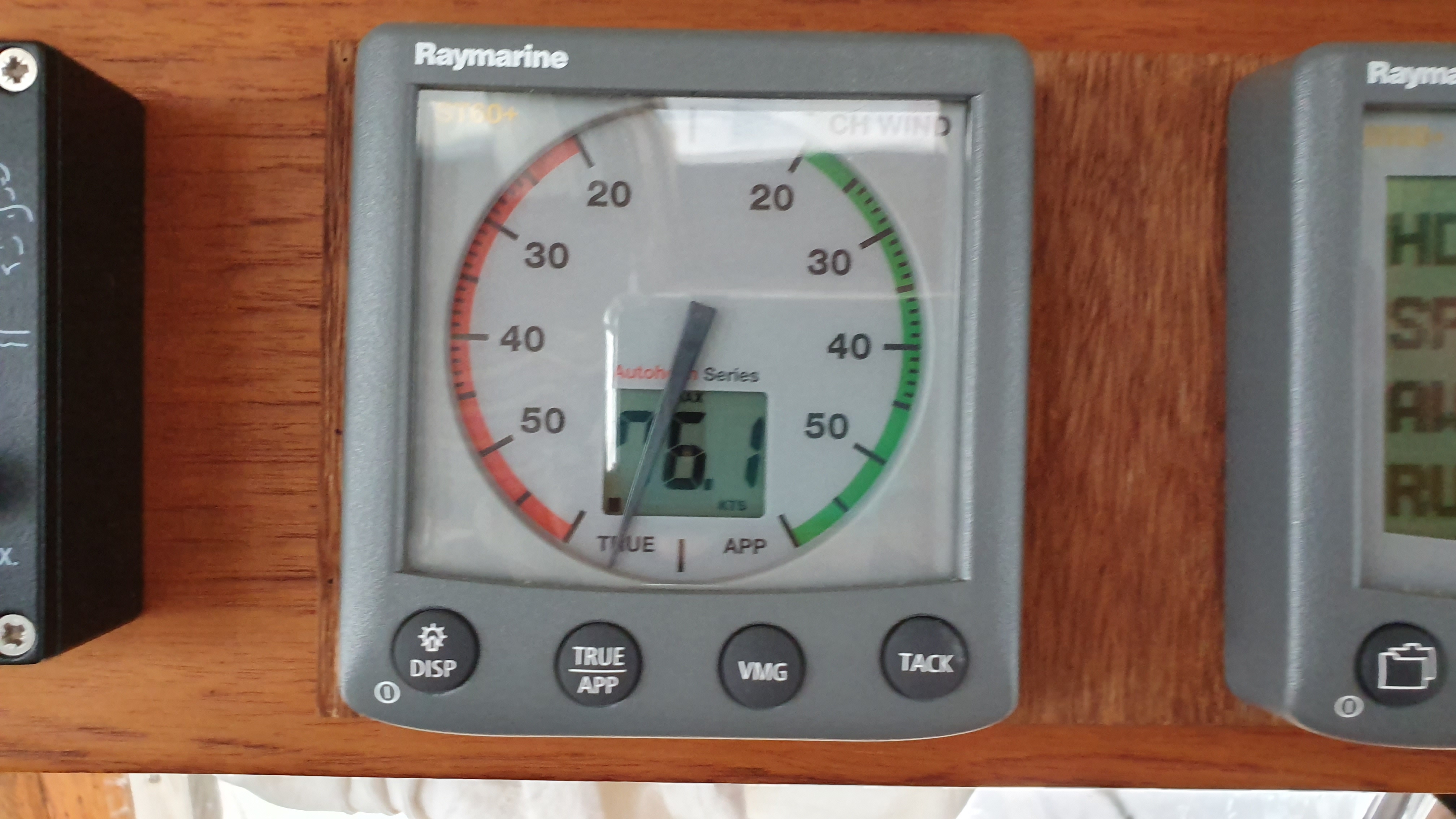
The ocean has turned mountainous. The swell is coming up from Antarctica; mountains of wind-driven waves are bearing down on us from the south-east, over the bow, while the wind has shifted and is blowing straight against them. We feel as though we’re in a washing machine. The mizzen rattles from time to time, Lady Mary shudders, and foam sweeps the full length of the deck, right to the stern. I don’t know how hard it’s blowing—the wind instrument is displaying some kind of secret symbols. Andryukha says it has been up to 50 knots since this morning.
15:00. At last the pressure is creeping up, and even the sun has shown its little yellow chick’s flank. A steady 35–40 knots, and the same cyclopean waves.
The Cycle of Breakdowns
The engine failed to start again last night, and so did the heater. If we can’t repair them after the storm, we’ll have to forget about going via Kerguelen. We’ll freeze there, at 49 degrees south. The latest Kerguelen weather forecast, downloaded in Africa, predicted +2°C. Farther south it is Force 11 now, and Kerguelen is considered one of the stormiest places in the Indian Ocean. After the storm, we’ll work out where we’ve been carried and once again strip the entire hold down to the bare hull to find out what the starter doesn’t like down there. The rudder-position sensor has broken again; on this voyage, every breakdown has happened more than once. Repairing it can’t wait for calm weather. And for the third time, we dismantle the aft sections of the holds, flying between the bulkheads.
A 6 mm metal rod has snapped in two, and the captain is trying to improvise something on the fly—he has set up a vice and is working with a file. We’ve been repairing it for two hours now. Under the bed, the captain is attaching a huge pin cobbled together from assorted parts to the rudder stock, while I turn the wheel and call out the readings: -33, -27, -71, 0, 6, -72... The children are reading and cooking pasta. The crests of the mountainous waves scatter into foam like snow from a bulldozer blade. In the space of three seconds, the wind instrument shows anything from zero to 50 knots—it has gone completely bonkers.
I’d say we were “sailing by instruments,” except that the instruments are precisely what have stopped working. So we are drifting at Poseidon’s whim. The main systems—the sails and mast—are fine, so there is no reason to worry. And the storm—well, it can’t last forever. Though, of course, it really is mayhem when, after nearly a month on passage, you are seasick even while hove to.
Hoist the Sails
Captain Andrei and midshipman Nastya went out on deck to set sail and get us under way. They took down the mizzen, and under half of the small staysail Lady Mary sped off, for some reason, towards the north-north-east. The strong westerly wind keeps rounding the yacht up, making it impossible to head south-east. Now there’s the paradox of a following wind (!?). Once we stopped drifting, the yacht began to be thrown around twice as violently.
“The Power of Dreams”
The young sailor spends almost the whole day sprawled on his passage-making “no chance of falling off” little sofa, nibbling pine nuts and reading True Spirit by Jessica Watson—the Australian girl who, at sixteen, sailed solo around the world ten years ago, non-stop, in 210 days. Via Cape Horn, the South Atlantic and the Indian Ocean. We are now sailing about 7–8 degrees farther south than Jessica did.
“Yeah, Jessica was definitely nuts...” the young sailor says admiringly.
Nastya agrees with him. When you read books like that, you think: well, if a girl managed it alone, we’ll definitely pull through. After all, look how many of us there are—four.
We know how many people are praying for us and keeping their fingers crossed, how many warm rays are flying from you to us here in the Southern Ocean. And they truly warm us. Thank you, friends, and may everything be well with you! We’ll be sure to answer all your letters after the storm. Writing is impossible at the moment; the laptop keeps trying to fly into the captain. And he has a hacksaw in his hands again, which in a Force 9 storm is inherently unsafe:).
Thank you for supporting the crew’s morale via
PayPal and Yandex Money
Thank you to Oleg S. from Chelyabinsk, Andriy B. from Zaporizhzhia, and the unknown sender who supported us through the storm with a donation and a letter from the mainland. You are what keeps the expedition’s morale up.
Stage 4 of our round-the-world voyage with children, via the great capes and Antarctica, continues! South-western Australia is 2,698 miles away in a straight line. (5,000 km).
Transmitted by satellite.