
From the Travely-Family archive · Atlantic
The Mangrove Delta of the Saloum. Senegal by Sailing Yacht
An original publication from the former Travely-Family website. This English translation was preserved from the technical-site archive without editorial rewriting.
The Saloum Delta. Its Inhabitants
The first living creatures we saw that morning in the Senegalese backcountry were a pair of pelicans. They glided sedately among the fishing boats, tipped forward by their enormous beaks with yellowish pouches. Our first pelicans in the wild. Exactly like the picture in the book. Lada and I immediately checked this and were even more delighted. Later there were flocks of pelicans, white herons and many other birds, but those first ones amazed us and were therefore especially memorable ).
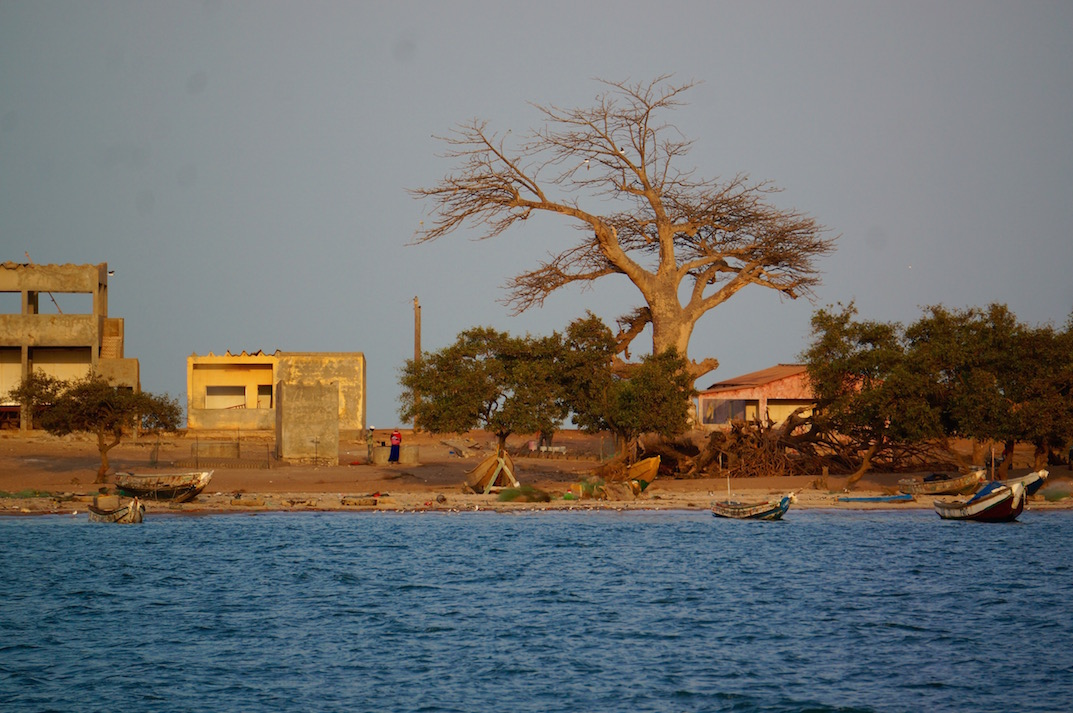
A warm, woody scent drifts from the shore. The river mouth is so broad that it seems part of the sea. The village of Djiffer—a row of concrete houses with very few windows—stands on a narrow, sand-coloured spit stretching from east to west. At its western end, the spit sinks like a sharp needle into the Atlantic. On the continental side, it meets a kingdom of baobabs and mangroves, and the savannah. The first baobabs tower above the houses of the fishing village of Djiffer, and for some reason they have no leaves. “Must be the wrong season,” thought Stierlitz... and began weighing anchor.
The trade wind blows here too, over the mainland, driving away the mosquitoes. It was them, and the tsetse fly, that I was probably most afraid of.
The village of Djiffer at the entrance to the Saloum River from the Atlantic Ocean
About the Famous Tsetse Fly
Judging by what I read online, humanity has yet to come up with any effective antidote to the bite of the tsetse fly. It is not the bite itself that is dangerous, but the parasite that enters the victim’s bloodstream with the fly’s saliva. And against that, humanity has no defence. The medicines used destroy the carrier’s liver and other organs almost faster than they destroy the parasites themselves. Other methods—fire, the extermination of entire animal species believed to carry the scourge, pesticides and other chemicals—have failed to defeat the killer fly.
A biological method of wiping out tsetse populations has proved almost a panacea and has been used successfully for a couple of decades by Africa’s more developed countries. It produces excellent results, and in recent years not a single case of human infection has been recorded in Senegal.
The method works like this: male tsetse flies are irradiated—not to death, but to sterility—and sent off to mate with wild females. Apart from some ridiculous wriggling, nothing comes of it: no offspring hatch. And now herders and farmers in Africa’s wettest and most fertile regions can breathe freely. Hitler kaput.
They say that exterminating tsetse flies will not do nature any particular harm: apparently, hardly anything eats them, so the food chain will not be broken. Sounds good!
However, it is precisely thanks to the prevalence of tsetse flies that humans have not yet invaded Africa’s humid jungles. They have not cut down the forests, built roads or fouled everything that remains. This deadly fly has been a natural barrier against humanity’s murderous “opening up of virgin lands.” Environmentalists in Africa are listened to less than they are in Europe, so getting rid of the flies could spell disaster for nature. Although, to be honest, I was personally delighted by the news.
Like Huckleberry Finn
After breakfast we weighed anchor and set off upriver with the flood tide. I feel like Huckleberry Finn. As a child, I often imagined his and Jim’s life on a raft on the Mississippi.
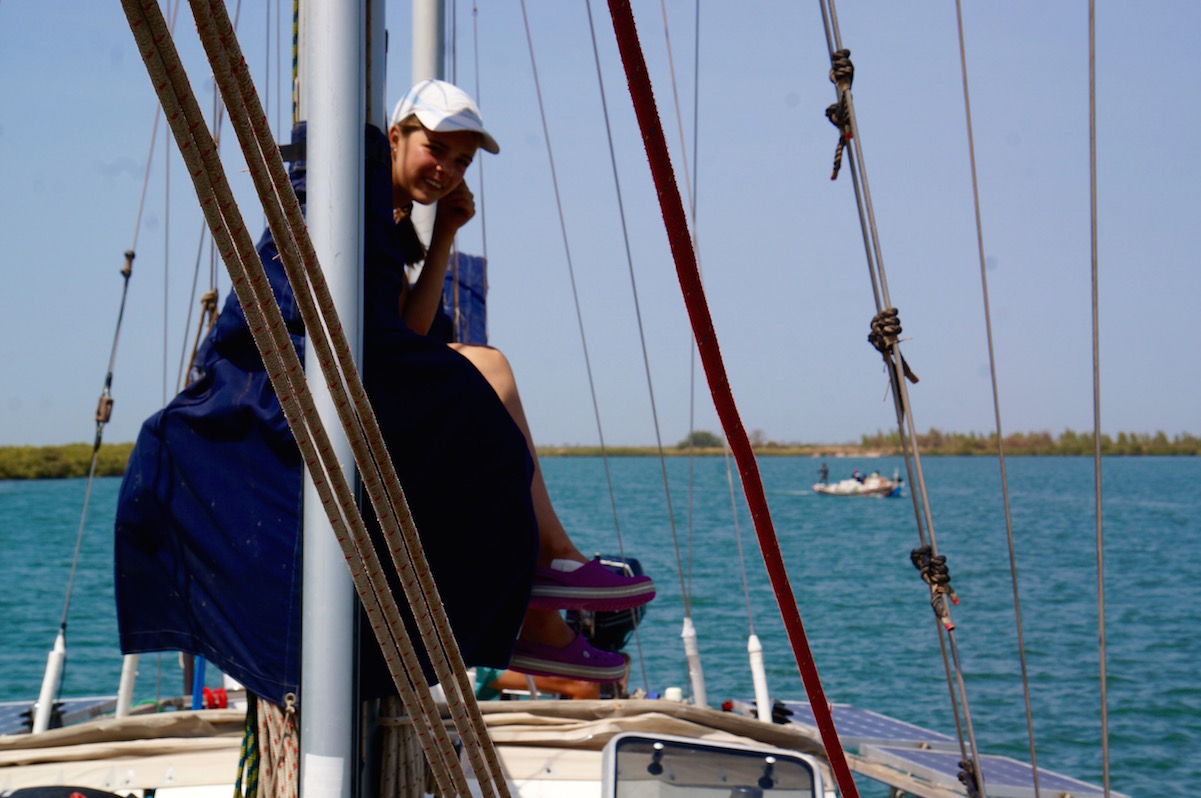
River life aboard a yacht is quiet and unhurried
We turn from the broad channel into a right-hand tributary. On the chart it looks like a heron with a curved neck, but when enlarged it becomes a winding ribbon. We proceed by instruments: the charted soundings have run out. But there is still hope of getting farther—the chart even promises an anchorage.
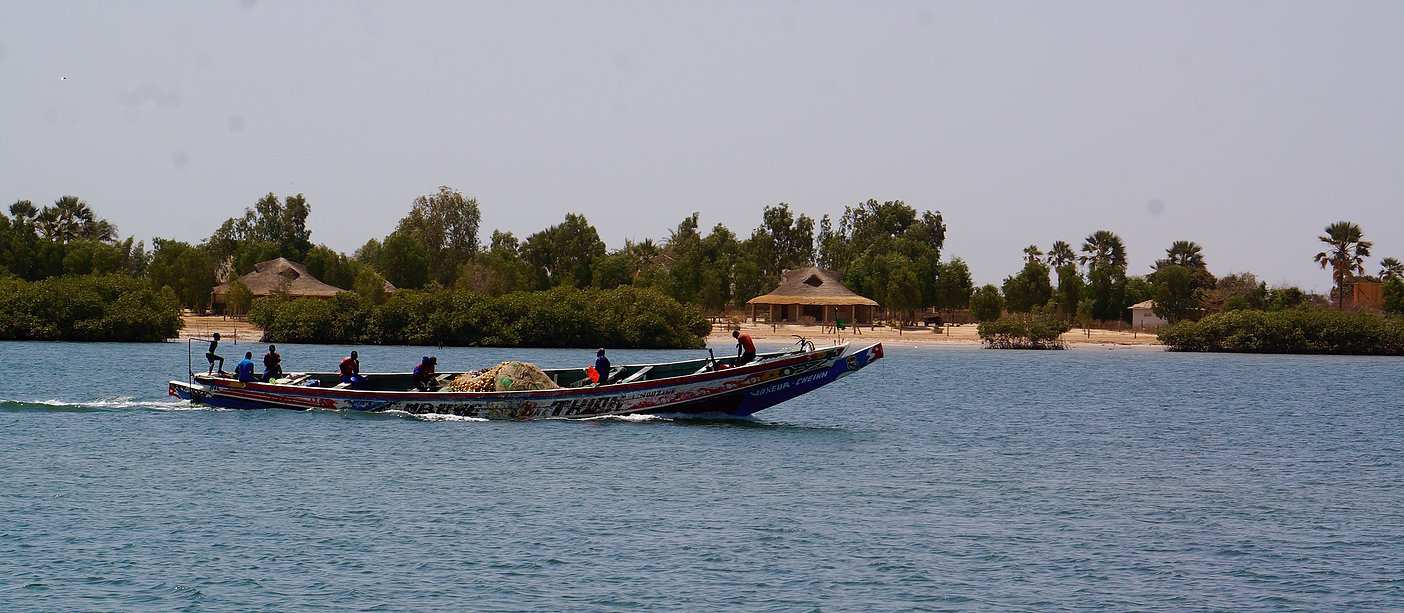
The banks are sparsely inhabited, though appearances are deceptive, judging by the boats darting to and fro. At first we take them all for fishing boats, but then begin to distinguish among them: some are carrying cargo—manufactured goods, hay and firewood—while others carry passengers. There are also excursion boats with white tourists: near the end of the navigable section, a small hotel can be seen, and white people are taken out for cruises or fishing trips. The rest of the pirogues are fishing boats. And the farther they get from the river mouth, the more modest (or does it only seem that way?) and smaller they become.
The Saloum Delta. Our First Grounding
Around the bend, the depth sounder reads 3.5 metres, 3 metres... Shallower and shallower, whichever way we steer. 1.8 metres (exactly our draught), 1.3... A soft—ooof—0. We’re aground. Hello, our first shoal.
Astern, smoke, silt churned up from the bottom. We’re off. In the process, we wound about 5 metres of thick fishing line from our rod around the propeller. We backed off a little and dropped anchor. The captain went diving to free the prop. Meanwhile, we discovered that our internet signal booster could pick up Wi-Fi from the hotel on shore. We rejoiced.
Mangrove River, Oyster-Covered Banks
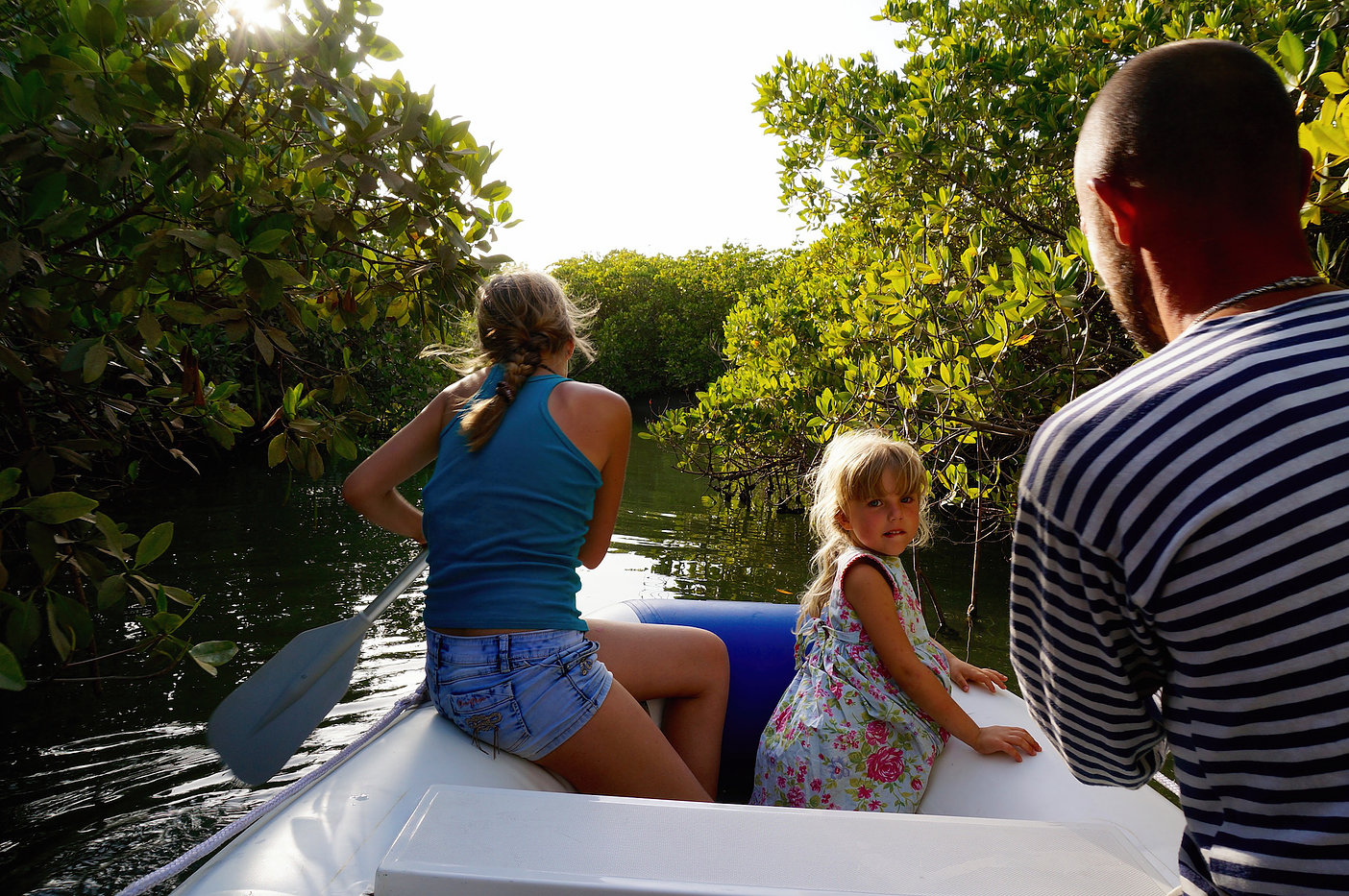
By evening we rig the awning and launch the dinghy. Opposite us is a narrow passage between the mangroves, a creek or little river, and it must be explored.
There is an astonishingly cosy feeling in this mangrove avenue on the water. Like in the movies, when they show couples boating along rivers and lakes. Shoals of fish leap from the water, heading in a single front towards the main river. The creek narrows, and we push the branches apart with our hands, raising a cloud of midges.
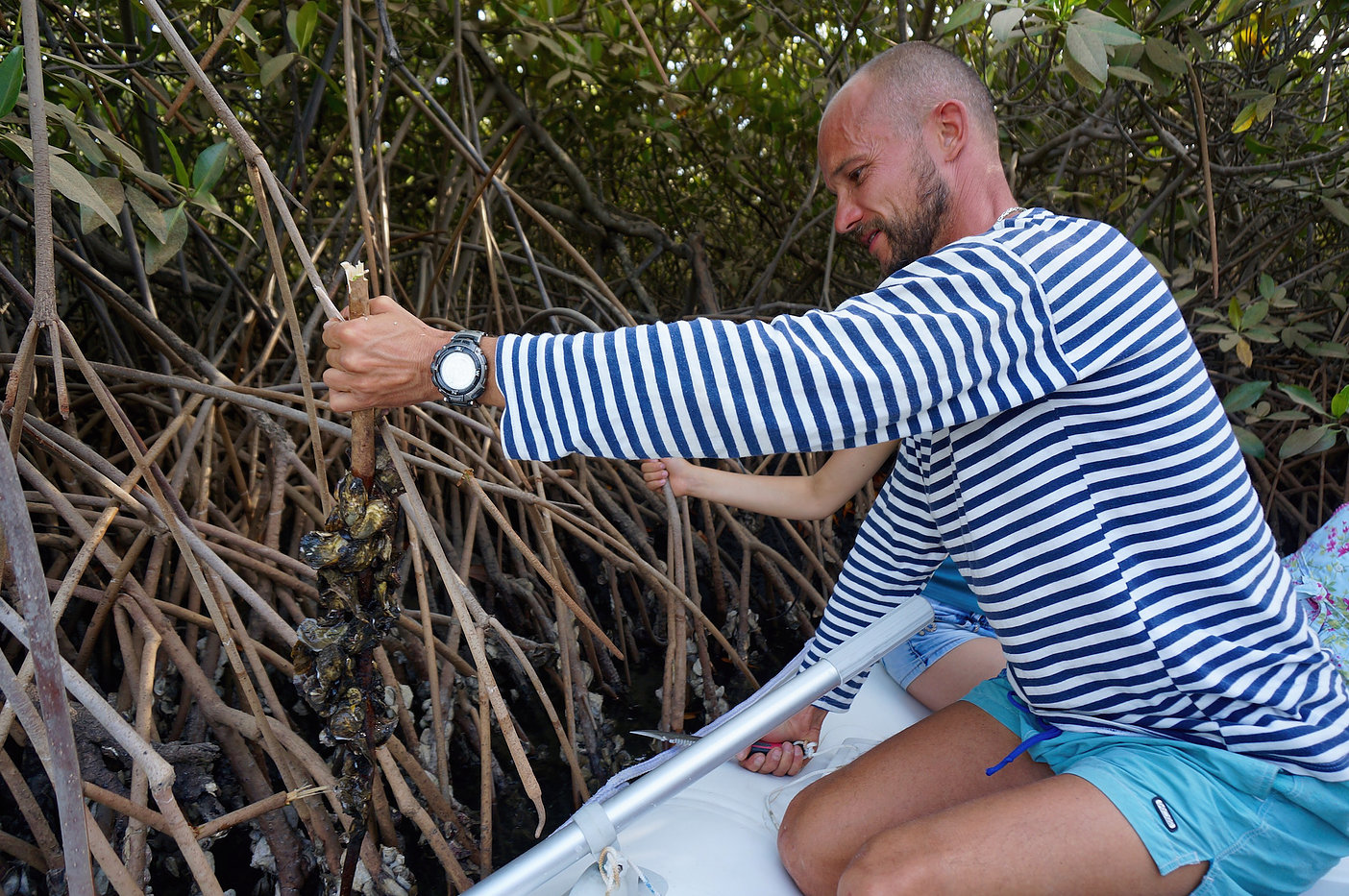
All the mangrove roots are studded with oyster shells. They are not like the ones in restaurants; they are mostly small. Andrei cuts off a couple of branches (you have to take them with the roots attached, then tear the whole cluster off afterwards). The cluster is cut free in the dinghy with a sharp knife, which immediately makes it—the dinghy—filthy.
An Unexpected Change of Position
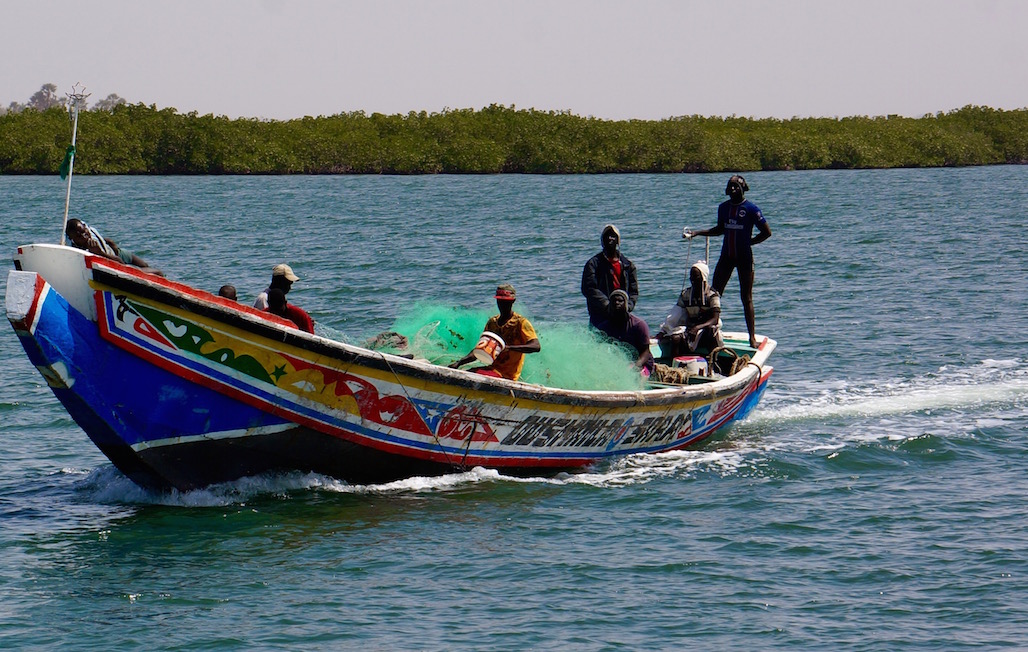
After stuffing the oysters into the pressure cooker, I pause in anticipation of dinner. But the languid evening immediately stops being languid, heralded by the unusually close rattle of an engine. The fishermen pull up almost alongside us, clearly intending to have a chat. After the opening “Bonjour” and “Ça va,” our vocabulary runs out, and the conversation begins to resemble one between the blind and the deaf.
The lads do not give up hope. The captain’s “Je ne parle pas français” nearly brings negotiations to a dead end, but the fisherman has an idea: “Oh!?... Hmm... ah... Spanish?”
“Poquito.”
The guy beams:
“We,” he says, “run a net right across the river here. We drift it from evening until night. You’ll have to move. We’ll show you where.” And off he rushes towards the middle of the bay.
The fishermen set off to drift their net through the night
We weigh anchor. We follow our pilot. Depth: 1.7 metres. We run aground. We get off. We run aground again.... On the fourth attempt we settle firmly onto the bottom. Heeled over, the boat slowly pivots for about a minute, while the engine smokes desperately.... Nastya and I are a little nervous: we are not yet accustomed to grounding. Dusk is closing in. The fishermen hold up their pole (a sort of sounding lead) and signal: “We’ve got two metres here. Come this way!” But our keel is scraping the silty bottom.
“No posible!” I shout, making a fearsome face.
We go astern. Hooray! Afloat again. After conferring, the lads decide to lead us towards the ocean (well, it’s 15 metres deep there—surely we won’t get stuck:)). A couple of miles downriver, the entire pirogue crew points joyfully at the water:
“Anchor right here!”
Well, we don’t argue. We drop anchor. The lads anchor right beside us. Just to be certain, we even lean our stern against their boat a little while testing our own holding. Five pairs of hands serve as fenders. We all have a good laugh and separate.
The fishermen try to make contact with me by shouting “Señorita!”—and I wonder whether I look that good, or whether they have forgotten the word “señora” ))). In fact, for most of them, “señorita” is where their knowledge of Spanish ends. So I retreat into the cockpit with relief when Lada calls me at just the right moment. Half an hour later, seeing that the show is not going to happen, the fishermen put out their net and, indeed, haul it right across the river.
Boiled Mud or Dinner?
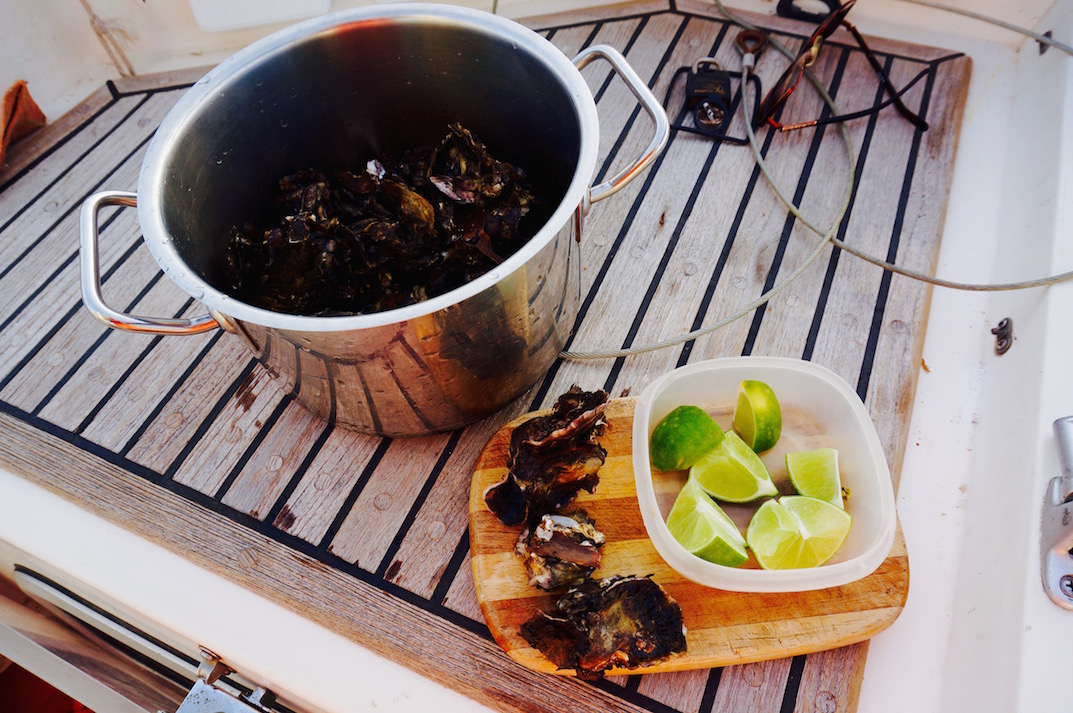
No matter how much you rinse the oysters, the pot still ends up full of boiled mud). Lada and I dare to try the concoction. It is quite tasty, especially with coriander and garlic. Only the grit crunches between our teeth.
Even Andrei tries several raw oysters. We do not risk it: a tasting long ago in northern France left us with only one association with this dish—snot with a drop of fish oil and lemon juice (may all oyster lovers forgive me!).
We gathered dinner from the mangrove roots
Darkness brings coolness, and the sky is strewn with stars. The throb of drums and rhythmic African songs carries across the water. The wind whistles, driving away the mosquitoes. And the wind generator seems to sing: “Peeeace be upon this house.” We go to bed.
What Does the Coming Day Hold for Us?
Morning tea in the cockpit, right beside the mangrove bushes, is invigorating in a special way. It is cool. The mangroves sing the morning in many different voices. Now and then, through the cackling and squeaking, come the previously unheard calls of African birds. A white heron watches for small fish in the shallows, motionless amid the lush greenery. Our movements on deck do not particularly impress it.
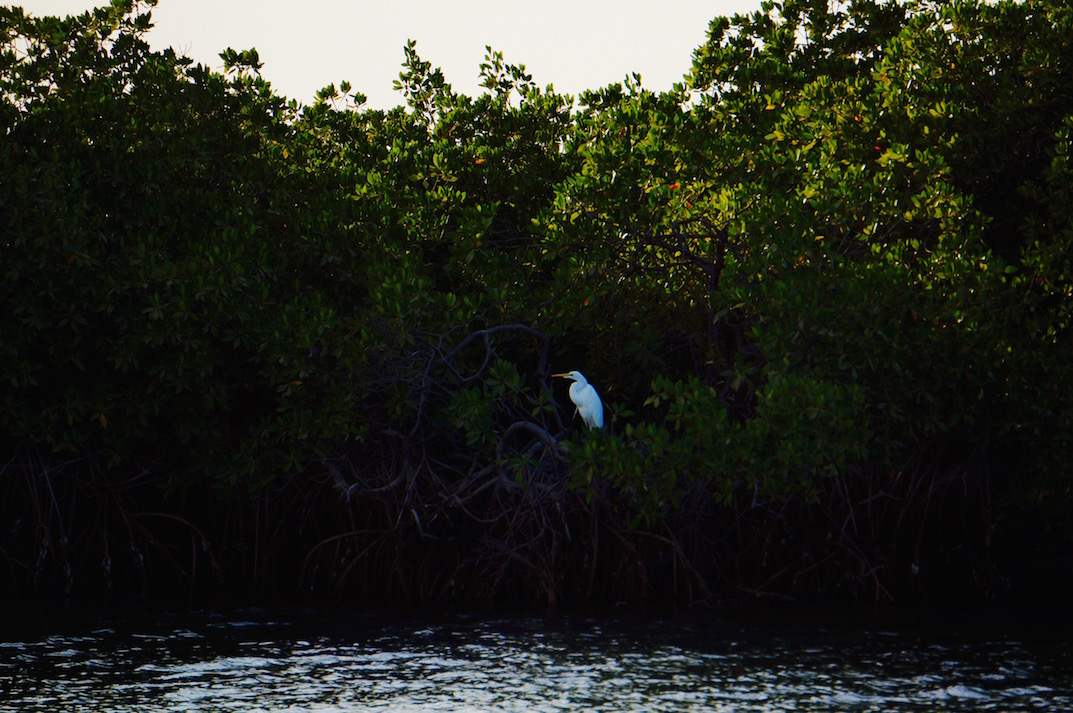
The Saloum Delta. A White Heron in the River
Meanwhile, we weigh anchor and set out into a new African day. No one in the crew yet suspects that water has begun entering the bilge...