
From the Travely-Family archive · Atlantic
Everything’s Fine: We’re Sinking! Senegal by Sailing Yacht
An original publication from the former Travely-Family website. This English translation was preserved from the technical-site archive without editorial rewriting.
No one in the crew yet suspects that water has begun pouring into the bilge... are we sinking?
Plan B
According to our original plan, we wanted to make our way through the channel into the Diombos River and follow it out into the ocean near The Gambia. Here is the turn we need. The depth sounder shows no more than 2 metres. The dredged fairway remained in the main channel of the Saloum. Where this channel for large vessels has not been dredged, the depth drops sharply to almost zero.
Lady Mary, like a blind kitten, tries to feel her way through. We nudge the bottom—shoal, astern, mud billowing up from below, move to starboard. We nudge the bottom—shoal, astern, mud billowing up from below... And so it goes about five times.
Not one attempt gets us more than 15 metres farther into the river mouth. After the thirtieth nudge, we decide to resort to Plan B: we are not going into the Diombos. We will head up the Saloum to Kaolack, then come back. Kaolack lies 120 km from the mouth of the river and the ocean. A sailing yacht cannot go any farther upstream—the first bridge across the Saloum is just beyond the city.
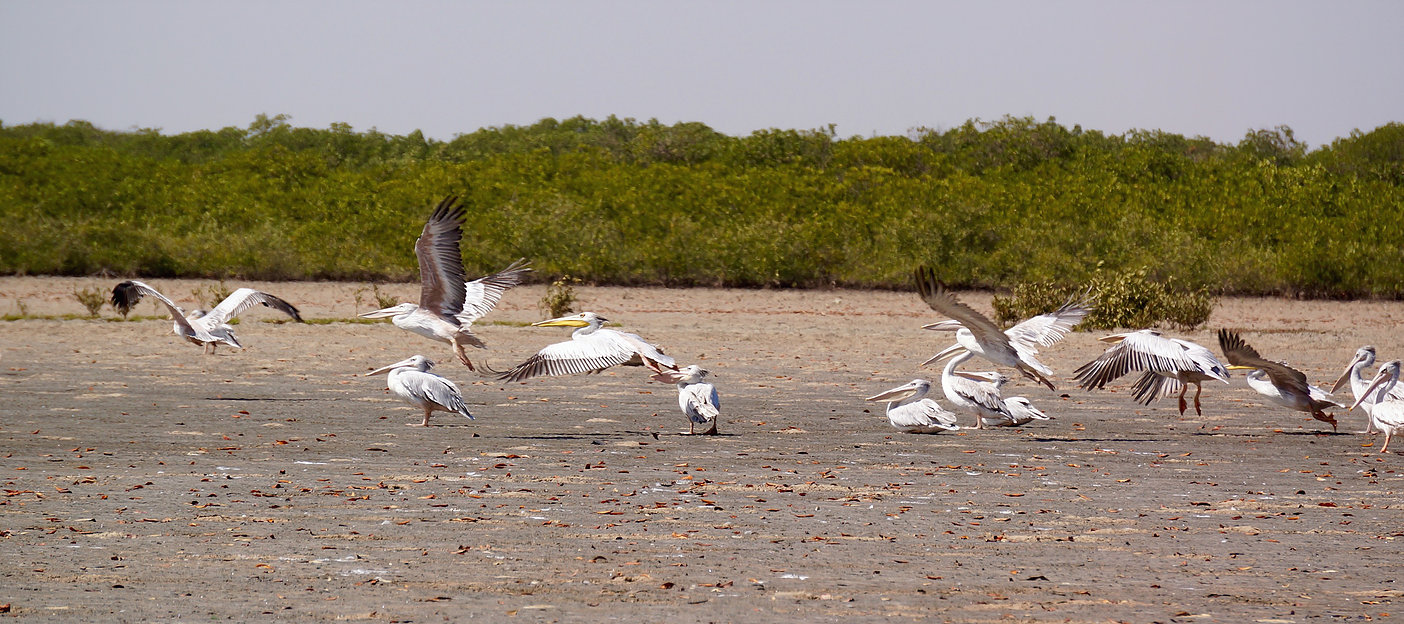
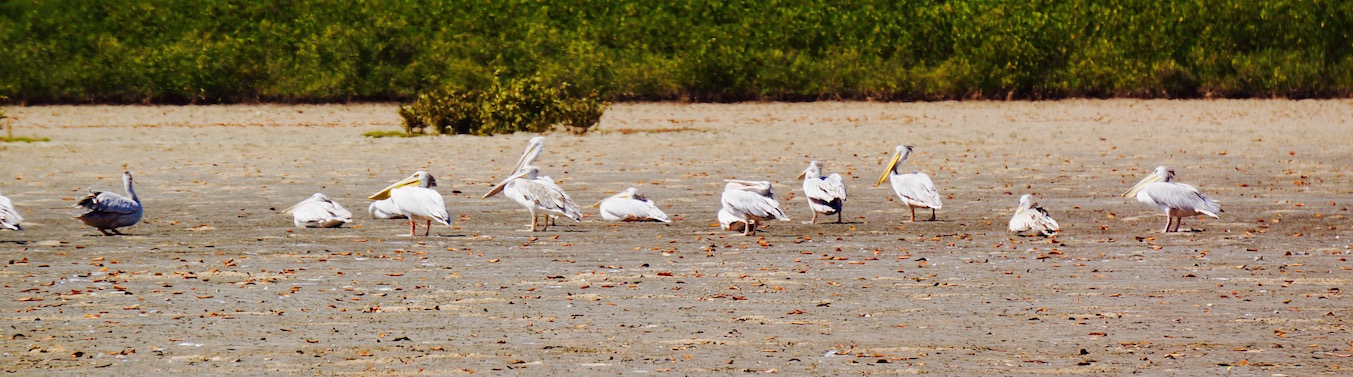
Pelicans at rest. An island in the Saloum River
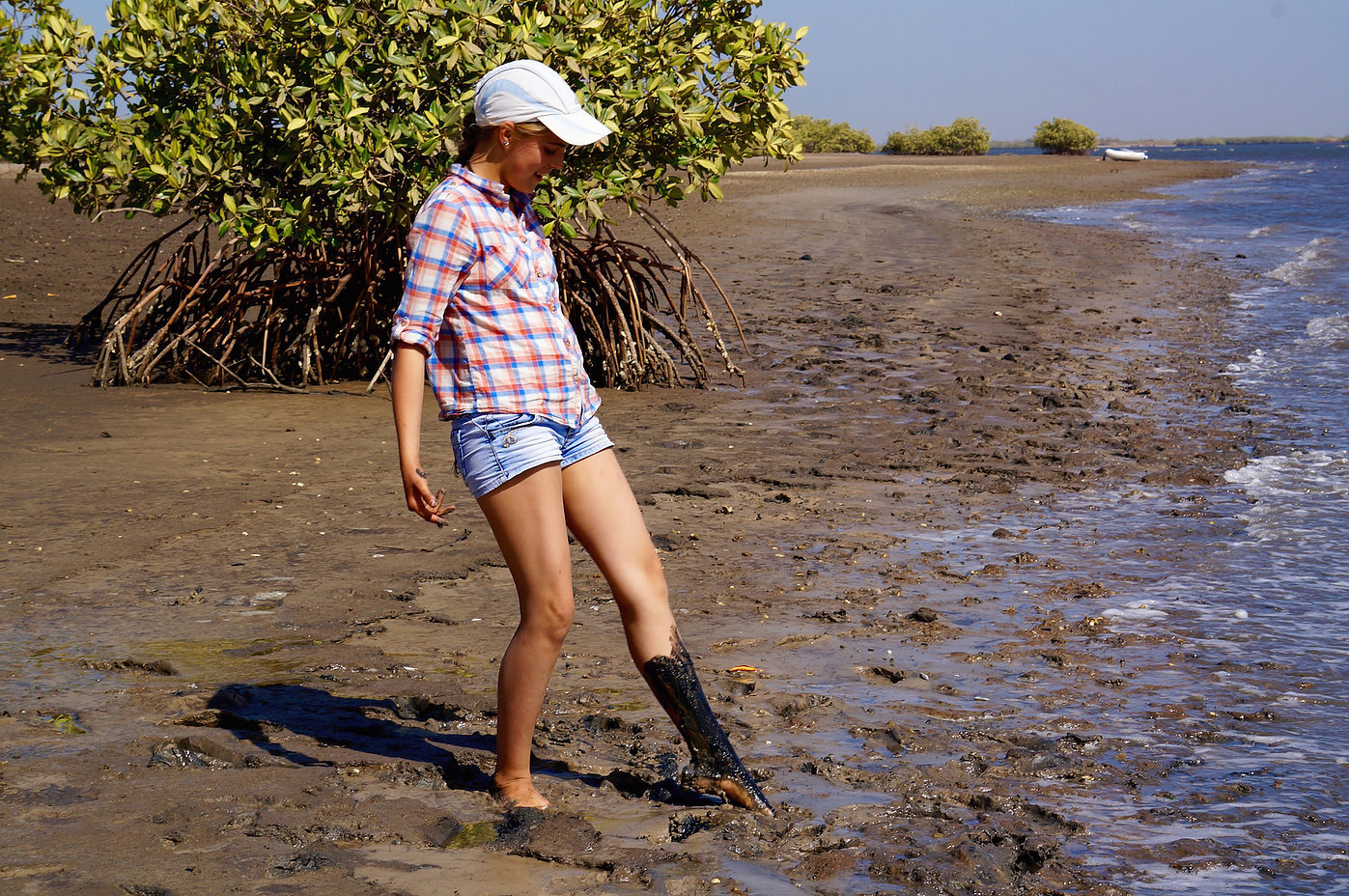
Landing Party on Pelican Island
In places, our voyage up the Saloum feels like sailing on the Ob Reservoir. If the occasional baobabs were replaced with pine trees and some bushes and islets added along the banks, the resemblance would be complete.
The depth allows us to approach a large island. The clay beach calls loudly to us in the voices of gulls and pelicans. We send a landing party ashore. The pelicans do not want to make friends, but the captain is curious to see whether there are any eggs where they are sitting... He found no eggs, but scared all the pelicans away ).
The boggy clay sucks at our feet and gently clings to our legs; we sink ankle-deep into it, and sometimes even deeper. Crabs scatter in all directions. The laziest hide in their burrows, covering themselves with one enormous claw like a shield.
We gathered some oysters and a couple of large snails. I am not yet ready to kill a crab with my own hands, so I make do with snails and oysters... A ridiculous squeamishness, considering that I am perfectly happy to eat not only crabs when they come cooked or frozen....
The snails tasted strange—I spat out the first one; it was pungent. After dissecting the second, I discovered that the white flesh resembles scallops: slightly rubbery, but pleasant. Everything that is not white is the unappetising digestive system. There is far too much physiology involved when an entire boiled snail is picked out onto your plate... and it smells strange... I’ll stick to oysters. We tried to catch a fish using a piece of snail as bait. The fish did not appreciate the treat.
Foundiougne
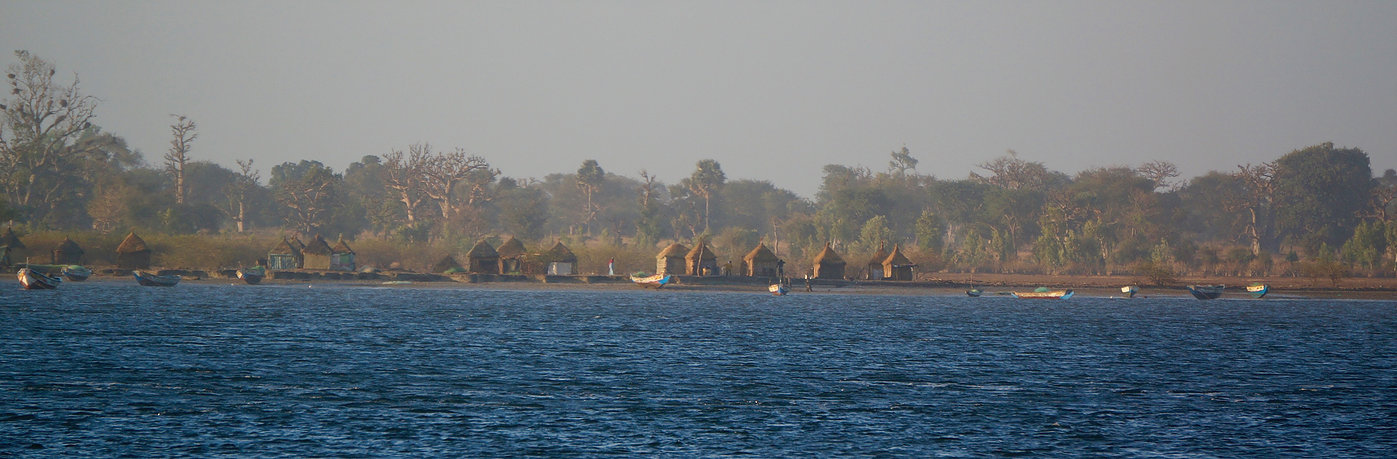
From a distance, the little town with its appetising-sounding name looks cosy and colonial; close up, it is dishevelled in the African way. All that remains of the piers are logs sticking up into the sky, and somewhere among them a small, not particularly inhabited yacht is tucked away. The port building is designed in the shape of a white ship. Cars and people queue for the ferry. Two enormous trees, apparently kapoks, with dense green crowns tower above the conical African roofs and European tiled ones. One or two miles beyond the town, we anchor beside the last mangroves on the river. Beyond them—heat and savannah.
On the opposite bank, a very authentic African village goes about its life. We can see conical roofs made of palm leaves, pirogues, and no concrete whatsoever. Alongside us, the mirror-smooth river gleams between the rounded mangrove islets. High tide; the water and air are motionless.
What’s in Our Bilge?—Water! Are We Sinking?
Mellowed by the beauty of our chosen spot and by the heat, we make plans for a swim, lunch, another swim, and a drift among the caps of the mangrove islets.
“Something’s wrong—the battery isn’t charging,” says the captain, and opens the bilge...
We’re sinking! All hands!—only the top of the engine and the battery covers are sticking out of the water. Steam is rising from the engine. Salt is crystallising on the surface, and the cabin reaches the temperature of a bilge after the engine has been running for several hours: +46°C.
We bail out the brown, oxidation-stained water with buckets and bowls, pulling the batteries out of their compartments as we go. The children try to operate the bilge pump by hand. The water snorts and spits out of the hole in the hull a spoonful at a time. No new water seems to be coming in. The captain checks the propeller-shaft entry point—everything there is as usual. No more, no less. So that is not the culprit. There is no hole in the hull either, thank God ).
We’re not sinking after all!
We empty every compartment, continuing to pump. Beside the engine lie the bicycles in their covers. One of them has clearly appeared in the film Jaws: part of the cover, the tyre, and the inner tube have been torn to shreds. And a third of the rim has been sawn through, as though a chunk of metal had been bitten out.
It turned out that all the fuss was caused by a leaking hose that supplies raw water to cool the engine. As for the bicycle, the engine mount had worked loose, and apparently the vibration shifted the bike against the alternator. The alternator pulley was what cut the hole.
As a result of the flooding, one battery died, but according to some laws of physics unknown to me, we will now live even better with one than we did with two. So says the captain. There may be problems with the starter. The engine started and we rejoiced, but prematurely:
two days later the starter remembered the flooding and refused to work. Once again, we dismantled half the bilge and cleaned everything that had oxidised. We got away with nothing more than a fright.
At least it gave us a chance to wash the bilges and sort through the food. The plastic containers of flour and grains survived the flood, which is more than can be said for the tomatoes: their life in the bilge ends crowned with beautiful fluffy white mould growing straight out of the bucket.
There is a joke in which a man complains that everything in his life is terrible, and he is advised to buy a goat. The man buys a goat, and everything becomes even worse. Then they tell him, “So sell the goat!” He sells it and realises what bliss it is to live without a goat!
That is how it is with us. We put the boat back together after all the bilge work and repairs, and Nastya walks around savouring it: “It’s so lovely in here—the floor isn’t torn up and everything isn’t turned inside out!”
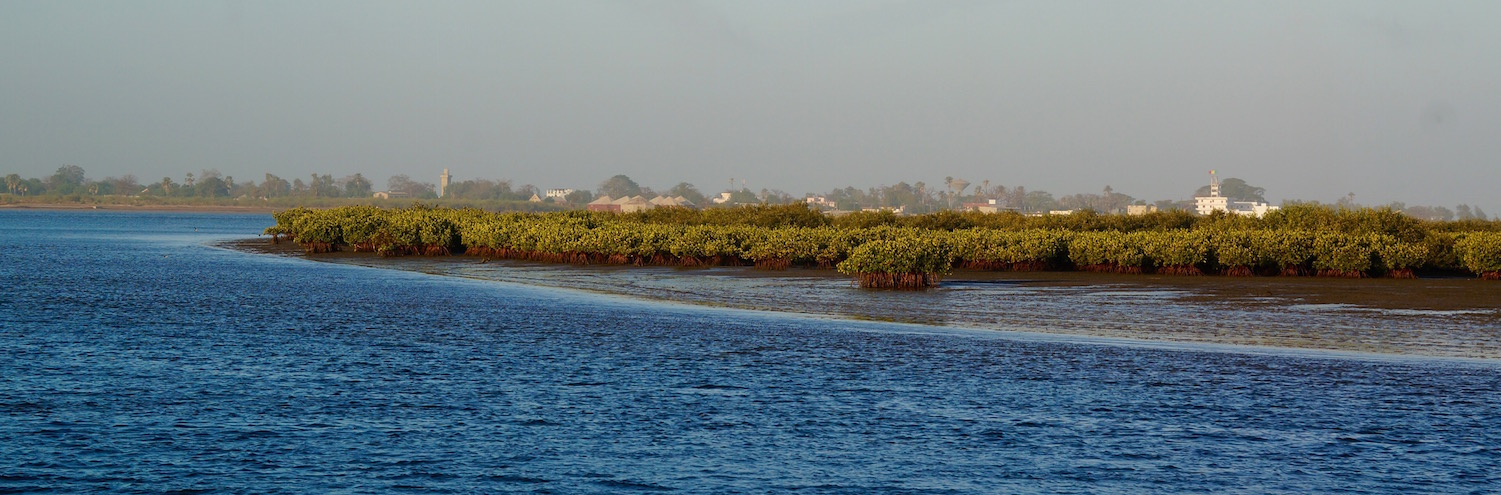
Mangrove islets opposite the town of Foundiougne
Now we can finally get into the water. Incidentally, while we were dealing with the flooding, the tide went out, and the marvellous islets became mere bushes standing on drab grey mud...
And the next day, we reached the point...
Continued here >>