
From the Travely-Family archive · Indian Ocean
Adventures in the Ocean. Day 9
An original publication from the former Travely-Family website. This English translation was preserved from the technical-site archive without editorial rewriting.
“Holy crap!” The captain’s eyes are round, visible even in the dark. “Our bilge is full of water!”
“Switch on the shower sump pump. Take the handle and go pump the water out from the cockpit with the manual bilge pump.”
To the cheerful gurgling of streams and the pump spitting, we head into the night. As I briskly pull on my waterproof trousers, just in case I wonder who to send an SOS signal to, and when it will be time to put on our life jackets. The captain, with a headlamp on his forehead, climbs down closer to the surface of the bilge water...
“Mum, this isn’t dangerous, is it?” the young sailor asks.
“It is dangerous, but it can be fixed.”
“Don’t be afraid, Zibi, we’ll fix everything in a minute.” Sleepily, Ladunya hugs her plush zebra to her chest.
A favourable current
For the past three days, Lady Mary had been making just 35 miles a day towards her destination through calms and an adverse current—three times slower than planned. There were hours when we moved north-west stern-first while flying south-east under full sail.
By yesterday evening, the calm and adverse current had become almost favourable.
And that was when the fun really began.
The adventures begin
Our second mate has been feeling unwell since the start of the passage. A headache, general weakness and a slight cough. She also got hit on the head by the boom about four days ago. And now, suddenly, she developed a fever. We immediately launched a detox programme.
“Drink water. Lots of it!”
Nastya went to fill a two-litre bottle.
“Dad, could the water in our tank have run out?”
“I don’t think so. The watermaker was running all day.”
“Nothing’s coming out of the tap.”
Where had the fresh water gone? Had it leaked out? The captain opens the bilge. And there...
The engine is already sticking out of the water like the tip of an iceberg. What a sight.
“Everyone to the pumps!”
Stumbling over the thought of why the bilge pump had stayed silent, I hope the water is at least fresh, because a valve somewhere by the tank has sprung a leak, or something like that. But the captain clears things up:
“It’s salt water.”
“Well, that’s it,” I think. And I can actually see the sea slowly pouring into our home. Twenty minutes earlier, I had been afraid we might have to call for emergency assistance for a crew member, and now the boat needs it too.
“Andryukh, keel bolts aren’t an issue for us, are they?”
“No.”
“You’re sure?”
“I’m sure.”
Waterworld
It’s a good thing the keel on our Nauticat 40 is designed so that it can’t fall off. One less thing to be afraid of. I went to the cockpit to pump the water out with the manual pump. The automatic bilge pump had failed to kick in again—it needs replacing. For some reason, the manual pump in the wheelhouse isn’t pumping either, despite being brand-new. Oh, and of course, the engine won’t start now, because the electrical contacts instantly corroded and fell apart.
All that remains is to find out where the seawater is entering the bilge. I run through every possibility—the through-hulls for all the various discharge and intake systems... A seacock in the bottom... The propeller shaft... A breach in the hull...
Without thinking, I whisper a prayer.
We found the problem quickly.
All the stern-tube grease had been washed out where the propeller shaft enters the yacht’s hull—the stuff that is pumped in so the shaft can turn without letting water in. Now a merry little stream is splashing onto the bottom of the boat like a small waterfall.
We pumped in fresh grease. Checked everything again. The stream stopped, leaving only the usual light drip.
Plan versus reality
By morning, the bilge is dry and everything is operating normally.
Our immediate plan is to empty the entire bilge, including hauling out three bicycles and all the rest of our riches. That will allow us to repair the wiring and replace the bilge pump. Oh, and by the way, the fresh water in the tank hadn’t gone anywhere; the bilge flooding had simply caused a short circuit that knocked out the pump supplying water to the tap.
On that cheerful note, the girls and I finally dozed off shortly after midnight. The captain spent the time until dawn editing the second instalment of the Antarctica film.
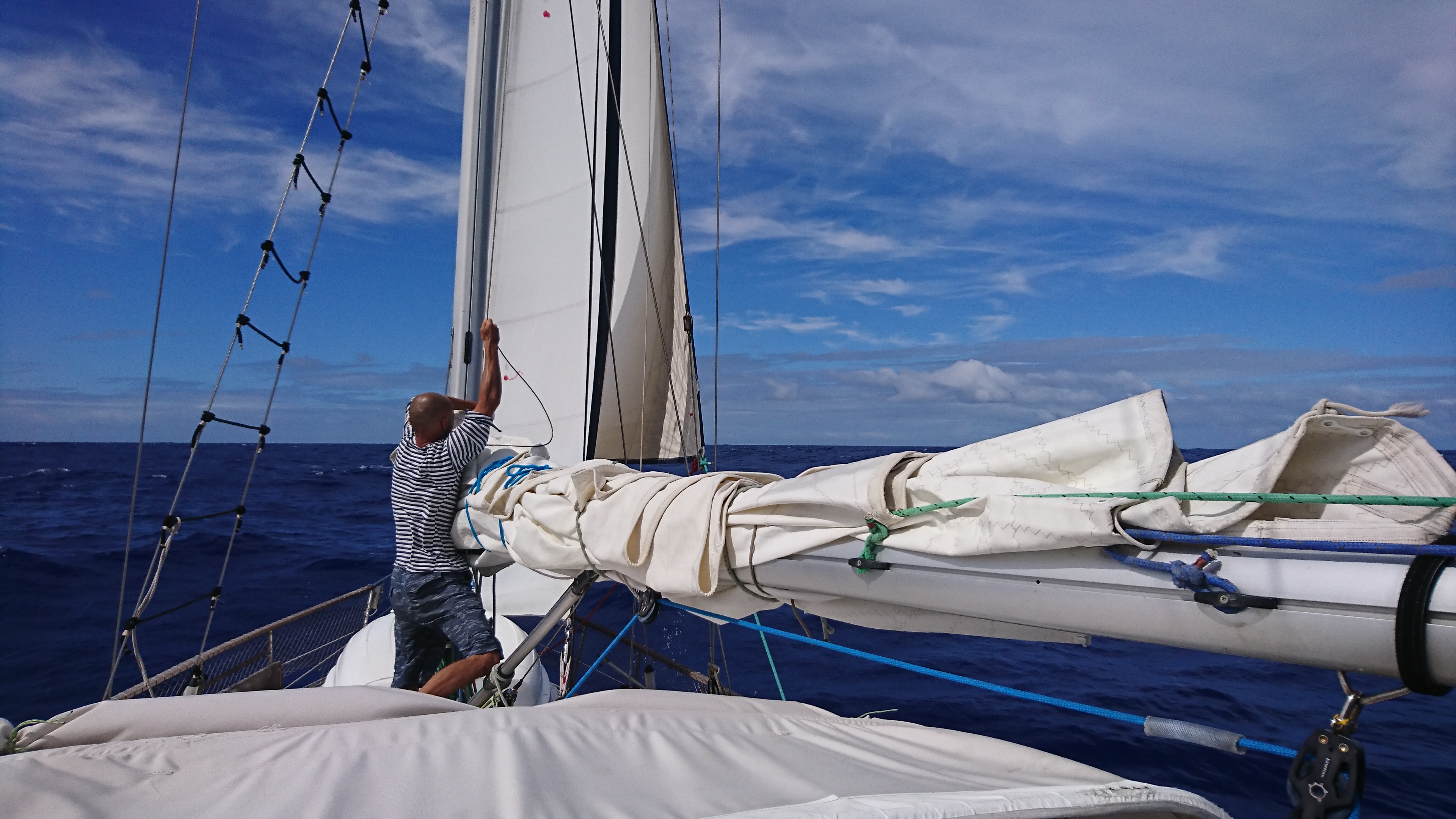
The sails flapped listlessly all night, so the skipper furled the genoa and went to bed. The wind woke up a little a couple of hours later. I set the genoa, getting its proportion to the double-reefed mainsail slightly wrong. The almighty captain awoke at around ten and performed another miracle. He reduced the genoa area, trimmed the sheet, and the yacht went one knot faster than she had under the full sail. The sailors among you are sniggering at me right now, I know. Never mind—I’ll reef it and trim it myself next time:).
Meanwhile, with a favourable current, we’re flying along at up to eight knots. Perhaps we’ll make up some ground after all. I’d only just written that when I discovered the current had ended, and now we’re crawling along at three knots again.
We still don’t know what’s causing Nastya’s fever. Nothing hurts. Starting antimalarial treatment hardly seems appropriate—Cape Town isn’t exactly the most malaria-ridden city on the planet. We’re keeping an eye on her, drinking plenty of water, and taking vitamin C and echinacea. Thinking positively. Doing schoolwork, drawing tables. Vegetables for vinaigrette salad are boiling on the stove. And so the ninth day of the passage draws towards sunset.
We’ll download the weather forecast now and set a date for the scheduled repairs.
This has turned into a rather contradictory post ). Friends, don’t worry: everything is under control.
Thank you for being with us!
You can still see our track with the weather, and the winding line along which we are making our way towards our destination, under the “Route” tab on the website. Our satellite tracker from MVS Telecom (Iridium) is faithfully standing watch and sending the route details there.
Our thanks to Ivan, Alexei R. and Elena P. for boosting the expedition’s morale via
PayPal and Yandex Money.
You are a tremendous inspiration!
Australia is 4,077 nautical miles (7,550 km) away. In nine days, we’ve covered one ninth of the distance—not much so far. We hope to find favourable winds soon.
Hugs to everyone from the 39th parallel in the Southern Hemisphere! Thank you for being there, dear readers, friends, acquaintances and strangers. And may all be well with you!
Yours, always.