
From the Travely-Family archive · Indian Ocean
The Doldrums. A Week in the Ocean
An original publication from the former Travely-Family website. This English translation was preserved from the technical-site archive without editorial rewriting.
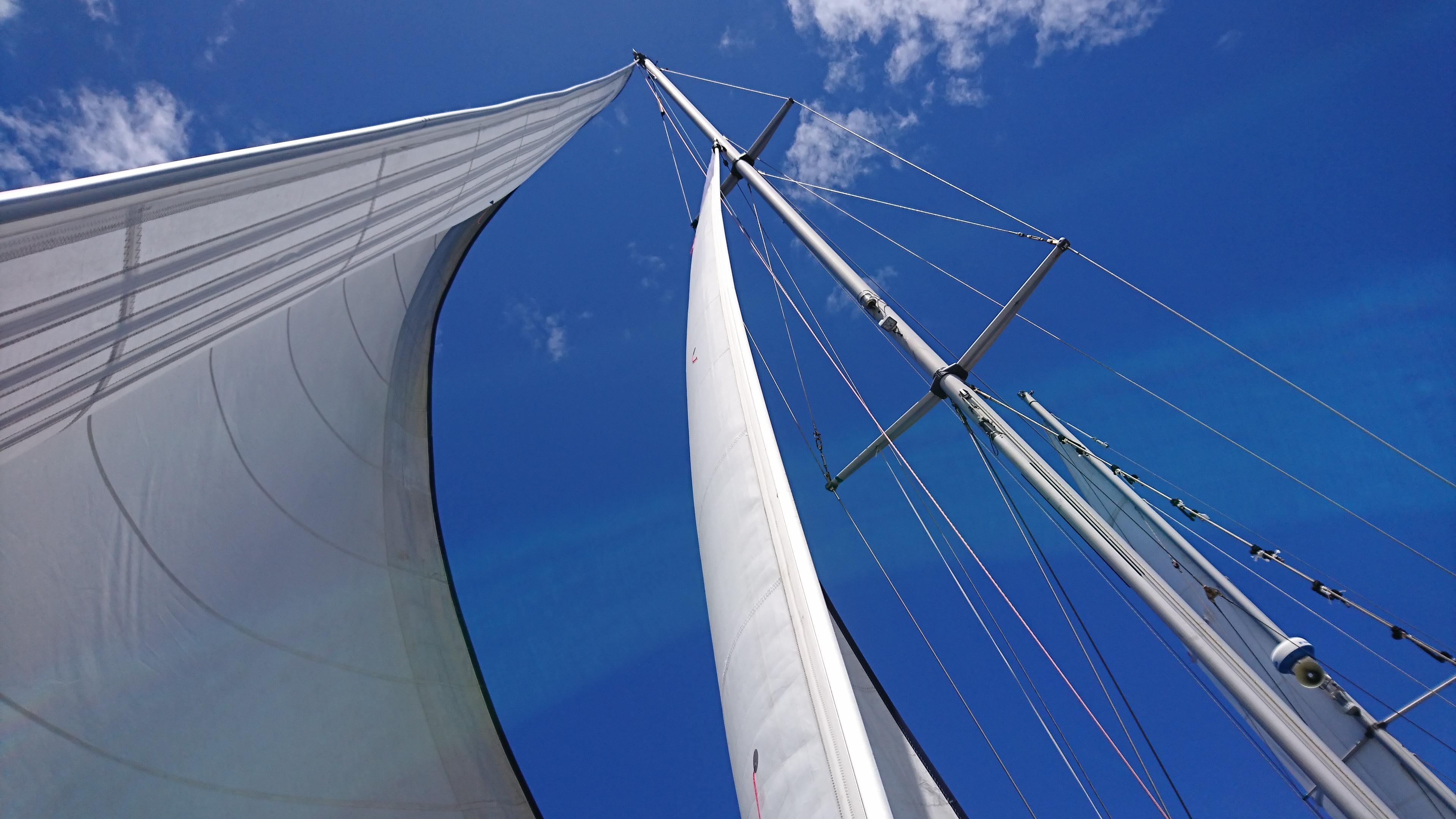
Over the course of yesterday’s daylight hours, we covered minus five miles. That is exactly how much farther Lady Mary ended up from our destination on the Australian coast. This prompted the first mate to sit down not only with the history of geographical exploration, but also with a chart of winds and currents. A branch of the South Equatorial Current, which has slipped down from the equator past Cape Agulhas, is stubbornly pushing the yacht back towards South Africa. Right now, for instance, while pointing south, we are moving north-west.
The night watch was even more interesting: we were racing close-hauled in a light breeze at 3 knots through the water, heading towards Australia. The stars whispered as much, and even the compass agreed. But the navigation display showed us moving at a knot and a half in exactly the opposite direction. In other words, calculating the resultant vector gives us a 4.5-knot current running against us. Pretty hefty, if you ask me.
The wind picked up a little in the evening, and overnight we clawed back about 35 miles. But since morning we have been edging backwards again in a dead calm. And that is what the forecast promises for the next couple of days.
A perfect opportunity to get on with chores and lessons.
Everyday Life Aboard
We are sorting through the fruit, and every crate of apples yields exactly one baking tray’s worth of bruised ones. Baked apples... mmm... with cinnamon and honey—just like Grandma used to make when I was little. Except hers had sugar.
The captain went over the deck armed with a sealant gun. And all the suspect spots were once again daubed with a beautiful black substance. As for the portholes in the aft cabin that refused to listen to reason, I sealed them up completely with duct tape. People, duct tape is the single most important spare part on an expedition.
Nastya has settled down to the theoretical part of her basic training; as soon as we reach Australia, she will go and sit the exam for the next level of captain’s qualifications. Ladunya has gone back to her lessons. We are learning the Russian mnemonic “Ivan Had a Girl and Told Her to Carry a Nappy” for remembering the case endings. Along the way, we are drawing a large table of the parts of speech, into which Mum, recalling her teacher training, has included not only nouns and verbs, but everything from adverbial participles to interjections. No more fooling around. The holidays are over:).
A Miscalculation
The promised chapter about the discovery of Antarctica turned out long and funny, so I will include it in the book. But meanwhile, do you know what I noticed? Most of my sources, including the invaluable 1950s book Essays on the History of Geographical Discovery, contain an error in the date of Antarctica’s discovery. Look: everywhere it says that Bellingshausen and Lazarev’s expedition approached Princess Martha Coast on 28 (16) January 1820. Notice anything?—It took me a while too. How many days’ difference is there between the Old and New Style calendars?—Thirteen. So, 25 October (7 November), or 14 (1) January... But here?—It does not add up.
So it turns out we were right to celebrate the discovery of Antarctica for two days aboard, on the 28th and the 29th.
At this very moment, 7:30 p.m. on 31 January, the family has waited for our young sailor to finish filling in the parts-of-speech table and is summoning me to dinner. Tonight’s menu features mashed potatoes made by our young sailor (did I already saaaay that Ladunya peeled and boiled a whole pot of potatoes, then mashed them with milk?). For gravy, we have sautéed vegetables and fresh tomatoes with garlic. We will finish with plums, then it is time for a film.
Today’s programme is the film Mercenary; some of its scenes were shot in Cape Town, in the historic Cape Town gentleman’s club we love so dearly. We visited it many times and held a meeting there with our compatriots, with the assistance of the Consulate General of the Russian Federation in Cape Town.
That very gentleman’s club—its custodians, history and interiors—deserves a separate story and lots of photographs. I will probably write it once we are ashore and have internet access, so you too can see the interiors where various films are shot almost every weekend. Everyone comes here—from Hollywood and Bollywood to Mosfilm. Richard Gere has been there, and now, in Mercenary, Steven Seagal too...
And finally, a little of what I promised about the discovery of Antarctica. You already know about Bellingshausen and Lazarev, so we will turn to the early, pre-Cook investigations.
200 Years Since the Discovery of Antarctica
If you ever find yourself in Istanbul, arm yourself with a modern map of Antarctica’s ice-free coastline (scientists created one in the 1950s) and visit Topkapı Palace. There you need to find the map drawn by the Ottoman cartographer Piri Reis on two pieces of hide in 1513. The cartographer marked not only both Americas on it, but also Antarctica, whose outline, they say, precisely matches the ice-free coastline of the sixth continent. What sources did Piri Reis rely on when drawing his lines? After all, in those days people did not yet properly know what America looked like, let alone Antarctica...
Having concluded 2,000 years ago that the Earth was a sphere, the ancient Greeks reasonably decided that the land in the Northern Hemisphere must be balanced by land in the south. They even named this land Antarctica—as the opposite of the Arctic.
During the Renaissance, people remembered the ancient Greeks, began sailing overseas and even around the Earth, and naturally did not overlook the question of balance. An unclaimed southern continent urgently had to be found.
Antarctica was discovered tirelessly and unsuccessfully right up until two hundred years ago.
In the Middle Ages, when people still did not give a damn that the Earth was spherical and that it was cold near the poles, great hopes were pinned on Terra Australis Incognita. For this imagined continent was fertile and very extensive.
Spain and Portugal divided Antarctica between themselves as early as 1494—two years after Christopher Columbus’s first voyage.
“From here to here,” they said, “is the Spanish part, and from here onwards, the Portuguese.”
“But what exactly are you dividing? Nothing has even been found yet...” the sceptics objected.
“Once it is found, it will be too late,” the Spanish and Portuguese kings replied imperturbably.
Hoping for a miracle, seafarers ventured ever farther south. By the seventeenth century, the boundaries of the unknown land had been pushed back almost to the latitudes of the fifties, without revealing anything more substantial to the hopeful seekers than a handful of scattered islands. True, Australia had already been discovered too. But for some reason they kept trying to find something else farther south.
As early as 1503–1510, the Frenchman Gonneville authoritatively declared that Terra Australis Incognita lay south of the fiftieth parallel. Barely 150 years later, his account was published in Paris. And then, in 1663, the French were somehow swept up in a craze for believing in Gonneville Land. In their delight, they proclaimed it theirs too. Thus the undiscovered southern continent had already passed into a third pair of hands....
But for now, Antarctica belongs to no one. That was the decision of the nations party to the Antarctic Treaty of 1 December 1959. Naturally, many powers would not mind getting their hands on its mineral-rich interior and continental shelves. They even have arguments for why one part or another of Antarctica ought to be given to Chile, for example, or Argentina.
But that is another story.
And our Lady Mary is still wallowing in the doldrums, 4,229 miles from Australia, and is unlikely to get any closer over the next couple of days. The ocean teaches patience.
Hugs to you, our dear friends, readers and support team! Thank you for being with us, as we are with you.
Thank you for replenishing the expedition’s ship’s fund via
PayPal and Yandex Money.
Thank you to Alexey K. from Singapore and Vitaly E. from Krasnodar. Your support makes us feel that what we are doing matters and is needed.
We look forward to your letters and comments. The track and current updates are still under the “Route” tab, courtesy of our hardworking Iridium tracker, which sends signals into space every four hours.
Wish us the wind we need, friends! Twenty knots, westerly, for example. And may both our dreams and yours come true. Happy final month of winter, everyone!