
From the Travely-Family archive · Atlantic
Atlantic Crossing. Days 23–24
An original publication from the former Travely-Family website. This English translation was preserved from the technical-site archive without editorial rewriting.
Atlantic Crossing. Days 23–24
Laaaaand!!!! At 17:10 ship’s time, the 23rd day of our transatlantic passage began. The captain decided to approach the unfamiliar shore at night. Heaving to until morning would have been both pointless and merciless: overnight, the current would have carried us about 30 miles farther north, and we would have had to fight our way back against the wind and the mighty ocean river—a highly dubious proposition. After dinner and a film, the girls went to bed, while the captain remained on watch, waiting for Land.
Modern means of communication have robbed sailors of the thrill of approaching land. There is no need to peer at the horizon in agonising ecstasy, frozen with fear of running onto unseen reefs.... Chartplotters have given us peace of mind and safety, but deprived us of... a miracle:). Even when we are thousands of kilometres from our destination, we know to within a few dozen metres exactly where we will land and what the terrain will be like.
We took down the gennaker closer to midnight, when the outlines of the coast and the hummocks of the islands emerged clearly a few miles from the yacht. The senior young sailor got up to help the captain take down the sails; the first mate poked her head lazily out of the cabin and decided to snooze a little longer.
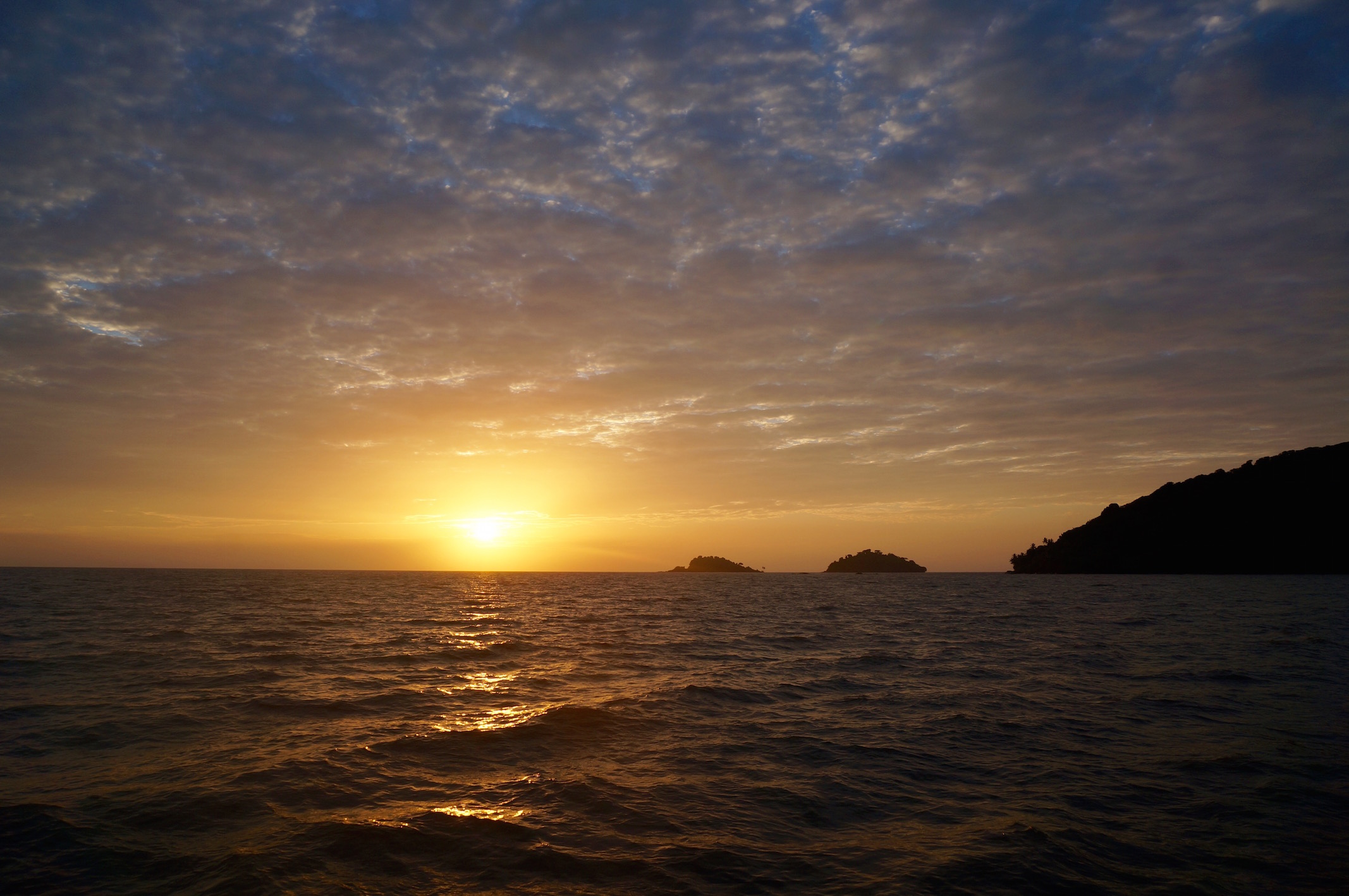
At half past midnight, we dropped anchor off La Mère, an uninhabited, jungle-covered islet six kilometres from the mainland coast of French Guiana. The anchor set on the fourth attempt. The anchorage is exposed, and the 20-knot wind kicks up a fairly strong chop in the shallows. But the forecast is stable, and the waves bother us no more than they did during the passage. The murky brown water smells of pondweed. The shore glows faintly with lights, while the water glows with red and green buoys marking the narrow fairway—the passage into Cayenne, still invisible to us. Even Lada came out on deck: “Oh, have we sailed to America?”
Guys, we’re in South America—wow... and we solemnly celebrate our arrival with tea and chocolate.
Morning in the New World. The first mate’s impressions, 13 October, six in the morning While the crew finishes watching the last of their ocean dreams, I settle onto the still-damp deck planking at the bow and breathe in the dawn. The jungle smells of something pungent and decaying, ochre and brick-red. In Asia, the jungle smelled entirely different. “Maybe we’d simply never smelled the jungle from the sea before,” Nastya suggested when she woke up.
We were right to anchor off an uninhabited place first—this must have been how the companions of Columbus or Magellan once felt. No cities, cars or harbour effluent; none of those ocean-going vessels that look the same the world over, no people around—there is time to take it in, look around, try this new world on for size. And fortunately, we chose the right distance from shore—so close that we can see every leaf, yet far enough away that the mosquitoes have not detected our presence. Part of the crew sleeps peacefully on deck; the scarlet sun rises out of the ocean, while white herons and some majestic birds of prey rise from the foliage.
The green caps of smaller islands, protruding palms and reefs ringed with foam. On the mainland, little houses are visible amid the lush green vegetation. During the day, only one pirogue sped past, while a small, brightly coloured vessel shaped like an old-fashioned boot set nets nearby.
For breakfast, we baked a celebratory cake, opened some children’s champagne and marked our arrival in America with three cheers of “Hurrah!” The captain even poured a little champagne for the windvane, which had guided us so successfully across the ocean. Oddly enough, on that very first day, the crew never set foot on the longed-for land. After the passage, the boat needed a thorough drying and washing: everything had become overgrown with mould again, never having had time to dry after the Cape Verde rains. The baking soda we had previously used with success proved powerless against 80% humidity and round-the-clock 30-degree heat.
Friends who have lived aboard a yacht in a humid tropical climate, please tell us what can be done to combat this flora gone berserk—or is it fauna already?
So all our belongings were hung out on deck, making the yacht look more than ever like a gypsy caravan at a stop. Exhausted and sweating no less than valiant steelworkers, we decided that the next day we would make no attempt to restore the yacht to a respectable state, but would simply set out to explore the shore.
Island of Green Monkeys. Day 24
After packing mosquito repellent, sunscreen and provisions against hunger into a waterproof rucksack, the crew set off to explore an uninhabited island in northern Amazonia. But we shall not weary the reader with a wall of text and will write a separate post about meeting the natives, monkeys, colonial ruins, Ron Weasley’s nightmare and replenishing our stocks of wild fruit.
Hurrah! Land! 🙂 Good luck to everyone in reaching your goal!