
From the Travely-Family archive · Indian Ocean
Cape of Good Hope Rounded!
An original publication from the former Travely-Family website. This English translation was preserved from the technical-site archive without editorial rewriting.
“Mum, I couldn’t find those Fisherman’s lozenges you wanted, but they’ve got these little open thingamajigs here. They’re minty and really strong.”
Nastya and I settle for the thingamajigs—what else can we do?
Our second day at sea. One headache tablet, lots of water, two films. That was all I could manage.
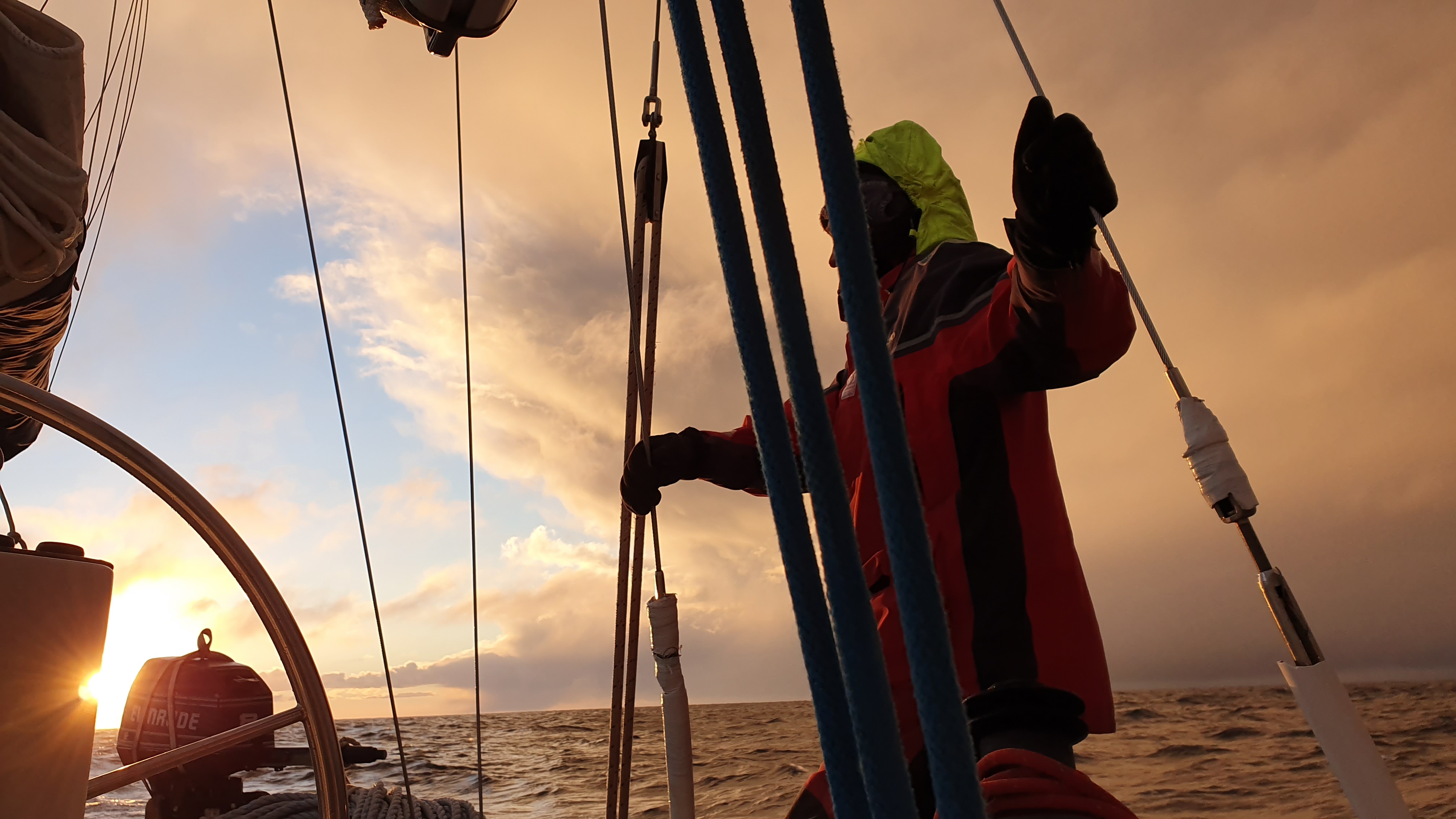
At first the weather was an absolute gift—fog like at Cape Horn, almost no wind, and then a following breeze. We had only just perked up and made a nice pot of potatoes stewed with vegetables when 30 knots arrived, close-hauled, with the wind on our starboard bow.
The evening ceased to be languid. Our young sailor decided to sleep under the table in the wheelhouse, while we praised the heavens that, after six years of suffering, we had finally managed to install a partition between the mattresses in the aft cabin. It gives us hope of something resembling normal sleep on passage. The partition agreed, creaking as it did so.
We carried a small jib and a reefed mainsail. By nightfall a squall hit, and we took the main down. The wave rejoiced at the sight of the three of us on deck and, for some reason, splashed me. Sprinkled me with holy water, so to speak. I had to wash my hair and my legs all the way up to my waist, without even taking off my trousers.
Rounding the Great Cape
During the night the yacht was tossed about, a couple of times enough to give us butterflies in our stomachs. Gritting our teeth, we keep the thought of our great goal firmly in mind. But sometimes you just want to whimper quietly.
“What did you expect? We’re rounding a great cape,” the captain reminded us.
And showed us the current chart. Enough to make you weep.
Rounding the Cape of Good Hope does not mean slipping through a weather window from Cape Town to Simon’s Town and back. Rounding the Cape of Good Hope means sailing around the southern end of Africa. There is a long continental shelf here and strong currents that run against the prevailing wind. This is the area with the greatest number of freak breaking waves capable of capsizing vessels. Encountering one is dangerous even for large ships. So our task is to head as far south as possible, going around the shelf. But therein lies the problem: with a south-westerly wind, heading due south is not exactly easy. Lady Mary is being set eastwards, however hard she resists. For now, we are managing to sail along the very edge of the shelf. There are currents here too, and they are slowing our progress south.
The crew is still more or less functioning. Nastya and I feel so-so and have to lie down, while Ladunya entertains us by reading aloud from under the table. The captain had a nap after his night watch and then immediately climbed into the bilge. The bilge pump was blocked.
To dispel our sadness at saying goodbye to Cape Town and our friends there, the girls and I decided to spend the first two or three days watching films tirelessly. On the third day we added documentaries to the feature films: we watched a couple of downloaded videos by sailing bloggers and a couple of interviews with Viktor Yazykov, who this year was named Yachtsman of the Year for his non-stop solo circumnavigation aboard Daughter of the Wind, without a windvane self-steering system or an engine. We saw his yacht in the Canary Islands during our second year of life aboard.
The waves are short and steep, pounding the hull. For the third day running, it is calm from morning until noon, then it blows up towards evening. We rush to drop the mainsail so we will not have to scramble around whenever a gust hits during the night. The forecast says 20–25 knots; in reality it is 25–30. It will strengthen overnight. But at least we are almost getting our sea legs now. Our course is plotted straight for Australia along a great-circle route, and the figure of 4,565 nautical miles on the display cannot help but cheer us up.
We try not to think about the two months of sailing ahead. Although the navigator says that if we maintain our speed, it will take only 36 days. We reckon that if they do grant us Australian visas, they will not yet be valid by then. We will have to bob about at sea somewhere for another 10–15 days. The fallback option is to sail straight to Melbourne or Hobart. Another thousand miles, in other words. But that is if they grant us the visas:). So far, there is still no email from the visa centre.
Cape Agulhas. A momentous occasion. 27 January
And so today, the day before the 200th anniversary of Antarctica’s discovery by the Bellingshausen and Lazarev expedition, at 16:15 we crossed the longitude of Africa’s southernmost point—Cape Agulhas. That hour can be considered the moment when we truly rounded the great Cape of Good Hope and entered the Indian Ocean. Our Lady Mary is sailing its waters for the first time. Now, to complete the set, only the Arctic Ocean remains. We celebrated with tea and a plum.
We are successfully rescuing the perishable fruit—the nectarines and plums—but we cannot keep up with the melons. We have already thrown a couple overboard after barely taking a bite. Albatrosses soar on their full three-metre wingspans, and, delighted by the calm weather, we sit down to make Japanese sushi—that is, rolls. At once the waves start building, so we run to take down the mainsail; after that, only the titanic efforts of the entire crew keep the rolls from flying around the saloon. We filled them with cucumber and tinned food.
Utterly disgusting. But we are not yet ready to catch fish for sushi. After all, we would then have to clean it, cook it and, most importantly, eat it. And food that is too rich is still at odds with our vestibular systems. How wonderful it was on solid ground! I miss normal sleep. Everything in the ocean feels more like oblivion.
Otherwise, all is well. The main thing is that our second Great Cape has now truly been rounded. And it seems we are managing to avoid the shelf with its killer waves. Our 5,000-mile voyage has begun.
Follow our movements under the “Route” tab.
You can see the track diligently recorded and transmitted by our satellite tracker from MVS Telecom (Iridium).
Dear friends, we look forward to your comments and trust that you have not forgotten to register on risk.ru and have already started voting for our project for the Crystal Peak Award.
Thank you to Valery L. for keeping us promptly informed about the operation of the tracker and our other instruments.
And a huge thank-you as well to everyone supporting our expedition through
PayPal and Yandex Money.
Our heartfelt thanks to Andrey K., Vladimir S., Arseny V. and Andrey from Israel! You have become part of our shore team, and we truly appreciate it!
Hugs to you from the cherished 37th parallel, from the position 37°00′ S, 20°17′ E.