
From the Travely-Family archive · Pacific Ocean
Between Tierra del Fuego and Cape Horn
An original publication from the former Travely-Family website. This English translation was preserved from the technical-site archive without editorial rewriting.
Between Tierra del Fuego and Cape Horn.
Snow-capped peaks and penguin shores. How a warship sunk near Cape Horn is being used, and how much it costs to stay there. Coming down after the passage and the young sailor’s social life The End of the World.
official
The overland road that runs through Chilean Puerto Williams to the far south is called Ruta del Fin del Mundo—the Road to the End of the World. This end lies farther south than any other inhabited territory on the planet (the children took the photo away with them on the phone; it’ll be in the next instalment).
It isn’t warm in the far south: at the height of summer it’s +10, and we wear jackets.
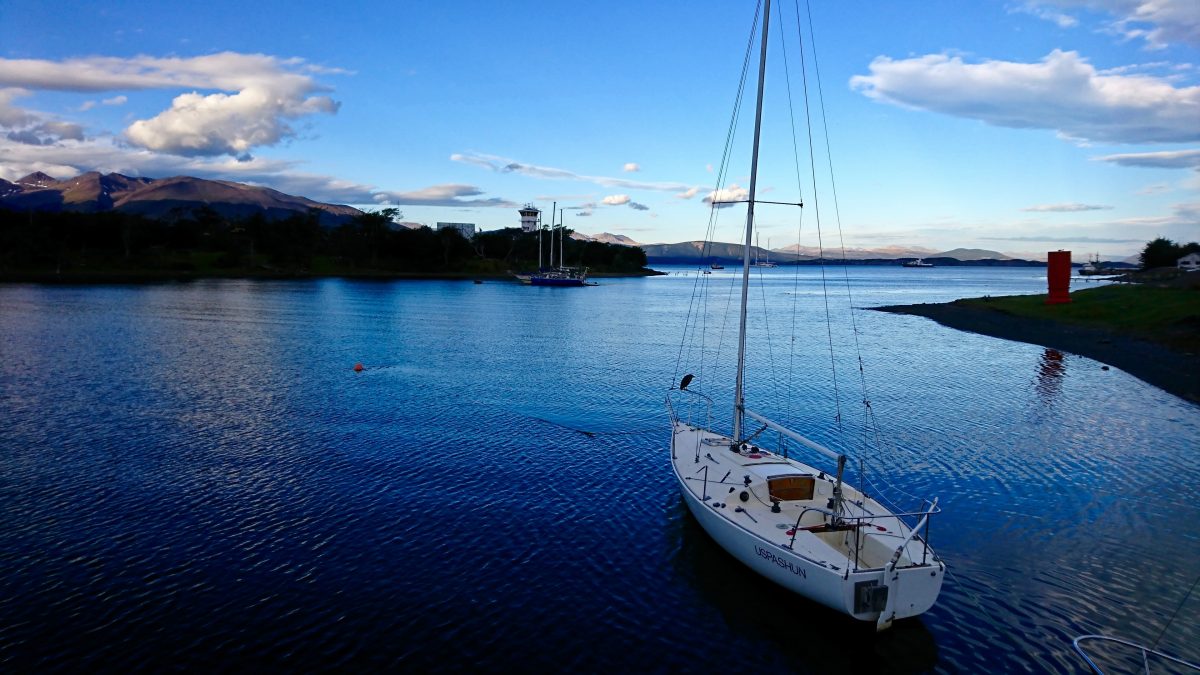
From the anchorage at Lennox Island, where the crew carried out some initial repairs and an equally thorough clean-up, we set off at about 5 a.m. along the channel named after the ship that discovered it in the 19th century—the Beagle. This is the very vessel aboard which the young Charles Darwin made his voyage around the world.
The Beagle Channel from shore
At last, unlike in the empty ocean, there was plenty of wildlife. If we hadn’t watched a film about these parts the night before, we would never have guessed that these birds, looking like plump little barrels with short necks and perfectly ordinary beaked heads, were penguins. Not the king penguins that live in Antarctica and are famous for their impressive size, snow-white bellies, and orange touches on their cheeks and necks, like a greeting from bullfinches, but others, with an elegant stripe separating head from body. There are masses of these penguins farther along the Beagle Channel, on a tiny rocky islet whose extremely dense population is betrayed by the pungent smell.
It smells of fish that has been through a digestive tract. It’s a good thing that when we watch bird colonies on TV, the smell doesn’t reach us (the local internet particularly dislikes penguin photos; we’ll try uploading them in the next report).
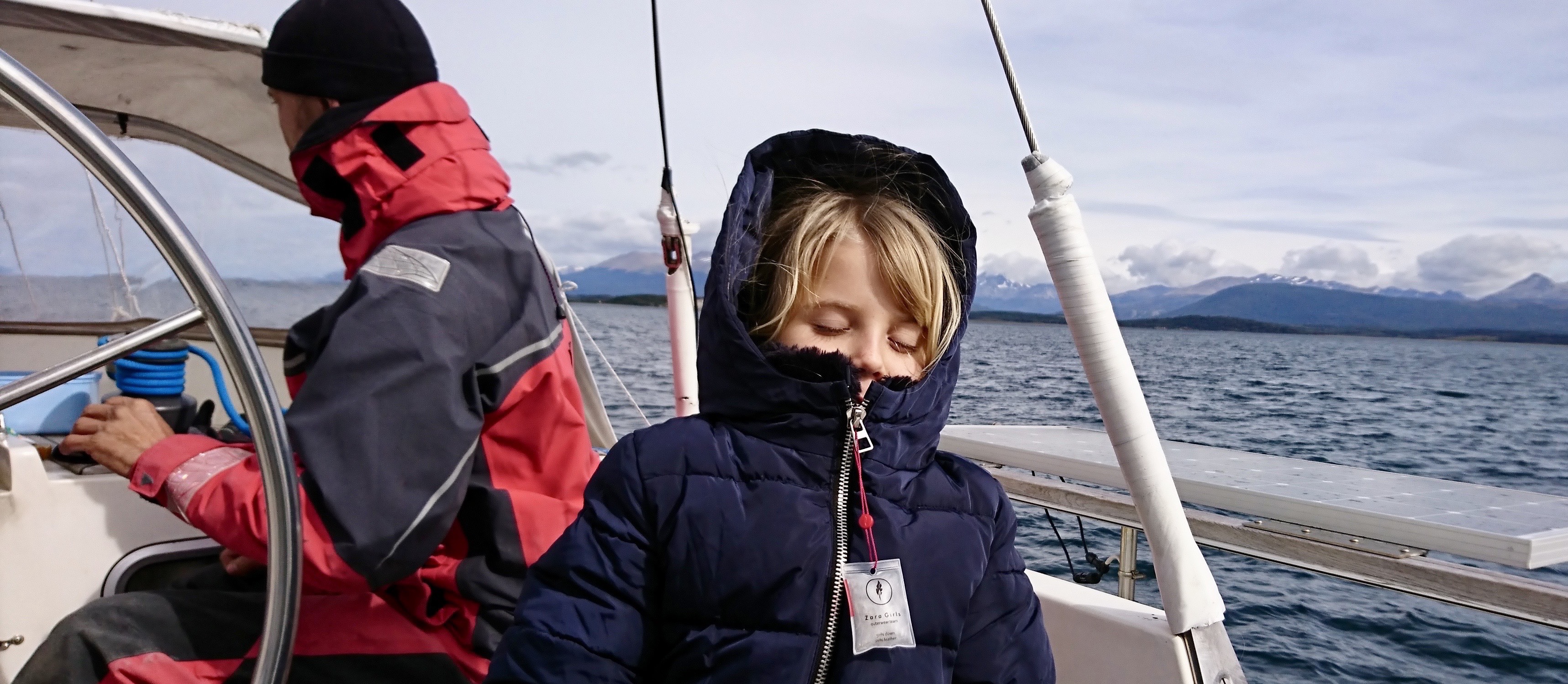
As the yacht approaches, the penguins dive silently into the depths. Albatrosses and other birds, including ducks, take off after a running start across the water. The sun rises and it gradually grows less cold. But the crew are still wearing three layers of sweaters and jackets. Even our frostproof young sailor is bundled into a down jacket right up to her little nose.
As we go deeper into the channel, the mountains grow higher, with snow lying here and there. Before now, we had only ever seen snow-capped peaks in midsummer above 2,000 metres; here, the feet of the mountains stand at sea level. After lunch, our destination appears on the southern shore—the small town of Puerto Williams.
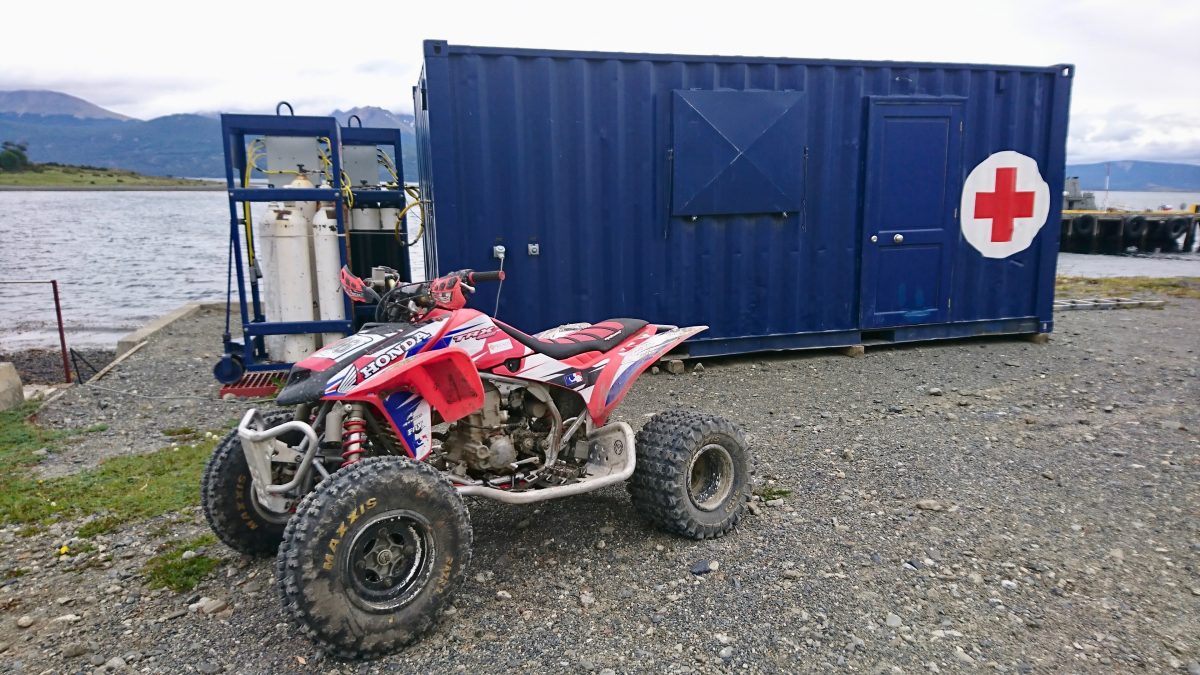
The town’s recompression emergency unit (for divers or people who have tried to drown) and ambulance) Parking alongside an old warrior
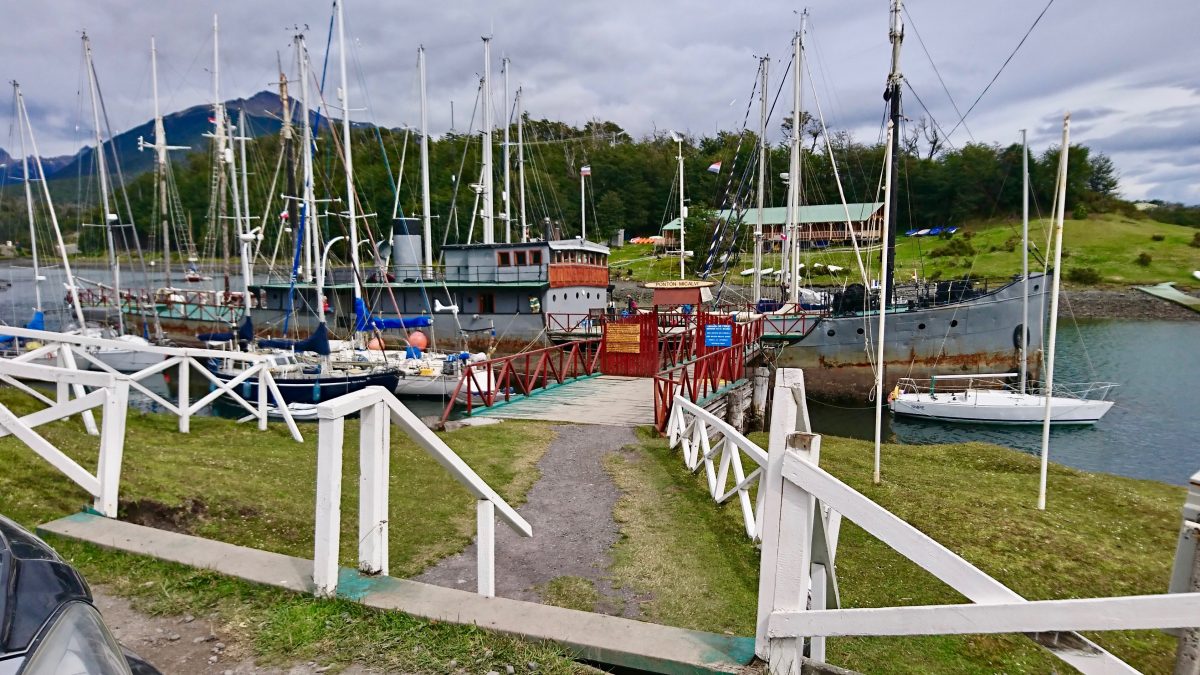
We request permission to enter on Channel 16 and make our way into a cosy little bay beside a green hill. Several yachts are moored there to large buoys, while the majority are parked alongside a warship that sank before the 1970s. It is still the property of the Armada de Chile, and is now looked after by a couple of military men who, rumour has it, want to take possession of the ship themselves.
So far, this is the story as we know it: around the turn of the century, some bloke brought the object rusting right by the shore into decent shape—painted it, knocked together a deck, and set up the very cosy, wood-panelled MiCalvi yacht club in the deckhouse. There was a café, a reading room and a cosy saloon. Most importantly, a marina appeared on the southern shore of the Beagle Channel. Sort of a marina. Yachts berth alongside the ship, side-on. From bow to stern, three fit lengthwise along one side, and up to six boats can then raft up alongside each of them.
So you get a 3 x 6 matrix. Another five or so yachts fit on the shallow inner side. We parked in the second column and became the fourth yacht out from the ship. Two more boats rafted up after us and left again fairly quickly. Today at 4 a.m., our neighbours cast off and departed for Antarctica. It is so wonderful and strange when, after two months in the vacuum of the ocean, whole crews want to traipse back and forth across your deck. Last year, the old fellow who had organised and owned this remarkable yacht club retired, and we arrived in the age of triumphant communism at its very best.
The marina from shore
Communism at the end of the world
We don’t know what the formal arrangements are, or who owns the yacht club aboard the decommissioned Armada de Chile ship, but there is nobody here to take your money. Yachtsmen can stay as long as they like, run hoses aboard to fill their water tanks and plug in electrical cables, sit in the saloon by the fireplace, and cook in the little galley. They can read books and sip wine they have brought with them, while admiring an antique globe, trophies, flags and pennants from every corner of the world, which cover the walls and ceiling.
They can use the shower and toilet, and nothing will happen to them for it. Personally, I even feel a little awkward, but when we asked, “Where do we pay?” we received no intelligible answer, so we stopped asking. If an owner turns up, no problem, but running around town looking for him could just as easily lead you to some home-grown Ostap Bender instead.
The forest begins immediately behind the yacht club, with sturdy pines bearing thick needles and some other unknown evergreens—it’s high time we opened the field guides. Ah, and here is another thing included in this communist paradise: free internet. Early in the morning and at night, it just about reaches the only device inside the yacht—the captain’s MacBook—so we can send messages and even upload videos to YouTube. But at around 9 a.m., everyone wakes up and is sucked into the World Wide Web with a pop. Then the internet is only available on the deck of that same half-sunken ship.
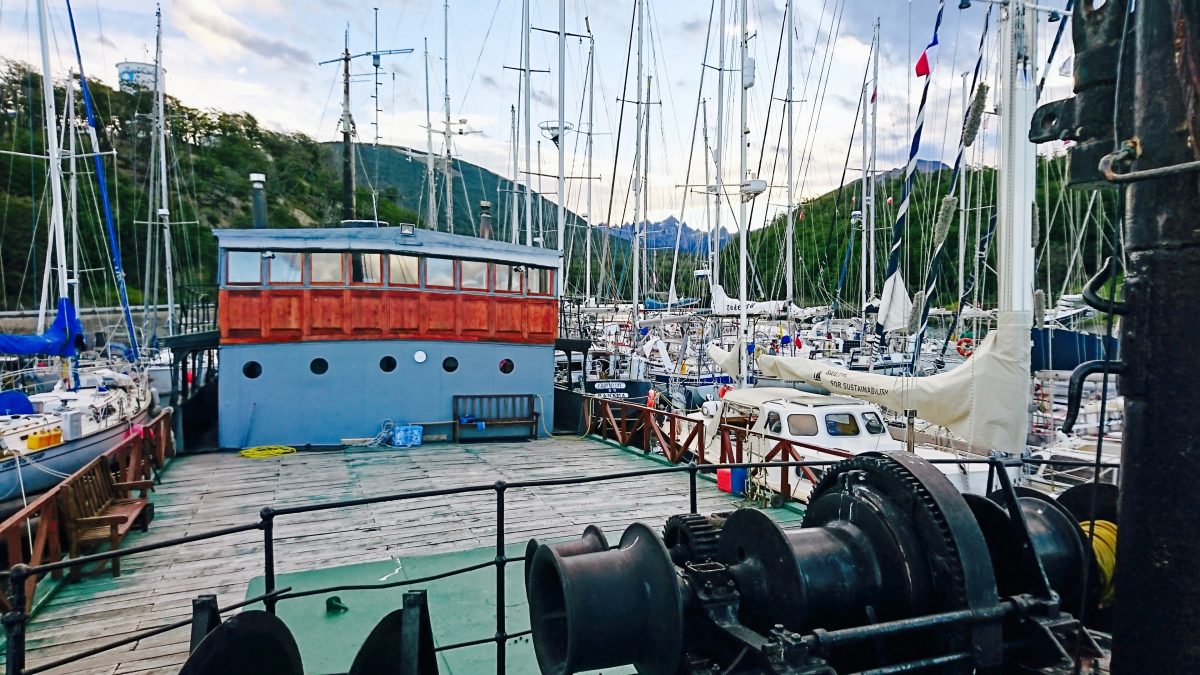
You can sit in the saloon with a cup of tea, preparing everything that needs to be sent out into space. Then you go outside, where our frozen sailor has been huddling against the rail since morning, and, holding the computer perilously over the water, try to catch flickers of a signal. The router is on the roof, and the signal struggles to penetrate the thick layer of metal.
The deck—the main square of the WiCalvi “yacht club”
That’s what we did for two days, until the captain spotted a neighbour from another yacht sitting quite serenely online on the sofa. It turned out that another network was available, with a similar password....and then things really took off for us! We offered to tell every newcomer who wanted the network and password what it was for 10 dollars. Everyone laughed. And Nastya was finally able to continue her swim through the Web in the warmth of the room heated by the fireplace....No, guys, we can’t go on like this; we have to stop, or we won’t see any of the land or get any chores done.
Today we’ll fill up with free water while making breakfast with free electricity in the kettle, and lunch in the yacht club’s free oven. We won’t get hold of any gas until tomorrow; yesterday we took a couple of empty cylinders over on a trolley, and the filling station is within walking distance. I hope this isn’t the same kind of “tomorrow” as everywhere else in Latin America. And today we need to clear the piles of stuff out of our den. Stow away a heap of foul-weather gear and rubber boots, change the bedding, and have a proper bath day. We ought to investigate what the shower is like inside, by the way—perhaps it would be better to go there for our bath than do it at home?
One thing they don’t have here is a laundry. So people wash their clothes on deck using the old-fashioned method our grannies used. So far, we’re too lazy to do that with large items and are counting on a laundry in Ushuaia, the city on the other side of the Beagle Channel, half a day’s passage away. But otherwise... damn, it looks as though we’ve once again found a place we don’t want to leave!
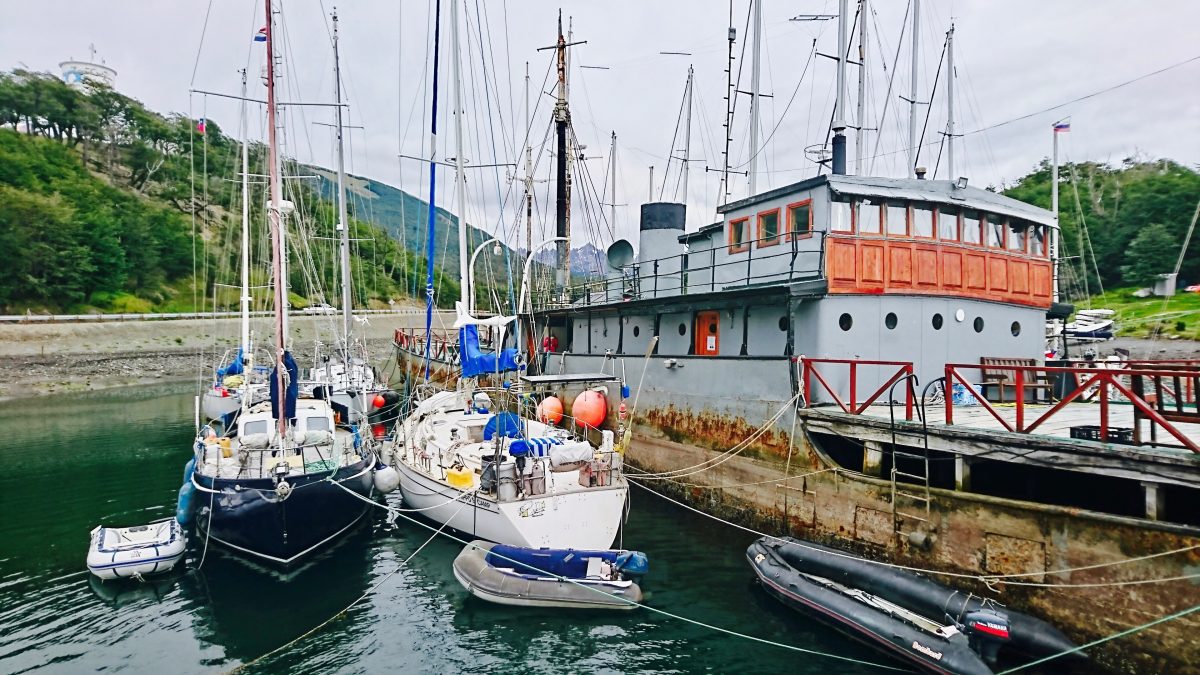
The inside berths by the pontoon 🙂.
The young sailor’s happiness
You have probably already understood what makes our sailor happy. Meanwhile, our young sailor wasted no time in making friends here. Girlfriends, to be precise—Amanda, aged 40, and Sophie, about 70. Having befriended them the previous evening, the next morning our young sailor displayed wonders of responsibility: she set an alarm for 8, sat down sleepily to do Russian, dashed off about four exercises by 9:30, ate breakfast and, saying, “I have a meeting,” skipped off to visit Amanda on her yacht. Then, very conveniently, an Argentinian family with three boys arrived there during the day, and we didn’t see our Ladunka until evening.
Over the course of the day, she visited the local museum twice, told her new friends everything about our voyage, our ages and our pets at home, and arranged to go and gather mouth-puckeringly sour black berries with Sophie tomorrow, because the rest of her gang of friends are leaving for the Patagonian fjords in the morning. Our young sailor can really jabber away in English now! Clumsily, of course, but she makes friends and communicates without an interpreter. By evening, Amanda and the boys’ mother had both expressed their delight with our young sailor.
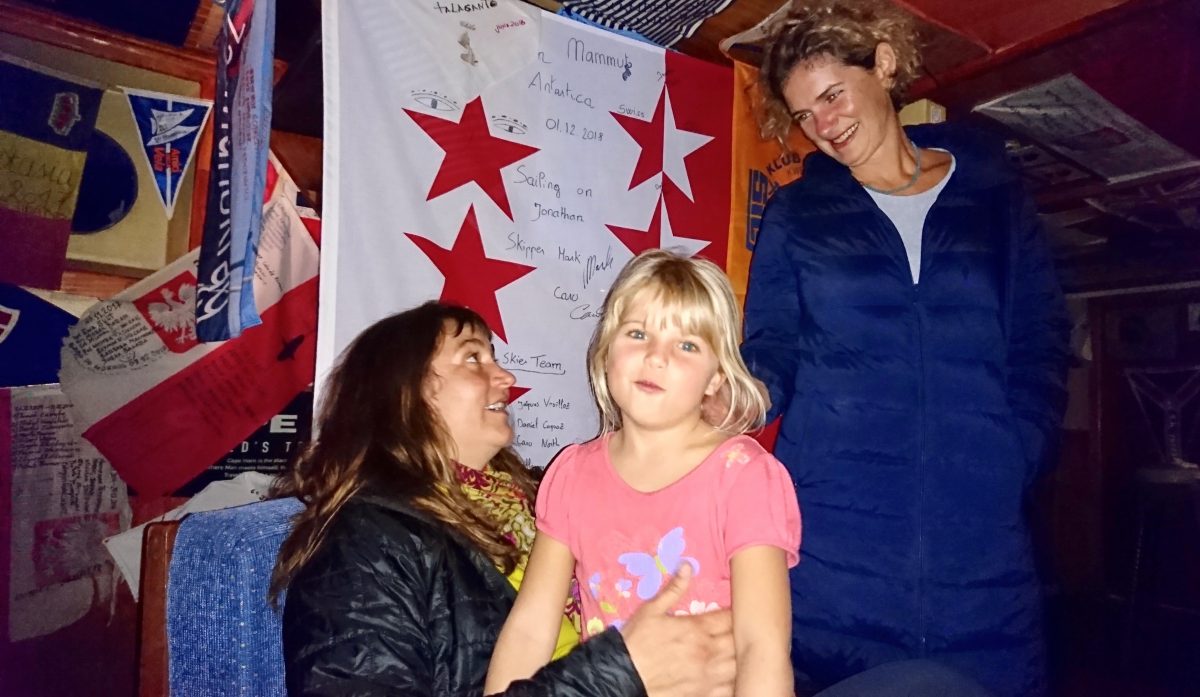
And the object of their admiration was sitting on my lap pulling funny faces and pretending to be a hedgehog. Ladka has been very fond of hedgehogs ever since she learned that when she was a baby, Mama called her “my little hedgehog.”.
Breaking news
This morning, the orange yacht with the boys and Amanda cast off somehow very quickly and disappeared around the corner; they’re sailing along the Beagle Channel. Meanwhile, a gigantic tide appeared in the channel, leaving the deck of the yacht nearest the iron ship level with the roof of the deckhouse. The girls managed to get across anyway and went for a walk to the shop, after making me promise that by the time they came back I would have finished and published this report and we could have breakfast (note—I didn’t manage to publish it; it takes so long if you do it properly and include photos—I’ve already been uploading one post for two hours).
And with that, I bid you farewell. We’ll tell you next time about clearing in on the Chilean side at the end of the world.
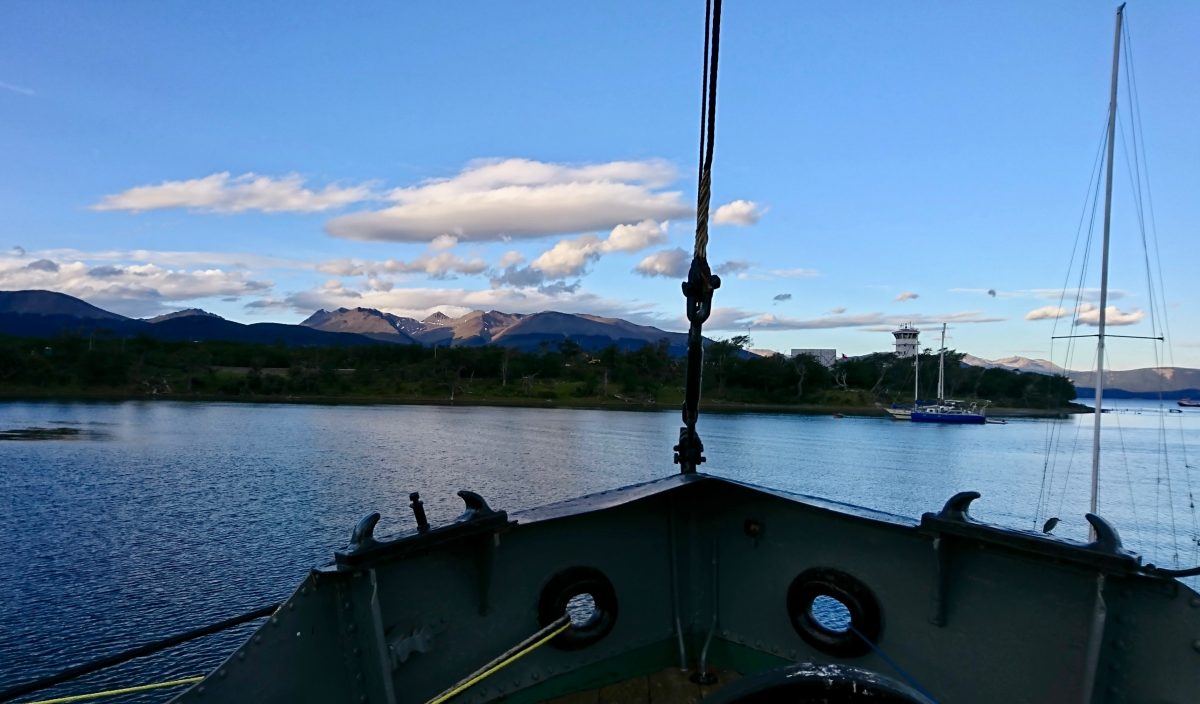
Friends, thank you so much for your warmth, reaching us across half the planet! Over nine weeks of ocean, we have grown very close to all of you. Ask us anything; we can now answer much more promptly.
Special and enormous thanks to Tatiana D. from Israel, Andriy Zh. from Ukraine, Alexei S. from St Petersburg, Valentina T. from Almaty, and Oleg E. from Brest for fuelling the expedition and spurring us on to new geographical discoveries! Friends, you are now part of our shore team.
From the bow of the pontoon-marina