
From the Travely-Family archive · Pacific Ocean
The End of the Earth and the Come-Down
An original publication from the former Travely-Family website. This English translation was preserved from the technical-site archive without editorial rewriting.
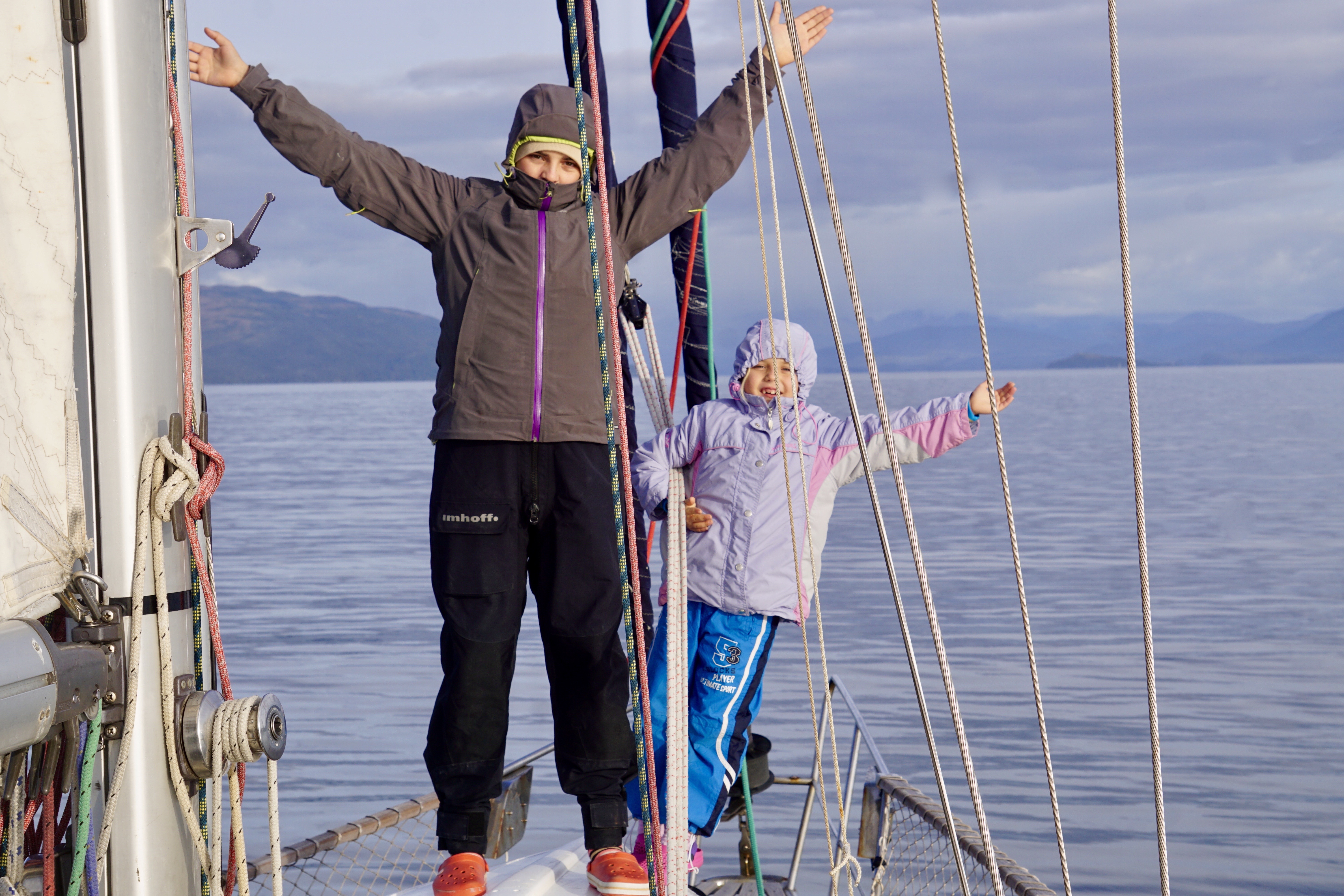
The End of the Earth and the Come-Down
Cape Horn is behind us. I have mixed feelings. And that frightens me. Feeling No. 1 is wonderful: We made it—the land really does exist!
It turns out that exactly a year ago, on January 19–20, we left the Atlantic for the Pacific through the Panama Canal. And this year, on January 19, we left the Pacific for the Atlantic around Cape Horn. A year ago, it never even crossed our minds that this would happen. At the same time, the overall direction of our circumnavigation remains the same—westward. And even our schedule for crossing the Pacific hasn’t slipped. Hmm... Can that really happen?
Seasick
Beyond Cape Horn, we still had several dozen miles to go before our first anchorage. Had the windvane self-steering been in working order, we would have carried on. But Iron Felix had strained himself. No sooner had Lady Mary rounded the corner out of the Drake Passage than 30 knots of wind swung round to meet her head-on, blowing off the mainland. And off our dear girl went, dancing between a beam reach and close-hauled (wind abeam and slightly on the bow, a heavy heel and a galloping ride). Some of us suddenly felt like lying down with headphones on—in other words, they got seasick. But no one got to meet Ichthyander, because the waves calmed as we went deeper into the channels between the little islands. By evening, we had dropped anchor off an almost uninhabited island, amid a forest of kelp.
The kelp off Tierra del Fuego isn’t grass—it’s trees. The bottom is 10 metres down, while broad oval leaves and resilient stalk-trunks sway with the waves at the surface. If BBC documentaries are to be believed, sunlight really does filter through it as through a forest, and fur seals and penguins glide gracefully through the shafts of light. Both have already appeared. The former play and leap out of the water like dolphins, while the latter dive when we approach. Even dolphins lazily waved their fins among the patches of kelp forest. The last time we saw any was way back in Tahiti. Our 6,000-mile passage across the South Pacific hardly spoiled us with wildlife encounters. And once upon a time, these waters teemed with life.
Our first anchorage by the shore
All those manoeuvres with the anchor, so very last year: freeing the chain, rigging the bridle, setting it under engine power...—isn’t this what we had been dreaming of for the past two months? The wind dropped to 20 knots; from the deck it seems—wow, it’s really whistling! But step down into the boat and it feels as though you’ve parked on tarmac. You can even put dishes on the table. And there’s no need to wedge our young sailor in with the sofa back cushions so she doesn’t go flying under the table in the wet night. You don’t feel the yacht’s gentle rocking at all.
The full moon glares in through the windows; the fog banks are still hanging there, now without us, in the open space of the Pacific. And who knew the nights here were so light! This is how I understand it: down in Antarctica, the polar day is in full swing, and it’s only a stone’s throw away. The sunlight must be reflecting off the ice sheet, so even with the sky covered in cloud, there is still no pitch darkness. Do you think that’s why? Or simply because the Antarctic Circle is nearby? The contrast with the black tropical nights is striking! In fact, everything here is a contrast.
We wander around the boat, slightly dazed
Nothing rolls, nothing flies, nothing......... Even the blanket doesn’t fall off, for goodness’ sake. The most astonished members of the crew slept until noon. Of course, it also had something to do with our immediately putting the clocks forward by two hours. We don’t fall asleep until around one in the morning, and by half past four it’s already light. But once we woke up, did we ever get to work—we scrubbed away the worst of the den-like grime! We combined cleaning with a disco and, in our joy, played the vacuum cleaner like a guitar. Can you imagine the level of happiness required for that?
Only one circumstance slightly spoiled the general merriment—the galley ran out of gas. Which meant no food and no tea until we got a new cylinder. We changed the gas exactly a month ago; it should have lasted at least three. It looks as though the supply hose had been leaking for more than a day or two. But where had the gas been going before we noticed the leak in the galley itself, and might it escape the same way again? We were unbelievably lucky! If we had failed to notice the leak for one more day, we would have run out of gas a week before reaching land. For now, meals are organised as follows: water heated by the diesel heater to +60°C is used for pseudo-tea and sort-of-cocoa, and even the last packet of Doshirak noodles has diligently swollen up.
In the heat of the cleaning, someone from the crew keeps glancing out of the window, rushing onto the deck, and asking: “Is that really land? Are we actually by the shore?” And on the shore there’s a forest! And the trees in it aren’t firs, pines, or dwarf birches, but some sort of wondrous trees.
A life hack for rubbish
The Captain repaired the windvane self-steering, inflated the fenders for the forthcoming mooring, and dealt with the solid rubbish. We have a brilliant eco-friendly life hack for this. It deserves a song of its own, but briefly, this is how it works:
At the provisioning stage, we try to buy food with as little plastic packaging as possible. Disposal stage: all plastic is stuffed into plastic bottles that once held water, Coke, ketchup, Fairy washing-up liquid, and even liquid soap. In our rubbish bin there are several empty bottles with their caps beside them, and a long screwdriver sticking out. It’s our magic wand: it pushes particularly large wrappers into the bottles and tamps them down inside. Andryukha cuts the harder plastic into strips and stuffs those into the same bottles. The result: after more than two months on the open ocean, the rubbish produced by four human beings fits into a small shopping bag. We’ve been doing this since our land-based days, and it saves our household—and now those of many of our friends—from a rubbish-induced collapse.
On the airwaves
That evening, the passenger ship Akademik Vavilov appeared on AIS. She was heading towards Tierra del Fuego from the south, but the islands kept her hidden from us. We had already gone to bed when we heard such a dear, familiar Russian accent over the radio. Not the thick, exaggerated one comedians use, but the kind where someone pronounces foreign words using the sounds you’ve known since childhood. Oh, my dears! In short, after the vessel finished her radio session with the shore services, we too—the ones who had gone feral out in the ocean—came on air. “Hurrraaaay! We’re not alone in the universe!” sang our young sailor.
Every two to three weeks, Akademik Vavilov takes tourists to Antarctica. Returning to Ushuaia at 7 a.m., by 6 p.m. she is already carrying around a hundred new guests towards the icy continent. And so it goes all season. During the Northern Hemisphere summer, Vavilov moves to the Greenland area and works to the same schedule. The crew are Russian; the tourists come from all over. After meeting us over the VHF airwaves late one evening on her way back from Antarctica, our compatriot ship headed south again just 24 hours later. We hope that in about three weeks, when she pops in for another day, we’ll meet our fellow sailors in person. That evening, the crew went to bed three times happier. Cape Horn was the first reason, flat water the second, and a radio conversation in our native language the third.
After spending two nights off a little island inhabited by no one except either weather forecasters or border guards, today at 4:30 a.m. we weighed anchor and finally set off for the site of our first landing ashore. That is Puerto Williams, on the Chilean side of the Beagle Channel.
Friends, may I tell you tomorrow how we tacked through the channel named after the ship aboard which Darwin did what he did? How penguins shaped like plump little money boxes swam all around us. How we moored as the fourth boat out alongside a half-sunken vessel where communism had recently triumphed... How we kissed the ground, and how we completed our formalities, rushing around the village from one little building to another. Can I tell you all about it tomorrow? We’re tired, we haven’t eaten (there’s no gas, remember), we’ve been running around... And while waiting for an answer from the immigration officials, I fell asleep on a bench in the reception area.
Ah, we forgot to mention Feeling No. 2—the frightening one
We rounded Cape Horn. And...? What next?... It’s that “And...” that troubles me most of all.
We send hugs to all of you from a new end of the earth—the southernmost village in the world. Friends, thank you for being there for us; thank you for your congratulations, your warm words and most precious messages, for your attention, support, optimism and romanticism, pragmatism, and questions that make us think. We value every one of you very much!
And we extend our heartfelt thanks to those who are becoming our real shore team by supporting the expedition through
PayPal.me/TravelyFamily. Thank you to Alexander T. from Kurgan, Denis M. from Moscow, Sergei D. from Moscow, Alexander P. from Croatia, and Konstantin K. from Moscow! Guys, you are the best motivators in the world. Thanks to you, sleepy eyes stay open, new ventures beyond the limits continue, and new people believe in themselves just a little more.
May you all believe in yourselves!