
From the Travely-Family archive · Cape Horn
The Strait of Magellan Successfully Negotiated!
An original publication from the former Travely-Family website. This English translation was preserved from the technical-site archive without editorial rewriting.
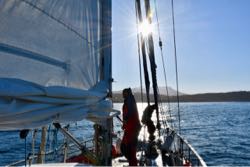
The Strait of Magellan has been successfully negotiated! Sent via satellite.
Our last foray ashore happened two days before we set off into the most terrifying of all romantic straits. At the time, we had no idea that the port would be closed and we would be stuck between shore and ocean for two days. We completed the formalities for clearing out of Chile and said goodbye to Kristina’s family. For some reason, I firmly believe that one day we’ll return to Patagonia and meet both them and our friends from Ushuaia again.
We rowed back to the boat at dusk, with a bit of a breeze. We secured the dinghy on deck in passage mode and stowed away anything liable to take flight. We’re leaving.
And then the wind showed up too... 37 knots, 39, 42!... 46! The captain’s eyes grew rounder as the numbers on the anemometer climbed.
Now that’s lucky!
What exactly is lucky about this? I ask rather grumpily. Meanwhile, I’m thinking: Oh, brilliant, getting the anchor up is going to be a barrel of laughs. And I’m increasingly keen to loaf around on the sofa instead of dealing with all this in a Force 8–9 wind.
We’re lucky we managed to get back aboard and even hoist the dinghy!
Oh, right. True enough, we are lucky!
The captain calls the harbourmaster’s office.
And just where do you think you’re off to? the latter asks politely.
Well, um, to Africa, obviously, the captain replies, pulling on his foul-weather gear.
Calm down, lads, says the voice on the radio. Customs won’t give clearance. Weather conditions.
At first we don’t believe it, thinking everything will change any moment. We wait until midnight and decide to sleep. They don’t give us clearance to depart the next day either. It is still blowing in places, but for us this 25–30-knot wind is favourable, so it’s just right. Especially since we won’t be going straight to the Falklands. First we need to cover 15 miles, anchor, wait for the ebb stream and ride it through the narrows. The current in the narrows can reach 12 knots (12 nautical miles per hour), which is twice Lady Mary’s cruising speed, plus a little extra.
After the first narrows, we have to anchor again for several hours and let the flood stream pass, as it runs against the wind. It creates waves up to four metres high, in which ships have perished. Once the next ebb arrives, we have to weigh anchor and make a dash out of the Strait of Magellan and into the open ocean.
They still won’t let us out on the morning of the third day, when the sun is gently caressing the motionless sails with its rays and the fabric wind indicator hangs completely limp.
The port is closed due to weather conditions, the radio replies. Call at noon.
At noon they told us to call at six, and then again in the morning.
A submarine surfaced off our port side and hung around for a couple of hours. A message came over the radio giving the coordinates of channels closed to shipping. And we understood everything. Today’s weather is military-style—exercises, in other words... Though we couldn’t go ashore for the second day running, we weren’t bothered. Ladunya did her schoolwork, there was still internet, so we could even fire off a post with photos about our off-road travels and general slapdashery:). By evening, the young sailor and the deckhand set about making salads and buckwheat, thereby saving the first mate from having a trim waistline.
I wonder what would happen if we gave a gas cylinder a good shove across the water towards the submarine? the captain asked sweetly after a hearty dinner.
Oh, come on, Andryusha. A world war could start.
Heh heh... Russian sailing yacht Lady Mary torpedoes Chilean submarine...
Then they definitely won’t let us out of here for the rest of our lives:).
Or at least we could let one rip from the flare gun in their direction... the captain daydreamed.
An hour later, as though it had heeded the captain’s musings, the radio announced that the port was opening. Grabbing everything needed for such occasions, we raced for the exit. Weigh anchor, say goodbye to Arctic Wolf, and hurry to the anchorage before the narrows.
We came close alongside the Russian trawler, waved and wished them luck. The bosun tossed a bag onto our deck:
The young sailor forgot her toy. The bag contained not only the snake puzzle she had already mourned, but also a stack of blini.
Hooray! Thank you! And we waved three times as hard.
Honestly, I just can’t get over how kind people are! Lada says, touched. And our hearts fill with such gratitude that it makes us want to do good and fill the world with love.
We would cover most of the strait during the night. The captain sent us to get some sleep. The girls managed it properly; I slept until about two. It was nerve-racking, and I couldn’t sleep. Around four, I went out to join the captain. There was still an internet signal; the evening Instagram post made it to Facebook by morning, but the next one, about negotiating the narrows, sadly lost control and got stuck. And it even had a video showing the ebb stream rushing into the 280-metre-wide narrows, with Lady Mary tearing along at speeds of up to 14.5 knots.
The current provides half the speed. Before dozing off on the watchkeeping settee, the captain ordered me to keep an eye on our speed. If it began dropping below 7 knots, we had to turn around and scuttle back into shelter, anchor and wait out the flood stream.
Thank God, we were lucky. The favourable current lasted long enough to carry the yacht out of the narrows, and at dawn we dropped anchor off a flat, desolate shore. We’re waiting for the next ebb, then off we go. The children took over anchor watch while the adults retired to their sleeping quarters.
Sunshine and 15 knots of wind from astern, oil rigs stretching for many miles across the continental shelf. We tried in vain to catch the last scraps of mobile internet, but there was only enough for one and a half WhatsApp messages before everything died. No sooner had our friend Sergey from Ushuaia written that local dolphins often escort ships at the mouth of the strait than some amazing creatures appeared alongside. Dolphins, unquestionably. But judging by their colouring, they had been crossed either with penguins or with panda bears. White bodies, black heads, dorsal fins and tails. The cheerful pair spent a whole hour deftly dodging the bow, then grew bored and disappeared.
The famous Cape Dungeness, after which Magellan confidently turned west around the South American continent, was left astern to port. The captain went for a shower, the first mate got her hands covered in herring, and just then the Armada de Chile remembered Lady Mary over the radio.
Aah! Nastya! Answer them—my hands are covered in herring!
And for the first time the deckhand handled the radio exchange by herself; until then she had always been rather shy. We need to eat herring more often and lock the captain in the shower, and then our little sea wolves will grow up completely.
If you are following the expedition via the Iridium track, under the Route tab on our website, you can see that we are dropping south of the Falklands. That’s how we’re letting a low pass. It is moving farther north, out of the strait; we’ll catch its southern tail, which should give Lady Mary a kick straight towards the Falklands. For now, we’re gently rolling and warming ourselves in the sunshine. Tomorrow is the first day of spring. The wind has strengthened from 15 knots to 25; we’ve reefed the sails, the rolling has increased, but it’s bearable. Squalls have started sweeping in.
The automatically updated tracking map is also available at bit.ly/iridium360.
Hugs from the 55th parallel, friends! Special greetings from newly minted second-grader Ladunya to the Russian Geographical School, its administrators and teachers! Happy Knowledge Day to everyone! See you in the comments.
Our heartfelt thanks to everyone who has helped replenish the ship’s kitty through Paypal.Me/TravelyFamily and Yasobe.ru/na/TravelyFamily. Your contribution to our inspiration is invaluable!