
From the Travely-Family archive · Pacific Ocean
Easter Island. How We Nearly Got Hauled Off by the Police
An original publication from the former Travely-Family website. This English translation was preserved from the technical-site archive without editorial rewriting.
Rano Raraku—the quarries of Easter Island. How we nearly got hauled off by the police.
Guardians of antiquities, crime and punishment.
Kilometres of rough terrain, bushes and barbed-wire fences, a three-hour climb and a picnic on the rim of a volcano. Face to face with the most mysterious idols on the planet Rano Raraku. The volcanic crater.
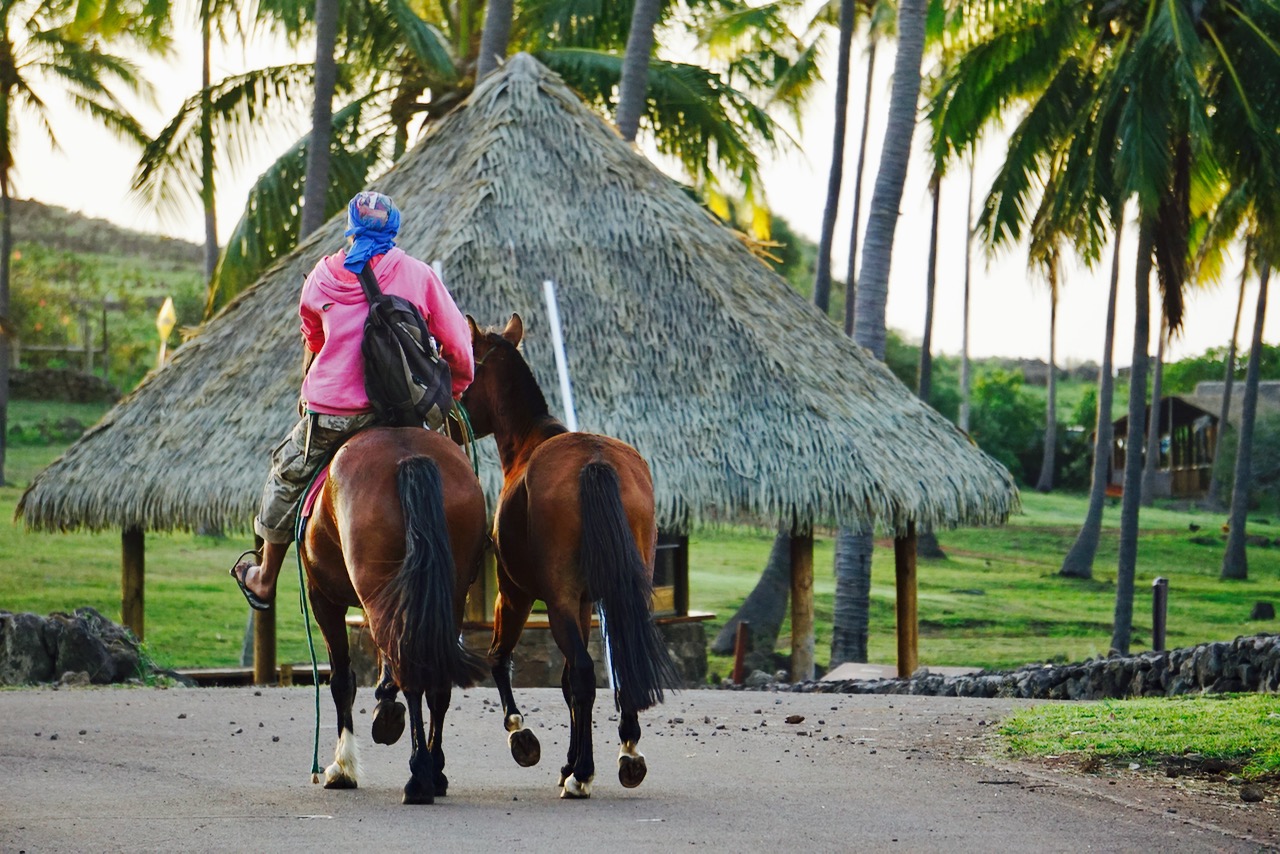
You! The four of you!—one, two, three, four—all of you, follow me. Move! Stay beside the horse. Quick march! No photographs, no wandering off. With me. Stay close!—the caballero’s eyes are flashing. His lips are pressed into a straight line. There is a ranger’s badge on his jacket. No arguing with that.
Andryukha, what do you think—will they take us straight to prison, or torture us first?
I don’t know, Marinochka. We’ll find out when we get there...—there is not a trace of laughter in the captain’s voice.
A bright and cheerful beginning
The previous evening, having spotted two lads from a Swedish boat on the summit of Rano Raraku, we resolved to climb up there ourselves the next day. (We would never in our lives have made out people in those two tiny specks if they hadn’t radioed us from the top.)
We packed a little picnic into a rucksack, took water, strapped an impressively large tripod to our backs, and went ashore.
On the other side of the volcano, giant stone heads lie half-buried by scree on the slope. There are proper paths, an unfinished statue in a rock niche, and tourists wandering about, apparently with tickets. There must be a checkpoint there. We don’t need to go that way. We want to climb the mountain, and after that—it depends on what we can see from the top.
A preliminary reconnaissance the day before the expedition.—The first 200 metres of the route look perfectly respectable
If I weren’t so adventurous and brave, I’d have collapsed ages ago, like a glass tower struck by flaming arrows!—exclaims the young sailor as we force our way through the scrub on the slope of Rano Raraku.
Say that again, I’m recording!—I switch on the camera. The young sailor showers us with metaphors; you could listen to her all day.
The rain-soaked, boggy ground is woven over with a web of dwarf guava trees, flowers and thorns. Only the top of Laduska’s head is visible above the gnarled branches. All we can hear is the ceaseless little bell of her voice:
Mum, I never thought climbing to the top of a volcano would be this hard. I’ve already fallen over five times, lost my trainer and found it again, and I’m tired of fighting through the bushes. It’s a good thing you and I are so heroic and always choose the hardest route.
Uh-huh, I agree. And sensible heroes always take the long way round....
But there is no way round if we want to climb this particular mountain. Any detour here means going through more scrub. I have already lost yet another—and my last—lens cap in it. We mustn’t damage the tripod in these thickets—we want to film something beautiful from the very top. A couple of times we climb over barbed-wire fences, apparently put up to keep the horses out. And, generally speaking, to keep out random people like us..
The ascent
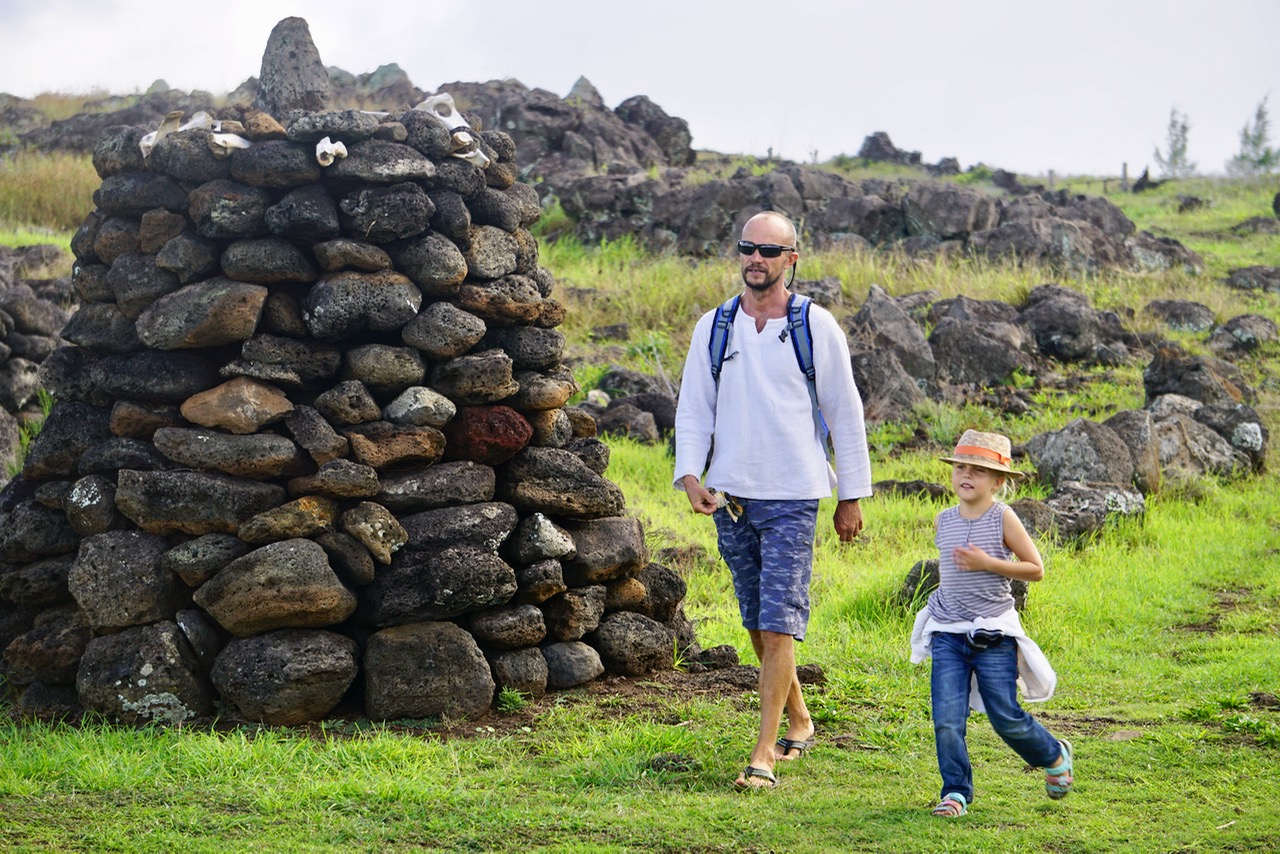
The climb begins. The yellowish rock crumbles slightly underfoot. This is the very rock from which all the moai statues of Easter Island were carved. Here and there are inclusions of dense grey stone—the ancient stonecutters made their tools from it and used them to peck out the statues.
At first we take the shiny pieces of black lava for tar, then for glass. But no one ever comes to these slopes, so where would glass and tar have come from? Obsidian! The very stuff used to make the spearheads of the Rapa Nui people and the pupils in the eyes of some statues. Our pockets become two handfuls of obsidian shards heavier, while the way up grows steeper and steeper. The ceaseless loudspeaker that is our young sailor praises the Creator for making the rocky ledges look like steps, and for making her so persistent, still walking and walking even though she has wanted to sit down and eat for ages.
We’ll reach the top and have a picnic. Look, Dad and Nastya are already there,—I encourage the young sailor. Dad and Nastya look like people who have discovered an internet signal on their smartphones. Andryukha is smiling as he reads WhatsApp, while Nastya hurries to post on Instagram. Lada and I have been allotted the video camera from among the gadgets, and we prepare a report from the rim of the crater.
Oh, look, there are statues here too!
Laduska is the size of one idol’s nostril. For hundreds of years, the solemn faces of the stone giants have gazed intently into the boggy volcanic lake inside the crater. The unique totora reed grows there—the only other place it is found on the planet is Lake Titicaca. On learning that totora stems are not round but triangular in cross-section, the young sailor absolutely must acquire a reed for herself. Do you know what she later did with that unique reed? Stripped it until it was unrecognisable and... threw it away piece by piece. Luckily, Mum had tucked an unstripped end inside her clothes for the collection.
Behind the giants, we can see a wooden platform with several tourists. One man is walking among the heads while the others remain on the boardwalk. It looks as though they all reached this side through a tunnel running right through the rock.
For now, let these worthy giants who have turned their backs on us stand in for the others. Because the largest statues from Rano Raraku had to be erased under torture, but we’ll probably restore them soon:)...
Tongariki platform
An attempt at a live broadcast
The sun is slowly sinking westwards, but there is still time. Though the thought of returning the way we climbed is not at all pleasant. Walking over grass or rocks is far better than fighting through tough scrub.
Oh, why don’t we do a Facebook Live broadcast!
What time is it? It’s getting on for one in the morning in Moscow... hmm... well, let’s try.
We are live for about ten minutes, then a text message arrives from the mobile operator and the connection cuts out; we cannot even save the broadcast in the group.
Luckily, we still have Nastya’s phone. But Facebook always freezes on it, and the minute we spend trying to establish contact with outer space from the summit of Rano Raraku comes out as choppy Morse code. A little disappointed, we begin getting ready for the journey back.
Let’s walk as far as the heads, then see where we can get down without entering the ticketed area.
Descending into the volcano’s crater
The captain and the young sailor are slowly making their way down; Nastya and I are still at the top. The area by the lake looks like open ground, and some men in the distance are hauling a bale of something. Perhaps that road runs between farms, taking us round the bushes and the national park?
Then a dashing caballero appears on the road and heads straight for us. Stopping below the slope, he fixes his gaze upon us as we descend.
Wouldn’t it be hilarious if all four of us suddenly turned round now and bolted back up the mountain!
Yeah, Mum... I told you we shouldn’t go down there,—Nastya is cautious, as always.
We’ll say: Dear sir, no money. What money? Oh, we know nothing about any ticket, I swear on my mother’s life, yes?
The caballero waits doggedly for us, then gestures for us to follow him. His spirited horse carries him off into a hollow. We are baffled—maybe he thinks we are local tourists and that we are about to fall, so he has shown us the way? We had actually been planning to head back over the crater rim before the sun went down, while we could still see the bushes. But now that we are here, here we stay. And... we freeze among the silent stone statues. The cicadas begin their evening songs; the damp wind wraps us in the scent of grasses and flowers. In the crater there are only us, the ancient Rapa Nui ancestors and the lake with its rare triangular reeds. Our imaginations are just about to run wild, and we are just about to ponder eternity, when suddenly...
A quadcopter buzzes from behind the rocks.
Andryukh, run down to the lake and get Lada a reed. She’s dreaming of seeing what it’s like—the triangular reed.
Yeah. And they’re watching us from above, and the police will come galloping over any moment now.
Oh, come on, maybe tourists are filming. Besides, look, the drone’s flown off.
The captain and the young sailor manage to gallop down to the volcanic lake, pluck a lush green triangular reed and return to us and the idols. Since we have come down anyway, we quietly move below the fence towards the road, still hoping there is some farm there and that we can calmly leave by a route around both the obstacle course of thorny bushes and the closed area.
The beat of hooves answers us—another caballero is galloping menacingly towards us on a spirited horse. The horse is snorting fire from its nostrils. And neither horse nor rider is at all pleased to see us.
This isn’t the same caballero, but he’s handsome too )
You! The four of you!—one, two, three, four—all of you, follow me. Move! Stay beside the horse. No photographs, no wandering off. With me. Stay close!—the caballero’s eyes are flashing. His lips are pressed into a straight line. There is a ranger’s badge on his dark jacket. No arguing with that.
Andryukha, what do you think—will they take us straight to prison, or torture us first?
I don’t know, Marinochka. We’ll find out when we get there...—there is not a trace of laughter in the captain’s voice.... Now we’re really in trouble....
Awaiting retribution
Mum, if anything happens, I don’t understand any language except Russian,—says Nastya.—And you keep quiet too; let Dad handle it.
So I keep quiet, listening to the conversation between Andryukha—the good-natured simpleton—and the stern, I would even say vicious, horseman.
What, are we not allowed to walk here?
No! This is a restricted area.
But we came from way over there, from miles away, and there’s nothing written anywhere. We didn’t know it wasn’t allowed.
The conversation continues in this vein; the guardian remains severe. We obediently follow the horse, struggling to keep our faces good-natured. The captain finds out our gendarme’s name. It turns out his name is Anakena!—after the bay where the legendary Hotu Matuʻa, leader of the first settlers, came ashore.
The captain introduces himself and says we are—either stupid or brazen—from Russia. I keep the conversation going by mentioning the World Cup, and we find out how many children Anakena has.
At some point the caballero’s face lights up with a smile. Phew... this one shouldn’t torture us.
Want to ride the horse?—the rider asks Laduska.
Yes!
We breathe again and once more—and, as it turns out, prematurely—take out the camera. Ten minutes later, our caravan arrives at gates that are remarkably grand for Easter Island. On the way, Anakena tells us not to trample the grass and warns us:
There’s my boss over there—she’s terrifying when she’s angry! A real battleaxe, worse than your Prokofya Lyudmilovna....
Only the captain hears this warning; the rest of us charge straight into the furious shout of the woman whose name we are too frightened to ask. The entire park staff stand frozen in anticipation of bloody retribution. The last tourists look curiously from us to them and back again. And we find ourselves longing for the cosy thorns of the impenetrable bushes on the far side of the volcano.
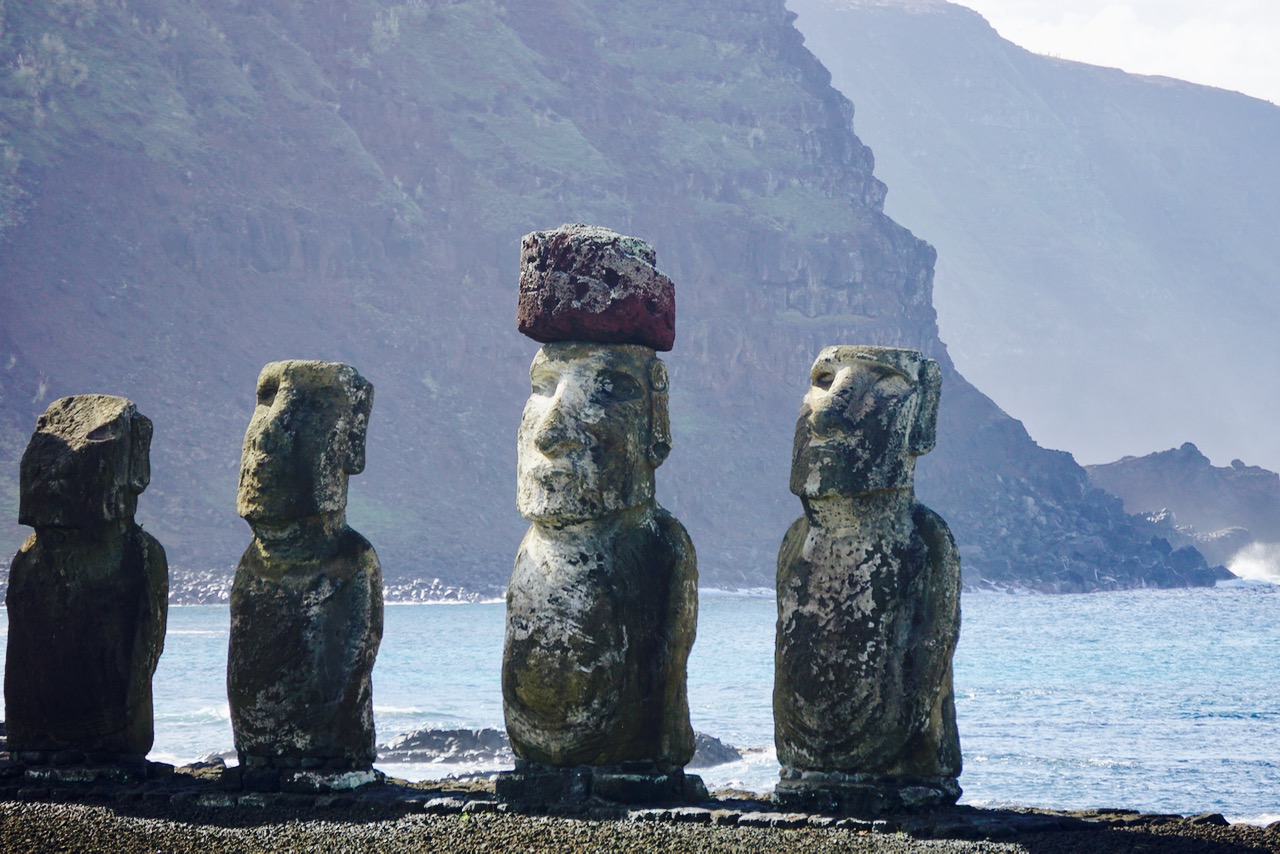
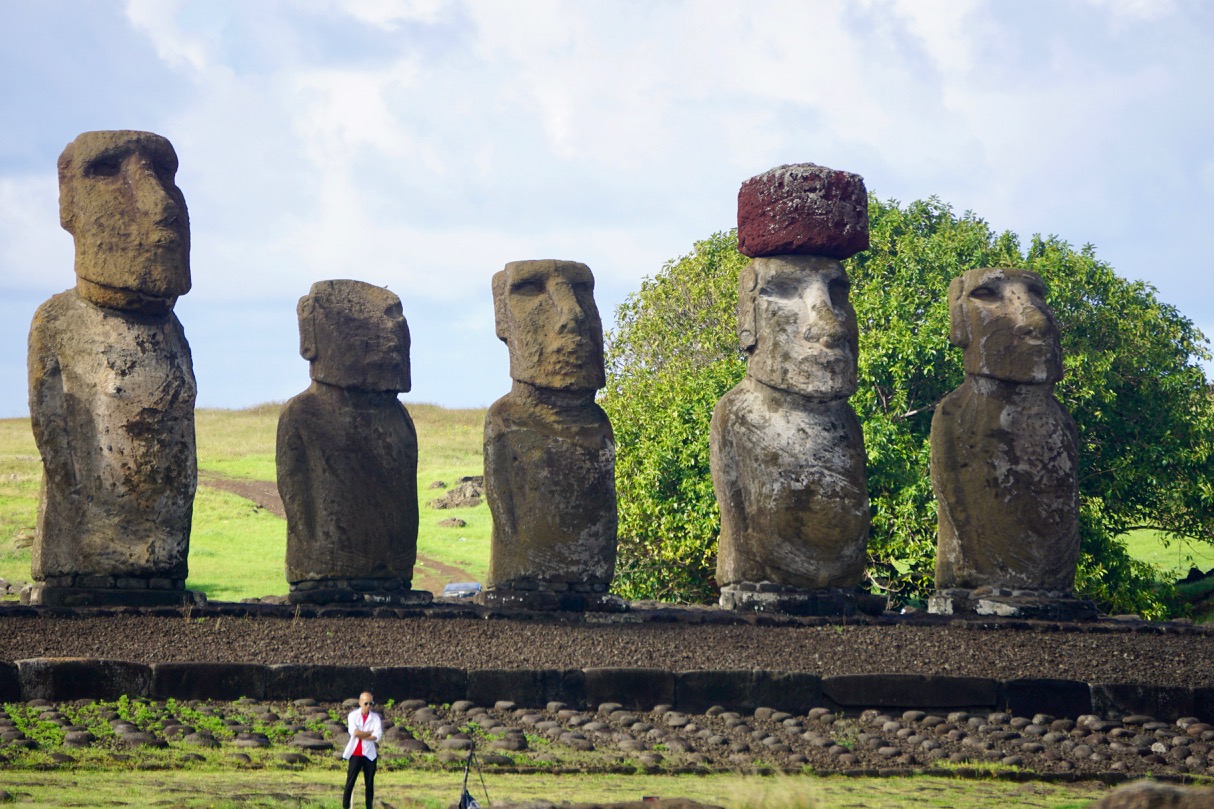
These moai on the Ahu Tongariki platform guard our lonely dinghy while we are off hiking
The woman speaks Spanish, and the entire meaning of her speech can be boiled down to two sentences:
What the hell are you doing here, illegal freeloaders without tickets?! We’re about to set the entire police force of Chile and the surrounding territories on you, and you’ll be deported from the world’s oceans for ever.
The captain asks her to repeat the same thing in English. That saves us.—A rather plump, intellectual-looking employee becomes a buffer between the punishing hand of authority and us—the hapless hikers who have accidentally wandered onto Easter Island and had no idea there were any statues here.
Embarrassed by his enforced role as punisher, the employee tells us:
You entered the national park illegally. We must hand you over to the police.—OO (that is us, our eyes very round indeed).
But we didn’t know we weren’t allowed in here. We were out hiking. We came from way over there, on the other side.
How the hell could you not know?—the punishing woman howls in pure Spanish.
The buffer translates.
Honestly, sir, we really didn’t know. We weren’t even coming here; we were hiking. We go hiking everywhere, all the time—that’s why we brought a picnic with us.
Documents!
We don’t have any documents with us.—The captain is still hoping to get off scot-free.
What do you mean, you don’t? What about your driving licence?—well, they don’t know we arrived by yacht rather than car...... Umm...—that is the captain’s reply.
Why didn’t you go straight to the exit when you were called?
Well, look, our young sailor’s face is scratched. She fell over and was crying, and we were comforting her.
That’s your problem!—the punishing woman shouts in my face, unexpectedly switching to English.
Yes, of course it’s our problem, but we didn’t know we weren’t allowed in here.
The intellectual buffer:
You must delete all photos and videos taken within Rano Raraku from both the camera and the phone, or you will have to explain yourselves to the police.
Of course, here you are.—And I give the camera to Andrei, hoping that he is a shrewd fellow and will not wipe absolutely everything, leaving at least the panoramas from the summit, and especially the footage of the young sailor and me climbing and fighting our way through the bushes, where she was coming out with such gems.
But Andryukha’s honesty knew no bounds, and he deleted every photograph from that entire day.
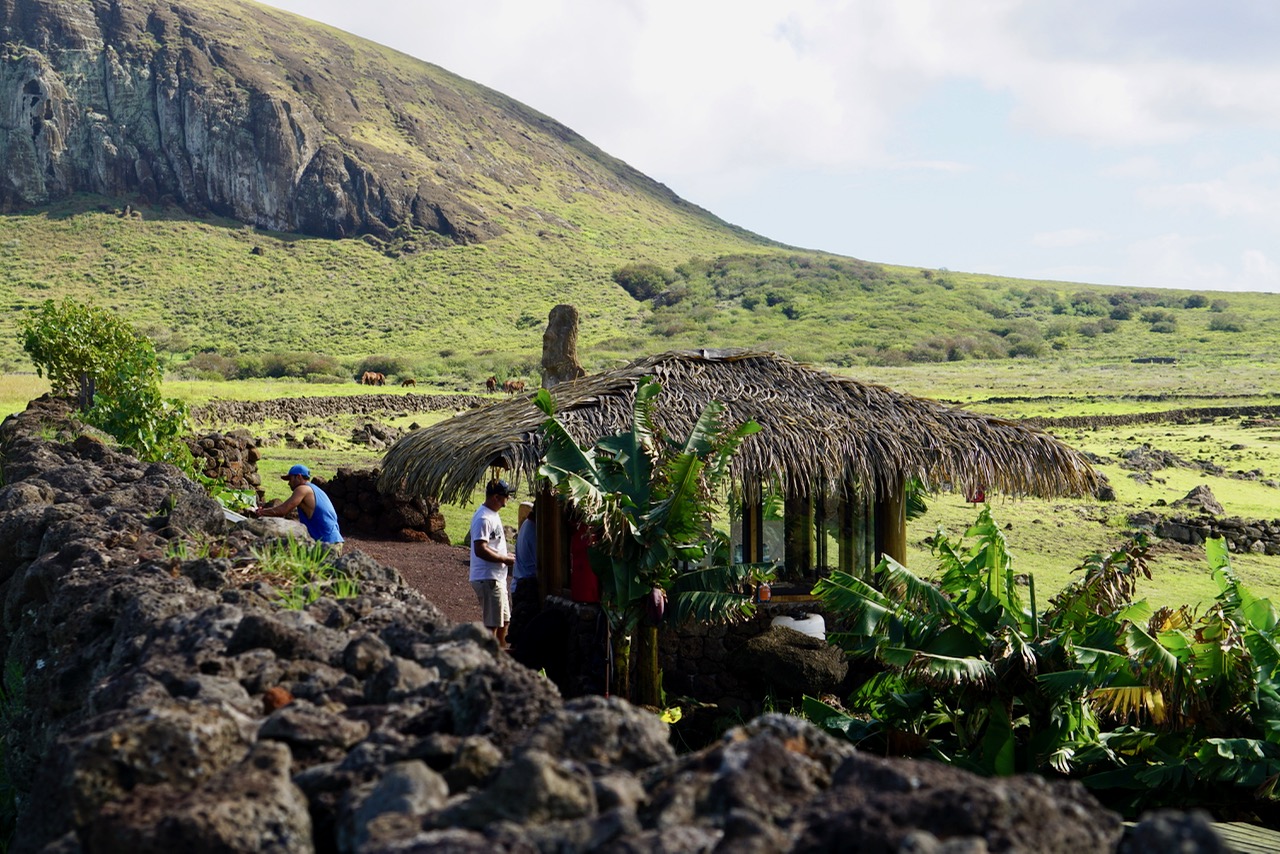
Then, out of nowhere, an employee from the Tongariki platform appears—the place we had tried to visit a week earlier. We had even wanted to pay, but they sent us to the island’s capital to buy a single pass for all the statue sites.—Yes,—he says,—I’ve seen them before.
This is where he saw us, the rat 🙂
Continuing to shout that we are in the park illegally, the woman smokes, turns away and mutters to the employees. I ask the intellectual interpreter:
Where can we buy a ticket for Rano Raraku?
In Hanga Roa, naturally.—And the interpreter explains to his boss that we are not some kind of bandits; look, we even want to buy a ticket.
Documents!—followed by more about the police, very insistently. So insistently that the captain suddenly remembers he has a copy of his ID card with him. The employees painstakingly copy every letter and number into their notebook.
While all this commotion is going on, Ladunka tries to sit down and pulls a sour face. An affectionate puppy appears from somewhere, and we fuss over it. The staff avert their eyes, but their expressions grow warmer. The fearsome caballero Anakena smiles and offers to drive us to the village in his car. At this point we pass the buck to the captain, saying we have to ask him. The captain has not told anyone that we came to the island by boat, which is why we have no idea where the entrances to the statue sites are. Our own entrance to the shore only opens once every three days. But no one knows about the boat yet.
Another quarter of an hour of incomprehension from the administration—how can anyone not know there is a national park here??! And the same answer from us—honestly, we were just hiking!
Finally, something clicks in the Universe (possibly everyone is expected home for dinner). They let us go. I shake the fearsome Anakena’s hand and say, “Thank you,” for offering us a lift. And we walk off into the twilight along the dirt road.
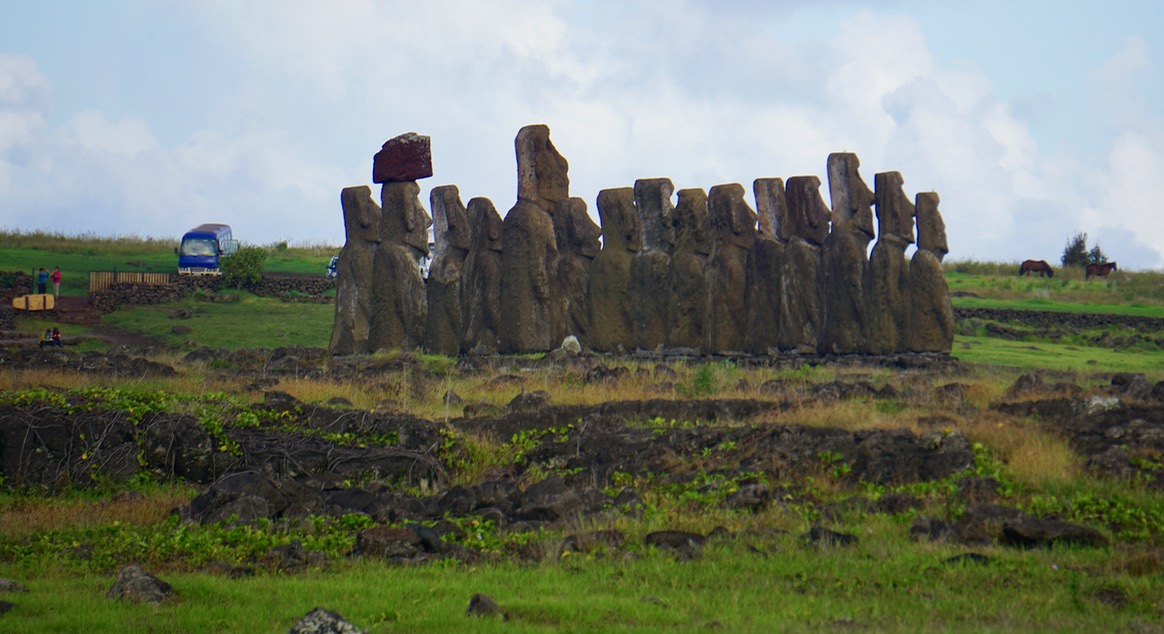
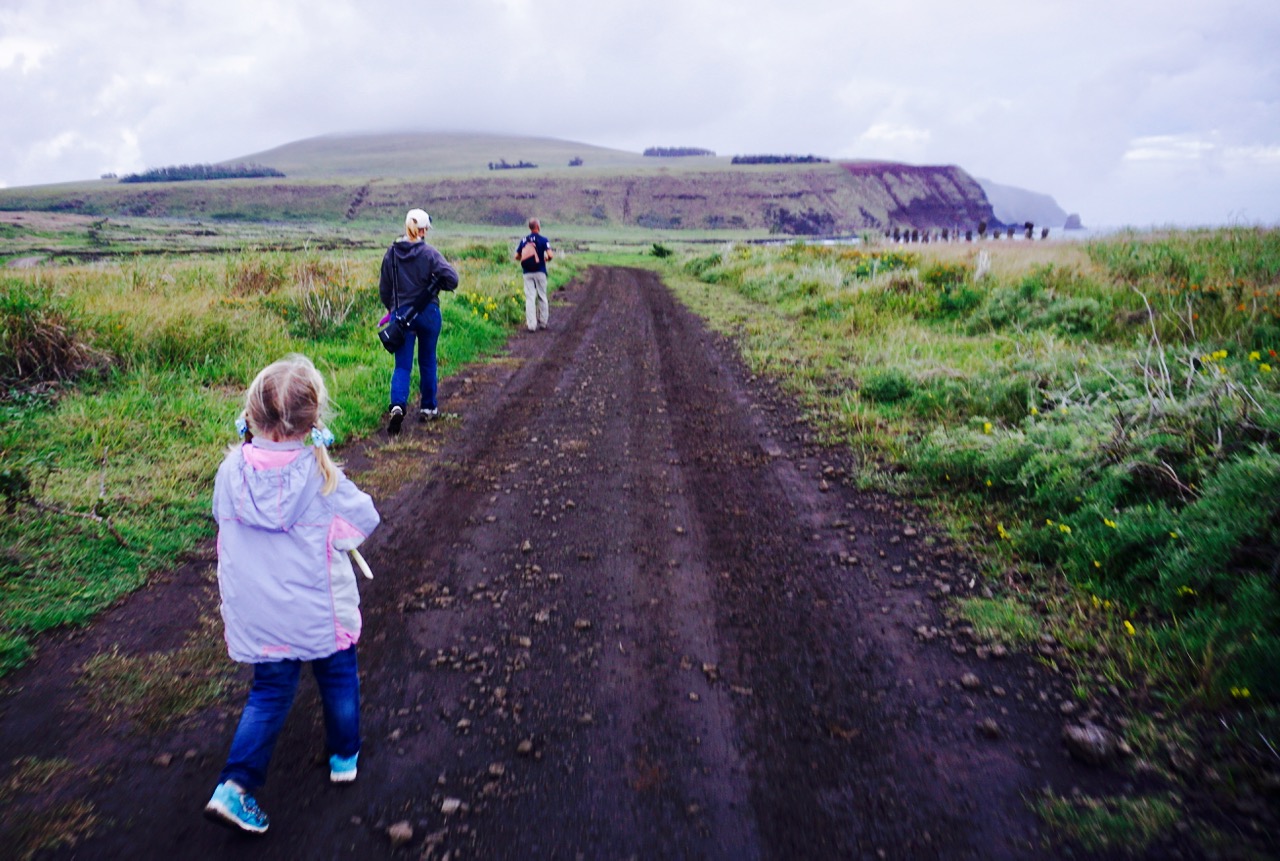
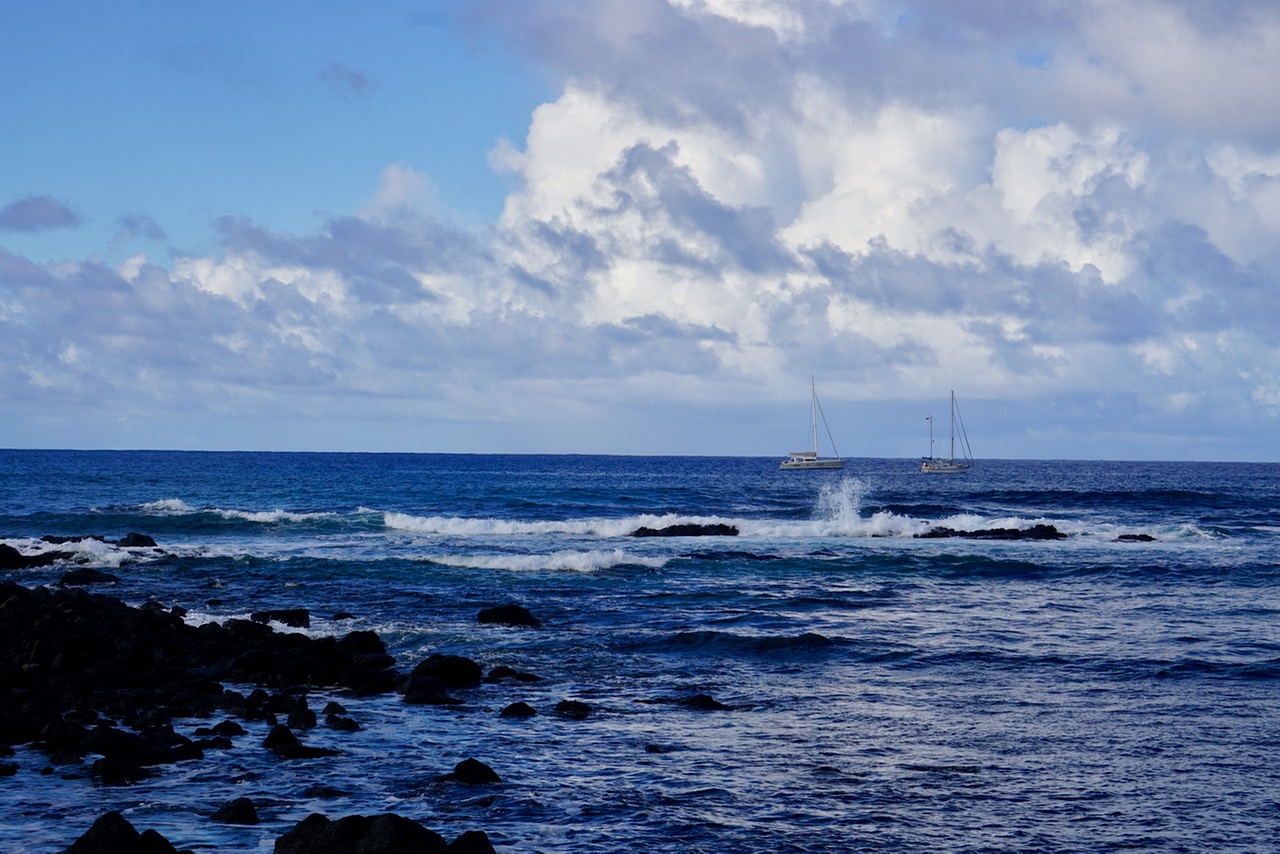
The only photograph from that day:). On the horizon to the right are the Tongariki platform and our bay
Andryukh, do you know the most important thing we didn’t tell them?
What?
That we never meant to enter the park at all; we wanted to go back the way we had climbed. And when the rider told us to go down to the statues and then vanished, we thought he was trying to keep us from getting ourselves killed. So we followed him straight into the trap.
That’s always how it is with me—the coherent answer comes when it’s already too late. I simply lose my bearings when someone shouts at me. Something lost and forlorn switches on inside me. And nothing comes to mind except distress.
That’s enough worrying!—the captain says the next morning, and climbs the mast to repair the wind generator.
Yes, enough; it’s over and done with,—I say, sitting down to breakfast with the children.
Ten minutes later, we hear the roar of powerful engines, and a grey-and-orange launch appears alongside, bearing the inscription “ARMADA de CHILY”....... We really are in trouble after all...
To be continued!