
From the Travely-Family archive · Pacific Ocean
Second Foray onto Easter Island
An original publication from the former Travely-Family website. This English translation was preserved from the technical-site archive without editorial rewriting.
Second foray onto Easter Island. Passage to the sheltered side. Anakena Bay, a sacred place of the ancient Rapa Nui people. The yacht as a swing at anchor. Descendants of cannibals, both stone and living. Weather forecast.
In the morning the wind veers, and the yacht turns broadside to the shore and bow-on to the swell, which pounds us like a giant football.
“We need to get out of here!” says the captain.
“Well, let’s at least have breakfast without all the drama,” I plead.
We are leaving behind the only glimmer of connectivity we’ve had in the past month. It is probably strange to write about Easter Island and not post any photos.
But I can’t get through to the website. And once we round the headland, the last crumbs of internet will disappear. We seem to be anchored beside an island, yet we are still sending posts by satellite, just as we did out in the ocean:). And, of course, there are still no photographs. The archives are piling up, waiting for the day when I can settle into the internet café in the island’s only village and illustrate all our reports from the past few months. We can’t reply to your comments, but we devour them eagerly. Write to us, friends! For the third day running, we are enjoying bread and butter and cheese with sweet tea—a pleasure that has long been beyond our reach.
After breakfast, the captain gives the order to weigh anchor. Nastya hauls up 100 metres of chain while I wedge the flying plates into corners. We have barely secured the anchor before the waves drench us almost over our heads. In two and a half hours beating into the wind, the deck, rinsed fresh by the rain, is thoroughly salted by the waves. Because of the weather conditions, we move to our original intended anchorage, Anakena Bay. It was here, on the island’s finest natural beach, that the first Polynesian settlers landed.
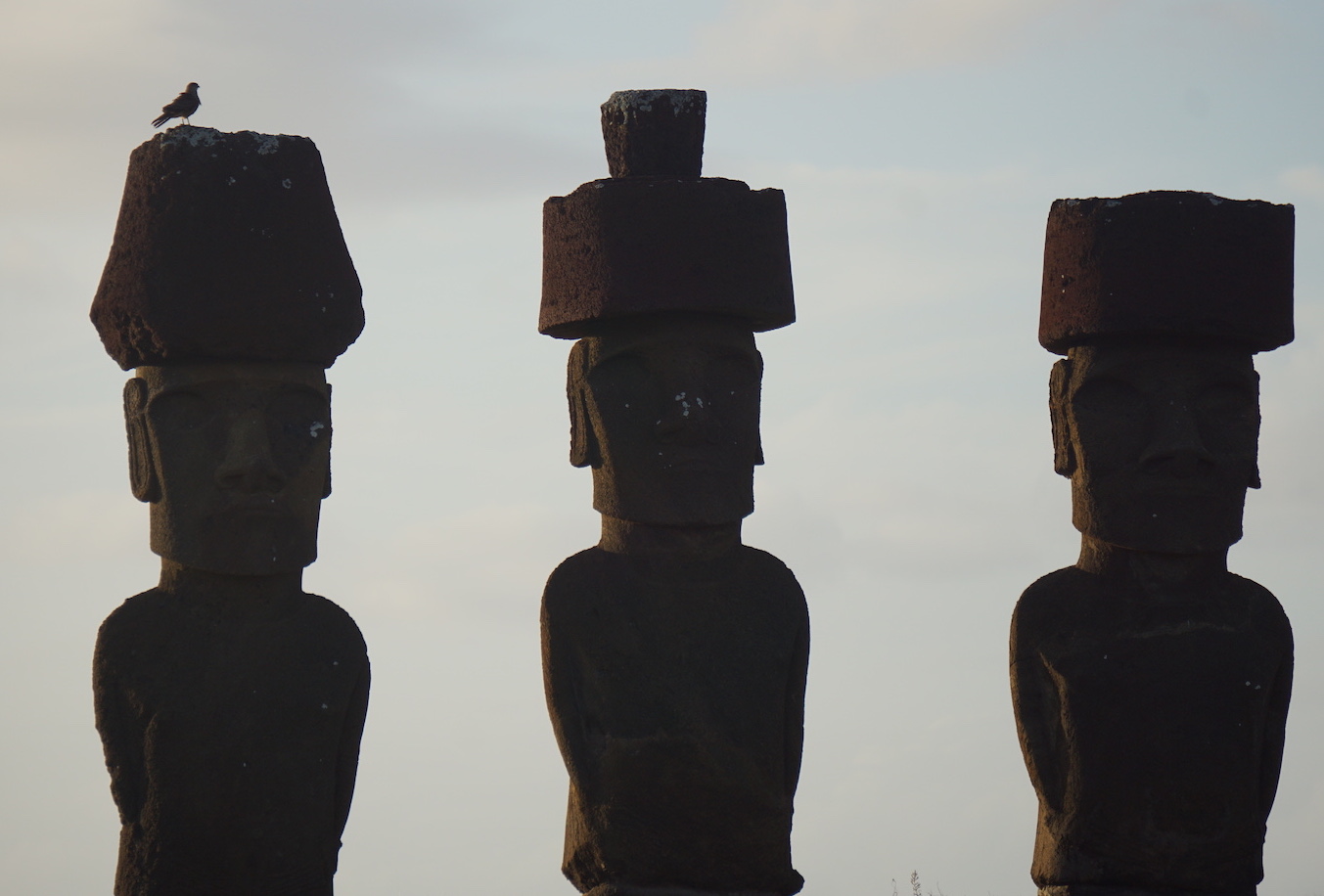
Moai in Anakena Bay
Their chief, Hotu Matu’a, is something of a national hero, although everything known about him comes from legend. No one knows exactly when Hotu Matu’a brought his people here, but it was certainly no earlier than AD 400 and no later than AD 1200. Anakena Bay. Thor Heyerdahl’s expedition vessel lay in Anakena Bay in 1956. They pitched camp ashore in the shadow of the stone idols. That is where we want to land too. The wind has shifted, but not yet far enough for the shore to shelter us from the swell. The two-metre ocean swell hits us broadside, tossing the anchorage—and us along with it—even more violently than during the passage.
At least we are not heeling. The beam swell doesn’t merely make it impossible to relax. It makes everything impossible. You brace your legs apart to keep from sliding back and forth along the bench with an amplitude that threatens the integrity of your backside. Meanwhile, the shore is crowded: Rapa Nui islanders and tourists have come out for the beach and a barbecue.
The three most inquisitive ones swim out to the yacht and are embarrassed to discover me in the companionway.
“Oh,” they say. “Hi!”
“Hi!” I smile, and bury my nose in my book.
How are they not cold? I’m wearing a hoodie. Today has not been a particularly productive day. We were tossed around for two hours during the passage, and now we are flying from side to side at anchor. Articles refuse to be written, video refuses to be edited, and no one is getting ashore. The crew has devoted itself to reading, while its youngest member has also devoted herself to whining about how, “Oh, my wings hurt so much!” Yesterday she walked 10 km after a month aboard the boat, then had a vigorous workout on a merry-go-round, spinning herself and everyone around her.
I watch sadly as our young sailor changes: whenever there are lots of Spanish-speaking children around who want to talk to her, she falls silent. It is as though she remembers fewer Spanish words than she did a year ago in Mexico. And all the while she thinks she’s terribly grown-up. Our little chatterbox is growing up.
Diary entry, early morning: Monday, 14 May
This isn’t an anchorage, it’s a complete bloody nightmare. We are being rolled all over the bed. Everything is rattling; thank God nothing is flying about—we secured it all firmly, just as we do on passage. But the tossing and howling are something else. We slept badly... While making tea, Nastya and I both scalded ourselves from the dancing kettle. We decided to have breakfast ashore: sandwiches, fruit, tea from a thermos, and cold hibiscus tea. We pack our rucksacks and, risking life and limb, climb into the lifeboat (also known as the dinghy). We row ashore. To our surprise, we land in one piece and almost dry.
A middle-aged woman and a boy of about seven are walking along the beach with a rubbish bag. The woman holds out her hand.
“My name is Tau. Tauranga Hoku.”
“Marina. Andrey.”
“Ana,” Nastya introduces herself. Foreigners usually find Nastya or Anastasia difficult to pronounce.
“Anita!” Señora Tau immediately turns her into little Anya.
The boy is shy. His name is Kailo. We walk together, tossing the rubbish we collect into the bag, then climb up beneath the palms to have breakfast while gazing into the sleepy faces of five stone idols. By noon, people begin gathering on the sandy dunes beside the statues. Señora Tau treats us to coconuts picked up beneath the palms. Beside the stones, under a spreading tree, a fire smoulders with two kettles on it. Her companion, Julio, scrapes the coconut flesh clean against the stones and seems to hear that our young sailor is terribly hungry and wants coconut water. Deftly, he chips the top off the torpedo-shaped husked coconut and hands it to a delighted Laduska. Julio keeps an eye on things, shooing away exuberant tourists who try to climb onto the platform or go where they shouldn’t.
“My house is over there, behind the trees. It has no electricity; in the evenings I light candles. Where are you from?”
“We live on a yacht, and we’re from Russia.”
“Oh. Far away, cold... I know Kaliningrad in Russia; it has access to the sea.”
As we talk, we draw a map of Russia, Siberia, Europe, and Africa in the dirt. We agree that we have strayed rather a long way from home.... A smoky-coloured mother hen clucks her chicks towards invisible grains, while somewhere a fatherly rooster trumpets reveille. A calico cat squints lazily in the sun. Our young sailor drinks coconut water from the narrow shell cup.
“Is there any way we could find a horse for our young sailor?” the captain asks Julio.
“Of course! My friend lives behind that fence. He keeps horses.”
And Julio unexpectedly disappears.
“Anita, would you like coffee?” Señora Tau is working her magic at the improvised outdoor kitchen beneath the tree.
“Say yes,” I tell her. Nastya nods modestly. Tauranga hands the junior crew member two mugs—one is for me.
From the direction in which Julio disappeared, a caballero comes galloping up on a spirited horse. The horse nibbles a willow bush, Lada and the little boy feed grass to the placid gelding, and the owner, whose name is Andres, places a boiled chicken on the table.
“Would you like some?” he asks Nastya and me in Spanish.
“No, thank you! We’ve just eaten,” we reply in a hybrid Anglo-Spanish tongue. Our Spanish-speaking captain isn’t nearby; he is over there establishing a mental connection with the horse.
We drink hot coffee, sitting at a rough wooden table with ordinary descendants of Polynesian cannibals. A breeze brushes our faces, and there is a smell of woodsmoke. Tauranga and Andres talk in a mixture of Spanish and Rapa Nui. The water has a strange taste, but that is nothing beside the unexpected feeling that you are almost at home. Like in childhood, on the first trip out to the dacha on 9 May. It is cool, the young grass smells fresh, and you are walking with your mum, dad, sister, and friend to build bonfires and drink tea from a thermos. We felt a similar sense of home and happiness in Altai.
“It’s so lovely here!” Nastya says. “Let’s stay longer.”
“Just like at Nadenka’s,” I agree.
And we don’t want to leave these hospitable hosts, who speak another language and live on an island lost in the ocean on the far side of the Earth, yet with whom you feel such incredible warmth. Andres lets Lada ride the horse. The three of them—young sailor, horse, and captain—proceed along the path beneath the stern gazes of the stone moai. Afterwards, Ladunka stays to play with Kailo and the horse while we explore the shoreline and the fences of the neighbouring ranch. By the time we return, Lada and Kailo are already racing around the beach. Together, we spend a long time wandering through a grove of trees strewn with red flowers. The ocean foams around bony boulders, and horses graze among the thorn bushes.
Beside the volcano we discover a place where the half-wild horses come to die: three skeletons and one horse ready to give up the ghost. Andryukha had read that the local horses technically belong to someone, but in practice they breed and die off the land, left to themselves. Ladunya measures herself against the dimensions of the ritual stone huts of the Māori Rapa Nui elders. There is a tiny entrance, and inside you cannot stand upright. People used to spend the night here while performing some ancient ritual. Beneath a cliff, we stumble upon the humming nest of wild bees. The slopes of the volcano are overgrown with dwarf guava.
“Mmm! I love guava!” Our young sailor licks the sweet pink juice from her lips.
Tomorrow we will bring a mountain of biscuits to have with tea beneath the tree with Tau and Julio. Then we will climb up to the crater. We say goodbye to Tauranga, and she kisses us on the cheeks. Ladunka runs off for a swim, while we wrap ourselves in windbreakers and settle into our brave little dinghy. The captain has made contact with outer space. The forecast promises a storm. We will be changing position.
To be continued. Warm encounters to everyone!
A photograph sent by satellite looks like this (Moai in Anakena Bay