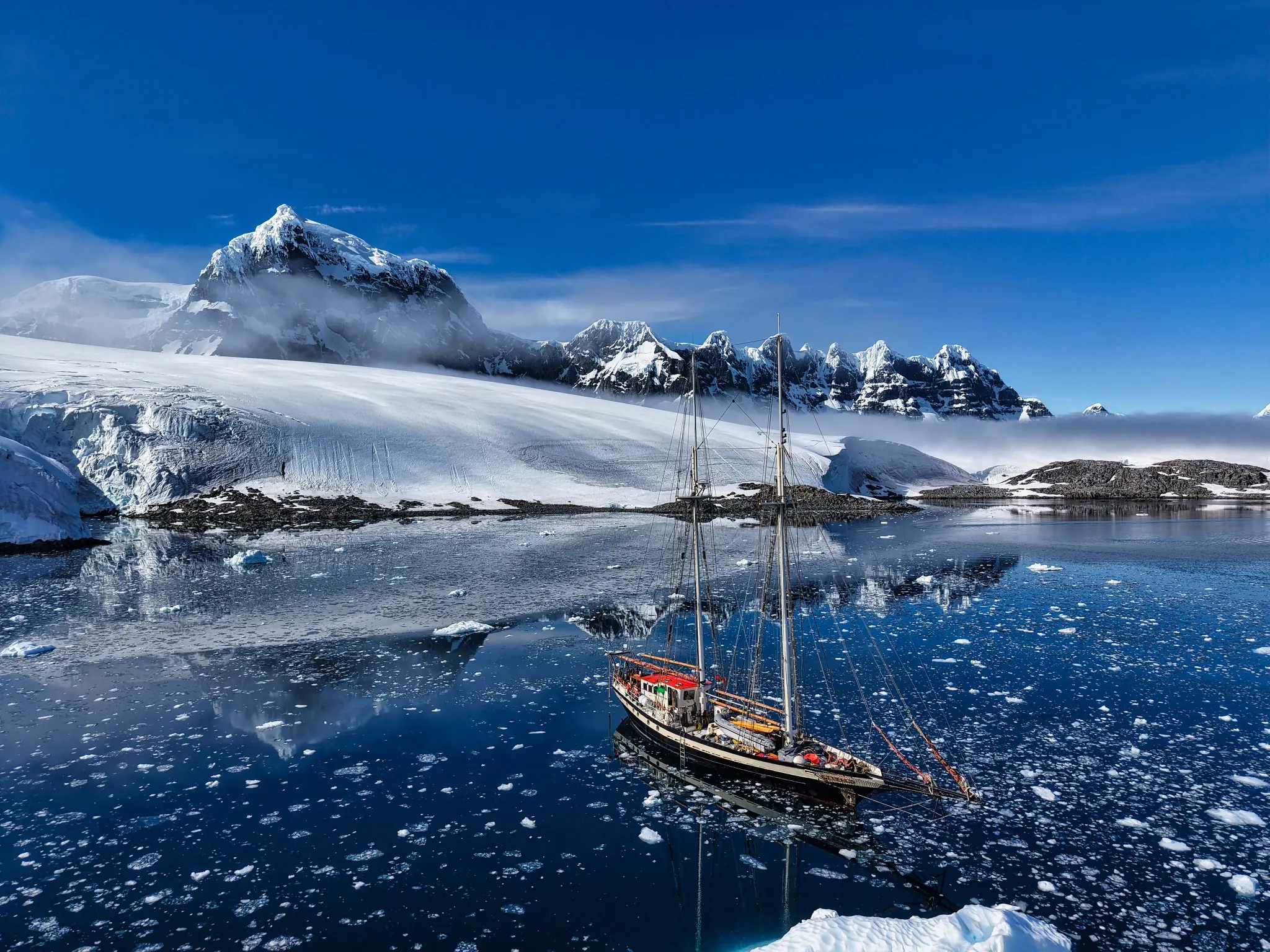
⛵ Format: Fly & Sail – flight from Punta Arenas in Chile to King George Island, a sailing expedition, and a return flight to Punta Arenas.
📍 Duration: 17 days
Group: up to 17 participants
Route: Punta Arenas – South Shetland Islands – Antarctic Peninsula under sail – Punta Arenas
Expedition programme
Day 1–2. Punta Arenas and Bellingshausen Station (King George Island)
Our expedition begins in Punta Arenas, a city on the Strait of Magellan in Chile. At the appointed time we gather at the airport and board a polar aircraft. There are no accidental travellers here: everyone on the plane will soon join one of the sailing vessels.
After a flight of two to three hours, we land on King George Island, home to the Russian Bellingshausen research station.
Even in winter, temperatures on the South Shetland Islands rarely fall below −10°C.
History: The island was discovered by the expedition of Fabian Gottlieb von Bellingshausen and Mikhail Lazarev in 1821. Bellingshausen Station was founded on 22 February 1968 by the Soviet Antarctic Expedition. The island also has one of the southernmost permanently operating churches in the world, the Holy Trinity Orthodox Church, built in 2004.
Day 3. Yankee Harbour (Greenwich Island) and Half Moon Island
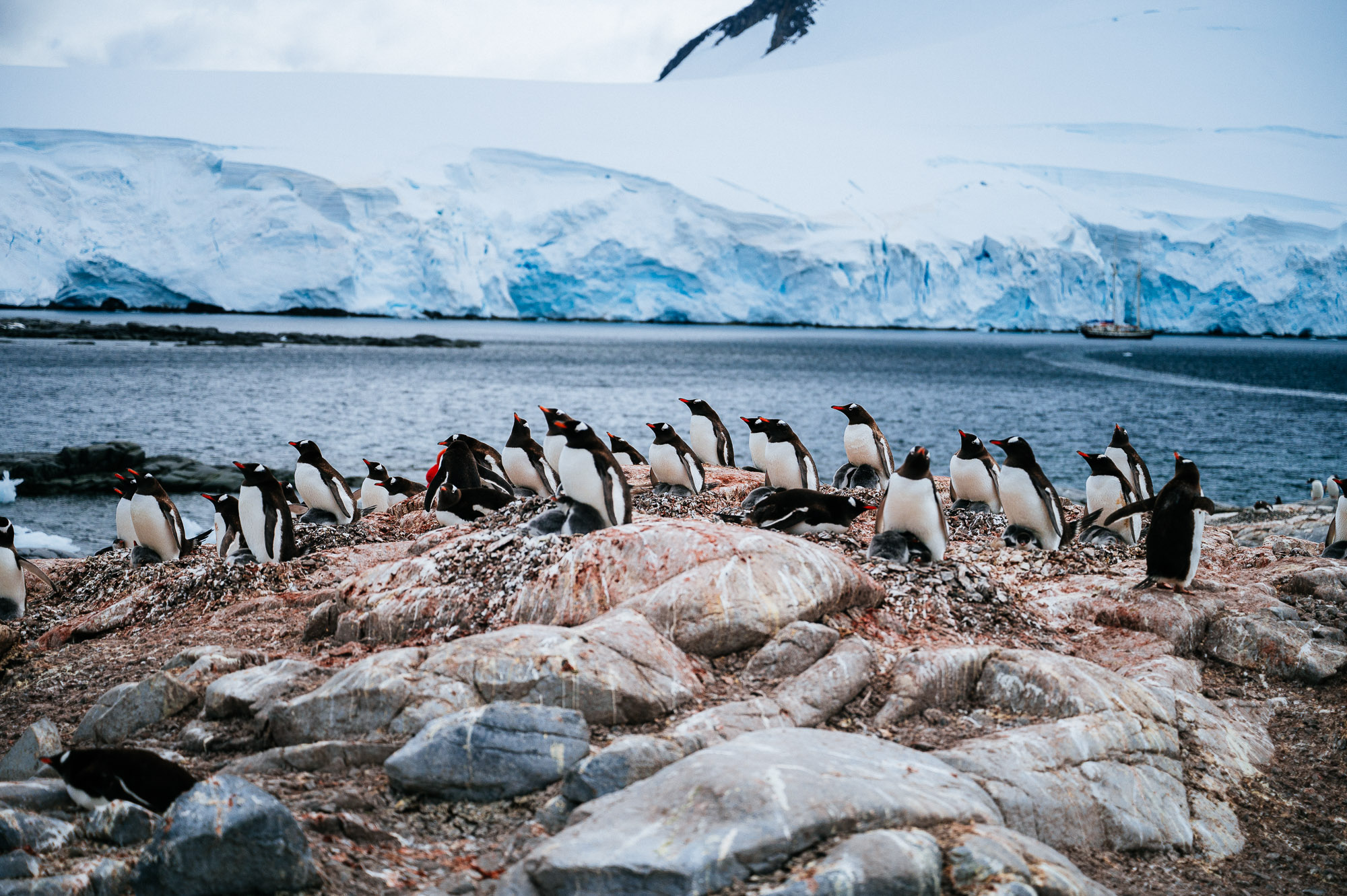
Yankee Harbour is a sheltered bay with a glacier, home to nesting gentoo penguins. From above, Half Moon Island resembles a crescent moon; elephant seals and seals live along its pebble beaches.
History: American whalers and British explorers visited Yankee Harbour from the 1820s. Half Moon Island was first recorded by early nineteenth-century whaling expeditions.
Day 4. Deception Island
Deception Island is an active volcano whose flooded caldera can even be entered by a large vessel. Its inner harbour offers shelter from bad weather, but reaching it through a narrow passage is challenging and impossible in strong winds. Remains of early twentieth-century whaling facilities and research stations survive on the shore. Outside the island, at Bailey Head, is an enormous colony of chinstrap penguins.
History: British and American expeditions explored the island in 1820. The Hektor whaling station operated here from 1905 to 1931.
Day 5. Trinity Island
Trinity is an island surrounded by icebergs. We usually explore the coast by dinghy rather than land, travelling along the glacier. Seals and sometimes leopard seals inhabit the bays. Farther south is the Argentine Primavera Station, where our first landing on the Antarctic mainland may be possible.
History: The island served as a landmark for early expeditions approaching Antarctica's continental coast in the late nineteenth and early twentieth centuries.
Day 6. Enterprise Island
Enterprise Island preserves traces of early twentieth-century whaling. We moor overnight at the wreck of the Gouvernøren and spend the day exploring among icebergs in small boats and watching humpback whales.
History: Norwegian and British whalers worked extensively in the bays around the island in the early twentieth century.
Day 7. Orne Harbour, Cuverville Island and Neko Harbour
In good weather our schooner will drift in the deep waters of Orne Harbour while we follow a winding trail up to the hillside nesting grounds of chinstrap penguins. From the top we see spectacular panoramas of icebergs and mountain slopes on either side.
The neighbouring shores of Cuverville Island hold a large gentoo penguin colony. At Neko Harbour we may see huge blocks of ice calve from a glacier and crash into the water.
History: Orne Harbour was discovered during Adrien de Gerlache's Belgian expedition in 1898. Cuverville Island was explored by Jean-Baptiste Charcot's expedition in the early twentieth century.
Day 8. Lemaire Channel and Yalour Islands
Lemaire Channel is one of the must-see places on the Antarctic Peninsula. It is a spectacular narrow waterway between sheer cliffs. We hope for clear weather as we sail towards the Yalour Islands, where a dinghy excursion among icebergs and Adélie penguin nesting sites awaits.
History: The Lemaire Channel was first noted during a German expedition in 1873–74 and navigated by the Belgian vessel Belgica in 1898. The Yalour Islands were explored by a Belgian expedition during the same period.
Day 9. Port Lockroy
Port Lockroy is a museum of polar life, a shop and one of the world's southernmost functioning post offices. You can send postcards from here and buy souvenirs.
History: Built as a British Antarctic base in 1944, it was used for reconnaissance during the Second World War and later became a research station. Today a small team of volunteers welcomes visitors and studies their effects on the penguins. A well-preserved whale skeleton lies on the shore of one of the small islands, a legacy of whaling.
Day 10–11. Return to Bellingshausen Station and Punta Arenas
We head back through Bransfield Strait to King George Island and Bellingshausen Station. During the passage we hold our light-hearted Golden Drake film festival. It brings together memories and shared crew jokes and makes the rolling of the boat almost disappear.
There are farewells, hugs and the flight to Punta Arenas.
History: Punta Arenas stands on the Strait of Magellan. Before Magellan's voyage, the shores were inhabited by Tehuelche hunters and fishers. Europeans first landed here during Ferdinand Magellan's expedition in 1520. The name Punta Arenas was suggested following English admiral John Narborough's description of the area as Sandy Point in notes from 1669–1671.