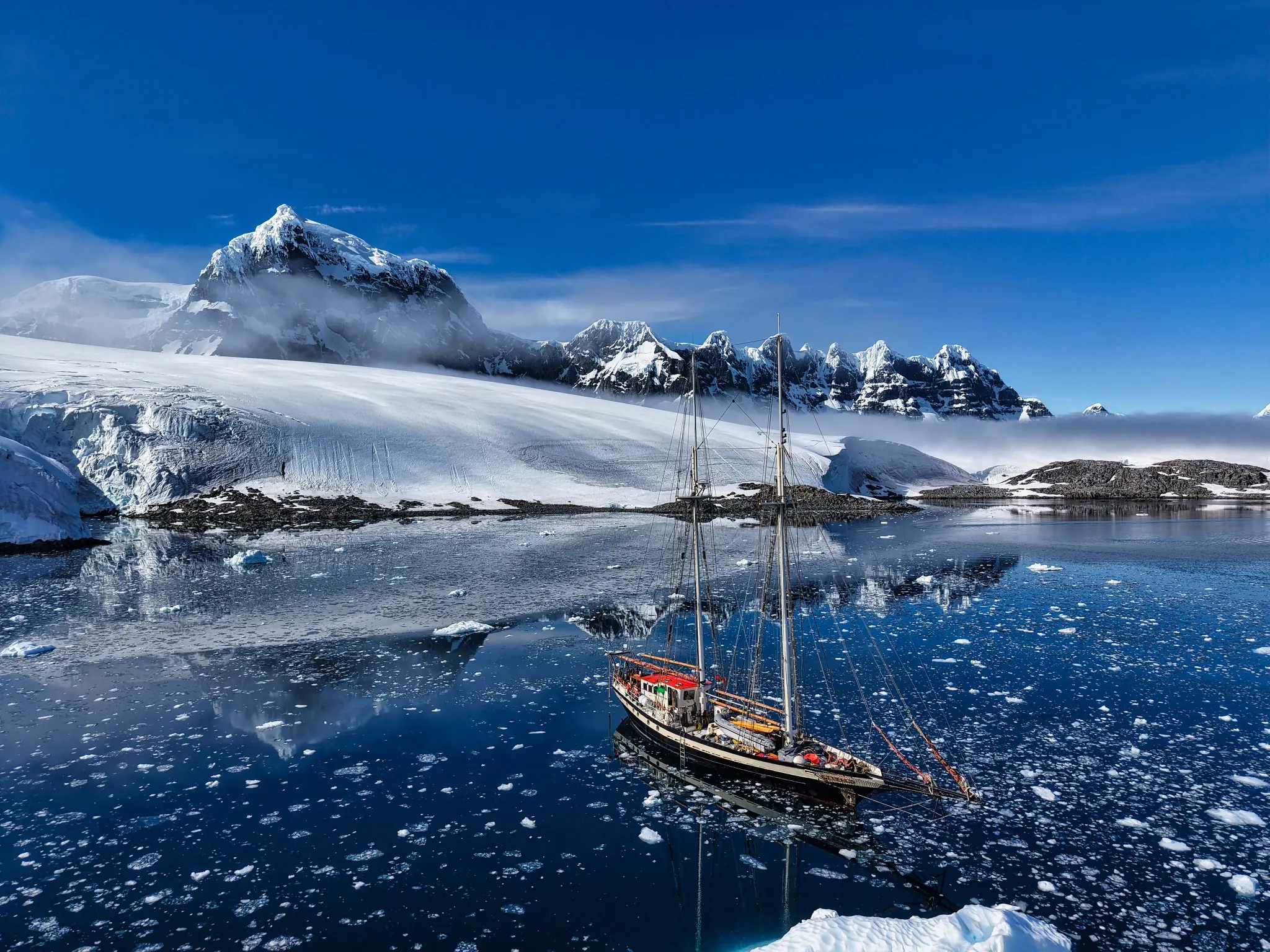
A sailing odyssey to the end of the Earth and back – the complete ocean experience.
⛵ Format: Just Sail – a full ocean expedition starting and ending in Tierra del Fuego.
📍 Duration: 17 days
Group: up to 17 participants
Route: Ushuaia – South Shetland Islands – Antarctic Peninsula – Ushuaia
Day 1. Ushuaia and the Beagle Channel
We meet in Ushuaia, one of the southernmost cities in the world. We settle into the yacht, get to know the crew, breathe the salty air and feel the anticipation: our greatest journey is beginning.
Our beautiful schooner enters the Beagle Channel, named after the vessel that carried the young Charles Darwin around the world. To starboard are the shores of Chile and to port, Argentina.
Keep your cameras ready: we may encounter whales, hourglass dolphins and Magellanic penguins. After the captain's safety briefing, we steer south. About 70 miles later Tierra del Fuego lies astern, and our crossing of the legendary Drake Passage begins.
📍 Fact: The passage is named after English navigator Francis Drake, who reached these waters in the sixteenth century.
Days 2–5. Drake Passage
Four days of real ocean sailing.
The Drake can test our resolve, but it offers extraordinary freedom too. Sometimes the sea is calm; at other times a storm rages. Everything depends on the Southern Ocean's changing moods. Step onto the deck, feel the wind and realise that you are following the legendary route of explorers.
🌊 Fact: This passage is where the Atlantic, Pacific and Southern Oceans meet.
Day 6. Bellingshausen Station, King George (Waterloo) Island
The first Antarctic land appears on the horizon. We go ashore on King George Island, also known historically as Waterloo Island, where the Russian Bellingshausen Station was established in 1968. Polar researchers live and work here studying the climate and ecosystems.
We plan to visit the Holy Trinity Orthodox Church, one of the world's southernmost permanently operating churches, then walk towards the coast and an elephant seal colony. This is also our first chance to meet Antarctic penguins.
🧊 Fact: The station is named after Fabian Gottlieb von Bellingshausen, who explored Antarctica in 1820 together with Mikhail Lazarev.
Day 7. Yankee Harbour and Half Moon Island
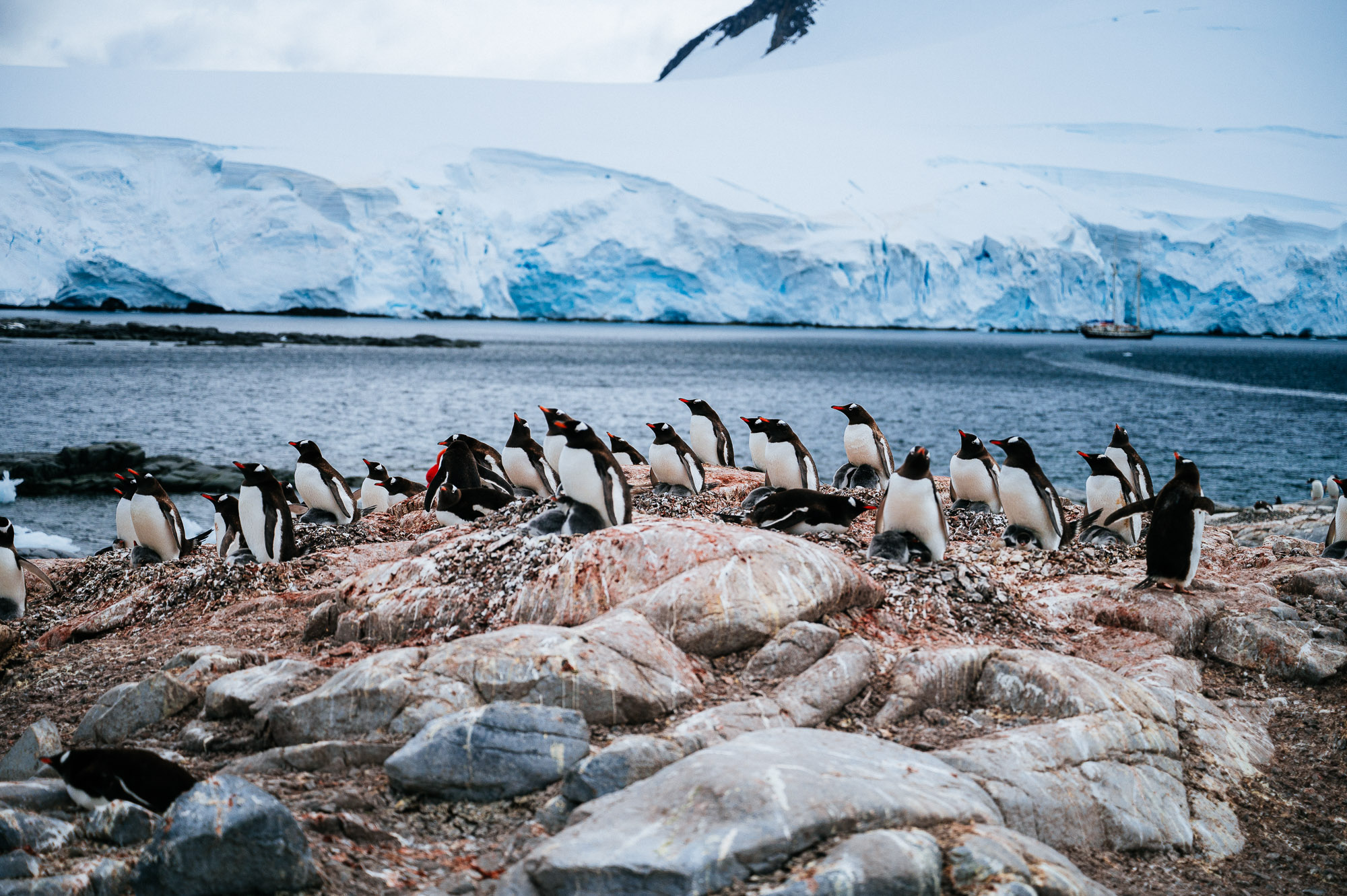
We sail along the South Shetland Islands. Yankee Harbour offers shelter from the wind, with a glacier running down towards the sea. Gentoo penguins share the gently sloping shore with seals and elephant seals.
Then comes Half Moon Island, curved like a crescent. Gentoo penguin colonies live here alongside giant petrels and Antarctic mosses.
🐧 Fact: British whalers encountered these islands in the early nineteenth century and used the sheltered bays during polar storms.
Day 8. Deception Island – a volcano under sail
We cross Bransfield Strait and enter the flooded caldera of the active volcano at Deception Island. Its sheltered crater is large enough for a seagoing vessel. Remains of an old whaling station and whale-oil processing equipment still stand on the shore.
Outside, at Bailey Head, an enormous chinstrap penguin colony awaits.
🔥 Fact: Geothermal activity can warm coastal waters at Deception Island to around +10°C in places.
Day 9. Trinity Island and a possible first mainland landing
We pass Trinity Island among icebergs as grand as cathedrals. Leopard seals often rest on the ice.
Farther south lies an area near the Argentine Primavera Station. If the weather allows, we may be able to make our first landing on the Antarctic mainland.
📖 Fact: The original programme relates the island's name to Prince William, Duke of Clarence and St Andrews, and nineteenth-century British voyages.
Day 10. Enterprise Island
This is a place with a rich whaling history. We moor near the remains of the wrecked Gouvernøren and set out to watch whales.
If we are lucky, we may witness bubble-net feeding: humpback whales herd krill into a rising spiral of bubbles.
🐋 Fact: The Norwegian whaling vessel Gouvernøren sank here in 1915 and its wreck is now used as a mooring point by visiting yachts.
Day 11. Orne Harbour, Cuverville and Neko Harbour
In good weather our schooner drifts in the deep bay of Orne Harbour while we climb a winding track to a high nesting area of chinstrap penguins. From above, we can look out over icebergs and snowy slopes all around.
Nearby Cuverville Island has a large gentoo penguin colony, while at Neko Harbour we might see huge blocks of ice break off a glacier and crash into the sea.
❄️ Fact: Neko Harbour was named after a Norwegian whaling ship that explored the bay in the early twentieth century.
Day 12. Paradise Bay, Lemaire Channel and Yalour Islands
Paradise Bay is paradise indeed! Blue glaciers, shining walls of ice and mountains reflected in still, marble-like water explain its name. Whales often visit these waters. Near the entrance to the bay are Chilean and Argentine polar stations. We hope to go ashore at one of them and spend the night in a sheltered anchorage inaccessible to larger vessels.
Then comes Lemaire Channel, a narrow passage between spectacular cliffs. In good weather we admire the sheer rock faces while humpback whales surface nearby. Ahead lie the Yalour Islands, the southernmost point on our planned route, with their colony of Adélie penguins. We thread our dinghies between ice floes to visit their nesting grounds.
🐧 Fact: The islands were named after Édouard Yalour, a French sailor associated with Charcot's 1904 Antarctic expedition.
Day 13. Port Lockroy and the Melchior Islands
One of the most impressive anchorages on the peninsula lies by a glacier overlooking Port Lockroy. Today there is a museum and one of the world's southernmost post offices, where you can send a postcard to any part of the world.
💌 Fact: Port Lockroy was established in 1943–44 under Britain's Operation Tabarin, a wartime Antarctic mission.
Near the entrance to Drake Passage lies the Melchior Islands group. An inactive Argentine station and an emergency refuge stand here. Late in the season, countless fur seals congregate along these shores. We photograph the snowy landscape from the island's high ground and prepare for the passage home.
Final. Return across Drake Passage to Ushuaia
It is time to head home, with the Drake Passage offering one more challenge. A second crossing reinforces everything we have learned. We find our sea legs, stand watches and grow into the rhythm of the ocean.
On the last day before entering the sheltered Beagle Channel, we hold the Golden Drake film festival, where cinema, laughter and team spirit replace the last traces of seasickness. We have crossed one of the world's stormiest passages again – and have every reason to be proud.
Back in Ushuaia, there are farewells, a barbecue at the yacht club, Argentine wine and conversations with the crew. We sailed to Antarctica and back. We did it!