
From the Travely-Family archive · Cape Horn
South Africa. A Strategy for Settling In. Teeth and Farms
An original publication from the former Travely-Family website. This English translation was preserved from the technical-site archive without editorial rewriting.
South Africa. A Strategy for Settling In. Teeth and Farms
“If it weren’t for the blacks, this place would be paradise”
“If it weren’t for the whites, we’d have a good life”
“We don’t have crime like this in Zimbabwe. But there aren’t any jobs either”
“South Africa has no future”
“South Africa has a bright future”
Ever since we arrived in the port of Cape Town, there hasn’t been a single post on the website.
And not because nothing has been happening, but because far too much has been happening.
Little by little, three and a half weeks have passed since our arrivoodle. During that time, we fell ill and almost recovered, enrolled our young sailor in school and after-school care, and sometimes even sent her off to boarding school overnight. We sent our crewman “to the galleys”—off to study for his captain’s qualification on a five-day trip away from home. We held a wonderful gathering with the support of the Consulate General and visited an old gentlemen’s club. We went visiting and celebrated Andryukha’s birthday in Table Mountain National Park, visited art galleries and went shopping, and attended a football match in the Very VIP area as guests of the owner of Cape Town City FC.
The girls and I went to see Maleficent at the cinema, dashed off to Cape Agulhas and two wine farms. We danced ourselves silly at a Ukrainian festival and in a nightclub, met up with friends, and are planning to round the Cape of Good Hope with them. And all this time we were also sanding the walls, replacing the anchor chain and shrouds, ordering and installing new solar panels, keeping house, and constantly writing something. For some reason, though, none of it made it onto the website; it all settled on Risk.ru, Instagram, and the other social networks. Dear beloved website and readers, please don’t be offended!
I keep wondering how to present our South African story on the website. This country has more contrasts than, honestly, anywhere else we have encountered in the world. And to sort it all out, we need to devise a system—a system for presenting the material and a system for settling into all of this.
A Country of Contrasts
“If it weren’t for the blacks, this place would be paradise”
“If it weren’t for the whites, we’d have a good life”
“We don’t have crime like this in Zimbabwe”
“South Africa has no future”
“South Africa has a bright future”
“You’ll like it so much here that you won’t want to leave”
“There’s a reason everyone who could has already fled”
“Paradise lost”
“The Promised Land”
“Nowhere else offers both luxury (opulence and comfort) and such magnificent nature”...
Well, you get the idea—South Africa is a country of contrasts.
So, let’s take it in order. Little by little, the coloured shards of the Cape Town kaleidoscope will come together into some kind of stained-glass window. It will include:
People and history
Nature and rhinos
National parks and lions
The great Cape of Good Hope and its neighbour, Cape Agulhas
Crime and city life
Art and sport
Fellow countrymen and celebrations
Wine, tea, and other farms
Russian school and African medicine
And many other things we don’t even know about yet.
Let’s go.
An Effective Strategy for Settling into a Foreign Country
Our system for arriving in a new country, refined over the years, has reached peak efficiency. The essence is simple: besides gathering information about the country and its power spots, formalities, and local situation, the first thing I do is reach out to the Russian diaspora through Facebook.
By now I have achieved near-perfection in this regard, though my first attempts were rather feeble.
My first stab at it was on the island of Grenada on the eve of 2017. We had crossed the Atlantic, spent some time in French Guiana, and headed for the Caribbean. For almost four months, the crew had spoken their native language with no outsiders at all, and we were desperate for company. And then there was New Year’s Eve. We celebrated it with Lyonya Vorobyov, captain of the yacht Laska, who had timed his arrival in Grenada perfectly. Rest in peace, Lyonya...
In some yachting group, I put out a call along the lines of: dear friends born in the USSR, why don’t we celebrate New Year together? That was how we met Lyosha Solyanik from Odesa (known online as Goolfstreamer) and Dasha Olen. And we ecstatically bawled out the anthem of the Soviet Union beneath the New Year’s fireworks, waving a bottle of wine. It was brilliant.
The Facebook group for our compatriots in Mexico gave the coolest reception to the arrival of our round-the-world yacht. But even there we found Vit and Ulya from the yacht Chaka-Chaka.
We had a lovely stay on Isla Mujeres; then
Igor Kiporuk and Marina arrived, and life glowed even warmer. We weren’t upset by the coolness of the Mexican Russians on Facebook, because we had friends in Puerto Aventuras anyway: Nastya, from my childhood in Zlatoust, and the family of Anya and Igor from Kyiv.
Our welcome in Colombia was wonderful. The Facebook group there immediately invited us over. We visited Anya for a dumpling party, and on the way back stayed with Tanya in Medellín.
And in the capital, Bogotá, we stayed with the wonderful Alexander Pavlovich and Elena Stepanovna, who welcomed us as if we were their own children. It turned out that ten years earlier, Tanya from Medellín and I had attended belly-dancing classes together in Novosibirsk. Later, Anya and Alexander Palych with Elena Stepanovna even flew out to visit us aboard the yacht—in Cartagena and Panama, respectively.
Then came
Polynesia and its epicentre—the island of Tahiti.
No need for a fortune-teller to know whom Lady Mary was racing towards under full sail. For four and a half years, right from the start of our yachting life, we had been gradually aiming for Max and Natasha, Ksyusha and Polina, and their yacht, Theophania.
Over that time, the gang had grown accustomed to us and even come to love us from afar:), so they welcomed us like family.
Overjoyed, we set off across half the Pacific in one forced march to the far south of Patagonia. Here, my plan to rely on the Russian diaspora did not pay off straight away. The “Russians in Latin America” group declared flatly that there were no compatriots in Ushuaia, and after that I didn’t particularly look for any. Only at the very end did it turn out that there was indeed a community of around twenty people, adults and children included. No sooner had we started becoming friends with them and taking our young sailor to Russian ballet than it was time to leave. We still send one another messages. In the Strait of Magellan, we were showered with affection by Kristina and the crew of the trawler
Arctic Wolf, and by the time we headed for South Africa, we were fully prepared. I had written to the “Russian Speakers in South Africa” group in advance. The whole crew melted in the glow of such a warm welcome and such eagerness to meet us.
On the way to the Cape of Good Hope, the Consulate General of Russia in Cape Town also contacted us through Facebook and our shore team. We arranged a gathering where we met a whole host of interesting people.
And the Cape Town kaleidoscope began to spin from the moment we entered the Cape Town harbour made legendary, thanks to songwriters and Mikhail Boyarsky...
Teeth and Doctors
While we were still out in the ocean, after a storm slightly broke one of my front teeth, we contacted Tanya by satellite. As a result, immediately upon arrival I found myself in a dentist’s chair, and afterwards even in the chair of a cosmetologist—the wonderful Yana, who had moved here from Donetsk with her husband Sasha five years earlier. I was greatly encouraged by the approach, familiar to me from Russia, and the prices that didn’t bite too hard.
First, we had my teeth fixed. After all, I had to speak before the Russian-speaking community somehow, without hiding behind a Baba Yaga mask. You can find a dentist around here, but appointments with them, as with any other good specialists, are booked months in advance. It was only thanks to the efforts of Tanya, a true magician, that I managed to land in a dentist’s chair just one day after arriving. The captain and I were preparing to faint when the price was announced, but the sum of $210 for restoring four front teeth instantly snapped us out of our stupor.
The dentist was somewhere around the town of Paarl—or was it Wellington?—about 50 kilometres northeast of Cape Town. This is where the famous, as it turned out, “wine triangle” slumbers sweetly in the rays of the southern sun.
Did you know that South Africa is not just rugby and a football club, not merely apartheid and Nelson Mandela, and not so much rhinos and giraffes, but also a wine region that puts Champagne in the shade? We had never even thought about it.
And indeed, coming to the Paarl–Stellenbosch–Wellington area is more dangerous than visiting “crime-ridden” Cape Town. Why?— It’ll suck you in and you’ll never get away.
The honest truth. And this is the second place on our route where I have said, “It wouldn’t be bad to live here.” The first was Colombia.
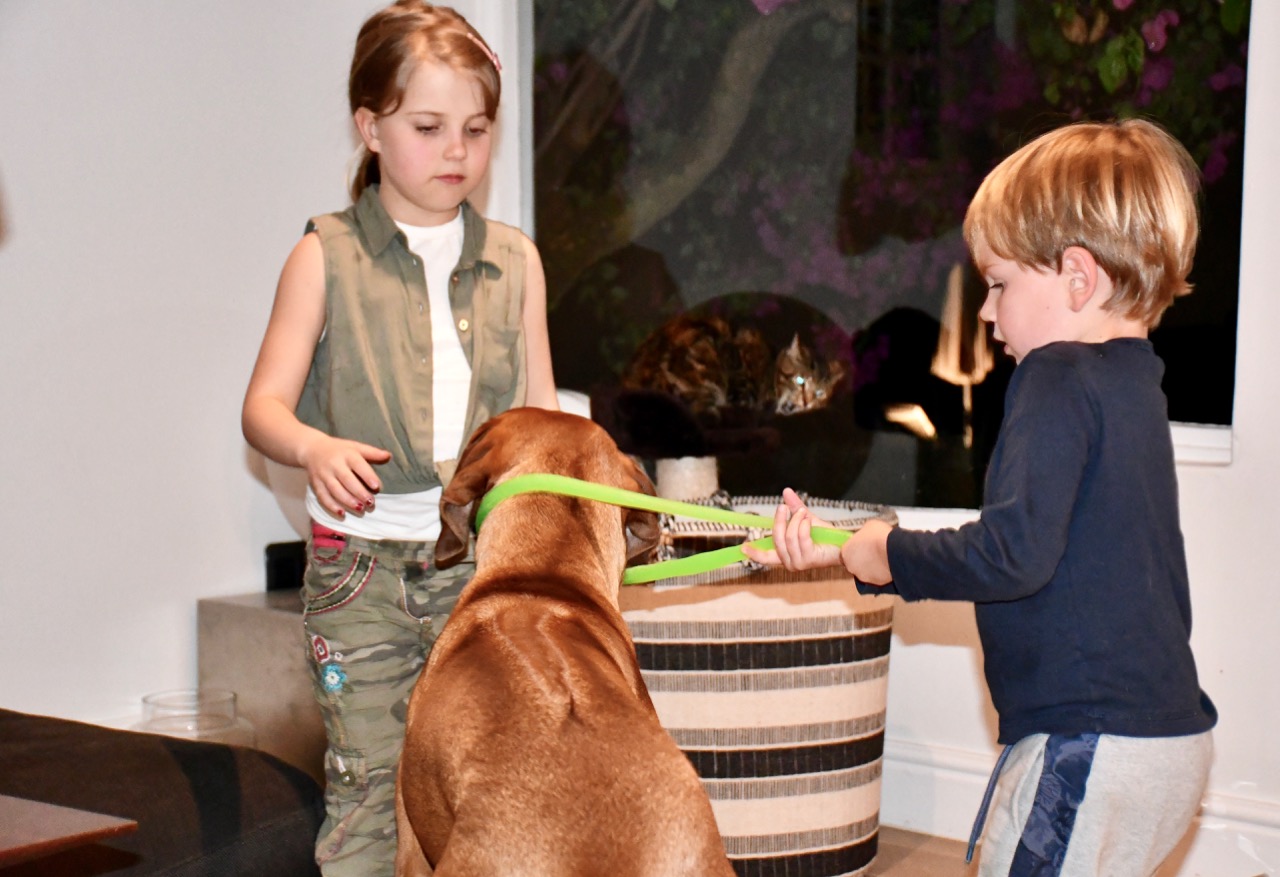
On the way to the dentist, we stopped by a field where dogs—and their owners—train for shows. The handsome dark-red dogs were Rhodesian Ridgebacks, a breed developed in Southern Africa specifically for hunting lions. Rex and his companions came bounding cheerfully to greet us. We got acquainted with them and their owners while stuffing ourselves with strawberries beneath the fading drizzle.
Tatyana wasn’t alone in the field, but accompanied by two other Russian-speaking women and their pets. They also live on farms. There are horses and wine there, and goats with bougainvillea. It was they—the women, not the bougainvillea—who told us that South Africa was pure paradise. “You’ll sell your boat here, guys, and want to settle down—just you wait.”
After midday, chewing over this information with my new teeth, my companions and I went to visit Tanya Kholkina and her husband Tom. At a wine farm called Tempel Wines.
Visiting a Farm
The perfect road streams between rolling hills, sheer cliffs frame the valley, and we look out of the windows without always grasping that this is Africa. Because South Africa is an Africa that immigrants from the Netherlands, Germany, Protestant France, and all the others who “flooded in” later spent 300 years turning into Europe. And, most uniquely, they succeeded! In my humble opinion, that trick has worked only four times in the world: here, in North America, in Australia, and in New Zealand.
The heavens sensed our admiration and, just to be safe, burst into tears again. So we postponed exploring the grounds—I love wandering around an estate—until the weather improved. For the time being, we explored the old house, the collection of ancient pre-Columbian figurines, and the winery.
Tanya and Tom have not been in South Africa long, about two years. Before that, they lived and worked successfully in the Emirates. Tom approached winemaking thoroughly. He built a new winery, which will soon resemble a contemporary gallery of wine and art. (Check out the walls.)
Pinotage, a popular grape variety in South Africa, produced its first harvest and then obligingly withered away in winter: some nasty little bug had taken to gnawing the roots. They had to say goodbye to the vineyard. The land had to be treated and fertilised, and first oats and then new vines planted there. The soil was scientifically analysed, six different types were identified, and an entire panel of experts developed a strategy for restoring it. Tom selected the varieties best suited both to the soil and to himself.
The farm has its own winemaker, Neil, a progressive, enthusiastic young man. At the time of our arrivoodle, Neil was doing an internship in France, at a real old wine château.
Incidentally, two of Tom and Tanya’s three wines were included in a catalogue of Africa’s finest wines, with four stars out of a possible five.
As at many other wine farms, you can stay at Tempel Wines.
There are well-appointed rooms with every amenity, a swimming pool, and a barbecue prepared by the host.
Actually, it is wrong to call all this “outrageousness” a farm. After all, what is a farm? Agricultural land and a house surrounded by apple trees—or banana trees, if you’re lucky. But here everything is different... To be continued.