
From the Travely-Family archive · Other Entries
Expedition to Cape Horn to Meet Fedor Konyukhov—and the Flotilla’s Unexpected Split
An original publication from the former Travely-Family website. This English translation was preserved from the technical-site archive without editorial rewriting.
Expedition to Cape Horn to meet Fedor Konyukhov—and the flotilla’s unexpected split. Chronicles. Transmitted via satellite.
Yesterday morning, as part of a flotilla of three yachts, we set out to meet Fedor Konyukhov’s rowing boat. A tricolour flag the size of the coachroof flies proudly from the mizzenmast. You can see it from miles away! We have two guests aboard our Lady Mary: Dasha, a documentary filmmaker, and Ivan, a friend of the Konyukhov family and Fedor Filippovich’s godfather-by-proxy.
On the first day, a following wind of 35 knots blew along the Beagle Channel, with gusts reaching a storm-force 43 knots. We reefed the mainsail, then dropped it; we progressively reefed the genoa until it was the size of a pocket handkerchief, under which we flew along at 7 knots. Lady Mary, finally let loose, galloped over waves unusually high for such a narrow strait.
Off Chilean Puerto Williams, the flagship of our flotilla, Australis, caught up with us. Nimbly rounding the foaming breakers by the lighthouse on a tiny islet, we entered one after another into the sheltered bay beside the southernmost village on the planet.
Australis anchored, while we rafted up six boats out at the pontoon of our beloved Micalvi Yacht Club. Sarah—the third yacht in the fleet—arrived afterwards. We went through the Chilean entry formalities as one organised crowd, while the captains, led by Oscar Konyukhov, headed off for a briefing with the Chilean Navy. The latter was represented by no fewer than seven people. The officers recommended Martial Bay on Herschel Island as an anchorage because of its shelter and proximity to Cape Horn. The Chilean Armed Forces are assigning a naval vessel to escort the flotilla for safety. They will also send a helicopter to the Cape Horn area on 9 May to pinpoint the position of the boat Akros. So, all in all, we’ll be celebrating Victory Day with a pretty impressive parade of Chilean military hardware.
A couple of hours later, we cast off from our neighbours and continued along the Beagle Channel into the night. They say that in Puerto Toro, 20 miles farther south, you can not only anchor but also go ashore. In the pitch-black bay, we can just make out the outline of some vessel; lights are burning ashore, a spotlight from Australis shines onto our stern, and the saloon lights of Sarah smile at us from ahead. Sarah’s anchor chain rattles out, and we circle around, preparing our own anchor.
“Marinochka, what’s that ahead? Shine the torch over there.”
The beam lands on a round buoy. A thick rope stretches from it close beneath the surface of the water.
“Astern!” I shout at the top of my lungs.
The skipper puts the engine into reverse; the rope flaps around just centimetres from the propeller, and we safely creep back closer to Sarah. We anchor, and then Australis arrives too.
At ten in the evening, the three yachts confer by radio: Oscar aboard Australis, Mikhail aboard Sarah, and Andrei aboard Lady Mary. The original plan to shelter behind Cape Horn is replaced by another one. On the morning of 8 May, breakfast at 8, departure at 10 for the Hermite Islands, where we will wait in Martial Bay until lunchtime on 9 May and then head for the Horn. The distance to our objective is about 15 miles along the route. Being the smallest, our yacht is slower. Therefore, in order to arrive at the designated location at roughly the same time, we need to leave a couple of hours earlier.
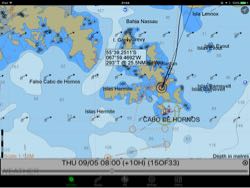
As soon as dawn touched the tops of the trees bent by the force of the wind, the chain rumbled into the anchor locker. We set a course south. Compared with yesterday’s 35–40 knots, the wind looked feeble, puffing at 5–8 knots (up to 16 km/h). We motored calmly for most of the day, only mildly surprised that neither Australis nor Sarah appeared on AIS. As we approached our destination, we made radio contact and, through the crackle and interference, heard Mikhail’s voice from Sarah. Grabbing hold of the fading signal by the tail, we managed to make out that they were, after all, heading for False Cape Horn.
So the flotilla has split up. We are spending the night 15 miles from the Horn; the other two yachts are almost 50 miles away, but farther west. We still have no idea how the main vessels’ plan has changed, as there is no radio contact. We emailed Ben, the captain of Australis, and are waiting for a reply. In theory, Ben should come online this evening to download the latest weather forecast. In theory, he should see our message.
Fedor’s estimated time of arrival at Cape Horn is 9 p.m. on 9 May. We will set off towards Drake Passage at 10 in the morning and should be there about three hours later. There, we hope to come within line of sight of the main flotilla and drift until the place and time appointed for meeting Akros, Fedor Konyukhov’s boat. Once Australis has taken Akros in tow, everyone will need to get out of Drake Passage in a hurry, because a Force 10 storm is coming. Old hands advise adding 10–20 knots to the forecast wind to understand the true wind at the Horn. The forecast promises up to 50 knots (25 metres per second, 90 km/h). The real maelstrom will begin on the return trip to Ushuaia: two days beating into 40 knots. We will probably decide to sit it out in Martial Bay, where we are spending the night at present.
Our coordinates are 55 degrees 49 minutes S, 67 degrees 18 minutes W. Wish us luck and a successful reunion with the others. Incidentally, a Chilean naval vessel has just tried to call us on the radio. It tried for a long time. We can hear them through the grinding and whistling, but they cannot hear us. Then everything fell silent. Peooople, where are you?
Happy Great Victory Day to everyone! May there always be peace. Let’s do our best, folks.
Friends, many thanks to everyone for your support, and special thanks to those of our people who are helping keep the expedition going through Paypal.me/TravelyFamily. Thank you to Dmitry M. from Moscow, Mikhail B. from St Petersburg, and Viktor K. from Simferopol.
Our daughter Natasha and Seryozha Yakubenko, please check your email!
Hugs from Cape Horn. We hope every circumstance falls into place. Keep your fingers crossed for us—we really need it.