
From the Travely-Family archive · Pacific Ocean
The volcano and waiting for the storm. How the captain skipped the volcano to sew sails while we met some Russian travellers. Where to hide the electronics and what to do with the anchor during a nighttime storm
An original publication from the former Travely-Family website. This English translation was preserved from the technical-site archive without editorial rewriting.
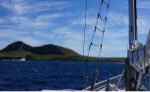
The volcano and waiting for the storm. How the captain skipped the volcano to sew sails while we met some Russian travellers. Where to hide the electronics and what to do with the anchor during a nighttime storm.
The morning greeted us with a lull. And then it dawned on the captain: since the wind was asleep, the planned hike up the volcano could wait. All hands to sail repairs!
Bracing ourselves for the grumbling, Nastya and I trudge off to take down the genoa, the large forward sail. Yesterday’s caballero, Andrés, gallops along the shore on his Rocinante as if to say, “Well, guys, why aren’t you ashore yet?” We wave to him while Andryukha hauls the sewing machine up to the foredeck.
For the next two hours, the children and I take turns encouraging the captain with questions:
“So, have you got much more to do? Are we going on our hike, then? Andryukh, we’ve already packed the sandwiches and tea! Can’t you finish the repairs later?”
With every new remark, the captain bears down on the sewing-machine pedal more furiously.
At lunchtime, the captain advises us to disappear among the dunes, taking a shirt for him just in case. We meekly pile into the dinghy and row away before we get into trouble.
Andryukha spends half the day finishing the genoa and hoisting it, then taking down the staysail, sewing it and hoisting it again, lubricating the furling drums, then diving overboard with a scraper to clean the fouled waterline, and then...
In short, we see none of this. Nastya rows to shore like a pro—she could hire herself out to the galleys.
When we reach Tauranga and Julio’s hearth, we discover that a different shift is on duty today.
“Well, next time,” the young sailor concludes philosophically, then runs singing after Nastya across grass, sand and the shadows of the stone moai, towards the fence bearing a NO ENTRY sign.
“Mum, don’t you think we break the rules quite often?” Laduska peers intently into my eyes.
“What do you mean?”
“Well, here, for example, we’re walking where we’re not allowed... And then we’re actually going to climb through barbed wire.”
“Yes, I suppose so... This is what I think, Ladus: if we didn’t break the rules, we wouldn’t be here now. We’d follow the rules and go to work every day, and you’d go to school.”
“Yeeah... it’s good to break the rules!”
“The main thing, Ladunya, is that you can break rules as long as no one is harmed by it. Your freedom ends where another person’s freedom begins.”
“So if we’re not hurting anyone, we can?” We’ve got ourselves a sharp little sailor.
“Yep. We can definitely climb through the fence.”
Scrambling through the grass and the not-too-ferocious thorns, our young sailor rejoices that an umbrella can be used as a walking stick. The aim of our hike is simple: climb the mountain, have a look around and eat in the wind)).
Mountain cows and horses have marked the top of the hill with droppings that have already dried out. That is where we find a picnic spot. From the summit of this not particularly tall but very ancient volcano, almost the whole of Easter Island is visible. You could watch forever as the blue of the ocean turns into the champagne of the surf and the cows nibble the green plush from the hillsides.
On the way back, our young sailor sings heroic songs, her little legs carrying her towards the guava avenue, where several fruits have just fallen into the grass. At the entrance to Anakena, we meet a tanned man with a bright smile coming towards us.
“Bueno!” I greet him, without the slightest suspicion that he is a fellow Russian. Two pleasant-looking young women follow behind him. Oh! They’re speaking Russian!
“Hello!” I beam.
“Hello!”
Vika, Nastya and Sergei are from Moscow. They have spent their three-week holiday travelling around Chile, Peru and Bolivia. They have 3 days on Easter Island, and those are already drawing to a close. We chat warmly and exchange contact details. How wonderful it is to meet friendly people from home, especially on the other side of the planet!
As we walk, Lada invents games involving pebbles and steps. Playing as we go, we slowly make our way towards the beach and notice that our captain has leapt off the yacht into the ocean so he can see out the sunset with us.
Dinner is rice with sauce, a coconut from yesterday’s haul, and a salad of avocado, tomatoes and onions. If we cannot get ashore in the village within the next week, we will run out of fresh food.
Before bed, we rejoice that during our time off Easter Island, the evening shower has moved from the cold deck to where it belongs—the aft heads.
We lie around chatting with the girls for ages before going to sleep.
There’ll be a fresh commotion tomorrow. A change of position ahead of the storm. During the day, we need to move to the southern side of the island; Friday night is going to be fun.
The captain forbids us from going ashore and orders us to prepare the yacht for departure. At 12:30, someone abruptly switches on a 20-knot wind. We set sails, change sails, take one down, put another up. Two hours of frantic rigmarole.
The swell rages against the high cliffs, while the surf on the south side of the island leaves us no hope of landing. The three-metre swell looks like a mini-tsunami. This means that Tongariki—the largest platform, where 15 moai stare inland—can only be viewed from on board.
We anchor in 12 metres of water and pay out 90 metres of chain. The anchor skips twice as we set it, but then digs in securely.
Despite the frightening surf, a fishing boat flies towards the shore, waits for a smaller wave and dives into an opening—a quiet nook among the rocks.
Above the bay rises the cliff of the Rano Raraku volcano, where all the statues of Easter Island were carved. Giant heads protrude from the grass to the left of the crater. They are visible through binoculars. Smaller statues adorn the shore.
We polish off a micro-pineapple: 400 grams for 8.5 dollars. Andrei explains to Lada that pineapple is the tomato’s brother. And since she doesn’t like tomatoes, she has no business gobbling up pineapples either. Our young sailor nods, still chewing.
At dusk, the radio comes alive with Officer Mauricio’s voice:
“Lady Mary, Lady Mary, channel 14!”
We had been unable to contact the authorities by radio from Anakena, although this has to be done every time we change anchorage, and the valiant guardian tracked us down by deduction, using the weather forecast and common sense.
“You’ve picked a good spot!” says the radio. “A storm is coming; tomorrow there’ll be 35 knots from the north, and the 40-knot winds should pass to the south. And don’t forget to pay the Easter Island entry fee before you sail.”
“Thank you! We certainly will; we remember.”
“Did you recognise me, Captain? It’s me, Mauricio!”
“Of course, amigo. The family sends their regards! Give our regards to your family too.”
After a virtual embrace, the captain and the officer switch to channel 16. And Mauricio’s white Jeep, winking its blue and red lights, leaves the shore for the village of Hanga Roa.
Soon, very soon, the storm will break.
The morning weather forecast promised a storm with winds of 40 knots and above. And the centre of the cyclone passing right over us. The evening forecast is more optimistic: the centre of the cyclone will pass to the south, and we will only catch 35 knots.
We’ll see what actually happens. Rano Raraku shelters us from west-west-north, but could the mountain turn out to be a wind-acceleration zone? What if something comes hurtling down the slope at around 60 knots, like the bora in the Adriatic?
We have sailed in winds like that, but we have only had to weather a storm at a poorly sheltered anchorage a handful of times.
The wind is made worse by the ocean swell. It comes in from the south and collides with the opposing wind waves, producing a boiling broth with one dumpling in the middle—our yacht.
By evening, the wind strengthens to 30 knots. The canvas on the sprayhood (the little roof over the porch) is flapping and wants to fly away. The captain and I improvise a way to keep the cover in place: we heat an awl in a candle flame, make holes, thread in bits of cord and roll the cover up like a sausage.
“How wonderful that we have a dry little house!” I breathe as I descend from the deck, riddled by the powerful wind, into the cosy burrow of the saloon. “How wonderful that the windows barely leak too!”
And indeed they don’t. We don’t even need to set bowls all around the perimeter.
We put torches in all the right places. Checked the anchor chain.
The captain proposes 2 emergency escape options, should anything happen:
1. Start the engine, weigh anchor and head out to sea.
2. Attach 15 metres of rope with a buoy to the anchor chain. Cut the bitter-end lashing (the rope between the shackle inside the chain locker and the final link of chain). After the storm, we return from the ocean and locate the anchor and chain by the buoy.
Excellent options, if you ask me. I think I’ll go and get some sleep. The captain has the first watch.
Zeus the Thunderer hurls lightning and rain. Andrei powers down the yacht, we hide the electronics in the oven and plunge into the howling darkness....
To be continued tomorrow.
Good weather to everyone!