
From the Travely-Family archive · Other Entries
Everything You Need to Know About an Emergency Stop. Or the Zombie Apocalypse on Christmas Island
An original publication from the former Travely-Family website. This English translation was preserved from the technical-site archive without editorial rewriting.
Everything You Need to Know About an Emergency Stop. Or the Zombie Apocalypse on Christmas Island We asked them for some water to drink
Or else we’d die before our prime
And the uncles sailed away for water
But no
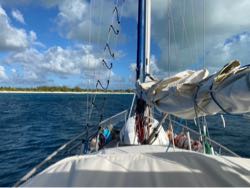
The most terrible calamity since Captain Cook discovered it in 1777 was bearing down on the glorious atoll of Kiritimati, also known as Christmas Island. A yacht was approaching the island. Its black sails were daubed with a skull and crossbones and some obscene word in Russian. The yacht’s arrival had been heralded by an email: the crew needed water and repairs in calm waters. All 7,000 islanders (or however many of them had survived the epidemic?) fell silent in terror: a plague was coming from the sea.
In their panic, the police gave permission to enter. No plague, least of all Covid, could remain infectious after ten weeks of self-isolation, the brighter ones guessed. But there were none among the police. They would have been even more horrified had they seen the yacht’s strange manoeuvres as it slowly but surely bucked the waves and the north-westerly wind. The boat bore down on the island at full steam, its engine roaring at 6 knots while it made only 2 miles an hour. Then the engine would suddenly fall silent, and the yacht would slide sideways backwards twice as fast.
Then the engine would roar again. And so it went, three times during the night. The headwind and equatorial current did their utmost to defend Kiritimati from the aliens’ attack. But by morning, the aliens had nevertheless materialised off a village modestly named London.
Find Another Country
“Marina Radio, this is sailing yacht Lady Mary.”
“Christmas Radio here.”
“We need an emergency stop.”
The voice on the radio asked what kind of boat we were and how many days we had been at sea.
“How many? Seventy?”
“Yes, seventy, without contact with anyone.”
“Where are you coming from, and where are you going?”
“From Hobart, Australia, to Panama City.”
“What do you want?”
“We need to anchor, make repairs and replenish our water supply.”
“Are you anchored now, or drifting?”
“Drifting.”
“Stand by.”
Fifteen minutes later, the radio obligingly crackled:
“We cannot permit you to anchor. We have no one to assist you.”
“But we’ve run out of water. There are children aboard.”
“We cannot bring you water. We’re sorry. Find another country.”
A stunned silence: the next country on our route was French Polynesia, more than two weeks’ sailing away. The Cook Islands, now astern, were closed in exactly the same way as Kiribati.
“What country?”
“I don’t know.”
“But we don’t have enough water to reach another country. We really need your help.”
“I’m sorry.”
“So you are refusing to help us?”
“Yes.”
We moved away from London village and anchored despite the prohibition: we had to climb both masts, find out what had chafed through the mainsail’s wire halyard, rerig another halyard in place of the temporary one, and sew up the torn mainsail. We could not do any of that in the open sea, pitching in 20 knots of wind.
After an hour of deck work, a boat came bouncing out from London with the police chief in a white shirt, an officer in black, and a helmsman. Andrey spread his hands helplessly from the mast while our young sailor waved from the stern as the boat made five ceremonial laps around Lady Mary. The police detail anchored about 50 metres away, and for the next two hours the chief never took his menacing eyes off us. He really didn’t. We hauled lines up to the captain at the masthead, lowered him back to the deck, sewed up the mainsail, and transferred fuel from jerrycans into the tank (we had burned 100 litres fighting our way to the atoll)...
By the third hour, the chief had grown bored and turned to his smartphone. But his boat continued guarding the island against our invasion. We disappeared below. And the guardians of law and order finally dared to come within shouting distance:
“What are you doing in there?”
“Making repairs.”
“How much longer will you be here?”
“A few hours. And we still urgently need fresh water.”
“We’re not allowed.”
At this point, the family’s mother brought out the heavy artillery, sticking her head out of the hatch:
“We’ll die out in the ocean without your water. The children are asking for a drink,” I announced optimistically.
“We’re not permitted.”
A Glimmer of Hope
Either the mother’s mournful remark put a crack in the officials’ dutiful obedience, or the lads thought there might be money to be made, but their next question was what kind of cash we had aboard and how much water we needed.
“We have US dollars. We need 300 litres.”
“How much?” They nearly fainted.
“Well, 200, 100—whatever you have.”
“You need it for drinking?”
“Yes.”
And the boat silently disappeared into the depths of the atoll. We carried on finishing our jobs and wondered: what if they brought 200 litres in one-litre bottles? How would they pass the jerrycans over? What if they thought to bring a bunch of bananas as well?...
Dusk was falling, and with it our hope was fading. We decided to wait until seven and then leave. The captain grew despondent.
“Look, Andrey, we can fight. We can wear them down and stay at anchor for as long as it takes. We’ll say that in that case they can watch our children die of thirst, and as a parting gesture we’ll give them a phone number so they can inform our relatives of our deaths. Are we going to fight for water, or can we stretch it as far as Tahiti?”
“We can stretch it,” said the captain. “We still have about 250 litres.”
The radio crackled:
“Lady Mary, are you still there?”
“Yes, we’re here, and we still need water and fresh fruit.”
“Stand by.”
An hour passed.
“Lady Mary?”
“Lady Mary standing by.”
“You must leave the country immediately.”
“Okay.”
No, We Were Under No Illusions
All year we had been following the fortunes of other yachts. So we knew about cases like this and did not head anywhere blindly. Before approaching Christmas Island, we wrote to the person who acts as a yacht agent there. We described our problems: several breakdowns without which the yacht could not continue the passage; we mentioned that we had had no contact with anyone for more than 65 days, and that our watermaker was broken, meaning we needed fresh water. The man contacted the authorities, who provided instructions for entering for an emergency stop. And we set off.
No one dreamed of going ashore; we were counting only on water and possibly some fruit. You know the rest.
So, friends, there is no such thing as an emergency stop. The so-called Maritime Law under which a yacht can enter any port in an emergency exists only in the minds of romantics. And a vessel in distress is unlikely to be rescued by anyone. Because there is a pandemic at sea. Yes, a yacht sailing through an empty ocean in complete self-isolation for 70 days is a carrier of infection—otherwise, where would the logic be? And having a child aboard does not improve your chances of receiving help.
Do You Know What’s So Sad?
It’s that this is the 21st century, and humanity is so stupid. In almost two years of the pandemic, no one has come up with a way to deliver food and water to a yacht without dangerous contact with the people aboard. Or rather, the methods are simple, but they are not covered by the instructions.
Do the people who refuse assistance to a vessel ever consider that their instructions violate not only maritime law, but also the laws of logic and the basic laws of humanity? Do they understand, as they look at a little fair-haired girl on deck, that she might not survive because of their refusal to give us water? Even 70 days of self-isolation do not lead them to consider that the crew might not be infectious.
People have ceased to be human, hiding behind restrictions. Something must change in this world so that the lumbering machinery of bureaucracy does not lose its human face. We need to make waves. Share this post with your friends. Because if not us, then who?
Give us a hug, guys—we need it right now. Thank you for being with us.
Lady Mary is heading towards French Polynesia, hard into the wind and a powerful current that continues to set us west of our course. We are utterly exhausted by the endless ocean and the bucking into the wind. The captain is pensive; the girls and I have each had a little cry. Tonight we will cross the equator again and enter the Southern Hemisphere. We hope there will be the first rain in two weeks there.
Thanks to good preparation and our stop at the uninhabited Suwarrow Atoll, we have plenty of food, including apples and coconuts. We can stretch the water as far as French Polynesia.
Thank you, friends, for your comments and warm words. Thank you to Mikhail P., Olga M. and the other wonderful people who keep the crew’s spirits up through YooMoney and PayPal
We are glad to have you in our family!
Where We Are Now
See our website, travely-family.com, under the Route tab. Lady Mary’s route is plotted there from the RockSTAR Iridium 360 tracker supplied by MVS Telecom.
Sent via satellite.