
From the Travely-Family archive · Other Entries
All Five of the Planet’s Southern Capes—Rounded!
An original publication from the former Travely-Family website. This English translation was preserved from the technical-site archive without editorial rewriting.
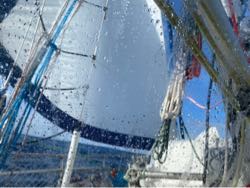
All five of the planet’s southern capes have been rounded!
Today, 15 September 2021, at 15:40 New Zealand time, Lady Mary and our crew crossed the meridian of 167°32′ E, the longitude of South Cape on New Zealand’s Stewart Island. With that, the expedition has rounded all five of the planet’s southern capes and the three great capes. Hooray, right, guys? To achieve the goal of our round-the-world expedition, we have 39 meridians left to cross. Now we’ll explain the geographical confusion involving this multitude of capes—brace yourselves, guys:)! In his book The Long Way, Bernard Moitessier, widely known in narrow yachting circles, wrote about the significance of the great capes for a sailor: “A sailor’s geography is not always that of the cartographer, for whom a cape is a cape, with a latitude and a longitude.
For a sailor, a great cape is at once a very simple and an extremely complex combination of rocks, currents, breaking seas and huge waves, fair winds and storms, joys and fears, weariness, dreams, aching hands, empty stomachs, wonderful moments, and sometimes suffering.” For a yachtsman, rounding the three great capes is considered a major achievement. Rounding all five southern capes of the Earth is an even greater one. And today we did it! Only one of the southernmost capes is also geographically one of the great capes: Cape Horn. The most difficult, dangerous, great and terrible cape of all time—the southern tip of Tierra del Fuego in the Drake Passage, which separates South America from Antarctica.
We rounded it first, on 19 January 2019, on the 52nd day of our non-stop passage from the Pacific to the Atlantic. The second great cape, the Cape of Good Hope, was formerly called the Cape of Storms. It went down in history as the meeting place of the Atlantic and Indian Oceans, although geographically that point is Cape Agulhas, the southernmost point of Africa. We rounded this pair of capes in late January 2020. The third great cape, Cape Leeuwin, crowns the south-western tip of Australia, where the Indian and Southern Oceans meet.
But 46 minutes farther south lies Torbay Head, the eastern headland of West Cape Howe (is your brain already turning to porridge? Mine is.) Anyway, this Torbay, the one that is a Head, is the Earth’s third southern cape. That is the end of the great capes, leaving two more southern capes: South East Cape in Tasmania and South Cape in New Zealand. We rounded the penultimate one on 31 May, and the last has only just been left 60 miles to the north.
Daily life and waves on the shelf
In honour of this important day, we ought to cook something tasty. The morning has already been brightened by pancakes from our young sailor, which she has been frying since yesterday. On the evening menu are spaghetti with cheese, fried aubergines and carrot-and-garlic salad; all that remains is to cook it all and then eat it. The latter seems difficult: we’re seasick. We’re crossing the shelf in depths of about 120 metres, with winds of 15–30 knots, making the waves short and wild. We have been standing steering watches since last night.
During the night, for the first time in 11 days, we crossed the course of a fishing vessel and were left alone once again. The watchkeeper’s task was not to pile into a rock south of New Zealand. The wind was setting us south, and in the morning, ten miles away, we saw the last land we will see for the next three thousand miles: the rocky outcrops of the Snares (Tini Heke) Islands. The only visible greeting from an unfulfilled childhood dream: Landia, Landia, Zealandia!
An unfulfilled dream
Maori cannibals, the fjords of the South Island, the hobbit village on the North Island, old friends from the yacht Manaia, who have been like family to us since Easter Island, and friends from the yacht Shownyagain, our neighbour in Panama and the Galápagos, my childhood dream of the islands of the Maori—all of it came to nothing because of the pandemic. New Zealand has passed us by for the second time now. About three years ago, we were heading there from the east, from the heart of the Pacific Ocean. But the ciguatera that struck the captain and me stole a month, scrambled our plans and sent us to Antarctica.
Now we were once again one step away from arriving in NZ, this time from the west. But Covid intervened. A parcel from home has been waiting for us in Auckland for three years. With Russian sweets, letters and my childhood copy of The Two Captains. Looks like we’ll ask some friends to send it back to Siberia )). The art of travel is the art of changing plans.
What you didn’t know about a fair wind
Meanwhile, we have left the shelf, and the waves immediately grew longer and stopped inviting our lunch back out. Nastya is watching video lessons; Lada is using reading to skive off taking biology notes. The captain is getting ready for the night watch. We have dropped the mainsail and are flying along at six knots under a reefed genoa. The boat keeps trying to round up into the wind and race off to Antarctica. We won’t let her—and we are racing towards Antarctica too, only much farther east. So much for a fair wind. We hope that, according to the forecast, the wind will veer south and drive us towards the equator.
We will not see the shores of New Zealand, or any other land until Suwarrow Atoll either. But more about that next time. A short video of the moment we left Tasmania has been posted on YouTube. The video tried to repost itself to the website and then automatically to Facebook, but judging by the comments Sergey Yakubenko sent us, neither attempt went very well. Hugs to everyone who is with us, from 48°37′ S, 168°23′ E. Thank you, dears, for supporting the expedition through PayPal and YooMoney. It means so much to receive your greetings!
And we are always delighted to get your comments and eagerly await them—it immediately feels as though you are not alone in the boundless ocean. Where are we now? Check the Route tab. It shows the track from our hardworking RockSTAR Iridium360 tracker supplied by MVS Telecom. We are currently at the following coordinates: 47°15′ S, 163°43′ E.