
From the Travely-Family archive · Cape Horn
Eastern Hemisphere! Strait of Magellan–Cape Town, Day 43
An original publication from the former Travely-Family website. This English translation was preserved from the technical-site archive without editorial rewriting.
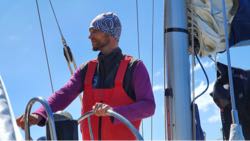
Eastern Hemisphere! Strait of Magellan–Cape Town, Day 43. For more than three years, we and most of our friends have been in different hemispheres: after crossing the Atlantic three years ago, we sailed around the Western Hemisphere. And almost two years ago we also crossed the equator, ending up diagonally opposite them—south and west instead of north and east. And yesterday, ta-da-da-da, we entered the Eastern Hemisphere again. Time to change the clocks. We are now two hours behind Cape Town, and Cape Town is another hour behind Moscow.
It will be easier to keep in touch with our loved ones, without having to squeeze in time on the eve of nightfall just to call................................................................................................................................................................... Around 20 knots of wind, two-to-three-metre waves—smooth sailing. If only it would stay like this for the remaining nine days. But tomorrow they are forecasting a day of headwinds dying away to a calm; no word of storms yet.
My crew is resting while I, busy as a bee, toil away at my righteous labours. I did some reading, lay around for a while, then started on the report; after that I remembered the letters and switched to the journal. All without getting off the sofa..... I sleep like Napoleon, about four hours a day; all right, more than Napoleon—five. I don’t know, perhaps my conscience is troubled. There don’t seem to be any Waterloos or Borodinos on the horizon, nothing to worry about—just the night watches. Today we passed a bulk carrier, and last night we even slipped between two of them...................................................................................................................................................................
Towards the end of our two-month passage across the South Pacific, there was nothing but fog and waves the size of houses, with not a hint of shipping. Now it is the other way round. After heading north from the Falkland Islands, we saw no one for a month, all the way to Tristan da Cunha. Just one savage storm after another. But now we are at 35° south, right on the edge of the Southern Ocean; we have managed to skirt the storms, there is plenty of sunshine, and every day some great hulking vessel appears on the horizon. In the cold latitudes, out of season, there was no one but us and a few shell-shocked albatrosses..................................................................................................................................................................
We have already removed the secondary window frames. Only three windows in the wheelhouse are still untouched. No, five—there are another two small ones. Oh, what a repair job awaits us in Africa! After ten months of constant condensation, the wooden panelling looks like the inside of a shabby old railway carriage with a leaking roof..... But really, let’s talk about something cheerful. Today is bath day—hooray. It still does not happen very often. We only have half our solar panels now, after all. They generate half as much electricity, and the watermaker consumes almost everything the panels produce.
Even though we conserve water in every way known to science, we still have to start the engine, especially on overcast days. We will have to find some new panels ashore. And perhaps a wind generator. Ours died long ago................................................................................................................................................................... We are corresponding with the Russian Consulate General in Cape Town; they first wrote to us on Facebook while we were still ashore.
We will be holding a meeting about the expedition and our sailing voyage to Antarctica. After all, the Year of Antarctica is coming—200 years since the sixth continent was discovered by the sloops Vostok and Mirny. It has been a long time since we had any major events in our lives; it is inspiring and keeps us on our toes...................................................................................................................................................................
And we really want to arrive soon. Although the second month of the passage has been considerably easier than the first, after 43 days of a non-stop offshore passage we could do with ending our isolation. The last time we set foot on land was 27 August, in Punta Arenas. After that we rode out storms at anchor and waited for permission to leave port, then came the Strait of Magellan, the storm off the Falklands, and a stop off Tristan without going ashore. So today is not even Day 43, but Day 45. Long-haul sailing...................................................................................................................................................................
Nastya and I are gradually psyching ourselves up for the next long haul: the passage to Australia, the last continent not yet covered by the expedition. By March we will have completed all six continents. The Roaring Forties again, and only one possible stopping place: the French Southern and Antarctic Lands—Amsterdam Island—or even Kerguelen, which lies almost at 50° south. The captain suggests following a great-circle route. That is when the distance is not merely shorter on the globe than on a map: the shortest route is actually the one that takes you in completely the wrong direction, down towards the Antarctic Circle...................................................................................................................................................................
Andryusha, I don’t want to be a polar explorer agai-i-in! I look at the cap with big pleading eyes. Andryukha laughs: “You didn’t want to last time either, and yet you got right up close to the Antarctic Circle. If we hadn’t played it safe, we’d have pushed even farther into the ice.”.... I remember—I was the one asking us to keep pushing on. That was when we could not get through to the Ukrainian Antarctic station Akademik Vernadsky because of the ice in the Lemaire Channel. And it turned out the polar crew there had been waiting for us.
Oh well, we will have to go again. We’ll swap the boat for a steel one—and off we go................................................................................................................................................................... The captain is up now, so I’ll go and rummage through the lockers for some biscuits. Yesterday we chopped the last of the cabbage into the borscht. We still have one beetroot, about ten oranges, roughly the same number of apples, lemons, a few potatoes, onions and garlic—and that is it.
Hello, tinned food! Ha, can you imagine, the other day we found a coconut in an outside locker. The old chap is nearly a year old. I’m afraid to crack it open; although it has spent that year at temperatures around freezing, it is probably no longer particularly fit to eat. Every now and then I subsist on Radix freeze-dried expedition food, which Fyodor Konyukhov left us. Everything about this food is fine except for one thing: for some reason, its developers put coconut in every dish. Even the Mediterranean-style chicken tastes of coconut.
What does the Mediterranean have to do with coconuts?.... Fyodor Filippovich truly is a man of iron: he lasted five months and never complained once. But my lot are not particularly keen on coconut-flavoured food. There is only one solution: go off on a five-month self-sufficient expedition—then anything will do...................................................................................................................................................................
As always, we very much look forward to your comments and letters. Many thanks to Vsevolod for the warm words in his letter. Our heartfelt thanks to Alexey Kh. from Yekaterinburg both for his wonderful letter and for supporting the expedition via Paypal.Me/TravelyFamily! How wonderful it is to have you with us! We are so glad that we inspire you to achieve things. And you inspire us. Hugs to all of you, friends! Until next time!............................................................................................................................................................
Transmitted by satellite. You can follow the progress of the First Russian Round-the-World Expedition “Three Great Capes” with children on our website under the Route tab, where the IRIDIUM track is plotted. The same map, with the track and weather, is available at bit.ly/iridium360