
From the Travely-Family archive · Cape Horn
Visiting the Volk Arktiki
An original publication from the former Travely-Family website. This English translation was preserved from the technical-site archive without editorial rewriting.
Visiting the Volk Arktiki.
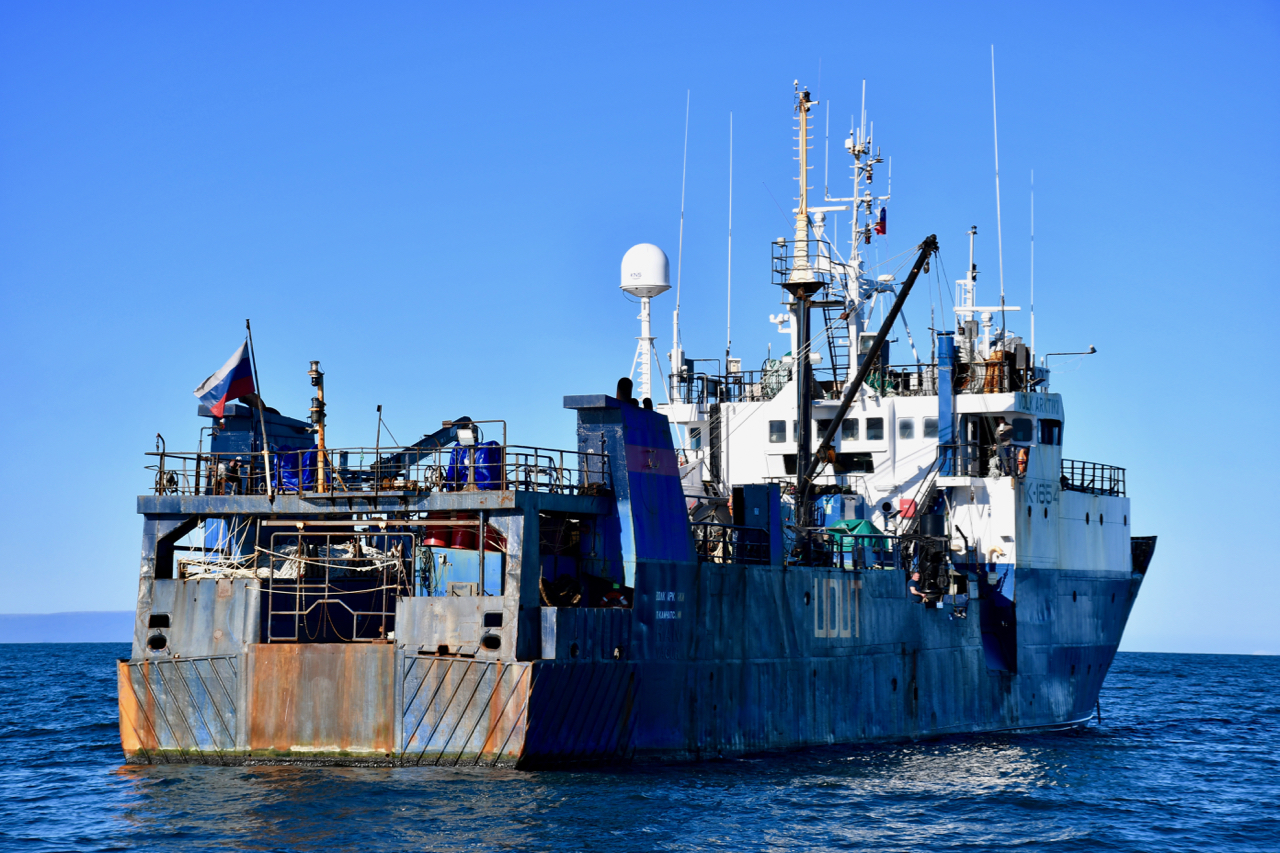
You arrive in the Strait of Magellan, at a port at the end of the world, and among the few other vessels AIS shows a ship with the suspiciously familiar name Volk Arktiki.
Our people! you rejoice. And at slow speed you head straight for her dark-blue, salt-encrusted side.
Meanwhile, seeing a yacht coming towards them rather than heading for the port, our compatriots peer more closely at the flag:
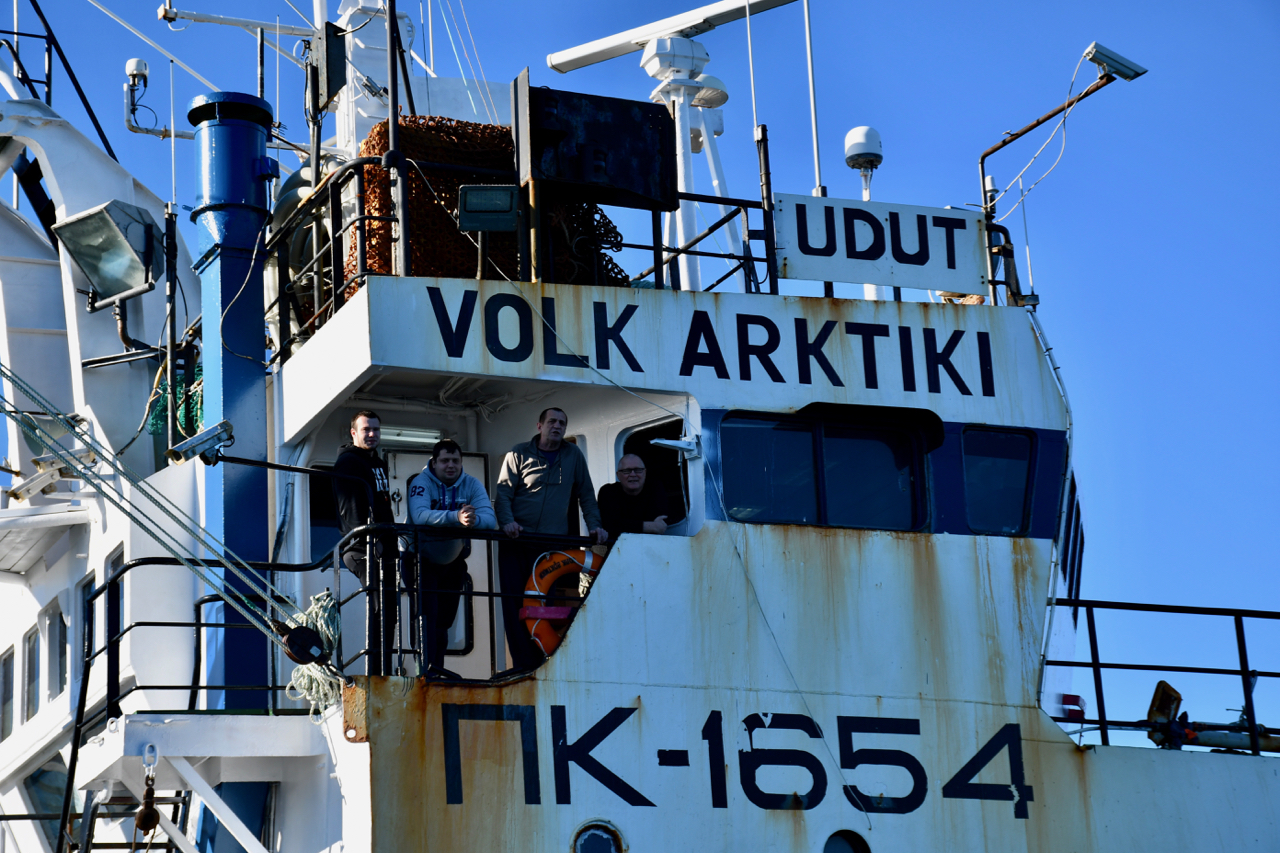
“Oh, are they ours?”
We come within hailing distance. Where from, where to, staying long?.. Then the young sailor emerges onto the deck.
“Oh, you’ve got a child with you?”
“Two. It’s just that one is already rather big.”
“Do you need anything, guys? Any help, provisions?”
“Come over for tea 🙂”
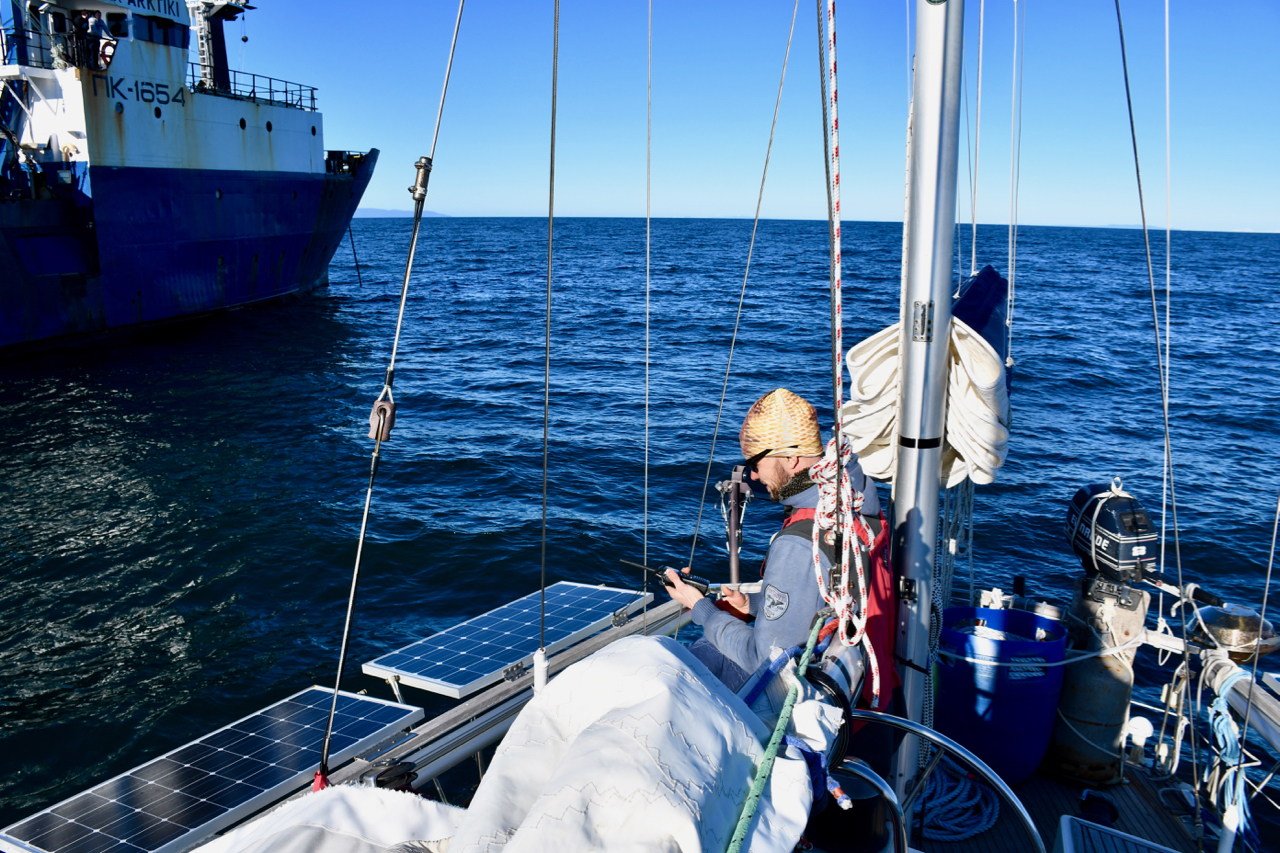
“Well, if you can spare us some buckwheat,” our captain replied, quick as a flash. “But actually, we need a welder. One of our engine mounts is cracked.”
They had already given us a lead on a welder over the radio, and we headed into port.
The fishing trawler Volk Arktiki has been lying at anchor off Punta Arenas for three months; the crew are waiting for a New Zealand visa that has gone astray somewhere. They had planned to prospect for crab-fishing grounds off the coast of Peru during the winter season, but the paperwork did not work out. Now the crew will sail for New Zealand along a great-circle route—south of 50° latitude, practically skirting Antarctica. Into a headwind.
We come almost alongside
We spoke to our compatriots over the radio a couple of times, and then an absolutely windless day came along.
“Well, shall we come over today, then?” the captain asked.
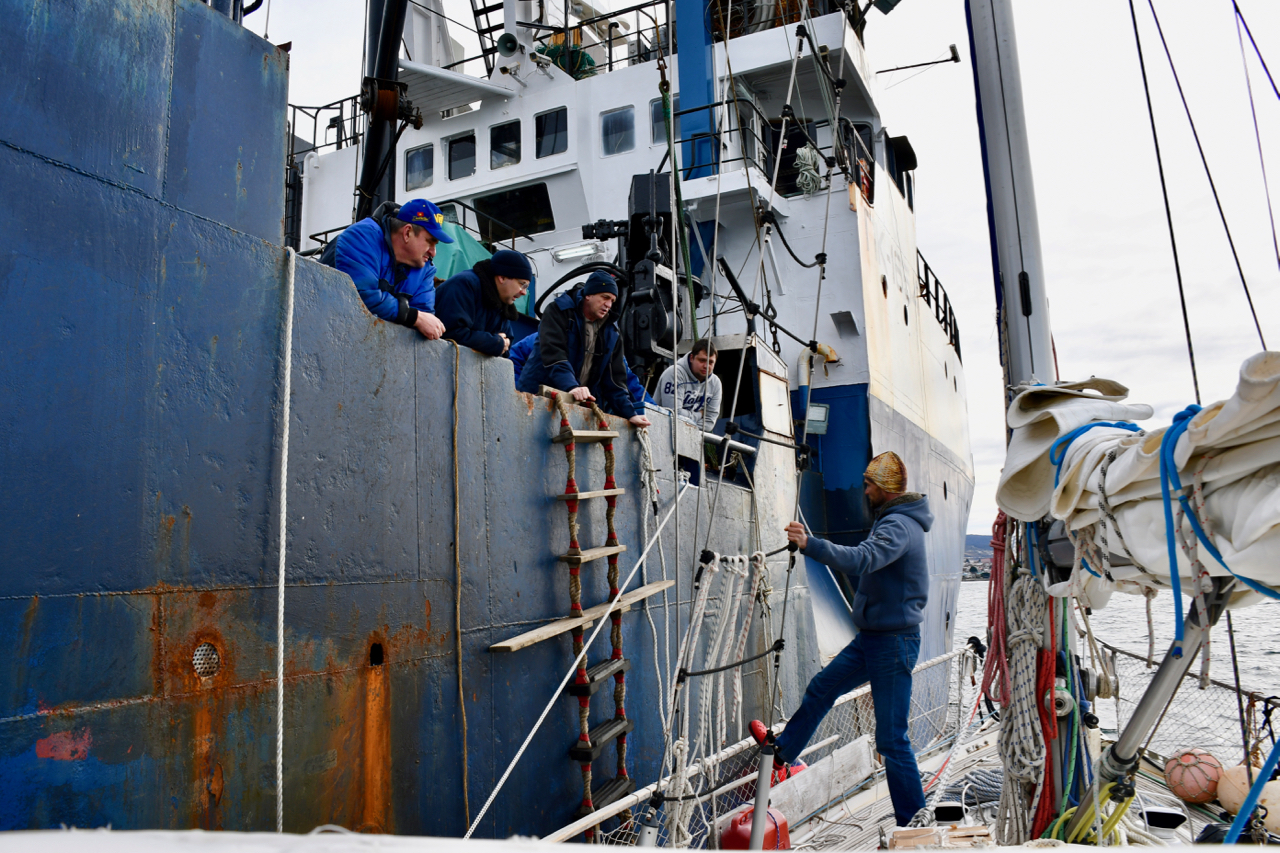
“Come on over! You might even be able to lie alongside; the lads have already hung fenders over the side.”
And Lady Mary happily set off away from shore and into the strait. I expect she, too, fancied spending a while beside the big, strong hull of a compatriot. The ship was lying a mile from the quay.
Calm or no calm, there was still a bit of a swell, and it wasn’t only the sea that was restless—we were nervous too: this was our first time mooring to such a high-sided vessel in open water. Almost the entire crew came out on deck. Volk Arktiki took our lines and made them fast, then lowered a rope pilot ladder with wooden steps, and we climbed onto the fishing vessel’s steady deck.
Just watch us climb aboard now!
“My darlings!” I cried delightedly, and started hugging the entire crew.
“Would you like to see the ship?”
“Of course we would!”
Half an hour into our tour of the fish-processing plant and engine room, the young sailor sensed that there was a galley somewhere nearby. And immediately vanished in that very direction.
About the fishing operation
From New Zealand, the trawler will head along the coast to Vladivostok, catching toothfish and processing and freezing it right there in the fish plant. If it were crab, they would even cook it, not merely freeze it. There are two production lines in the plant—one for fish and one for crab. They work in almost any weather, in shifts of 12 or 16 hours, with around 30 people. Fish and crab are caught under special quotas, no more than the permitted amount. They can catch a couple of tonnes of crab a day.
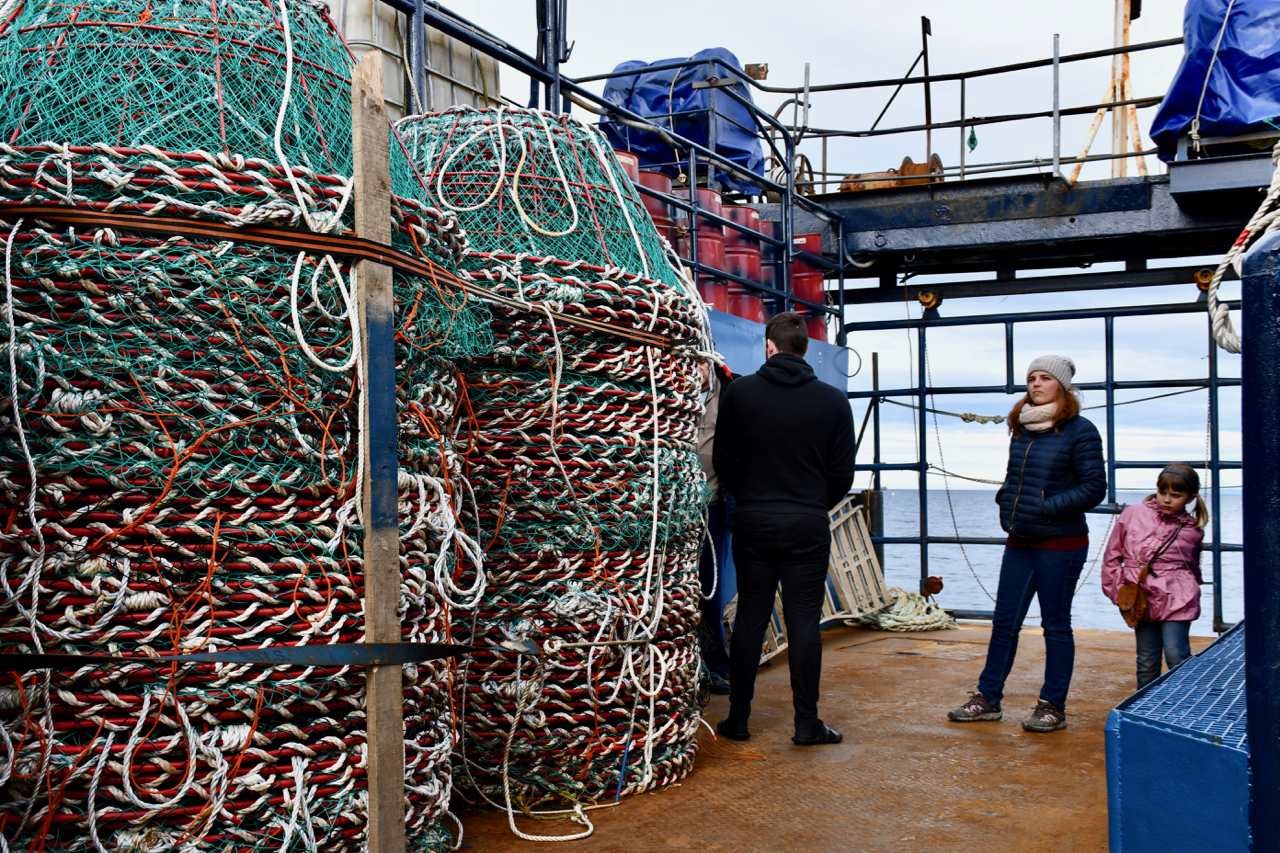
Stacks of crab pots; a single pot can bring in about 20 kilograms of crab meat at a time (if I haven’t got anything mixed up)
The vessel has a special gizmo (radio operator Ilya, please forgive my loose terminology), something like a radio beacon, which is used to track whether the ship has wandered into prohibited fishing grounds. There is also a large satellite antenna, which provides the crew with a reasonable amount of internet access anywhere in the ocean.
Some people come here to earn enough for a car or an apartment over several years, then settle ashore. Some cannot cope with such hard work and never go on a second voyage; others spend their entire lives at sea. Twenty-three-year-old second mate Sasha, the youngest officer aboard, has been going to sea for a year and a half. He is the first in his family to become a seafarer. He has not been disappointed in his profession and will work his way up to captain. We become friends with Ilya and Sasha on Instagram; we’ll keep an eye on each other:).
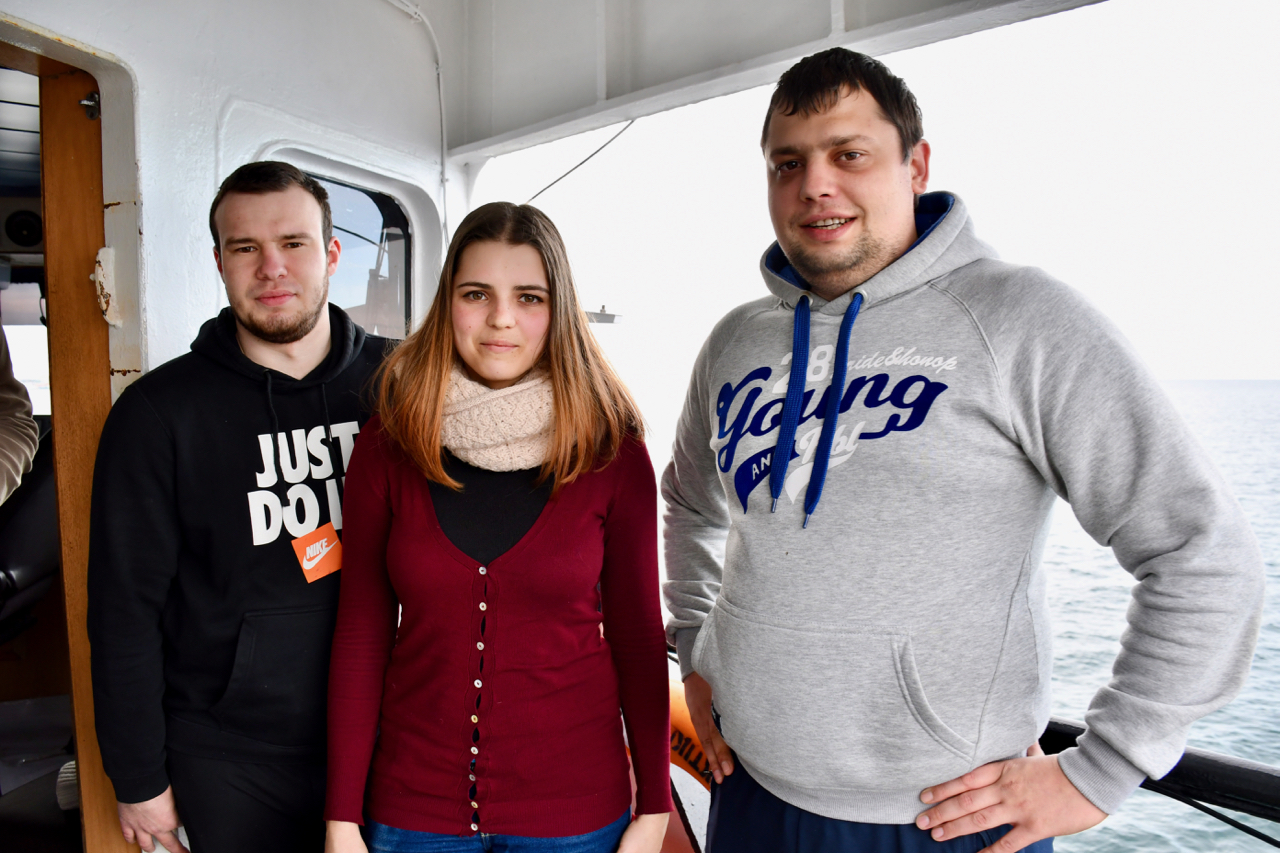
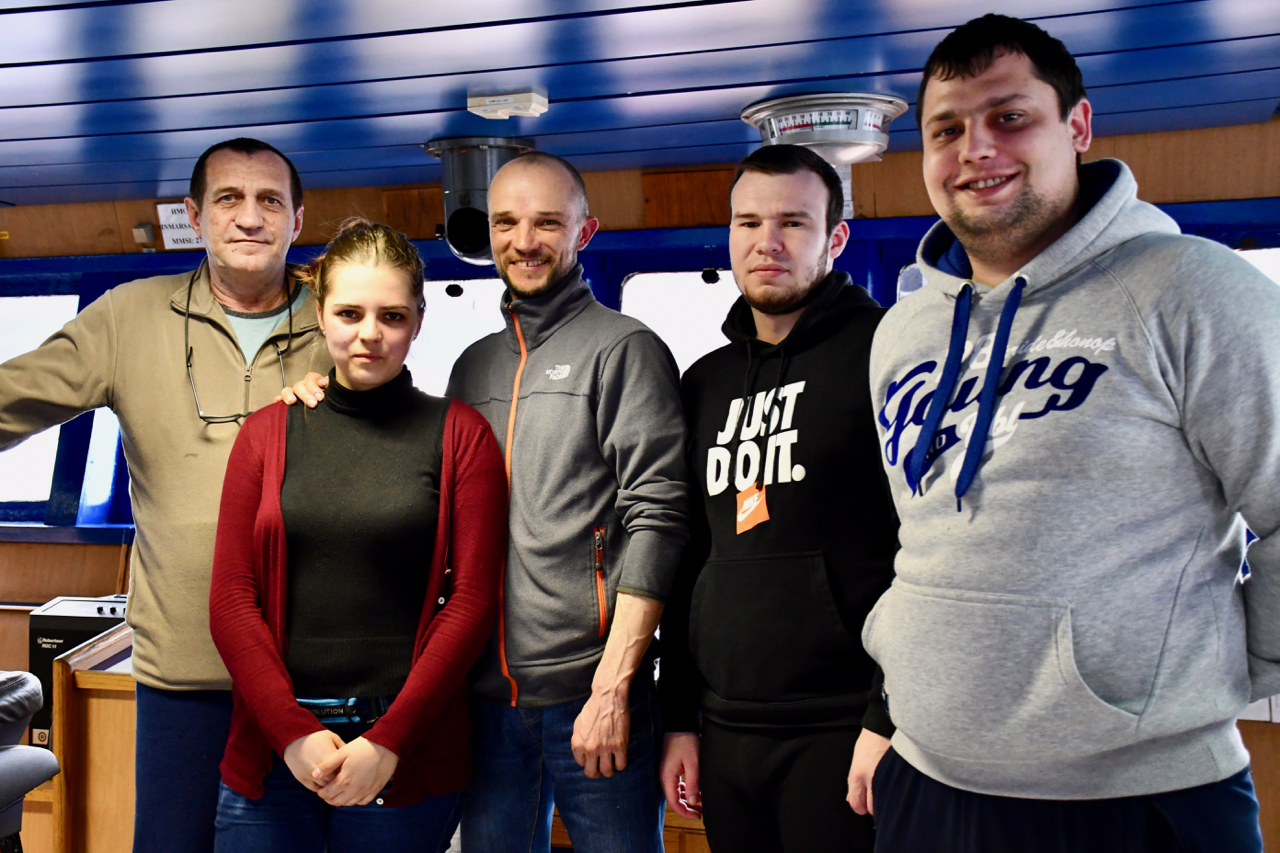
From left to right—Second Mate Alexander, Nastya, radio operator Ilya
Among our own at the end of the world
“Will you have something to eat?” the captain asked. “Our cook has just fried up some chebureki!”
Of course, we said we weren’t hungry, but who could resist chebureki? The young sailor announced that she had never tried such a dish in her life, and for that she was escorted straight to the mess room. We only saw her once more before dark. Lada came up to the bridge, looked around and said:
“I think I’ll go back. What is there here that I haven’t seen before?”—and returned to the mess room to beat Uncle Sasha and the bosun, “I-think-his-name-is-Uncle-Lyosha,” at backgammon and dice. She has now taught me to play dice too—and beats me as well.
On the bridge, over tea and chebureki, we talked, downloaded films from the ship’s library, and talked some more. Birds of a feather recognise each other from afar, isn’t that how it goes?:). Nothing warms the heart more in a foreign land than meeting compatriots. A whole bedrock of shared things makes complete strangers feel more like your own people than foreign friends you have known for months.
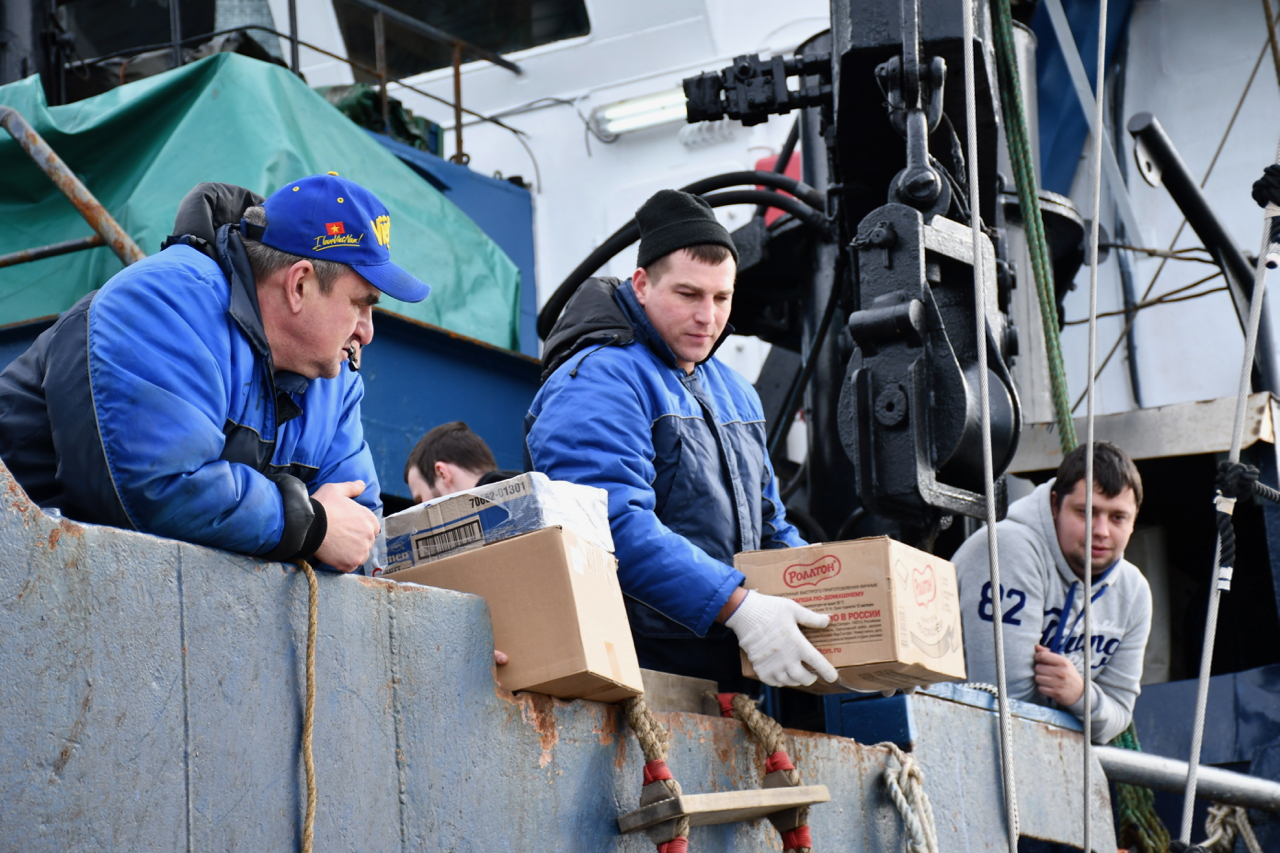
About the gifts
“I’ve gathered a little buckwheat for you, and some books too...” says Eduard, the trawler’s captain.
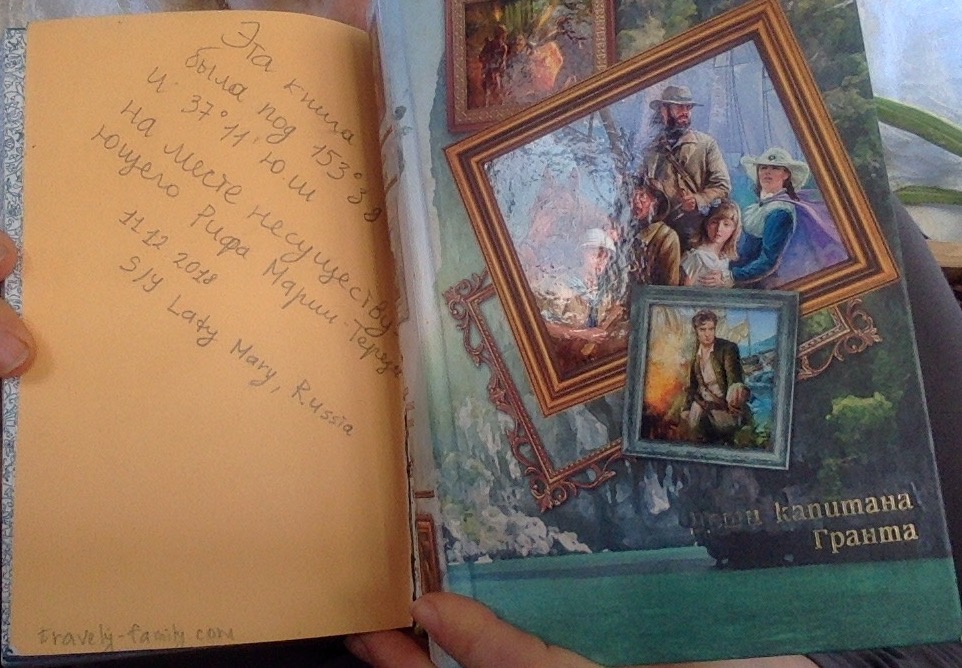
Among the paper books was Jules Verne’s In Search of the Castaways, a cult favourite for our family and our expedition. We now have two copies aboard. The old one bears a commemorative inscription made right on the 37th parallel, while the new one has a beautiful cover and a better translation from the French, just like the one I read as a child. And it was given to us in the middle of the Strait of Magellan, no less. Someday our descendants can auction it at the expedition museum ))).
Two books in one photo
“A few gifts” by Russian standards means a huuuge amount. Even Lada appreciated that. For her skill in beating the crew, she was given a box of sweets. A box as in a crate. And when the young sailor came home, she protested indignantly:
“No, really, how can they do that! They said they’d give us one crate of sweets, but they gave us one and a half!”
No, seriously, how can they do that!? 🙂
Besides various delicacies and teas from the Volk Arktiki captain’s stores, they filled our Lady Mary’s water tanks. Compared with our watermaker, their couple of tonnes of water a day is an entire factory. Besides, we had not switched on the watermaker all week; we had spent half the time alongside the quay, and the water beneath it tastes awful.
Midnight is drawing near, and we’re still visiting 🙂
Food at sea
We went into the mess room to fetch the young sailor, and it smelled just like home before a delicious lunch.
“Mmm...” I said. “That smells wonderful!”
My admiring sigh was overheard by the chief engineer—also known as the chief, or, in seafarers’ parlance, the Old Man—and by Vyacheslav the electrician.
“Let’s get some food into you, quickly!”
“Nooo, please, there’s no room left after the chebureki!” I pleaded.
“Bring us a pot; we’ll pack some for you to take away!”
And Nastya shouted to our captain to pass up some kind of container from the boat. It turned out to be a basin. They filled it with mashed potatoes, meat-and-rice “hedgehogs,” and salmon fried with vegetables. Damn, they feed you well at sea! Maybe I should sign up for a trawler too?
Not to mention the cook’s proper herring, which we sampled yesterday—mmm... with boiled potatoes and onions... All it needed was some vodka:). And we found decent pickles here too, in Punta Arenas. (They’re actually hard to find abroad—pickles you can eat, I mean. Only Slavs know how to make them taste good. In Ushuaia, polar seafarers Denis Davydov and Vanya Simonov showed us the only good variety of pickles, which were Polish. We bought every jar they had. And now in Punta Arenas, a local woman from Vladivostok, Kristina, and her husband have introduced us to some other pickles, from Germany but Polish-style too. So here is the life hack: if you want pickles, look for Polish-style or some other Slavic style; they’ll be just right, not made of vinegar alone)..
The return
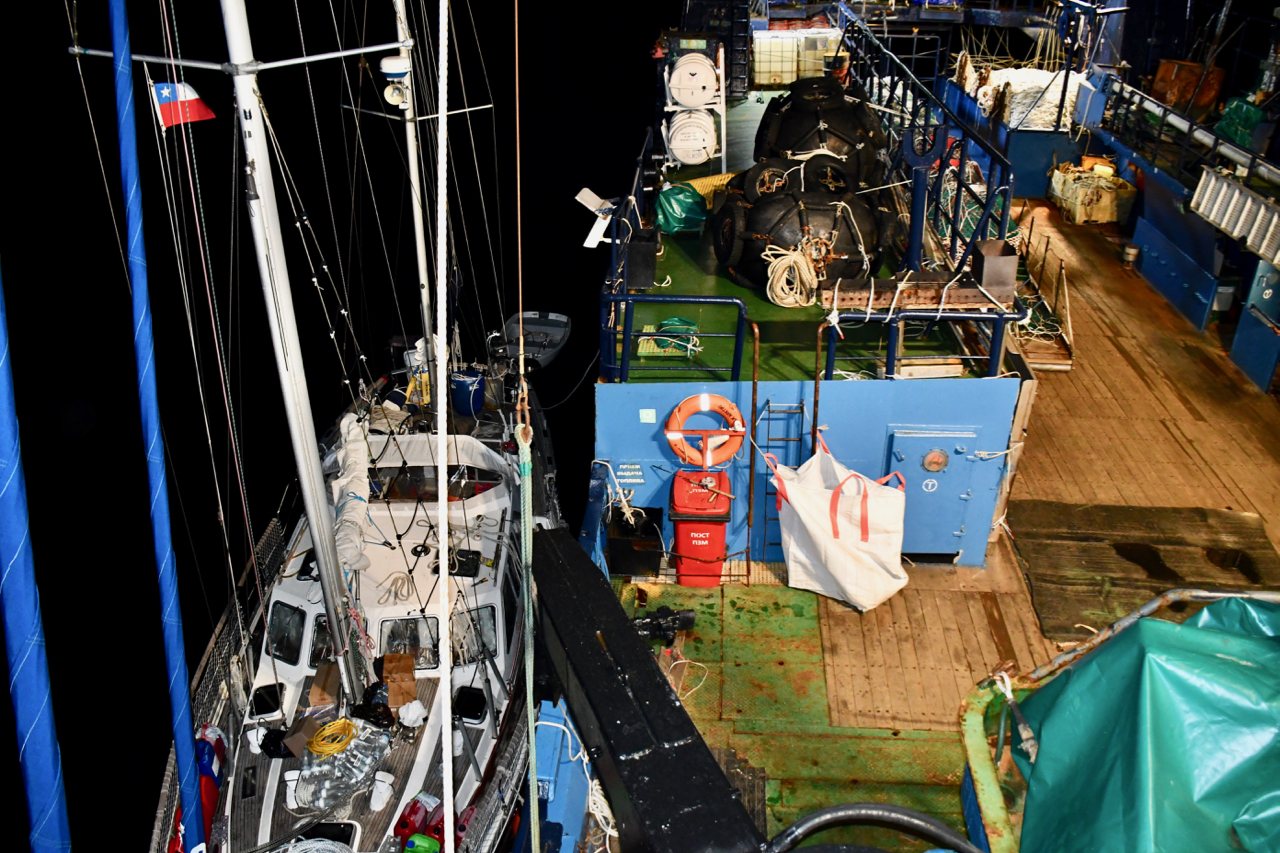
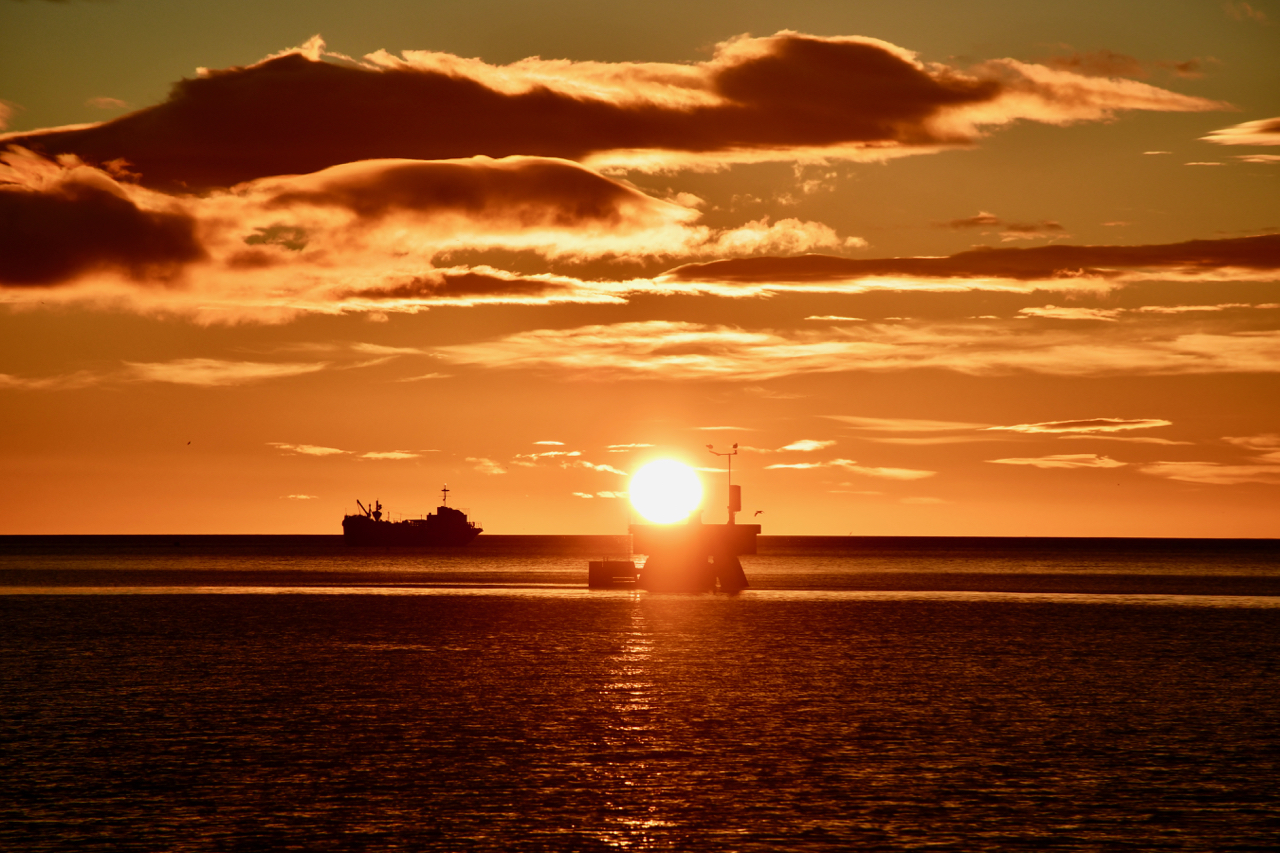
We returned to the boat, and then took the boat back to our anchorage, already in the dark. Really, the whole thing looked like a scene from a film. Over the public-address system, the captain ordered the crew to stand by to lower the guests onto the yacht and cast off. When you step out onto the deck, you discover several new faces. And here comes the basin of dinner.
“And where is your cook, anyway?”
“Here he is!”
“Pyotr.”
“Very pleased to meet you. Let me give you a hug. Thank you—we haven’t eaten anything so delicious in a hundred years!”—and that is the honest truth.
Having hugged everyone amid the bustle, we climbed down the ladder onto the yacht, which looked so small and fragile.
The captain was already aboard. The young sailor, the deckhand, a basin of food, a sack of sweets, and a box of some other provisions. The herring in its saucepan was already on deck, along with a large heap of gifts that took us the next couple of days to sort through. They still had not cleared us to leave port, so we stayed in touch by radio.
The same people, plus Eduard, captain of Volk Arktiki, and our captain
In farewell
Thank you, dear crew of Volk Arktiki from Vladivostok, home port Petropavlovsk-Kamchatsky. And have a successful rotation (voyage? Passage?—what is the right term?).
Hugs to our beloved followers and friends from the only city on the Strait of Magellan.
Today they should finally let us loose, so let’s keep in touch through your comments. You can follow us in real time on the website under the Route tab. The map with our track is also available at bit.ly/iridium360.
A huge thank-you from the entire crew to the new members of our shore team for contributing to the expedition budget via Yandex Money.
Our heartfelt thanks from the entire crew to Viktor V., Alexey G., and Dmitry. With you, we can move mountains!
Another link to the ship’s kitty for the Round the Three Great Capes with Children Expedition:
Paypal.me/TravelyFamily