
From the Travely-Family archive · Patagonia and Tierra del Fuego
Shelter for Fishermen
An original publication from the former Travely-Family website. This English translation was preserved from the technical-site archive without editorial rewriting.
Shelter for fishermen. Riding out a storm in a fishing cove. What are those cushions scattered over the slopes, and how do you find some privacy when you’re together all the time? Flora and crab-catching gear. Who is the crew’s chief water carrier and mussel gatherer?.........................................................................................................................................................................................................
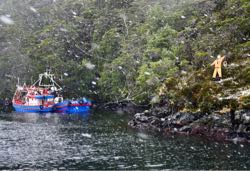
At the entrance to Emilita Cove, we are greeted by the figure of a fisherman in a yellow suit. A Styrofoam face and a hand holding a spear—a theatrical sort of harpoon—and a real solar-powered lantern. This is the first cove in the fjords visited by vessels other than yachts. A stream drops two metres into the inlet. Hills covered in bonsai trees on the left, and impenetrable taiga on the right. We need to hurry and make our landing. We inspected the crab pots stacked in piles and filmed a little video segment with our young sailor as the expert presenter on catching seafood.
We’ll splice it together with our review of the lobster traps on Easter Island, tack on some fishing footage from the archives, and it’ll be balm for the souls of seafaring gourmets. The weather is still treating us kindly at this anchorage; the big storm will come later. You climb uphill over hummocks of moss, your feet moving as though across soft furnishings, over the velvet of sofa cushions and armchairs laid upon snags and tree trunks. In my opinion, southern Patagonia is the world champion in the variety of mosses and felt-like plants of every degree of fluffiness.
Against such a green background, as soon as the thin layer of snow melts, it is hard to make out winter’s stern face. It seems as if it is merely a terribly poor excuse for summer here in this forest tundra. During the day it is still between 0 and plus 5; at night, it freezes........................................................................................................................................................................... On this outing among the beautiful hummocks, each adorned with a neat little curved tree in the Japanese style, even Ladunya chirped less than usual.
All of us, as one, felt the urge to commune with nature. The sailor and the young sailor went up one hill; the captain and I went up another. We whispered to the leaves on our own. The sun tickled the snowy edge of the mountain and vanished. At exactly the same moment, we all gathered back together. Curiously, everyone began longing for our little home and dinner at precisely the same minute. And while we’re on the subject of flora, some sort of slime appeared among the mosses and berry bushes—fungi, apparently. Honestly, it looked like paste in the unappetising colours of digested food, draped over the moss.
Slimy and slippery—what is it?.......................................................................................................................................................................... At night it howls from time to time, but somehow in the distance; the wind does not leap over our hill. It is warm sleeping beneath the blankets, though in the mornings it is still only 5–6 degrees above zero aboard. Admittedly, we have to lie around for a long time because dawn comes late and the living quarters warm up slowly. I read until I can’t anymore, and the young sailor comes over for cuddles. This morning, instead of saying Good morning, the captain announced categorically from the wheelhouse:
“Marinochka, you’re our Yámana woman, aren’t you?”
“Why do you ask?” I said.
“Well, it’s low tide now—why don’t you nip out for some mussels?” suggested our committed vegetarian.
“Well, er... um...” Rain mixed with snow is far more inspiring when it comes to drinking cocoa in front of the telly than climbing into a wet dinghy and prising shellfish from an ice-crusted shore. Luckily, our young sailor is always game. We decided to wait for a break in the weather, poised to spring into action while sipping cocoa. The tide had already begun to come in when the rain finally stopped. Hoping there was still something left above the surface for us to gather, we rowed off in search of mussels. And amid all the bustle, the quick-witted captain slipped some jerrycans into the dinghy so we could fill them with water at the waterfall...........................................................................................................................................................................
The local mussels proved smaller than the previous ones, but they grew on rocks, which meant there was less risk of breaking our teeth on grains of sand. The largest ones were already underwater, so I had to roll my jacket sleeve up to the elbow and tear the shells from the depths. The water was coooooold... I filled a medium-sized saucepan while Ladunya circled around at the oars—rowing practice for her. For now, she rows stern-first, but at least that way she can see where she is going. We filled four jerrycans with water; the captain poured them into the tank and sent us back for more.
In the cold, the watermaker produces half its rated output. There is little sun, and we don’t want to run the engine unnecessarily to charge the batteries enough for the watermaker, because water priced in diesel is not quite so palatable when there is a stream close by. Wet and chilled, we return to the wheelhouse for hot tea. How else are we supposed to warm up? The children don’t drink vodka, and neither do we. But we really do need to cut back on tea in such quantities and switch to herbal infusions, because I, personally, have started spending my nights reading instead of sleeping.
We’ve exceeded our caffeine quota........................................................................................................................................................................... We spend two days and two nights waiting out the storm. Thirty-five to forty knots of wind from the Pacific. Only the gusts reach our shelter, but when you look out at the open water beyond the islets, whitecaps dance in a merry crowd. The downside is that our signal cannot reach space from this refuge, and for three days we have been without communications: the mountain blocks the bearing to our satellite.......
On the second night, a fishing flotilla came into the cove. First one little boat sounded a friendly blast, and half an hour later there were already four of them lying side by side. Their lights were shining; it was cheerful, like beside a village jetty. By dawn, only two of the four fishing boats remained. They and the snowflakes, embracing one another, see us off towards our next anchorage. The sailor is in the dinghy handling the lines and casting off—let him gain some tree-climbing experience............................................................................................................................................................................
For half the day we buck against a Force 7 wind, sending our first emails and a post to the website along the way. We’ll move to a new cove, shaded by waterfalls, and write a few more letters. Another storm is approaching, reaching Force 11 on the Beaufort scale. We need to secure ourselves more firmly. Besides waterfalls, the new place also has a link to space. It brought us news from... Channel One and the programme Good Morning on Channel One! After our correspondence, the wonderful Anastasia Zavidova even managed to call us on Inmarsat to record a few words over the phone.
There will also be archive footage shot in Ushuaia in early May by Channel One correspondents Lyosha Belov and Dima Kulko. So, everyone, watch Good Morning on 7 August! On Channel One. The feature about desperate romantics sailing around the world will air on the anniversary of the departure of the First Russian Round-the-World Expedition aboard the sloops Neva and Nadezhda. Those were Bellingshausen and Lazarev. It is bound to be interesting. If you watch it, please tell us in the comments....... The blizzard brought fresh snow. We’re off to tighten the lines ahead of the 50-knot wind.
So that our Lady Mary may rest easy even in the storms. Hugs from the edge of the world!.......................................................................................................................................................................... You can follow the expedition in real time on our website under the Route tab, where our Iridium track is recorded. The map with the track and details is also available at bit.ly/iridium360.
Thanks to them for that!......................................................................................................................................................................................................... And thank you for being you, our dear readers and support team! Enjoy the rest of the summer in style, while we spend the winter down here on your behalf. Our coordinates, just in case, are 54 degrees 57 minutes south latitude and 70 degrees 47 minutes west longitude.