
From the Travely-Family archive · Cape Horn
Storms Again. Tristan da Cunha – Cape of Good Hope. Days 1–4
An original publication from the former Travely-Family website. This English translation was preserved from the technical-site archive without editorial rewriting.
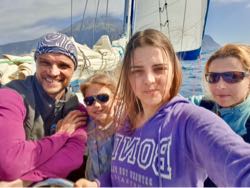
Storms again. Tristan da Cunha – Cape of Good Hope. Days 1–4. The storm that had besieged Edinburgh of the Seven Seas throughout our three days on Tristan da Cunha reached our secluded little corner as well. Gusts suddenly came flying in at up to 45 knots, and on that cheerful note, heeling together with the yacht, we set off into a wall of rain. The captain encouraged us: “It’s all right, girls—once it blows 50 knots, we won’t even need to weigh anchor; it’ll all happen by itself.” And on one gust, it did blow 50. So the anchor had no trouble popping out of its nook on the rocky seabed.
Thank God, we managed to heave in the chain relatively easily too. We had to send the captain forward to deal with the anchor while the sailor worked the helm and throttle. Our young sailor donned her waterproof suit and came out with binoculars for one last look at Tristan da Cunha. But there was no romantic waving of handkerchiefs, for the island immediately vanished into a cloud of rain spray. With the gusts pushing us down onto our side, we made our way out to a safe distance and into high, mountainous seas. Ah, the easy life was over.
All the girls sighed in turn. Never mind: it’s only half a month’s sailing, and then we’ll have a long stop................................................................................................................................................................ and then the waves again, and a steady 15 metres per second of wind—that is, 30 knots. The barometer plummeted, and we climbed as far north as the wind would allow. We managed to outwit the new storm, and the brunt of it passed south of us.
We got about 20 hours of winds up to 40 knots. Nothing unusual, apart perhaps from the dashing evening reefing of the small staysail. Nastya and Andrey were working on deck when suddenly: “Dad, Dad!”.... Ladunya and I stared wide-eyed through the windows, and there, off the port side, was a mountain with a foaming crest. Fortunately, that wave was not dangerous for our heavy boat; it did not knock her onto her side, but it broke over both sailors on deck. When, for just a moment, you imagine what might happen in an empty, unsettled ocean, your eyes fill with tears.
So it is better not to imagine it................................................................................................................................................................ The two came back from the deck and hung their soaked-to-the-skin foul-weather gear all around, while the saloon vent we had taped up on Tristan da Cunha began leaking with triple force. Why on earth would anyone put a vent above the settee, and right next to a hatch at that?
For all six years it has done more harm than good. No matter which way you turn the outer cowl, no matter how you cover it with the cap, a wave still breaks over the deck in precisely such a way that the water streams straight into that opening. Onto the books, toys, settee and bedding.... And there is no way to seal it properly. That is why our young sailor now sleeps under the table in the wheelhouse. Half a rubbish bag hangs like a curtain on the bulkhead in the cabin, protecting the locker and part of the settee from salt water; the other half of the bag serves as a seat, adorned with rags and a deep roasting tray from the oven.
Overnight it collected enough water to fill it by a third; the rest, of course, sloshed out as we rolled. Some of the settee cushions are stowed in the forecabin; others imitate the young sailor’s workstation. After all, she still has to manage her schoolwork somehow amid all this. In short, everything is dry and lovely. We urgently need a bucket of sealant. In a calm, if one ever comes, we’ll board up the hole and pour rubber over it. Enough fooling around...............................................................................................................................................................
Otherwise, everything is wonderful. The children will wake up soon—our sleepyhead young sailor and Nastya, who is on watch. I’ll give them tea. Today’s lunch menu is cabbage rolls; the cabbage leaves have been ready for ages, but the weather has not allowed any culinary heroics. Perhaps we’ll get lucky now. Thanks to Nastya’s efforts, we still have about ten oranges and around 15 apples left. If we don’t splurge, but slice up one or two pieces of fruit a day for everyone, they’ll last us to Cape Town. Wishing everyone delicious food and high spirits!...............................................................................................................................................................
Yesterday, for the first time since leaving the Strait of Magellan, we crossed a shipping lane. Over the course of the day, we passed two bulk carriers at distances of two and three miles. The first was called Pride of Dubai; the name of the second slipped the crew’s collective memory. And during the night the radar detector started beeping—it beeps when someone’s radar is painting us. But neither AIS nor a visual assessment of the situation revealed anyone except us. A submarine?...... In the first two days after Tristan da Cunha we covered 234 miles, and another 110 miles or so over the past 24 hours.
A pleasing number remains to Cape Town: 1,234 miles. Twelve days’ sailing, unless we are becalmed. The last time the crew went ashore was.... umm.... 27 August, at Punta Arenas in the Strait of Magellan. That makes 41 days since a human foot from Lady Mary last set foot on any solid ground. We still have not broken our South Pacific passage record. We continue eastward..... Warmest greetings to you, our dear ones, from yet another end of the earth. Thank you for being with us through your encouraging, entertaining and interesting comments.
The whole crew always looks forward to them!.............................................................................................................................................................. We thank Leonid K. from Singapore for his indirect participation in the expedition and for replenishing the ship’s kitty via Paypal.Me/TravelyFamily. You motivate us to pull ourselves together and write a new report. Thank you for the inspiration and support!
We also thank the anonymous sender at Yasobe.ru/na/TravelyFamily! Although we do not know your name, you are with us! And that means a great deal............................................................................................................................................................... You can follow the progress of the First Russian Three Great Capes Round-the-World Expedition with Children on our website under the Route tab, where the track from IRIDIUM is displayed. The same map, with the track and weather, is available at bit.ly/iridium360