
From the Travely-Family archive · Cape Horn
Tristan da Cunha. The Lost World
An original publication from the former Travely-Family website. This English translation was preserved from the technical-site archive without editorial rewriting.
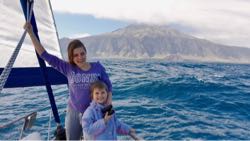
Tristan da Cunha. The Lost World. Well, girls, have you had a look at land? Let’s move on!.... The captain steers Lady Mary away from the breaking crests and back out. The only anchorage in the Tristan da Cunha archipelago proved inaccessible................................................................................................................................................................ The island’s enormous mass rose out of the morning haze.
Steep basalt shoulders crowned by a narrow neck and head disappearing into the cloud. Oh! Like a cake! the young sailor declares, seeing from the deck the peak that has opened before us, more than 2 kilometres high. Only one side of the ancient volcano proved suitable for human habitation. The little town of Edinburgh has settled into a gently sloping valley, with fewer than 300 inhabitants. They are all descendants of nine European men and seven women, five of whom were Khoikhoi women from South Africa. Lady Mary makes her approach from the north-west.
A fresh northerly wind has driven a heavy swell into this far-flung dominion of Her Majesty the Queen of Britain. And there is no reason to expect anything from the waves except the failure of our operation. It is impossible not merely to land ashore—there is not even a chance of anchoring. And Lady Mary has considerable experience of anchoring in all sorts of places. At Cape Horn and the Antarctic Peninsula, off windswept Easter Island and inaccessible Pitcairn, where the crew member on the bow was drenched from head to toe over the bowsprit while the anchor was being dropped—we could anchor everywhere.
Not here................................................................................................................................................................. Cows, look, cows are grazing! The young sailor takes in the lawns and houses at the foot of the lava plateau, and then her gaze runs into the waves. Ye-es, this is rougher than Pitcairn..... And with the northerly behind us, we edge away eastwards. A neat settlement glides past, a helicopter by the administrative building, roofed hangars and several large boats hauled ashore.
Someone in a red windbreaker by the metal tanks watches the lone yacht’s manoeuvres. And breakers foaming like champagne thunder into the little haven for fishing boats. We were so close to happiness...... Nastya sighs sorrowfully....... And that was how, this morning, the 33rd since we left Tierra del Fuego, we were greeted by the only solid ground for fifteen hundred miles around..........................................................................................................................................
It is blowing about 20 knots, but straight onshore. The radio briskly invited Lady Mary to talk and said something about the harbourmaster, who was eager to reveal the truth to us. But the dialogue did not go well. The harbourmaster delivered the truth in some tricky language incomprehensible to the uninitiated. We asked him to repeat it and still did not understand. The conversation died there. And we sailed on, disheartened, past the surf foam, grazing cows, wooden fences, a construction crane and an excavator. We also passed a South African passenger ship lying in the roadstead.
Afraid that the captain will put the yacht on a tack out into the ocean and order us to set sail, we try to keep our heads down, take photographs and not fall overboard. The swell rolls the yacht from side to side. Sooty albatrosses peer into our faces. And the young sailor chants the Russian tongue-twister about how the ships tacked and tacked but never managed to tack their way through. That one’s about us today, Ladunya. Exactly—we never managed to tack our way through...................................................................................................................................................................
Lady Mary rounds the eastern side of the circular island..... And the-e-ere—well, what do you know! No matter how many videos or accounts of visits to Tristan we watched, they all showed the island from just one side, the side with the valley and settlement. From space, all you can see is a green circle 6–7 miles across and sheer shores. Did no one really film the island from the other side? As soon as the barely ocean-breaching mass of Tristan da Cunha sheltered us from the wind, another world began. Sunny, with a gentle swell. Sheer cliffs covered in curly shrubs and little trees.
Grey, black and red volcanic rocks and a thousand birds. Every hundred metres, new clefts open up. Pale ribbons of waterfalls stream down the steep, mighty shoulders. Streams plunge vertically through every cleft, forming tall, narrow cascades...................................................................................................................................................... Andryukha, it’s pure paradise! But it is not for people; it is for birds and small animals.
People cannot get in here. There may be some gently sloping areas at the top of the plateau beneath the peak, but they cannot be seen from the shore. Why else would they have a helicopter here? Of course, perhaps they use it to fly to the neighbouring islets, but something tells me that is not all....... Another cleft, a second, a third. Andryukh, could we drop anchor here? We’d have to check, says the captain. For now, we’re looking around. The electronic chart shows depths of 300 metres and an uncharted coastal zone....... And the hope that we are not going to miss Tristan timidly unfurls its translucent little wings......................................................................................................................................................
Beyond the next bend, whitecaps are already visible on the sea; the sheltered zone has ended. But right at the edge of the wind, on a slope that is not sheer, we see—oh God—an entire forest! Pines or cedars, and some other conical trees, frame the rock, descending towards the grass on the hillside. If only we could anchor here! the children dream. Yes, and land! And go for a walk!.... The wind is stunned by our audacity and whistles into our side with all its might. We flee. On our second attempt, we anchor under the shelter of the cliffs.
By a magnificent, romantic waterfall, the wind has driven whitecaps round our corner. Lady Mary gives a petulant buck. We get the message, and next time drop anchor farther west, by another waterfall. At a depth of 10 metres, we pay out 70 metres of chain. It is hard to believe. We’re anchored!..................................................................................................................................................... The captain settles into the cockpit to contemplate the view; the girls put on music and start tidying up.
I pour some tea. Andryukh, it’s pure Jules Verne, isn’t it?! Uh-huh, the captain replies with an eloquent nod. Listen, this is the first real, genuine island on the 37th parallel of our entire circumnavigation! The very one from Jules Verne and In Search of the Castaways! The same parallel we followed in the Pacific and the Atlantic. And from Africa we’ll cross the Indian Ocean along it too, calling at Amsterdam Island, just as we should. Andryukh, if I ever have to name the person who changed my life on some form, I’ll write Jules Verne.
And I thought you’d write Andrei Klochkov, the cap drawls sourly. Well, without Andrei Klochkov, no J. Verne would ever have had enough strength, I agree. Okay, I’ll write two surnames: Verne and Klochkov. And so it was settled................................................................................................................................................................... White albatrosses sit on their nests on the steep slopes.
Spring streams down the green walls. And their distant relatives, sooty albatrosses, with funny raised nostrils on their beaks, bob on the waves around the stern and grumble at one another like puppies whose bone has been taken away. And when the young sailor shook some crumbs from a plate overboard, the albatrosses, like a flock of gigantic grey, beaky pigeons, rushed to snatch the crumbs from one another...................................................................................................................................................................
The radio is silent. We do not land ashore and make contact with no one except the birds. Life is looking up, guys! It is a pity we cannot show you the photos. Two and a half hundred people inhabit the opposite side of the island, but that lost world is uninhabited. Pure Jules Verne. And it is incredible. Dream, people, and keep your dreams moving! They come true. It gives me goosebumps. Sending you our love from the lost world in the middle of the South Atlantic, from the most remote and inaccessible inhabited island in the world...................................................................................................................................................................
We would like to say a heartfelt thank-you to the unknown sender for supporting the expedition through Yasobe.ru/na/TravelyFamily! You are now part of our shore team too! And that truly warms our hearts. Wishing everyone a bright October!................................................................................................................................................. You can follow the progress of the First Russian Three Great Capes Round-the-World Expedition with Children on our website under the Route tab, where the IRIDIUM track is displayed. The same map with the track and weather is available at bit.ly/iridium360.