
From the Travely-Family archive · Patagonia and Tierra del Fuego
Storm Tactics. A Week of Storms
An original publication from the former Travely-Family website. This English translation was preserved from the technical-site archive without editorial rewriting.
Storm Tactics. A Week of Storms. Sent via satellite..... Wow. It’s been a long time since it blew this hard and this relentlessly. The storm has already lasted a week, with only one half-day window, and we managed to slip through it from the bay with the waterfalls to our present shelter. It’s that sort of spell when 20–25 knots of headwind means it has calmed down................................................................................................................................................................................................................
We entered a narrow passage between the rocky promontories of Isla del Medio—Middle Island, that is. We’re lucky: just as we’re anchoring, the sun squints through and the sleet takes a breather. Our shelter is a ring about a hundred metres in diameter, with a narrow entrance through which a single yacht can squeeze carefully. The low hills are covered in dry grass and sparse groups of flag trees. They’re called flags here because constant winds have twisted them into the shape of the letter L—bent trees, in other words. You’d be bent into a pretzel too if the Pacific Ocean kept punching you in the gut...............................................................................................................................................................................................................
Today the sun somehow managed to break through the porthole first thing in the morning—that is, at about 10. And at 8, in pitch darkness, the captain’s alarm started singing in the wheelhouse.... Amid guttered candles and evening prayers, amid trophies of war and peaceful campfires.... Nastya and I listened from the sleeping cabin. Andrey had to establish contact with space and download the latest weather forecast. Then it would either be an emergency wake-up or we could sleep until dawn. Though I wake long before daybreak, I don’t like getting up for an emergency.
Weighing anchor in gloomy twilight, in rain and hail...... And the wet lines—a couple of hundred metres of them—to be untied from the trees and hauled aboard...... The most annoying thing is feeling so lazy. If only it would warm up already. I dream of getting up not at plus 7, but at least at plus 15, so climbing out from under my sleeping-bag duvet wouldn’t take such an effort.... Meanwhile, the sailor, having done her exercises in the wheelhouse, returned to the aft cabin.....
“Dad said it’s the wrong wind.”....
The wrong wind means it is still howling at 30 knots, gusting to 45, directly against our course, and forcing our way into it would be somewhat unwise. Spending all day fighting through 20 miles, wearing ourselves out and burning twice as much diesel. We have time; we’ll wait a little longer in shelter..............................................................................................................................................................................................................
On Wednesday it was whistling at 50 knots, jumping to 55—that’s 100 km/h. And if our mast were taller, it would have caught the full 65 knots. Force 9–11 on the Beaufort scale: one of the strongest and longest storms we have ever ridden out at anchor. The previous time we stormed not far from Cape Horn, when, on 9 May, together with the crew of the yacht Sara, we went to meet Fedor Konyukhov. Neither we nor Sara ventured out to the Diego Ramírez Islands then, so there was no warm group welcome right in the Drake Passage—it was too dangerous.
But the following day we rounded Cape Horn again and hid in a bay behind it. It was blowing 50 then, with gusts recorded at 64 knots. We’re more secure here: we’re not swinging around and are barely rolling, stretched out so firmly on shore lines that we could ride out a hurricane if we added another couple of ropes..............................................................................................................................................................................................................
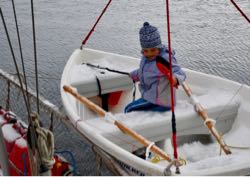
And quite a time we had running those lines. I got off lightly—I dealt with the anchor and paid out the lines; Ladunya never even poked her nose out of the boat; the captain was at the helm. Nastya bravely climbed into the dinghy and rowed against the wind, carrying the mooring lines ashore. Four times. Luckily, we ran the longest line during a relative lull, when it was blowing 20 knots rather than 30 with hail. The other ropes were shorter, but more fun. There were still drifts of graupel in the dinghy from the night before. In the morning it looked like crumbled polystyrene; now it had compacted a little.....
The diagram in the sailing directions says to tie up to the fishermen’s line stretched across the bay. The skipper assessed its strength and decided otherwise.............................................................................................................................................................................................................. First we ran a long line ashore, then Lady Mary, under Andrey’s steady hand, swung around for about half an hour while he checked where she would be driven if the wind blew from this direction, and what if it came from that one?.....
Nastya took out two bow lines and secured them to the gnarled trees. You have to fight your way ashore; on the way back, the wind carries you all by itself. The main thing is not to fly straight past the yacht. We battled through the gusts, hauled the sailor aboard and hoisted the dinghy alongside on two halyards. Then we went down into the wheelhouse.............................................................................................................................................................................................................. Over tea, we keep glancing at the anemometer. It’s blowing 35. Hail drums obliquely against the windows, grey mush has swallowed the sky, and it’s getting dark.
“Well, umm....,” says Andrey, our great ideas man, “let’s tie on another rope. I don’t like the way we’re lying.”....
Well, obviously, when it starts blowing fifty, there’ll be no chance to redo the lines if even now the dinghy and rower are being swept towards the entrance to the bay. Nastya’s face falls. Never mind, daughter—when we get back, we’ll finish our tea and chocolate with the satisfaction of a job well done.
“And a cartoon!” Nastya plaintively quotes the young sailor from the Navy Day report. Yes, and a cartoon.....
And out we climb into a wall of hail....... It lashes our cheeks so painfully! We lower the dinghy into the water, and Nastya puts the oars into the rowlocks. The captain hauls the dinghy round to port with a line, while I clip it with a safety loop to the rope running ashore. The rower is almost blown away, so we decide she’ll reach the shore by pulling herself along the rope—it’s safer that way. And Nastya disappears into the hail, hand over hand along the line..............................................................................................................................................................................................................
The captain stayed overnight on the watch berth in the wheelhouse. At 6 a.m. the big one was due to arrive—up to 60 knots. Despite the bay’s small size and our bow-to-wind position, the yacht is being tossed around; something flies off the table. The following morning, the young sailor pretended to be a poor little lamb and announced that even she had felt seasick. I sleep-read-sleep. Towards morning, my dozing is broken by the howl of the wind and wild leaps. Well, I think, it must be 6 a.m. The forecast is unbelievably accurate. The anemometer reads 54 knots.
The solar panels scrape pitifully, begging to be brought under cover; they’re worn out, poor things, but they’re holding on and haven’t been torn off. The ropes creak bravely. We’re lying well. By dawn, 40 knots of wind remain; by evening, 30. And so it has been blowing thirty for three days now, with brief breaks at 25. We’re snug as if in a tank: doing lessons, writing and reading, and we even held a super-mega competition that our young sailor had been dreaming about for a month. The posters are still hanging, beautifully lettered Culinary Duel.
The props create a cosy, kitcheny mood, while the celebration itself has inspired dreams of new competitions and performances............................................................................................................................................................................................................... We’ll tell you how we entertain ourselves during a storm in the next report. I’ll only add that our young sailor played Masha from the world-famous cartoon Masha e el Oso, or in English, Masha and the Bear.
She made jam to Masha’s song, just as Mashas from the cartoon are supposed to do.......................................................................................................................................................................................................... You can follow the expedition in real time on our website under the Route tab, where the Iridium track is recorded. The map with the track and details is also available at bit.ly/iridium360..........................................................................................................................................................................................................
We received a message saying that the Paypal.me/TravelyFamily link did not work. Perhaps the satellite encoding swallowed the slash after Paypal.me, or some punctuation mark got bundled into the link and confused it. You need to try again. Paypal.me/TravelyFamily. Thank you, our dear readers, subscribers, near and far! Your support and comments, which we regularly receive through our shore team, really give us wings. News from the mainland makes riding out the storm feel much better..... By the way, have you already seen the feature about hopeless romantics from 7 August on Channel One’s Good Morning programme?
It included a segment about us, Kruzenshtern and Andrey Nevzorov.............................................................................................................................................................................................................. Hugs from those very same famous storms off Cape Horn.