
From the Travely-Family archive · Cape Horn
Calm and Headwinds. Answers to Your Questions
An original publication from the former Travely-Family website. This English translation was preserved from the technical-site archive without editorial rewriting.
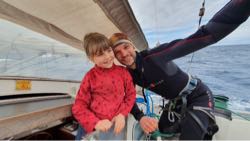
Day 14. Calm and headwinds. Answers to your questions. We answer your questions. The everyday details of a yacht passage with children through the furious fifties and roaring forties of the South Atlantic.
I don’t know, Marina, how you can eat jam without biscuits! That’s like the Madonna without the Child, like Chip without Dale, like... Like an arse without a handle, for goodness’ sake.
It’s just that you grew up a proper Bad Boy, Andryusha, so of course you don’t understand. But surely—a barrel of jam, a basket of biscuits... that’s sacred.
I don’t understand you, Marinochka...
This is our breakfast, accompanied by polite conversation. At last the weather has stopped being sick of us, and we of it, so we can sit around drinking tea. We moved the clocks forward by an hour. Now the time difference from Moscow is five hours instead of six.............................................................................................................................................................................................................
Almost no wind since morning. At first, 7 knots of wind gives us 2 knots of speed, but then the yacht is carried along solely by the following current. We have left the mainsail amidships as a steadying sail and console ourselves with the thought that the ocean here is flowing in the right direction, rather than towards the South Pole.
A few days ago, a low passed to the north, sending a high swell rolling all the way down to us, straight onto our beam. Thankfully, at least the wind has whistled off eastwards. We have all had our fill of storms for now. Although our forecast promises stronger winds in a couple of days.
It is plus 12 in the yurt this morning, even though a deck hatch accidentally opened during the night and, for the first time in eight months, we sailed with the window open. Scorching!
Since leaving the Strait of Magellan, Lady Mary has already climbed 10 degrees of latitude northwards, though that does not stop us from still going out on deck in jackets and hats....
“Mum, when are we finally going to take this stupid film off the windows?” asks our young sailor. That is what she calls the secondary glazing, with no respect whatsoever.
“Soon, darling. As soon as we stop firing up the stove, we’ll take it off.”
I am looking forward to the night when I can go to bed without terry-cloth socks. Andryukha misses the tropical heat; the children and I only miss swimming. Although we live at sea, the last time we had a proper swim was almost 10 months ago. Then winter set in........................................................................................................................................................................................
I’m off to fry French toast from the last ordinary bread on board, several loaves of which were given to us aboard the trawler Arctic Wolf. Real Russian bread—a great rarity and absolutely delicious. After that, all we will have left are long-life black bricks and flour. We’ll bake pies.
Our provisions are still holding up well: plenty of fresh fruit and even some vegetables. Nastya, our chief cook and sailor, has already taken up the defence of the fruit against the ravenous crew.
“If you eat it all now, you’ll be crying later. You’ve already had oranges and apples today; the rest is for tomorrow!”....
What can we do? We submit to the brute force of Nastya’s authority.
The gas cylinder lasted two and a half months; it was a good thing it ran out during the calm. The captain moved a new cylinder from the stern to the anchor locker, and at the same time we sent the first of our two floating 120-metre shore lines from the deck to beneath the aft berth. We used them to tie up to shore in the fjords of Patagonia and in Antarctica. Beneath the mattress of the aft berth, of course, it is damp; mould is growing underneath. Everything as usual......................................................................................................................................................................................
Hooray! Today is a happy day. Our shore team sent us a whole pile of your comments on several posts! You should see how eagerly we devour them, and how touching it is!
While it is still fresh in my mind, let me tell you this. Friends, congratulations are in order: after the storm I endured, I have developed geographical idiocy. Here is the evidence.
In the previous post, I wrote that Port Famine was in the narrow part of the Strait of Magellan, farther east than the point where we entered it. Well, actually, it was we who entered farther east, while Port Famine remained to the west.
The same disaster occurred in the report Aftermath of the Storm. I wrote that we were heading as far north as possible to give ourselves some room so that, when the northerly headwind arrived, we could fly westwards. What west, for goodness’ sake, when it is east? Twice in a row...
So all those jokes about women drivers mixing up left and right—are they about me?....
All right, I hope this affliction can be cured by proofreading more carefully...
The point of the manoeuvre is that, when expecting a northerly wind, you head north in advance; then, when it starts blowing from there, you can calmly fly east on a beam reach. In other words, your movement follows the two legs of a right triangle rather than the hypotenuse. Was that too confusing?
When the wind is against us, we tack in unexpected directions. When there is no wind, incidentally, we do too. Today I caught us in SEAiq Open on a south-westerly course: for a couple of minutes it looked as though we were going backwards while the wind dropped to zero........................................................................................................................................................................................
About the storm: the wind reached 62 knots, or 30–31 metres per second; waves of ten to twelve metres are perfectly normal in that sort of wind. The wind tears the foamy crests away. The waves were almost following, which is what saved us. The worst of the storm came at night, so who was going to measure those waves?
We flew along on a broad reach at up to seven knots under a scrap of baby staysail. We did not use the sea anchor, though we could have hove to under a reefed mizzen, as we did in the Pacific while approaching Cape Horn.
We do not know why the ship near the Falkland Islands, which was riding out the storm while hove to, did not ask at once whether we needed help. Perhaps the watchkeeper was relieved by someone more conscientious?
The only meaningful assistance a ship can provide to a yacht in a storm is if the yacht is sinking—to pick up a liferaft or passengers from the water. In 10-metre seas and near-hurricane-force winds, attempting to come alongside for any other reason is impossible; it is better not to approach at all........................................................................................................................................................................................
We think it would be great to rig up a bicycle for generating electricity, or somehow make use of the ocean as an electrolyte solution, but we have put off all such home-grown engineering measures until things become truly critical. They are not critical now. The sun shines more than it did in the 50s latitudes, and it even manages to charge something. We are using the heater less and less, so we can run the diesel engine to charge the batteries and power the watermaker, even though we do not like the whole idea of using diesel.......
Yesterday this report failed to fly off into space, so we are sending it this morning. Overnight, 15–20 knots of wind arrived, and we are managing to sail close-hauled, almost on a beam reach. Not bad so far.
The captain had a partial swim this morning, hanging behind the stern in a climbing harness while replacing the windvane self-steering gear’s broken control line.
A couple of white albatrosses, one grey one and several unidentified seabirds are following directly in our wake. It turns out that albatrosses have striking, slanted eyes outlined in black, and a slightly puzzled expression.......................................................................................................................................................................................
Our young sailor will be getting up shortly; we will do maths, and Nastya will tell us a new chapter from the International Regulations for Preventing Collisions at Sea.
We would like to offer our heartfelt thanks to Andrei Shtykh for keeping our website alive. It is thanks to him that you can see the reports flying in from the ocean to the website.......
Friends, thank you for your support, your concern and for following us! We positively grow wings, guys, when we see that we are not alone in this empty ocean and feel how close you are to us despite the depths and the distances......................................................................................................................................................................................
You can once again follow the expedition in real time on our website under the Route tab, where the Iridium track is displayed. The same map, with the track and details, is available at bit.ly/iridium360...........................................................................................................................................................................
This report was transmitted by satellite. Thank you for being with us, friends. And may all be well with you!