
From the Travely-Family archive · Central and South America
San Blas. Running Aground at Night
An original publication from the former Travely-Family website. This English translation was preserved from the technical-site archive without editorial rewriting.
San Blas. Running aground at night. In the land of the Kuna Yala Indians—continued. How we woke up aground in pitch darkness, trapped in a confined space.
And that night the rain set in. Then the wind picked up. And they carried on taking turns like that until we swung round, dragged at anchor and ended up aground. — That was how the previous post ended.
A Land of Umbrellas, Not Panama Hats
Panama is a country where it rains for eight months of the year. There is a respite from January until May. We arrived in Panama in early December, when it was still raining regularly several times a day, though no longer around the clock.
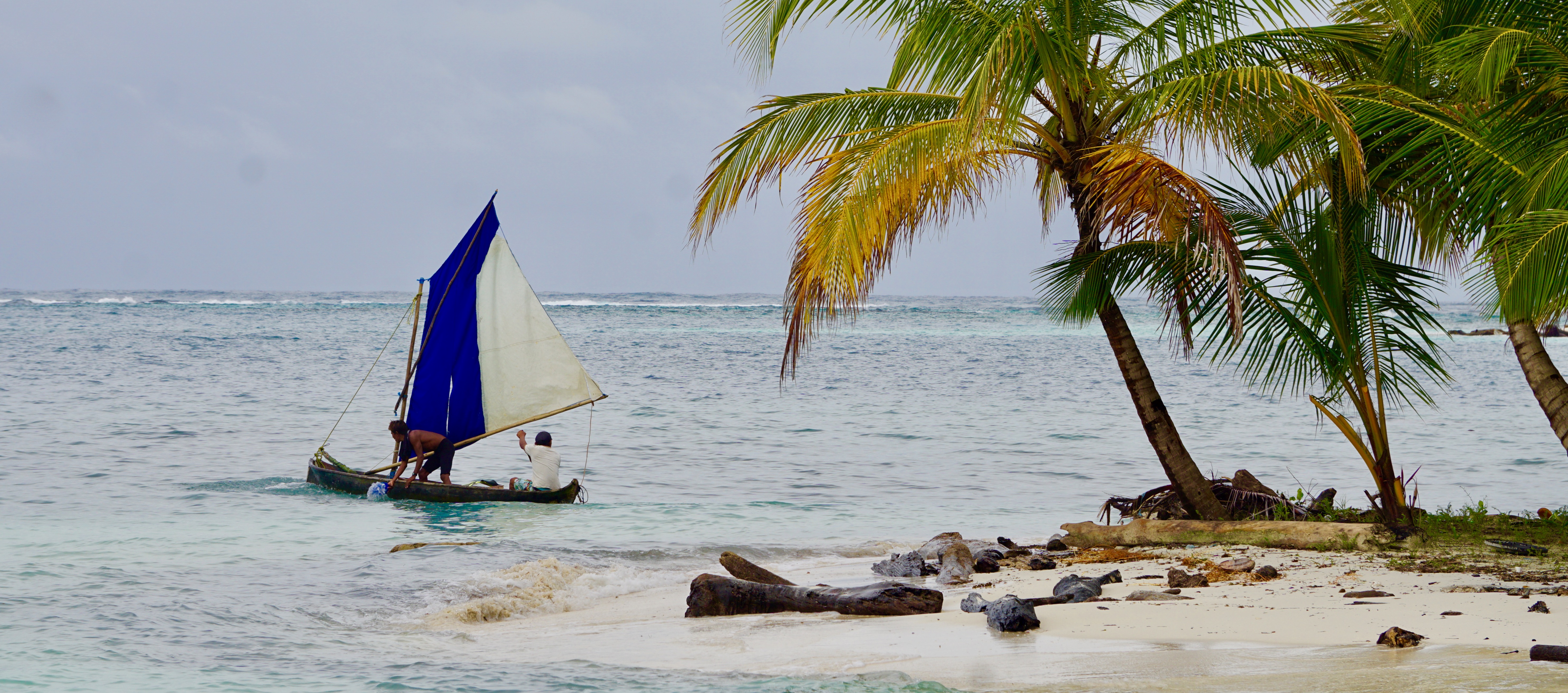
By the end of the season, Lady Mary looked roughly like the little boat on the right:
Having battened down the hatches and cursed seven generations of the foremothers of Panama’s rains, the first mate settled down for the night on the settee in the wheelhouse. It was the only place aboard where outside air could still get in through the half-open companionway hatch.
After tossing and turning for most of the night amid the roaring and pitching, the crew’s greatest lover of fresh air had just about dozed off.
Can’t you see, Marinochka, that we’ve dragged aground?!
The captain’s alarmed and sleepily sarcastic voice instantly brought the first mate’s body upright and gave her eyes a clear, somewhat bulging look. As if to confirm his words, the boat heeled slightly onto her side.
Two Merry
Geese
Hours
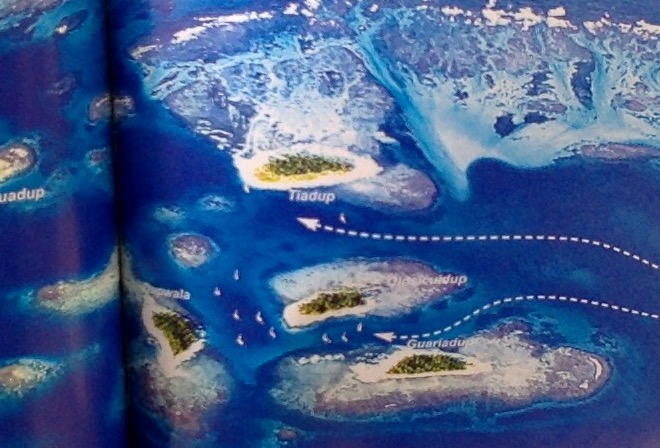
We had originally anchored in the middle of a triangle with sides 80–100 metres long, formed by three islands. There were shallows around the islets, while outside them a barrier reef described an almost impassable circle. The wind could not be called storm-force—25 knots (46 km/h), with gusts—but during the night it had shifted to the opposite direction. Torrents of rain and the kind of darkness they call pitch-black.
“Haul up the anchor!” the captain shouts, thrusting a torch into my hand. Streams of water run down my body beneath my waterproof jacket. The chain grates against the bobstay (a thick wire stay at the bow, in front of the hull). Lady Mary, as if sensing trouble, bucks her bow awkwardly into the wind, but cannot move.
“Maybe we shouldn’t?” My cry is swallowed by the wet darkness somewhere among the tiny islands of the San Blas Archipelago off Panama’s Caribbean coast.
“Thank God,” I think, “it’s sand here, not coral.” The chain jumps off the bow roller, then again... I haul it back by hand with all my strength. The captain opens the throttle, and the engine, roaring like a thing possessed, loudly belches out stinking clouds of smoke....
Perhaps we managed to pull ourselves a little towards the anchor; perhaps the engine had not been stinking and labouring so loudly for nothing.
“Anchor’s aweigh!”
Instead of answering, the captain switches off the light. Opens the throttle. A jolt, another, a lurch... We’re free!
From the sailing directions. The arrows show the approaches to the anchorage. We were anchored just to the left of the tip of the lower arrow. Then we went round in circles
Now nothing is holding us. Force 6 wind, gusting to Force 7, visibility—zero. Land is 30–50 metres away in every direction.
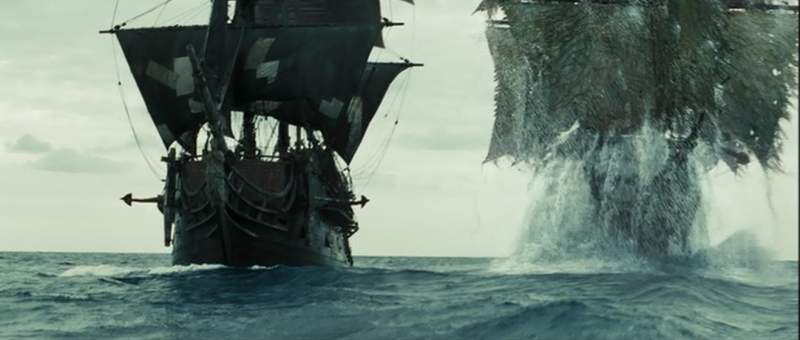
Like the Flying Dutchman
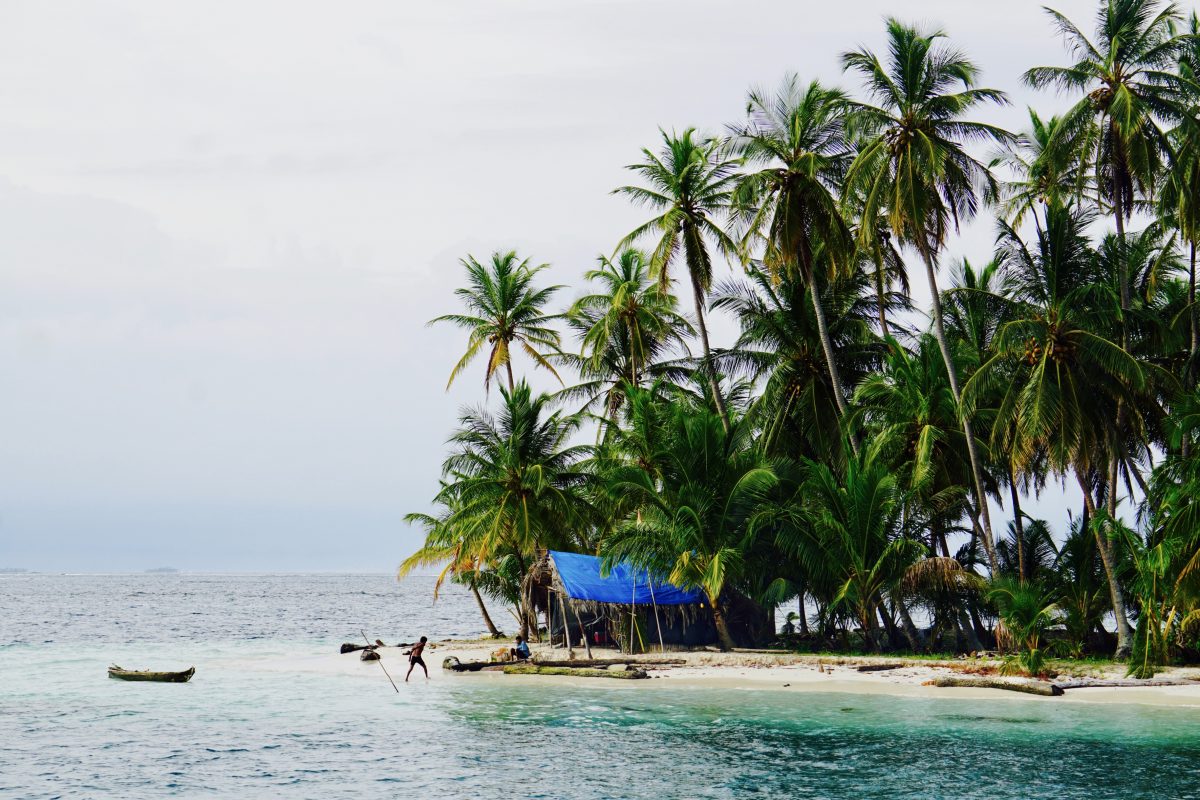
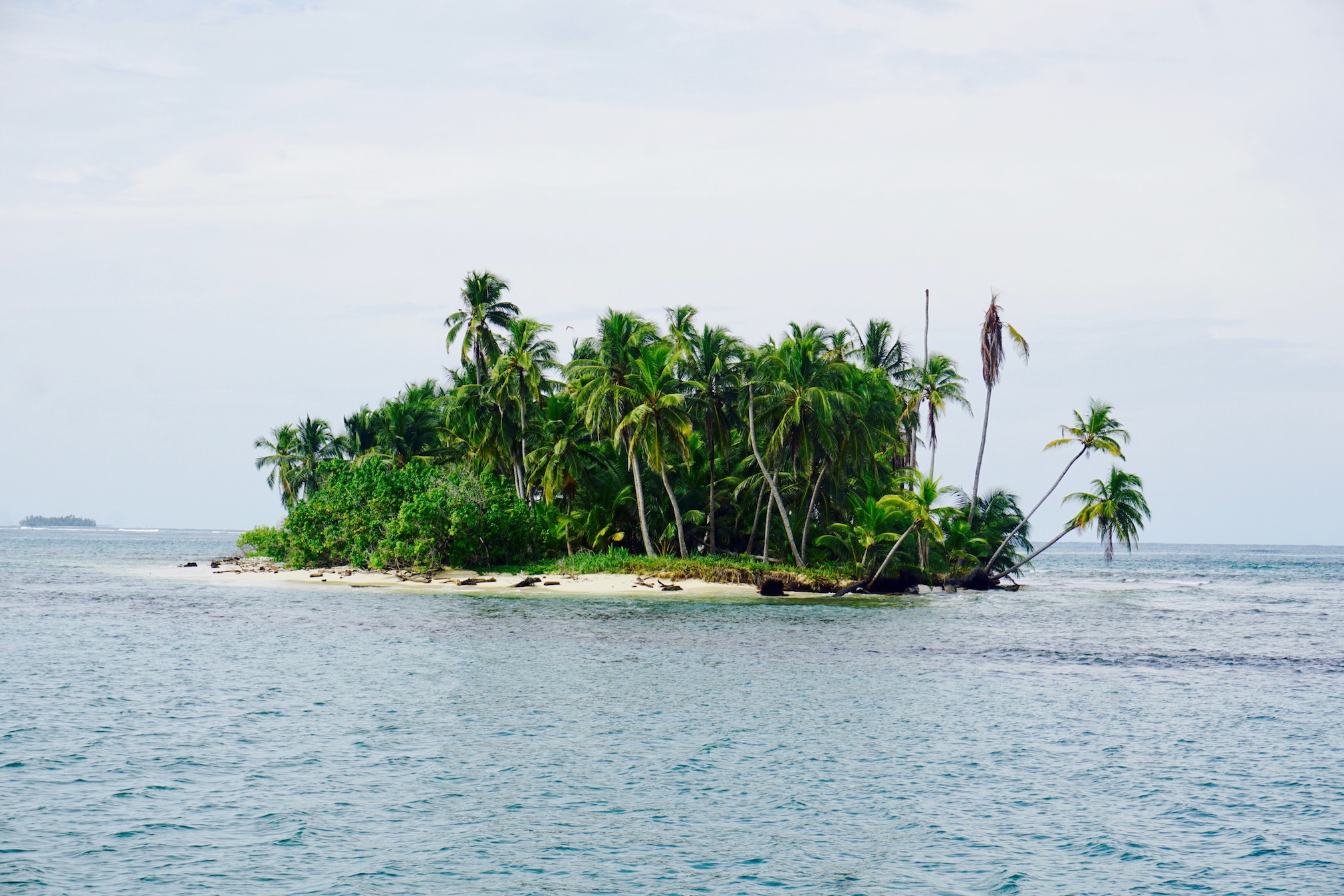
Two of the three little circles of sand and palms are uninhabited; on the third, beneath a leafy shelter, without communications or electricity, lives an old Indian man. None of this can be seen now. Only black, sodden cotton wool, the drumming of the rain, the howl of the wind and the growl of the engine.
Now we have to anchor again, making sure we hit the widest, deepest spot and that the anchor sets on the first try. The torch beam runs into a wall of rain. Only the occasional flash of lightning lets us glimpse, for an instant, where we are and where the land is.
The chartplotter is on, of course, but anyone who has navigated by GPS knows that the accuracy is ±50 metres, and on a patch only those same 50 metres wide, that does not exactly help with orienteering. For example, in The Gambia we had this track on the chart:
(temporarily not loading; we’re fixing the problem on the website)
Relying on memory and the track recorded on the chartplotter, the captain tries to reach the best place to anchor, taking into account the strong wind now blowing from the opposite direction to the evening.
I stand soaking wet at the bow, ready to drop the anchor at any moment. Judging by the scene illuminated by lightning once every five minutes, the captain has taken the boat out of the triangle, and we have rounded our islet, ending up between the foam over the barrier reefs and the neighbouring islands. A few lights from a distant Indian village appear first to port, then to starboard. Suddenly a torch flashes where there had been a black void—the old Indian man has woken up and come out into the rain so that we do not take down his shelter with our bowsprit:).
On the one hand, it is good that this long barrier reef is there—the waves from the open sea break against it rather than over our heads. On the other hand, there is this barrier reef. And that is not good.
The rain eases a little, and now the torch beam picks out first the foam over the reefs, then the driftwood on the uninhabited islet, then a sandspit two metres off the bow.
“Reef to starboard!”
“Astern!”
“Stop! Shallow water!”—I do not know whether the captain can hear my shouted directions, but by morning I am slightly hoarse. “Let dawn come quickly! Dawn, hurry up!” But the only answer is impenetrable darkness. How we avoided hitting anything, Neptune alone knows.
Here it is, apparently—the right spot.
“Anchor away!”
10 metres, 20, 30, 40... It comes taut. Not holding.
“Haul it in!”
The chain nervously clicks off the seconds, reluctantly disappearing back into the chain locker. A grinding sound, a screech, and... the iron braid of thick links jumps off the windlass. Thirty metres thunder to the bottom while the captain races forward to help me. Even Nastya in the forward cabin hears my colourful, unprintable... hmm... lament.
Second attempt. Every second counts. A metre to port, a metre to starboard—and you are aground. 10, 20, 30 metres... “More throttle!” It comes taut. Harder....
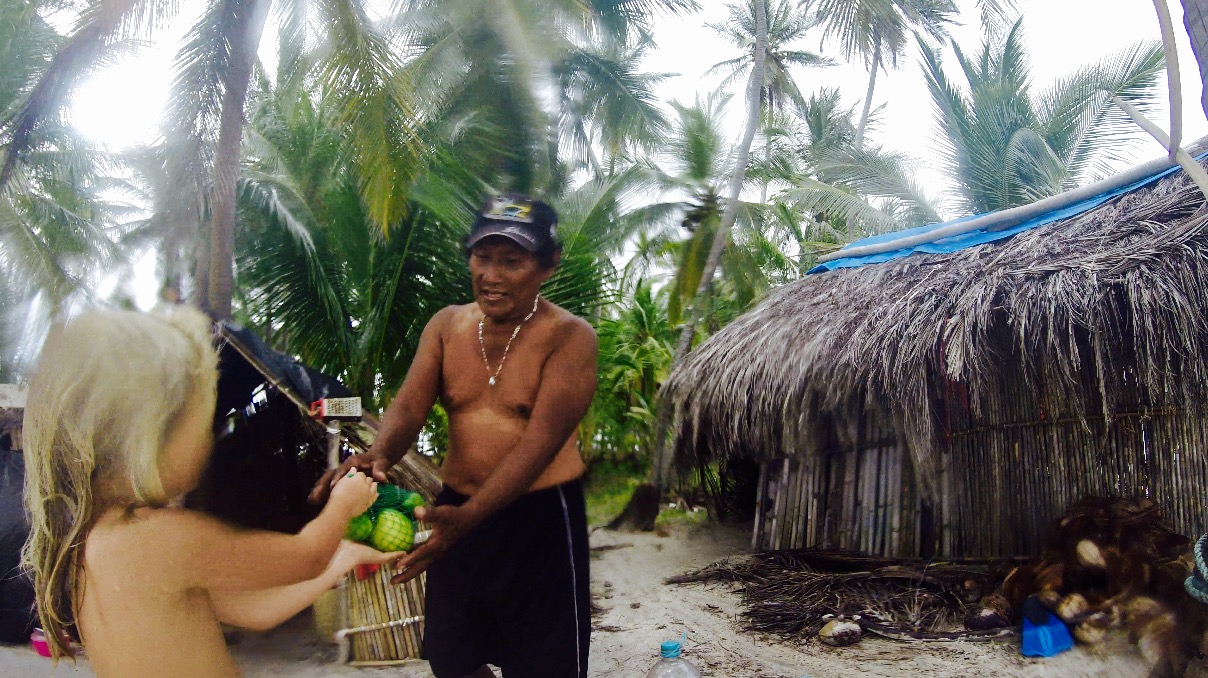
That’s it, we’re holding. The engine falls wearily silent. The captain makes an entry in the ship’s log. I close the chain locker and sweep the torch over all three islets, the sandspits and the old man’s hut. The old Indian man replies by flashing his LED torch.
Thank you, amigo!
Sorry about the quality—it’s a frame from an underwater camera. We swam a little gift over to the old man
Twenty minutes later, dawn began to break. By lunchtime, three newly arrived yachts and two catamarans were scattered among the islands in every navigable spot. Had they arrived a day earlier, there could have been quite a spectacular mess and merry dance that night.
The next day, one of those boats would choose a particularly bad moment to become firmly stuck in the sand right by the shore....
To be continued!
Lessons Learned
When we went to bed, nothing suggested that the wind would shift by 180 degrees; both the forecast and the actual conditions indicated only that it would strengthen. The wind shifted sharply and completely unexpectedly, after it had already strengthened. The yacht reached the very edge of the alarm circle but did not cross it. So the alarm did not go off. Ideally, though, we should have anticipated that too:).
Conclusion
In such confined places surrounded by reefs, you need to set not one anchor alarm but two: one defining the zone the vessel must not leave, and the other defining the zone the vessel must not enter.
And here is the story of how we lay aground right beside the fairway in Senegal’s
Saloum River.
The Uninhabited Island of Dupwala