
From the Travely-Family archive · Yacht, Sea and Equipment
Fresh Water on a Yacht
An original publication from the former Travely-Family website. This English translation was preserved from the technical-site archive without editorial rewriting.
Fresh water on a yacht. Water consumption regime for the crew of a round-the-world yacht. Drinking, cooking, washing and hygiene. How to conserve water
Life on a yacht is paradoxical—there is water all around, yet you have to conserve it.
With a little practice, it turns out that one person does not need all that much fresh water to live comfortably.
Fresh water. Main uses:
drinking, cooking, washing dishes, washing and showering, keeping the yacht clean (washing the floors, etc.)
Drinking and cooking
In the hot tropics, and given our fondness for tea, we use between 2 and 3 litres per person per day. Cooking can be included in that figure as well.
At sea, soups and main courses are cooked using one-third seawater.

Washing dishes
Fresh water is used only for the final rinse. The salinity of seawater does not stop it from washing dishes perfectly well. In fact, it even helps. The benefits:
it cuts through grease; it saves on detergent; it has a non-negative impact on the environment. Think about it: would you drink water with Fairy washing-up liquid dissolved in it? Yet fish, dolphins and corals have to. How long can they last?
After washing the dishes in seawater, all that remains is to rinse off the salt with a small amount of water from our stores. Otherwise, once they dry, plates and spoons are left with a salty coating, which makes the cupboard shelves salty; they absorb moisture and grow mould.
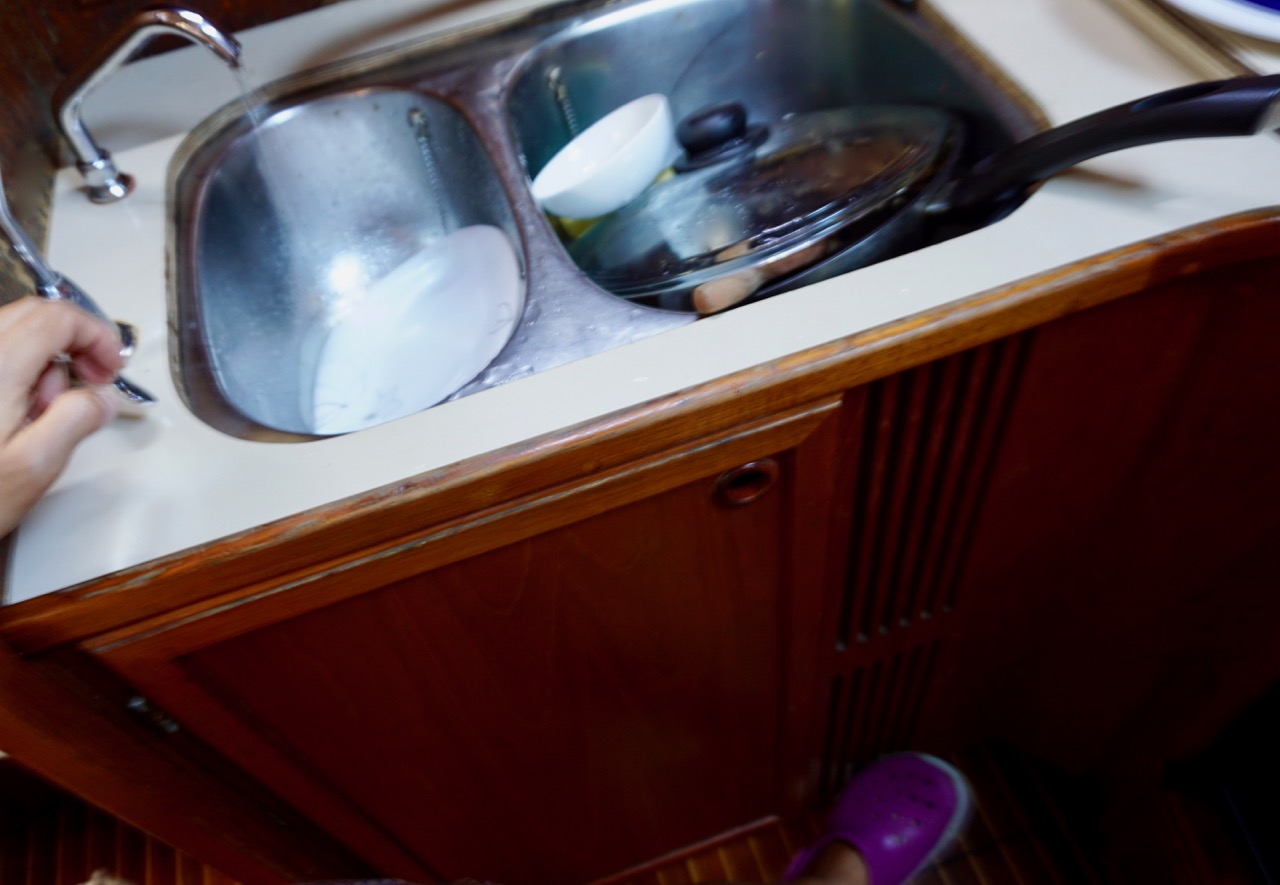
For convenience, we have a seawater foot pump installed in the galley. You work the pedal with your foot, and water flows from the tap.
The pedal is under the purple slipper 🙂.
Crew hygiene
Well, you have probably already guessed that, just as in the previous section, we wash in seawater too. Dive in, climb out, soap yourself, then dive in again to rinse off the soap, shampoo and whatever else you might want to use to scrub the sweat, soot and dust from your hard-working loins.
Another option: scoop up a bucket of seawater and pour it over yourself right there on deck (we do this on the bowsprit so as not to oversalt the deck, and whenever Nastya is afraid of sharks).
Fresh water is needed for rinsing off. After washing in seawater, thanks to his hairstyle—or rather, lack thereof—a one-and-a-half-litre bottle of water is enough for the captain to rinse the salt from his torso and vital organs. The girls, however, may need another one and a half litres because of their long hair.
Interesting fact: before crossing the Atlantic, all the girls in the crew cut their hair considerably shorter to save water when washing it:).
Keeping the interior clean
There is, of course, less dust at sea than on land:). But at anchor near some little town—or an arid shore—the deck first, and then the inside of the boat, gradually becomes covered in dust. Out at sea, mould appears.
Fortunately, a 12-metre boat does not have much floor area, and a thorough clean does not require decalitres of water. So we can budget a nominal bucket of water per week for that. Plus vinegar and mould remover, which are deliberately not rinsed off and partly replace water during cleaning.
Yes, cleaning and laundry really do require fresh water. Anything—or any body—that has been soaked in seawater keeps drawing moisture to itself and eventually becomes sticky (in the case of a body) or mouldy (in the case of an object).
Daily fresh-water consumption — Drinking and cooking: 12 litres — Washing dishes: another 5 litres — Crew hygiene: 15 litres — A nominal 3 litres for keeping the boat clean and for unforeseen needs.
Total daily fresh-water consumption:
35 litres. For a crew of four, three of whom are girls/women. And that is without strict rationing.
Is that a lot or a little?
This is our Nastya. Drinking some water 🙂.
Ways to replenish water supplies on a yacht
Taking on water from shore:
directly into the tanks from a filling station or at a marina in jerry cans filled ashore and brought back in the dinghy
Collecting rainwater from awnings, sails and rigging. Many ingenious yacht owners make special gutters around the edges of their awnings, allowing the water to drain directly into a tank. We used to hang a funnel where the boom attaches to the mast, connected to a hose leading down into a bucket or tank. The captain calls this contraption an “enema”:).
They say that in particularly rainless conditions, people also collect condensation from fog. Obviously, this requires clean, absorbent cloths, which can then be used to wipe up the moisture and wring it out into a container.
Desalinating seawater while at sea or at clean anchorages. (See
Watermaker on a Yacht)
How to prepare yourself for life with limited fresh water (on a yacht, for example):
Keep the flow from the tap low
Turn the water off when it is not being used
While waiting for the hot water to come through, drain the water into a container rather than the sink—you can use it later.

Turn the tap off while brushing your teeth and washing your face
Wet the toothbrush, turn off the water, brush your teeth, then turn the water on to rinse your mouth and toothbrush. Wash your face, then turn it off. You can look in the mirror, wipe your bright eyes, pick your nose\teeth\ear... Then turn the water back on to wash off the bogies.
Train your memory: simply turn off the tap whenever you step away from the sink.
Incidentally, after living under water restrictions, it seems crazy that so many people do not do this:).
Whenever possible, take a shower rather than a bath (how many litres of water does your bathtub hold?)
Learn how to use the dual-flush button on your toilet cistern—seriously, why are there two buttons? ☺
Make sure that taps and pipes do not leak (on a boat, this can be a matter of the crew’s survival)..
What will you gain by adopting these rules in everyday life?
1. substantial savings in:
water (future generations will thank you) money (does everyone have a water meter?)
electricity (if you have a private house and a well)
2. an easier transition from a life of convenient abundance to life “in the dream” 🙂
3. greater adaptability to change (anything can happen in life), and therefore greater personal resilience.
4. a boost to your karma—for choosing between what is right and what is easy. Conserving resources and not polluting the Earth is RIGHT. Not giving a damn is easy.
5. Personal growth arising from points 3 and 4.
6. ☺.
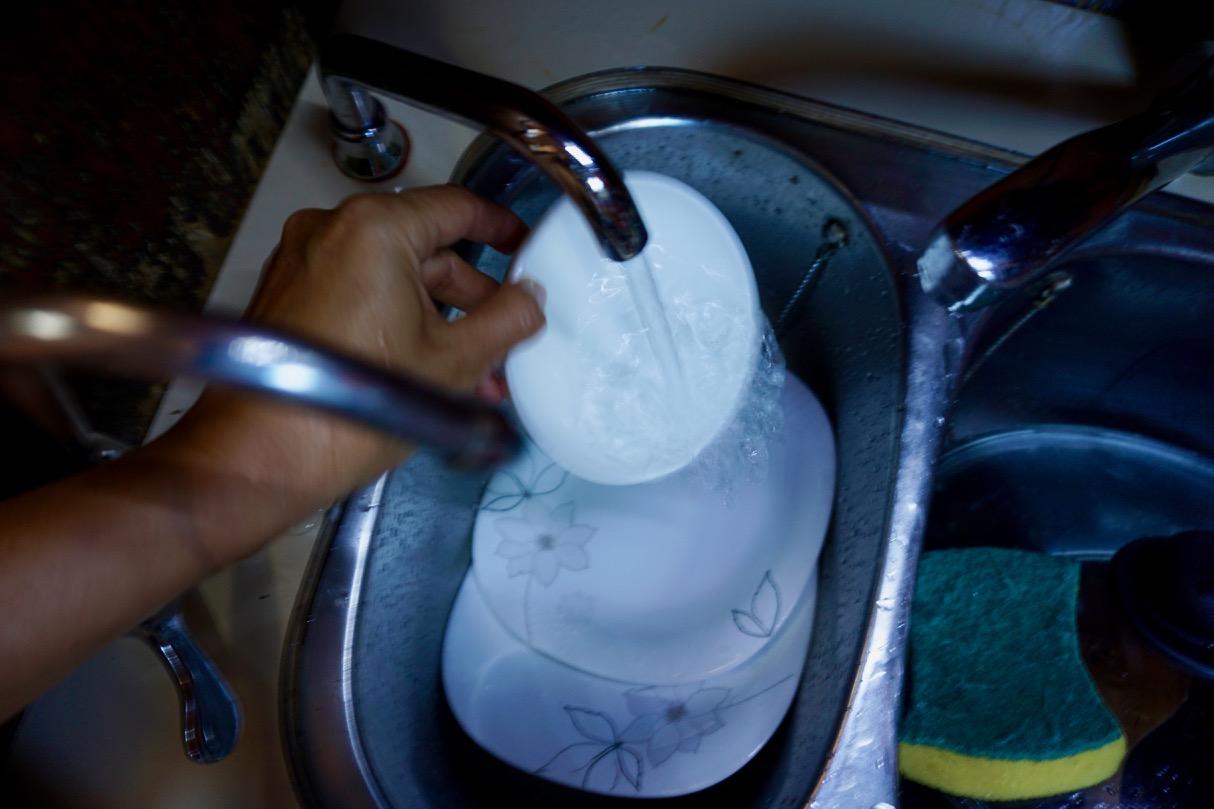
Three taps in the galley, from left to right: drinking-water tap with additional four-stage filtration, red seawater tap, and fresh-water tap supplied directly from the tank.
Other articles in the “Tech from the Captain” section:
Satellite Communications for a Round-the-World Voyage
Windvane Self-Steering
Watermaker on a Yacht
Read about the finer points of organising provisions and meals on a round-the-world voyage in the “Galley” section.
Wishing everyone skilled hands and reliable equipment! 🙂
Now is the perfect time to thank the author generously for such a useful article by clicking the “Thank You” button