
From the Travely-Family archive · Pacific Ocean
From Easter Island to Pitcairn. Fleeing the Storm
An original publication from the former Travely-Family website. This English translation was preserved from the technical-site archive without editorial rewriting.
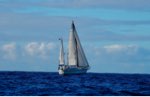
From Easter Island to Pitcairn. Fleeing the storm. We left the most mysterious island in the world for the world’s smallest country. The Pacific Ocean and Wind-In-Your-Face, the junior crew member and I build ourselves a nest and fend off the waves.
On the day we weighed anchor at Easter Island, everything was at sixes and sevens: the forecast was now promising a storm, and to skirt it to the north we had to leave a day earlier than planned. And since there is no eradicating the Russian habit of leaving a mountain of things until the last minute, that whole mountain was tumbling around with us. The yacht-radio programme was still not fully recorded, the articles had not all been sent to the editors, the treasure had not been buried on the island, and even the postcards had not gone out to everyone.
The crew might have been left without fresh provisions as well: the Easter Island maritime authorities had closed the port and did not want to receive the captain for outward clearance. The Cap set off in the dinghy, surfing along the curl of a wave that, this time, couldn’t have cared less where the reefs were and where the fairway lay, with errands to send, clear, find, ask and buy. I was rushed off my feet online, my ear decided to start hurting for no apparent reason, and the children were preparing the yacht to head out into the ocean. And by evening we cast off live on Facebook:). The phone battery gave up the ghost along with us, and the broadcast cut out.
We sailed off into the night. I didn’t want to leave, despite the lively anchorages in storms, the constant wind shifts and the rolling. Sensing our reluctance to go, the wind died instantly. For several hours, the lights of Easter Island bobbed astern until we started the engine and tore ourselves away from their alluring glow.
At last the cloud gave birth to rain, and the wind arrived too. By morning, squalls were sweeping in. By day we were tossed about; by evening we were being hurled around. We were approaching the edge of the storm moving in from the west. We would catch no more than 30 knots of it; Andryukha had calculated everything. We were close-hauled on starboard tack.
“Girls, reef the mainsail!” (reduce the sail area, that is).
We put the second reef in the main. When the boat gave another lurch, Nastka clutched the boom with the furled sail lashed to it, hugged it like her nearest and dearest, and sang, “My beloved, my own...” We cracked up and tied the last reef points (little bits of line, known as accessory cord in hiking).
Overall, the combination of waves and wind was exhausting. At dusk, the Cap ordered the main down. For the night we left up the staysail, a scrap of genoa and the mizzen. What a blessing it is to have one! The mainsail is far too much bother at night in a strong wind. If you take it down altogether, there isn’t enough stability under the headsails alone. The mizzenmast and its namesake sail balance the boat beautifully. With each passing day, the Cap is happier that he chose a ketch. Even Nastya and I have stopped grumbling that the mast gets in our way in the cockpit and means we can’t put up a table ))...
After all, the most important thing on a yacht isn’t the table, but the sails. I hope Lady Mary hears this paean of mine and, in gratitude, stops bucking and letting water in through the ventilation cowls, hatches and mast boot, as she did throughout the second night. We’d grown complacent; before, we always plugged the vents on passage. At least the night wasn’t boring, and the settee in the cabin got soaked ).
It blew up to 25 knots (12–13 m/s). Nastya handed over the watch to the Cap at half past midnight. At three in the morning, we sprang up to wipe away water that had surged through the gaps around the windows. After that, it kept lashing in without pause. By morning, our high-sided boat was drenched in seawater.
We made porridge and Ladunya and I settled down with some English fairy tales.
“Mum, how can I lie down with you? My forehead hurts.”
She really would feel better lying down. The settee in the saloon is too small for us, so we decided to build a nest: we removed all the back cushions and secured them under the table, creating a cosy little Lukomorye. Now we could lie side by side and look at pictures with English words. We would test the resulting double bed, sleeping head-to-toe, that night. I would settle down on one side and whoever was on watch on the other.
For the night, we took down the mainsail. It was blowing a steady twenty knots. As usual, right in our faces.
“Eekh,” I breathed out after doing the prescribed fifteen push-ups. Have you ever tried doing push-ups in three-metre waves? It’s a hilarious ride. The main thing is not to smash your nose.
“What is it, Marinochka?”
“I’m bloody sick of this rolling.”
“That’s just the sea breathing. You’re a circumnavigator,” Andryukha’s voice was unusually gentle.
“Uh-huh. Some bloody circumnavigator.”
The Cap is lucky—he doesn’t get seasick. Oh well, in a couple of days we’ll get our sea legs too.
We covered 220 miles in two days. 970 miles remain to Pitcairn. Position: 24°42′ S, 112°16′ W.