
From the Travely-Family archive · Central and South America
Five Steps into French Guiana
An original publication from the former Travely-Family website. This English translation was preserved from the technical-site archive without editorial rewriting.
Five Steps into French Guiana—or How We Landed in the Lap of the Gods
Can You Stay Illegally in an Overseas Department of France (and for How Long!). How Sea Gypsies Live, and Where They Put All the Stuff That Won’t Fit Aboard Their Yachts
After all was said and done, we arrived in South America on 14 October. We did not complete even part of the formalities until the 28th. So for two weeks, the ranks of illegal immigrants in French Guiana included four Russians, alongside the Brazilians and Surinamese. But shhh—not a word to anyone! 🙂 So, five steps into French Guiana:
Step 1—Feel Our Way into the Channel
Dégrad des Cannes (the town of Cannes, in Russo-French) is where our crew first set foot on the South American mainland. It lies at the mouth of the Mahury River, 8 miles from our previous anchorage (the Îles du Salut). We had to tiptoe through the shallows into the channel. The bottom was invisible, and even in the channel the depth sounder initially showed 1 metre (!). Perhaps the water, thick with suspended silt, was confusing the gadget. The channel is marked by buoys and looks like a ditch dug through the mud. But the skill of creeping across shoals, acquired in Senegal, and the memory of bailing water out of the bilge kept us so thoroughly alert that we made it in without scraping the keel against the mud even once.
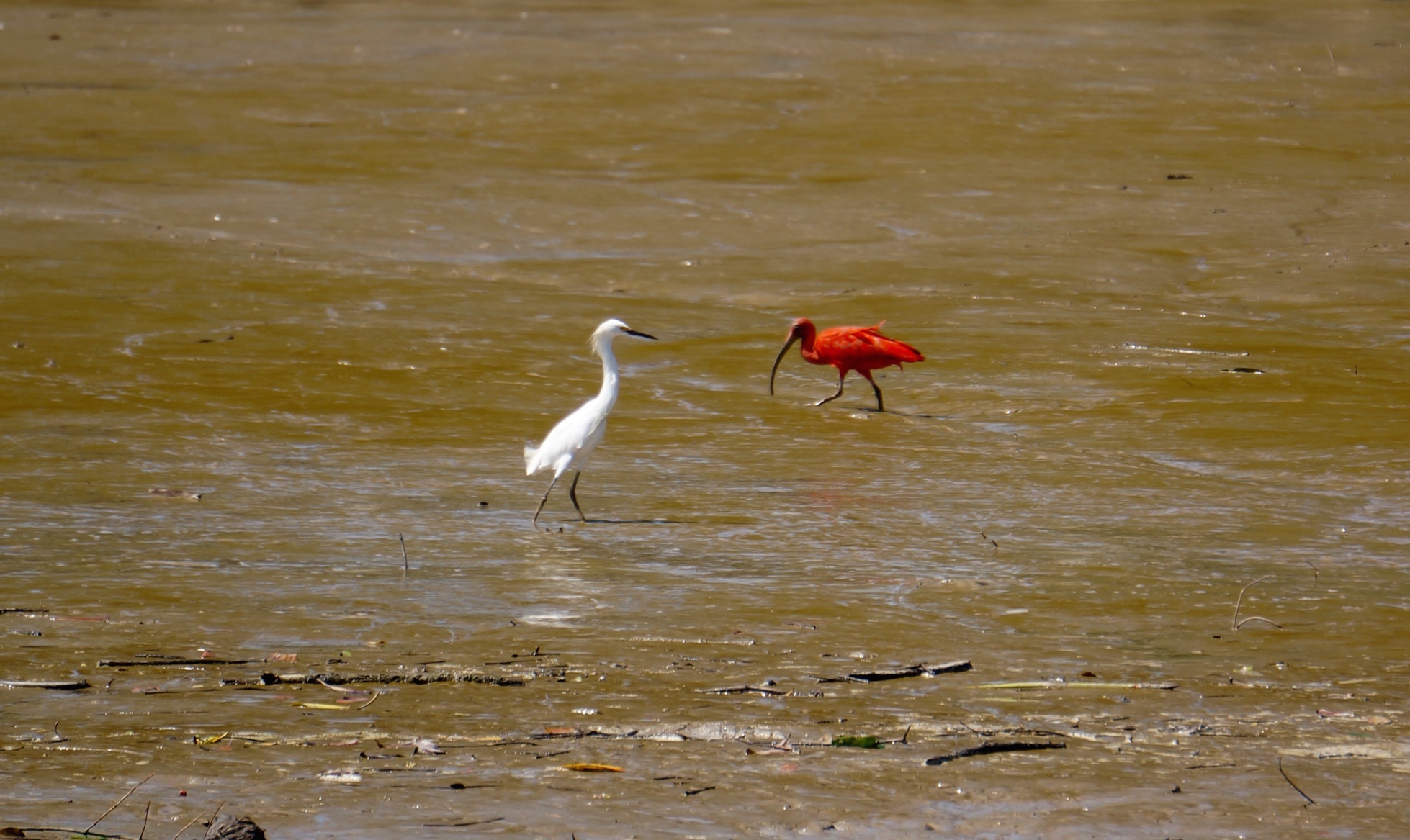
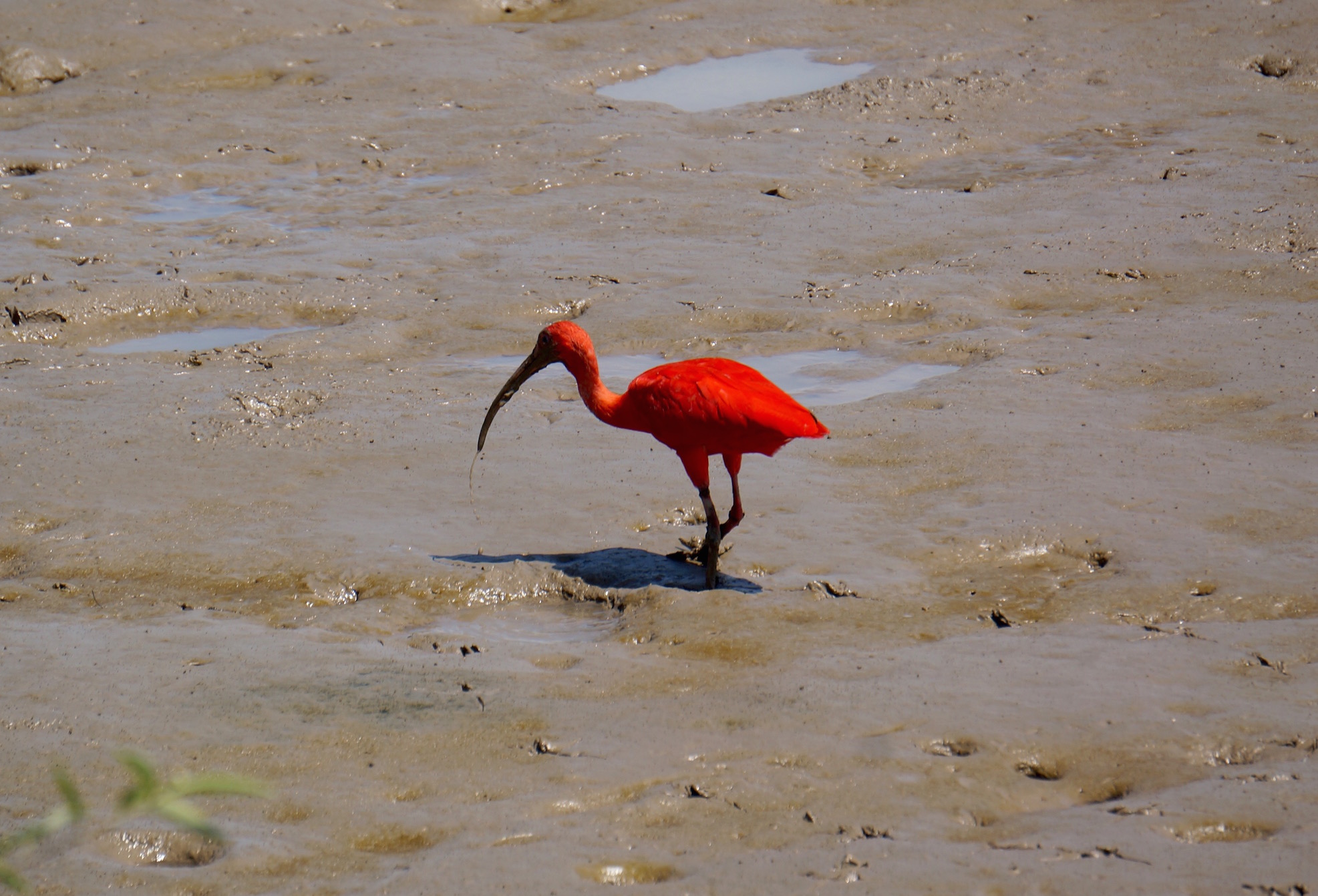
To port of the channel begins a marshy shore where white egrets stroll about and... scarlet splashes appear—it is hard to believe a living creature could contain so much colour (surely they couldn’t be parrots!). Through binoculars, we saw that the splashes were birds too. Our young sailor clapped her hands when she recognised the mysterious creatures as scarlet ibises—birds the size of herons, with long, curved bills.
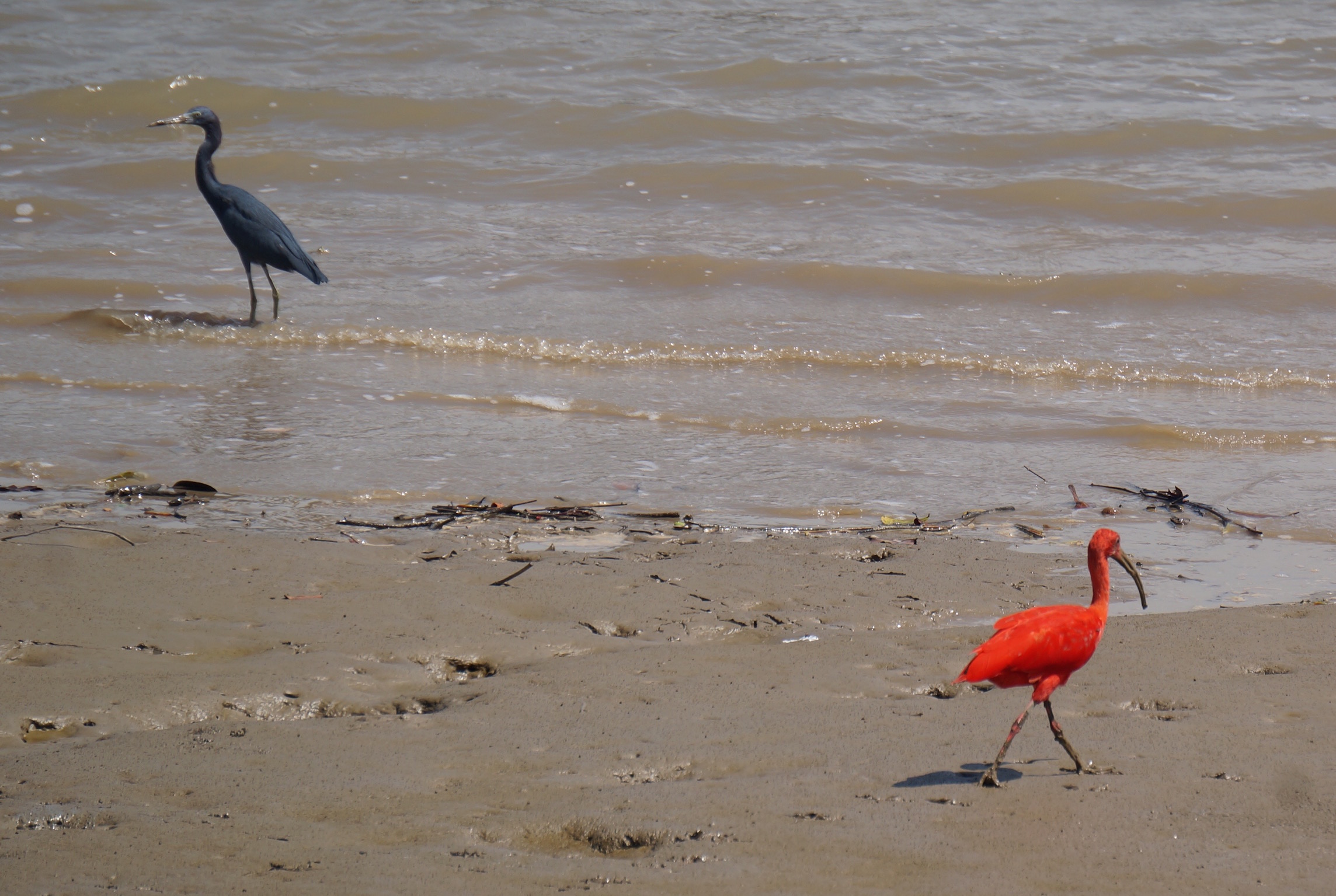
A white egret and a scarlet ibis at low tide in Dégrad des Cannes Marina
Out in the ocean, leafing through a bird encyclopaedia, she had been particularly fascinated by the bright scarlet ibis. It seemed unlikely that we would ever see one in the wild. Who would have thought that an ibis would be the first to welcome us to mainland Guiana! (Our encounter with green monkeys and a hairy eight-legged monster is described here—The Islands of French Guiana: Ron Weasley’s Nightmare and Lots of Wild Monkeys) Dégrad des Cannes Marina.
Step 2—Infiltrate the Floating Village (Cannes, South American Style)
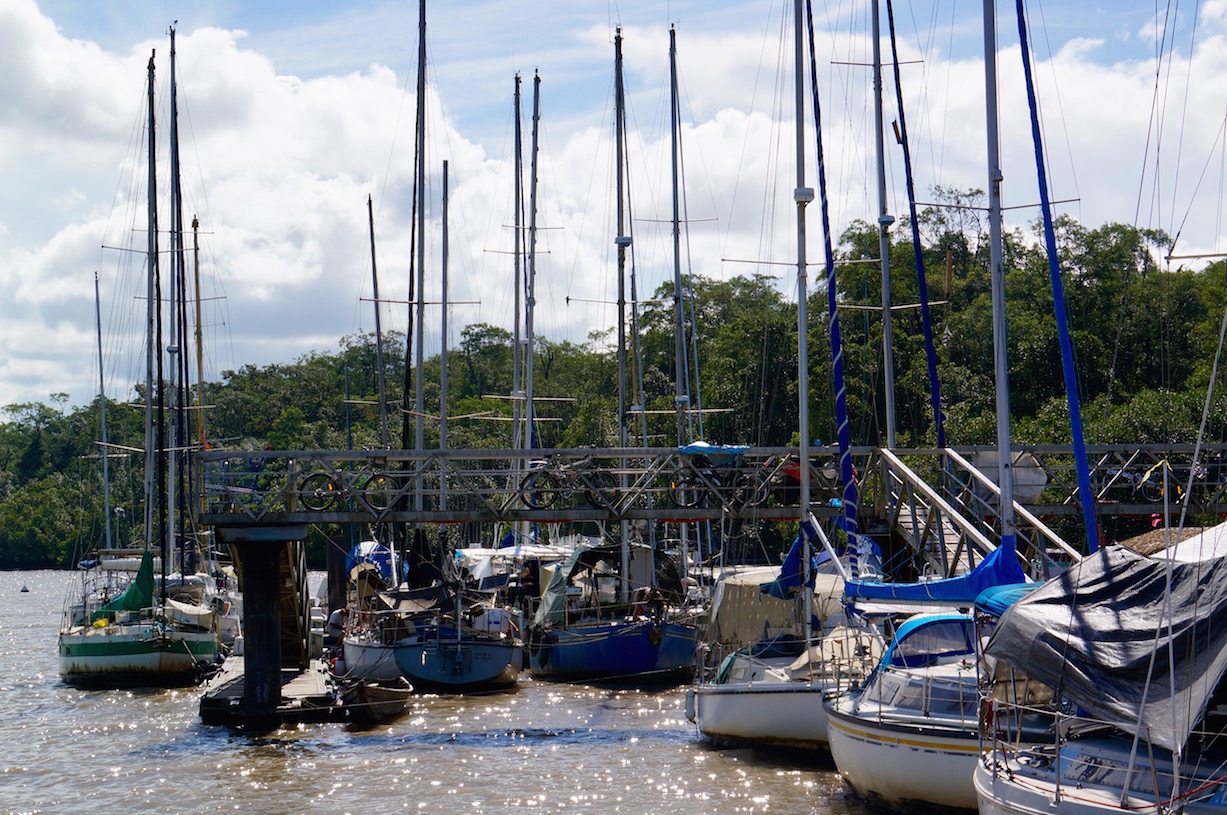
The port of the same name juts into the river on its sole pier; it contains two large cargo ships and a couple of more modest vessels. Containers are stacked several storeys high on the pier—either they have just arrived or are preparing to leave. The port blends modestly into the evergreen landscape and is by no means overwhelming in its grandeur. Immediately beyond it lies the marina. It consists of roughly two and a half narrow pontoons occupied by several fishing boats and yachts.
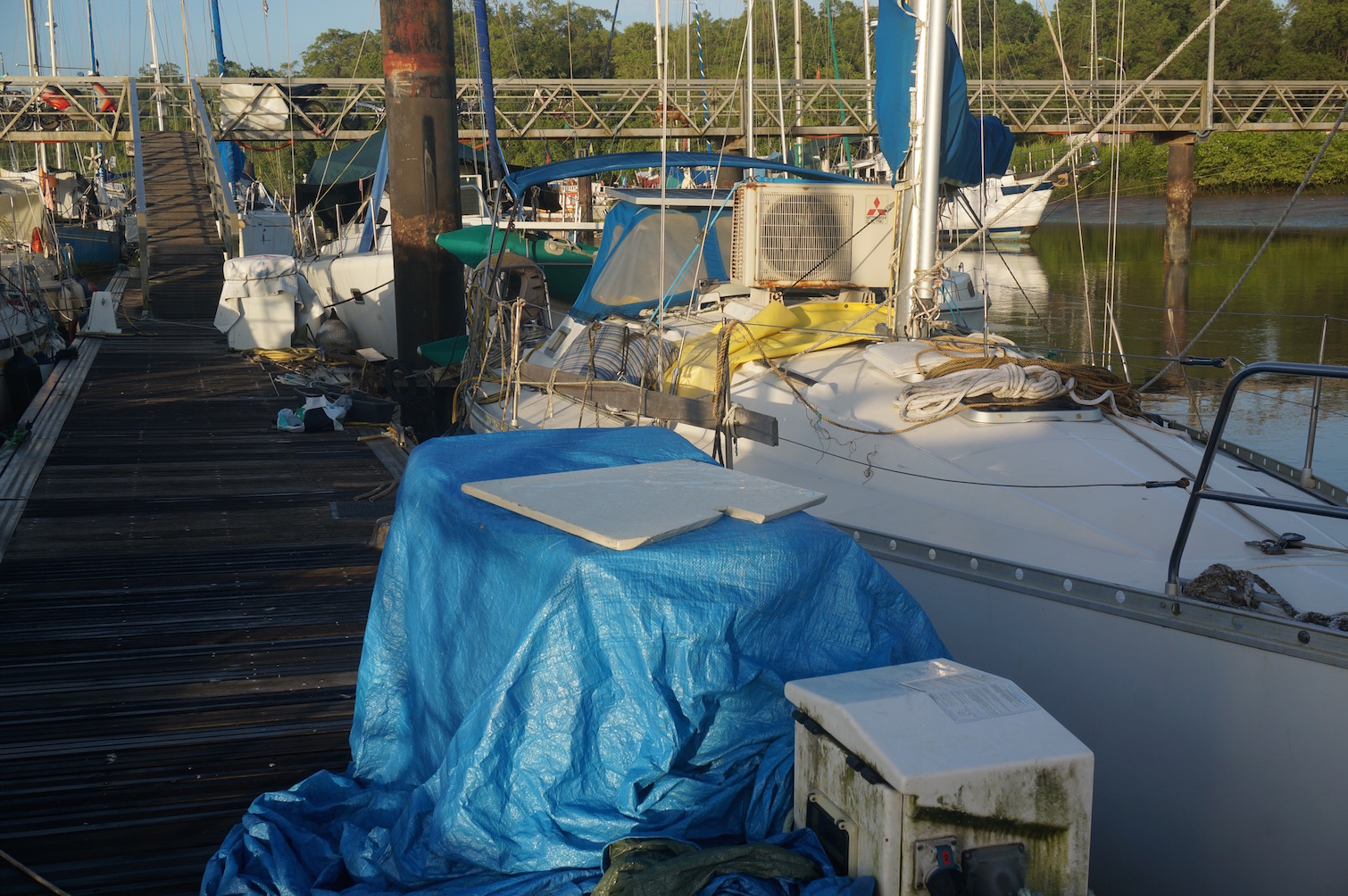
The pontoons’ rotting boards are crowded with crates of grass, pots of sickly greenery, refrigerators in assorted configurations, washing machines and barbecue grills. A broken mast lies in one spot; elsewhere, an elderly rigid dinghy is propped up with a chair.
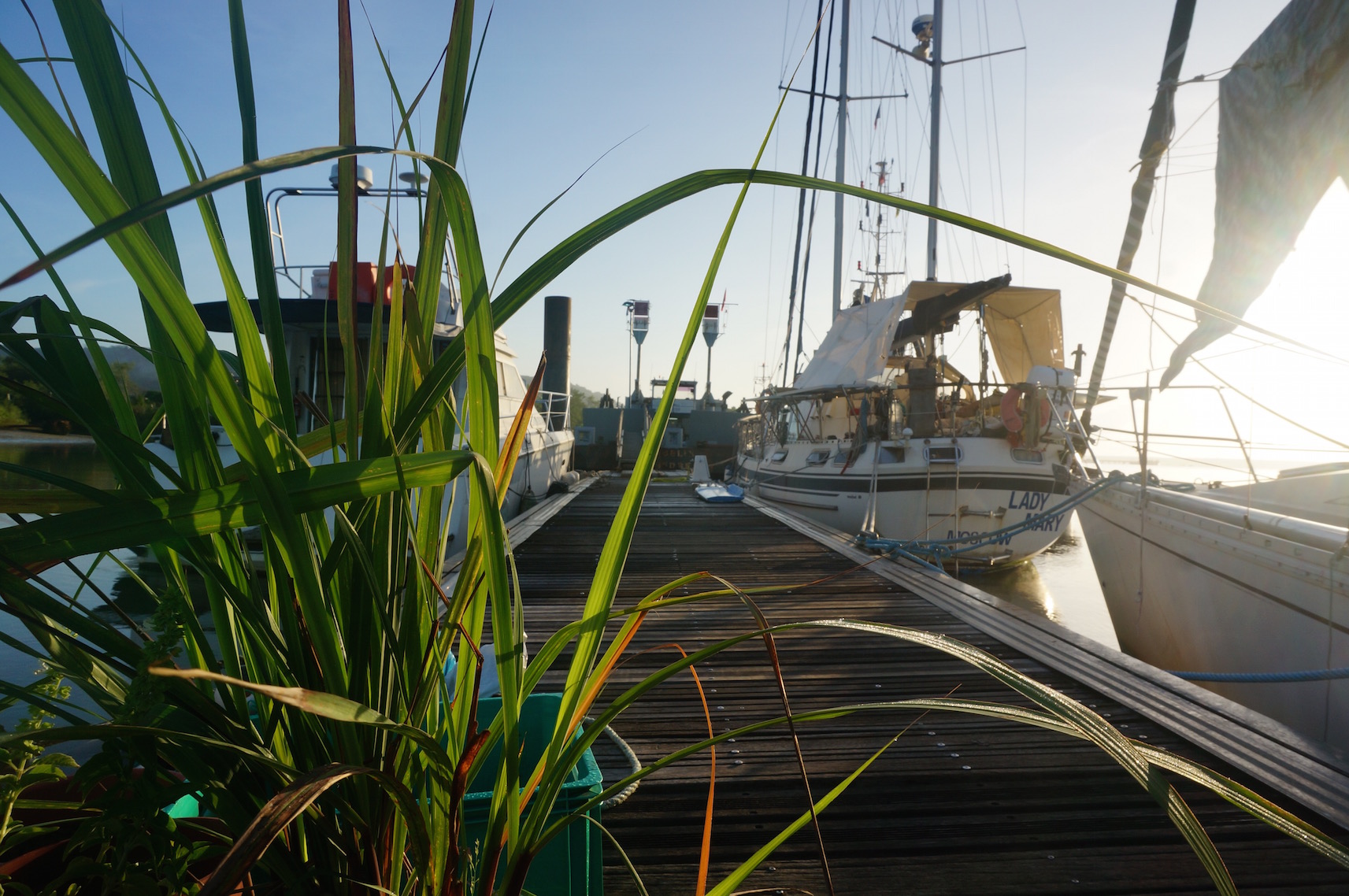
A view of Lady Mary through the grass on the pontoon. Dégrad des Cannes Marina
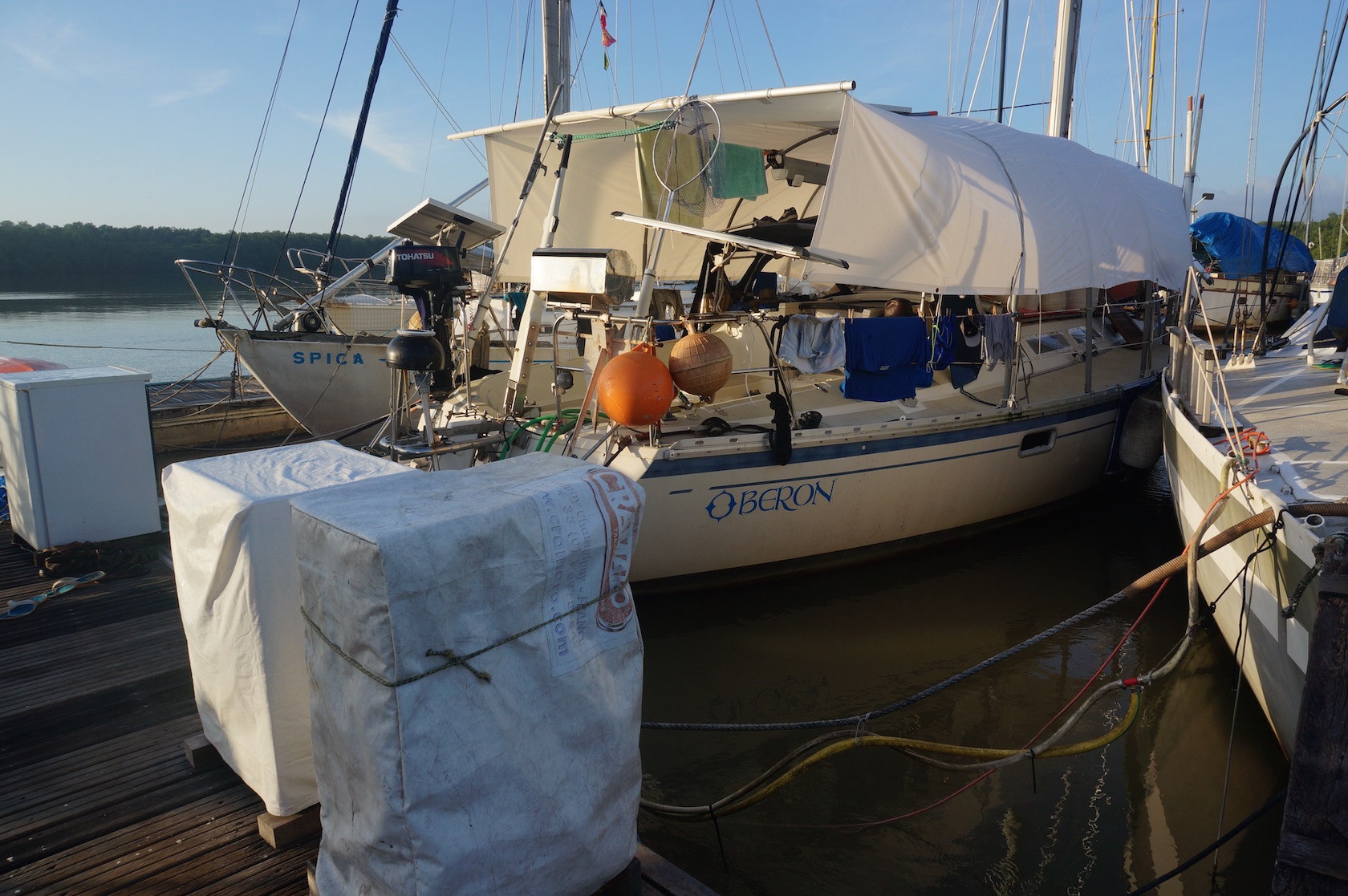
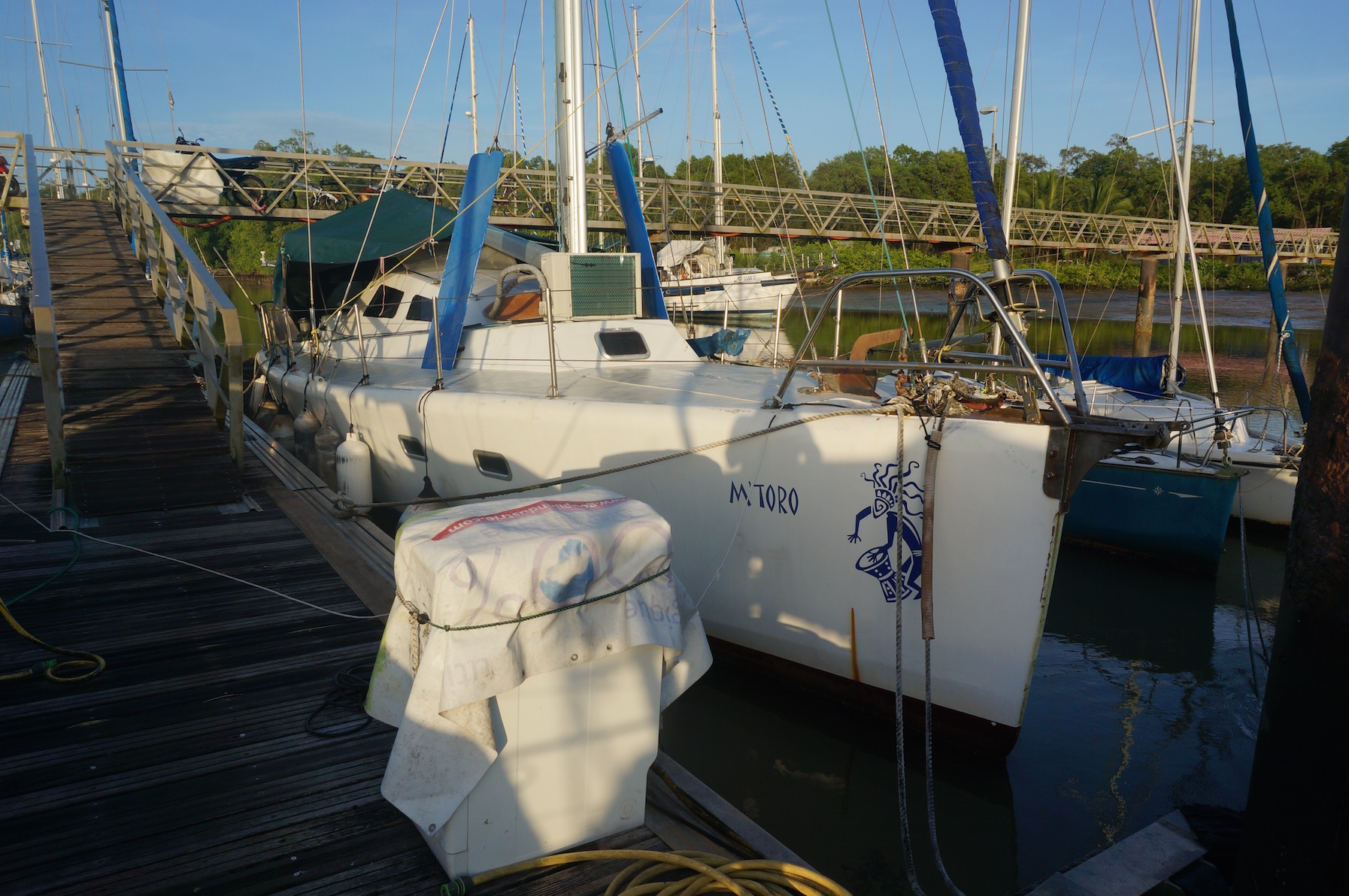
How to Incorporate a Fridge and Air Conditioner into Life Aboard a Yacht. Option 1
There are about thirty cruising yachts in the marina, from 30 feet upwards, without a single vacant berth, and some are even rafted up. Two yachts are at anchor—one from the States and one from France. While we are dropping anchor, the latter moves into a newly vacated berth in the marina. A strong 4-knot tidal current suggests that we need to set the anchor firmly on the first attempt and pay out about 60 metres of chain in 4 metres of water.
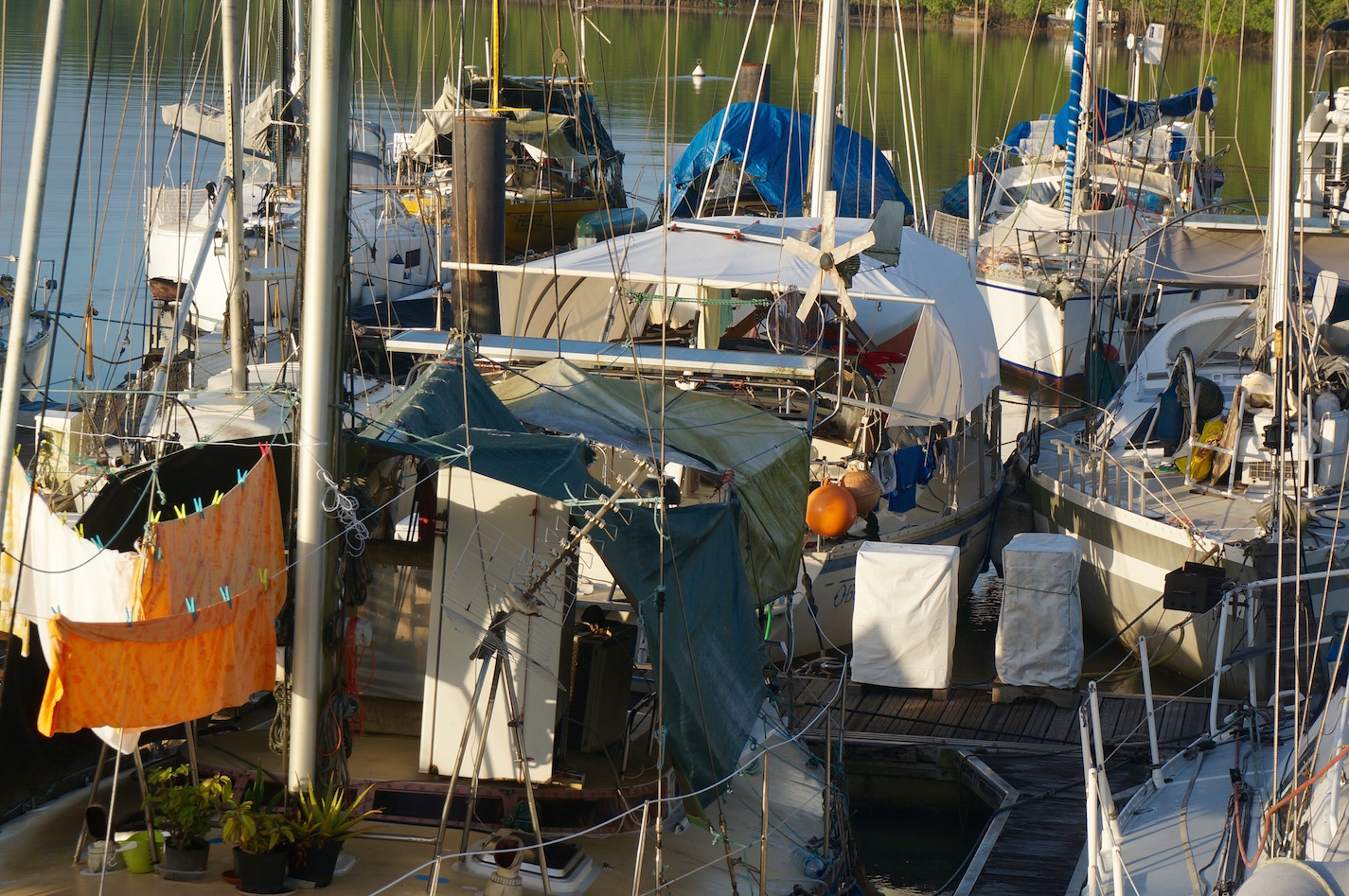
Most of the yachts have already put down roots here. The place looks less like a European marina than a camp of gypsy caravans packed tightly together and covered with a motley assortment of awnings. There is a microwave on the coachroof, a plantation in the cockpit, laundry drying on the sheets, and hulls overgrown with grass and shells. A couple of teenagers leap from the bridge railings between the yachts into the muddy river—from a height of about five metres at low tide.
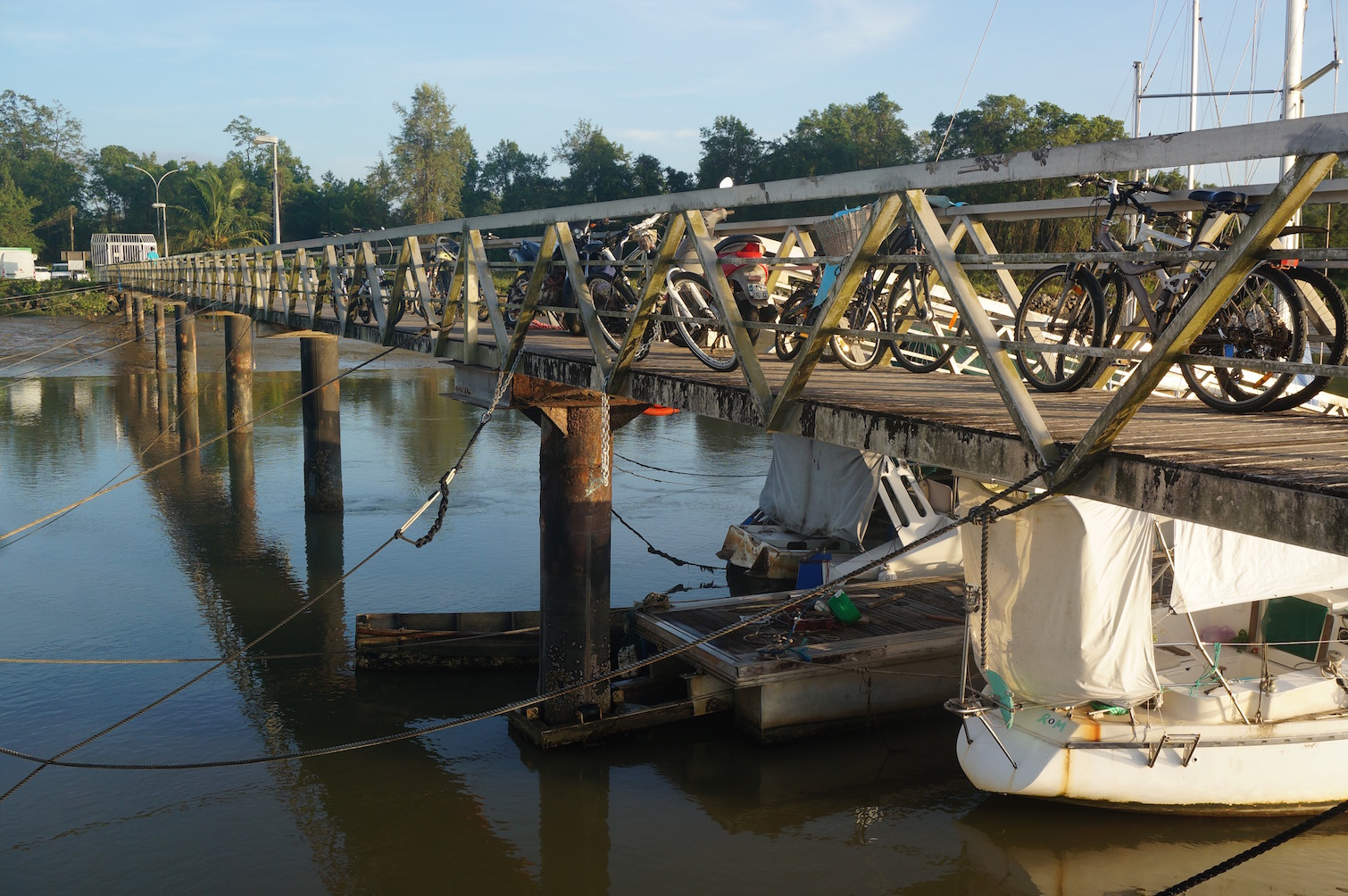
The bridge the boys jump from. We have not managed to photograph the jumpers themselves yet), but we have not given up hope
A young French boy and a Creole boy, about 13 years old, climb onto the pontoon from a fishing pirogue and run back up to jump again.
Step 3—Become One of the “Collective Farm”
At Dégrad des Cannes Marina, it seemed as though the sailors had spent years waiting especially for us:). Their care was so thorough and gentle that it created the absolute illusion of arriving at Grandma’s house in the country.
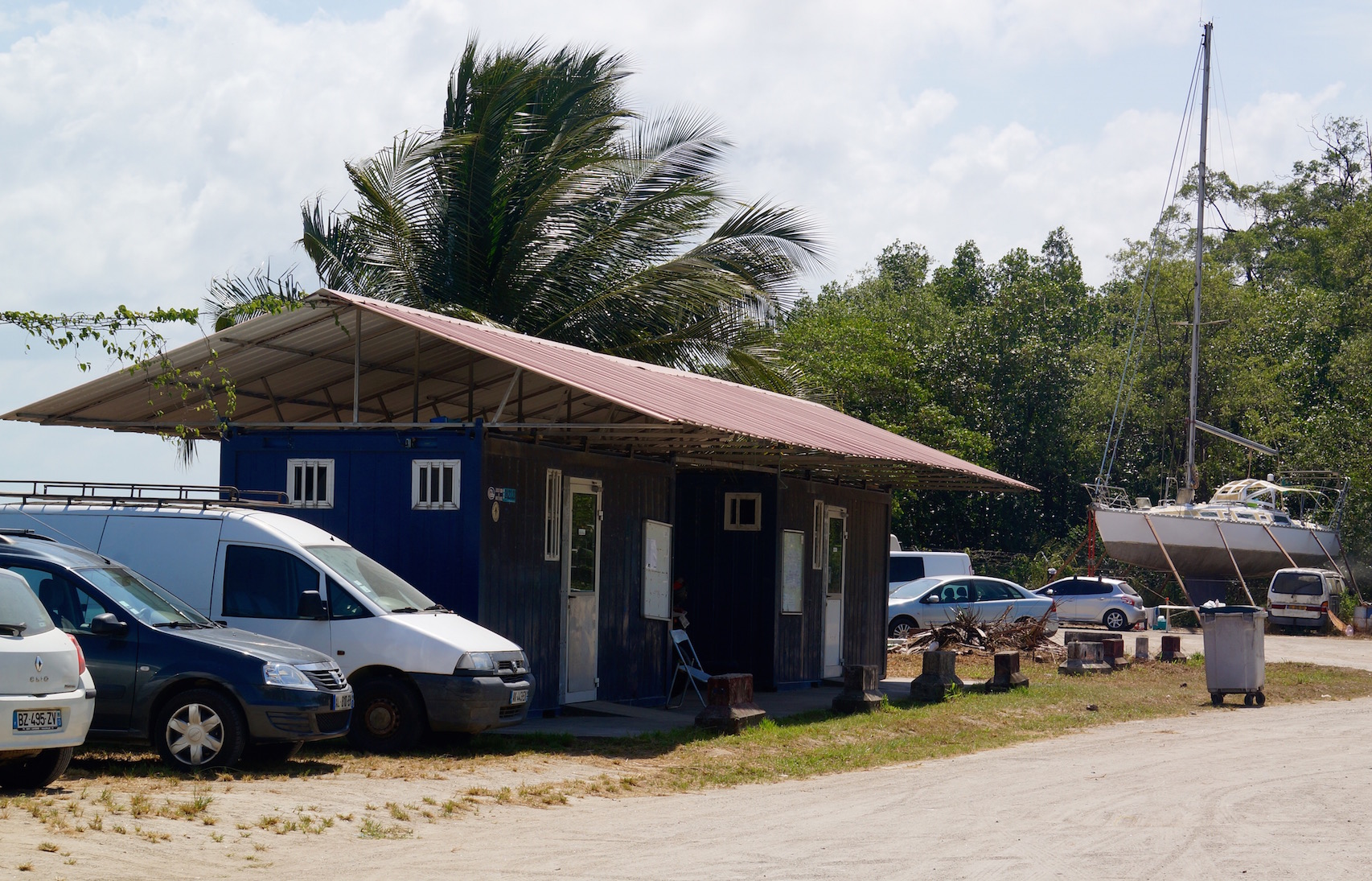
At some point, communism triumphed in Dégrad des Cannes Marina (or perhaps a mild form of anarchy—we have not yet worked it out). Many yachts manage to stay almost free of charge, making full use of the Universe’s gifts in the form of water and electricity. At night, the marina entrance is locked with a keypad, and the old hands gave us the code the very next morning. In two little buildings on shore—formerly freight containers—there are locked showers and toilets, and something resembling an office that is closed around the clock.
Against this backdrop, the marina even gives the impression of belonging to no one—or, more precisely, to the collective farm.
Office, showers and toilets—two freight containers beneath a shared roof
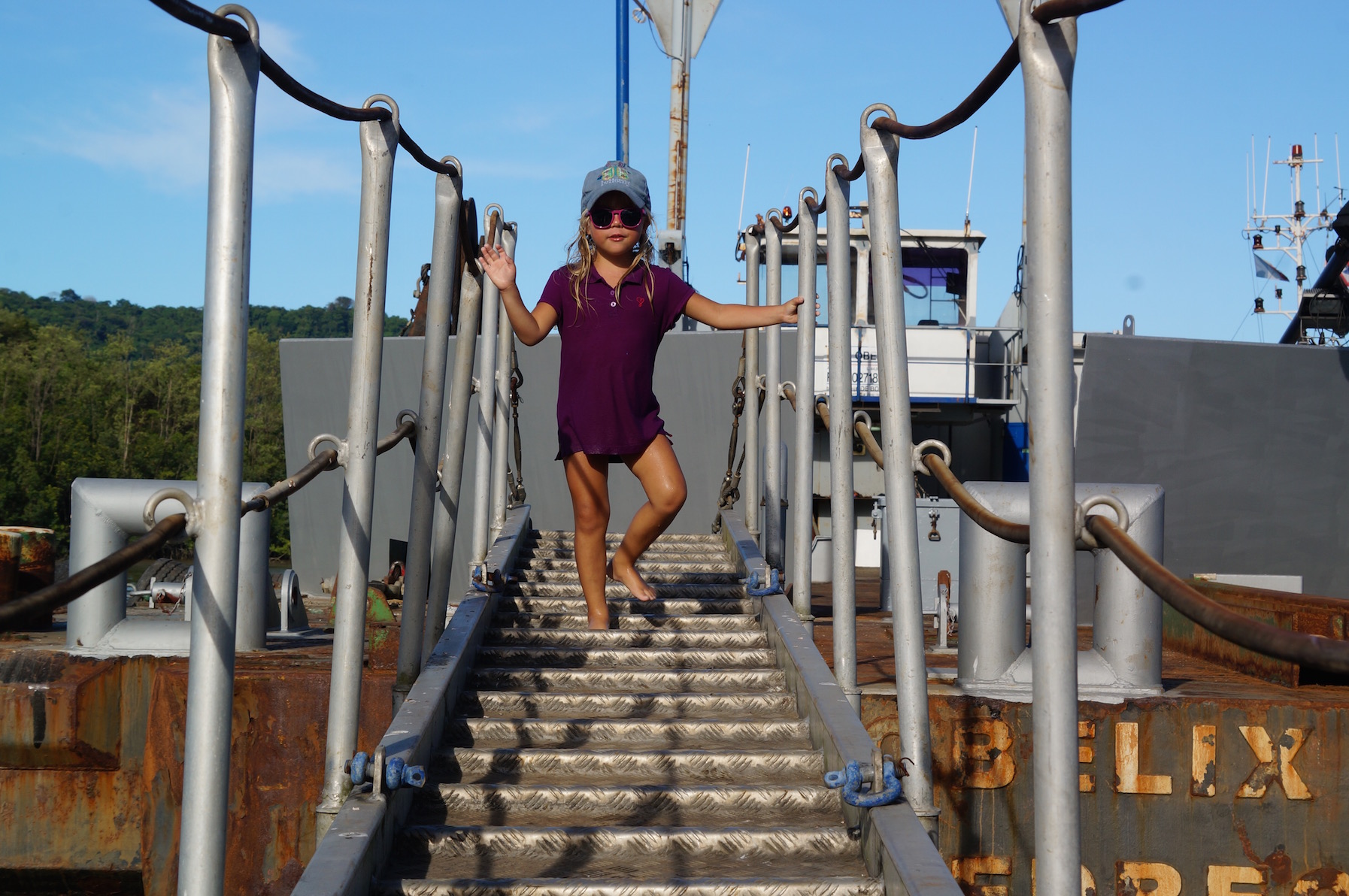
Our young sailor returns from a technical inspection of the neighbouring vessel. She is satisfied with the repair work
On the third day, the collective farm’s general assembly—also known as the shoreside brotherhood of Dégrad des Cannes Marina—helped us move from the anchorage to the pontoon. Now there was no need to launch the dinghy, buck the flood or ebb current, and get splashed with muddy water.... The shore came right up to our yacht’s side, something we had not experienced since the beginning of March, apart from one day in Mindelo Marina before setting off across the ocean. The girls finally had all the fresh water they could wish for, and together with everything described above, this brought complete harmony to our family!
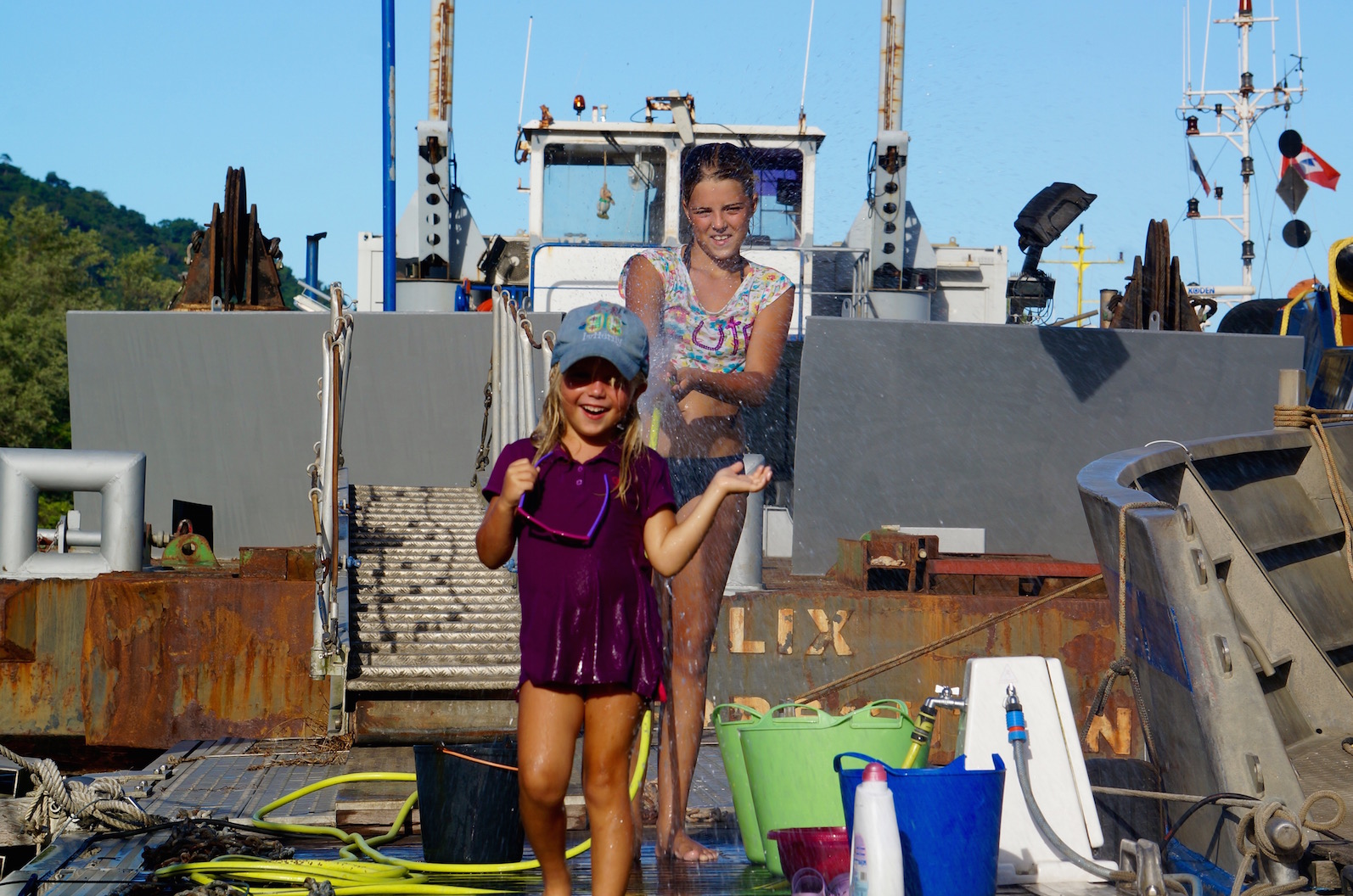
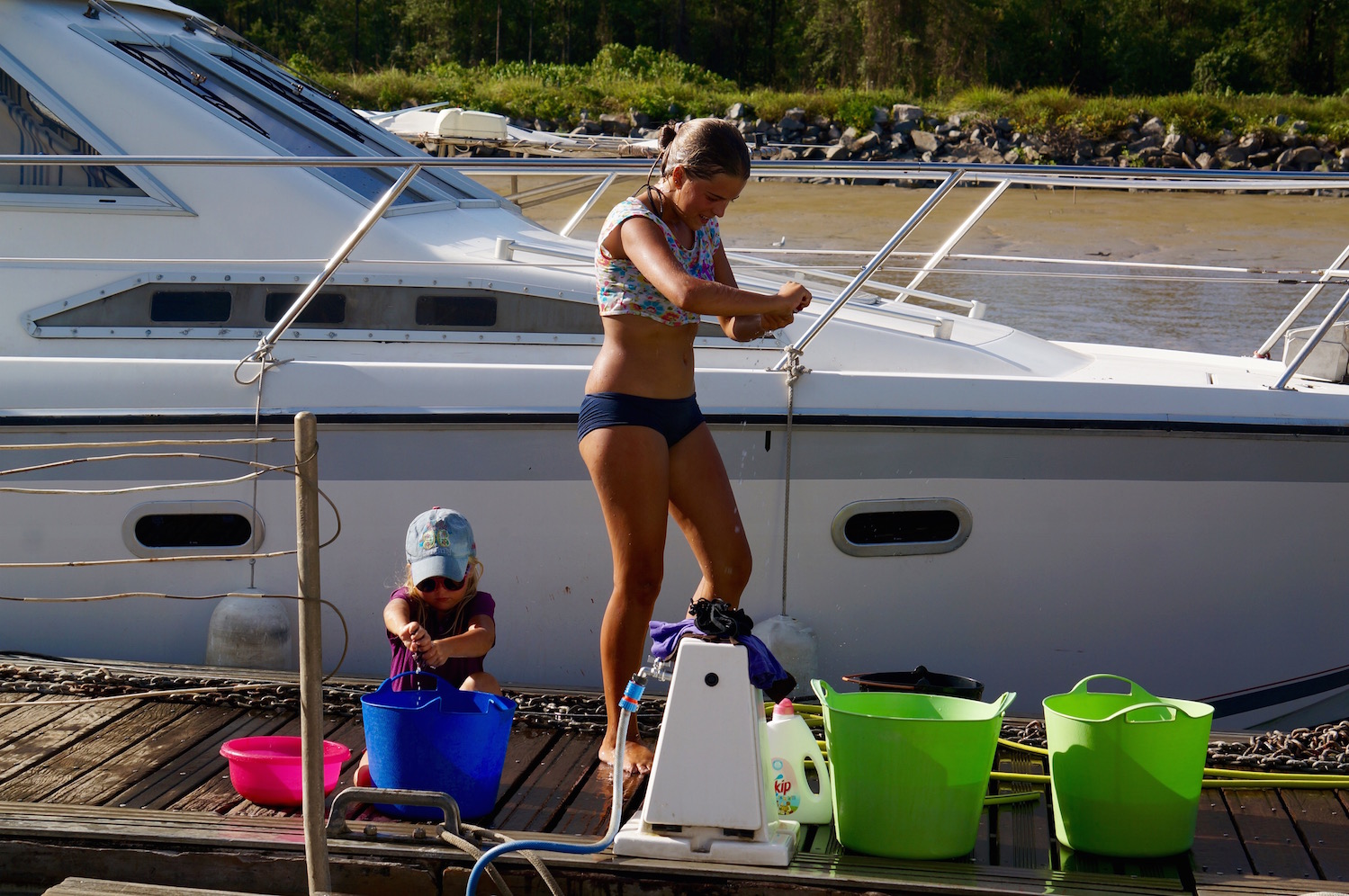
The bikes were ceremoniously teleported onto the bridge; large buckets and basins began bursting with laundry, while the young sailors squealed as they doused themselves with hot water from the hose. They trod sheets and other laundry in the basins, whipping up clouds of foam. Something like the beautiful Italian women crushing olives for oil, or the doe-eyed grape treaders of the Caucasus.
Can words convey the delight of splashing about in clean fresh water, when you can shower with a hose ten times a day if you like! And what a pleasure it is to wash dishes! To actually wash them, rather than smear them with sea salt or cloudy brine during parsimonious watermaking. For the first three days, the first mate was so ecstatic that she hardly left the sinkful of dishes:).
Time for a rinse, by the way. I am already getting jealous of the young sailors frolicking in the jets of water without me.
A shower between loads of laundry. For the first time in 8 months—alongside a pontoon where there is plenty of unmetered water
Step 4—Don’t Overstay the Pause (or, in a Whisper, About the Formalities)
We saw a living, breathing marina employee for the first time only three days after arriving in French Guiana. On the advice of the old hands, Lady Mary had moved alongside the pontoon the previous evening to fill her tanks with water—and stay overnight while she was at it—in the berth normally occupied by the workboat servicing the channel buoys. In the morning, a well-fed Creole man in a light-coloured shirt materialised beside the boat. Switching easily to English, he apologetically told us that the berth’s usual occupant would arrive in a couple of hours. “Where am I going to put you?” the marina attendant said, scratching his head and asking in passing whether we had completed the formalities.
The first mate assured the kind man that we were just about to do precisely that: literally today, the captain would visit the port and call in on them as well—the marina management was based at the port. We were perfectly prepared to vacate the berth, since we had been warned that it was not ours. We had only come in for water; we were so thirsty there was nowhere else to spend the night:).
We misled the marina attendant: the captain did not make it to the port—a 10-minute bicycle ride away—until a week later, under the gentle escort of the next marina employee. Otherwise, no one would ever have lived to see the day when a family of Russian travellers decided to become legal visitors to an overseas department of France. Yes, lying is wrong; we once wrote about that already:).
Step 5—Agree to Everything 🙂
Ten days after our arrival in the marina, a scout wearing a bright vest marked “Marinaport” came to count the rotten boards beside us, making notes in a notebook. The next day another one appeared, wearing the same vest. That was when we realised: we had been spotted.
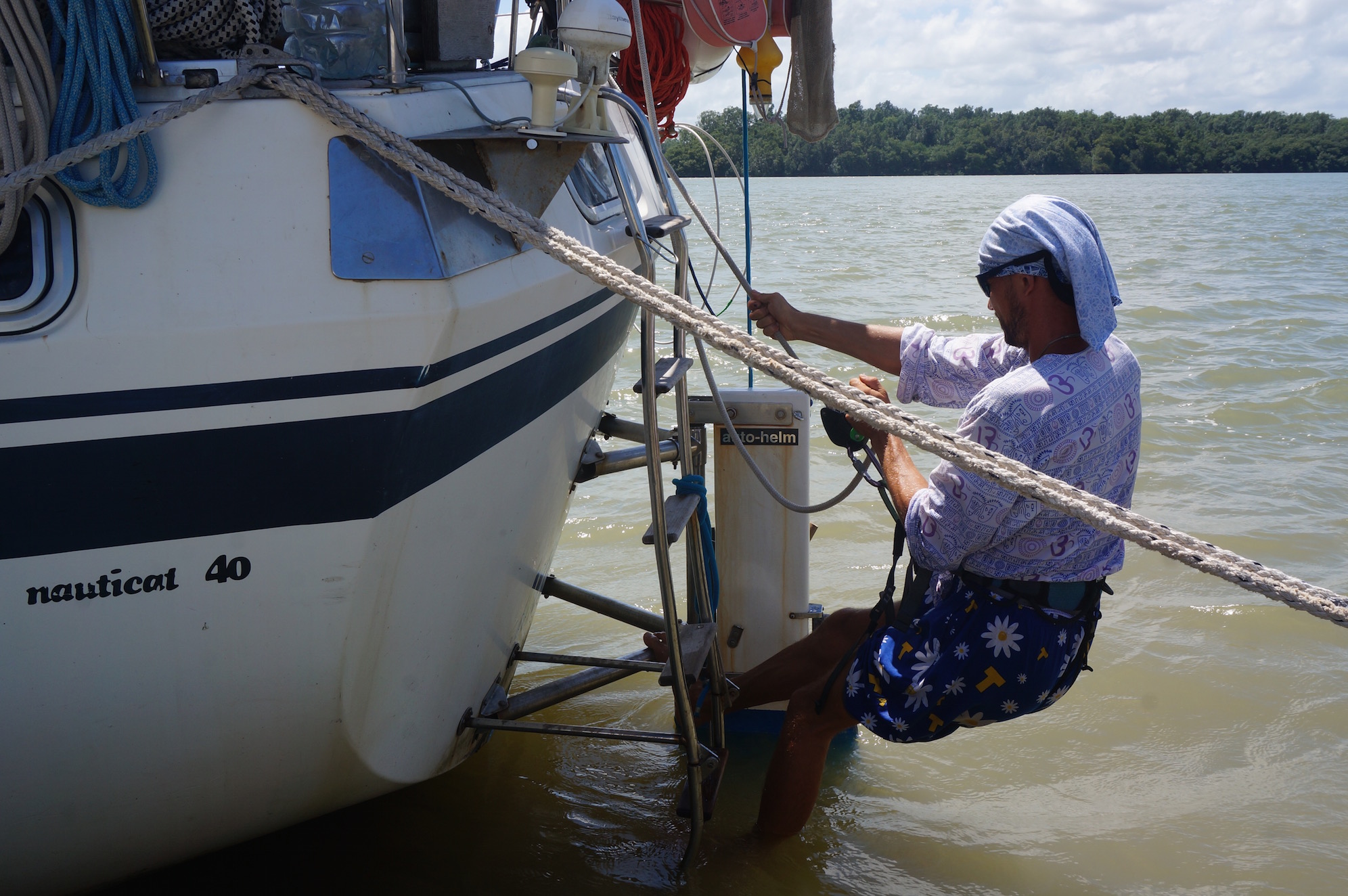
Repairing the Windvane Steering Gear
Noticing the captain hanging over the stern above the wounded Windpilot, the marina attendant asked solicitously:
“Didn’t you go to the port to report your arrival?”
“No,” we said, “we’re doing repairs here.” And the captain assured him that he would definitely go tomorrow.
The employee returned the next day and once again found the crew busy with repairs and heard the same answer. Putting on a concerned expression, the first mate politely asked about the opening hours. It turned out to be from 8 to 12. Hard to make it, considering it was already half past two:).
“Oh!” said Moreau (for Moreau was his name). “I can come and get you in the morning!”
There was no way back, and the captain agreed on eight in the morning. For the occasion, a pair of lightweight white trousers—never worn!—and a clean T-shirt were extracted from a locker. Moreau arrived at exactly eight, and an hour later the captain was already back. The marina office charged 22.3 euros for two (hmm...) days’ berthing. Port customs gave us the all-clear, but we did not go to immigration. Old hands say that a Schengen visa is quite sufficient for a trouble-free check-in. We have those. We are simply having a day of disobedience, which we have elegantly named “the immigration experiment.”
We want to see whether it is possible to leave the country without ever reporting to immigration. Why?—mmm... just because. The captain cannot be bothered to go into town:). (We do NOT recommend repeating the experiment; we are simply writing everything here exactly as it happened, truthfully.)
On the way from the port back to the marina, Moreau assured us that if we needed anything, we should come to him. He would drive us to the grocery shop as well, 5 km away by car. And the next day, he took the captain to get a gas cylinder.
We will write another time about the different types of gas cylinders and the problems they cause, as well as about Moreau himself, a former French Navy serviceman. For now— More Photos of Dégrad des Cannes Marina at the Mouth of the Mahury River:
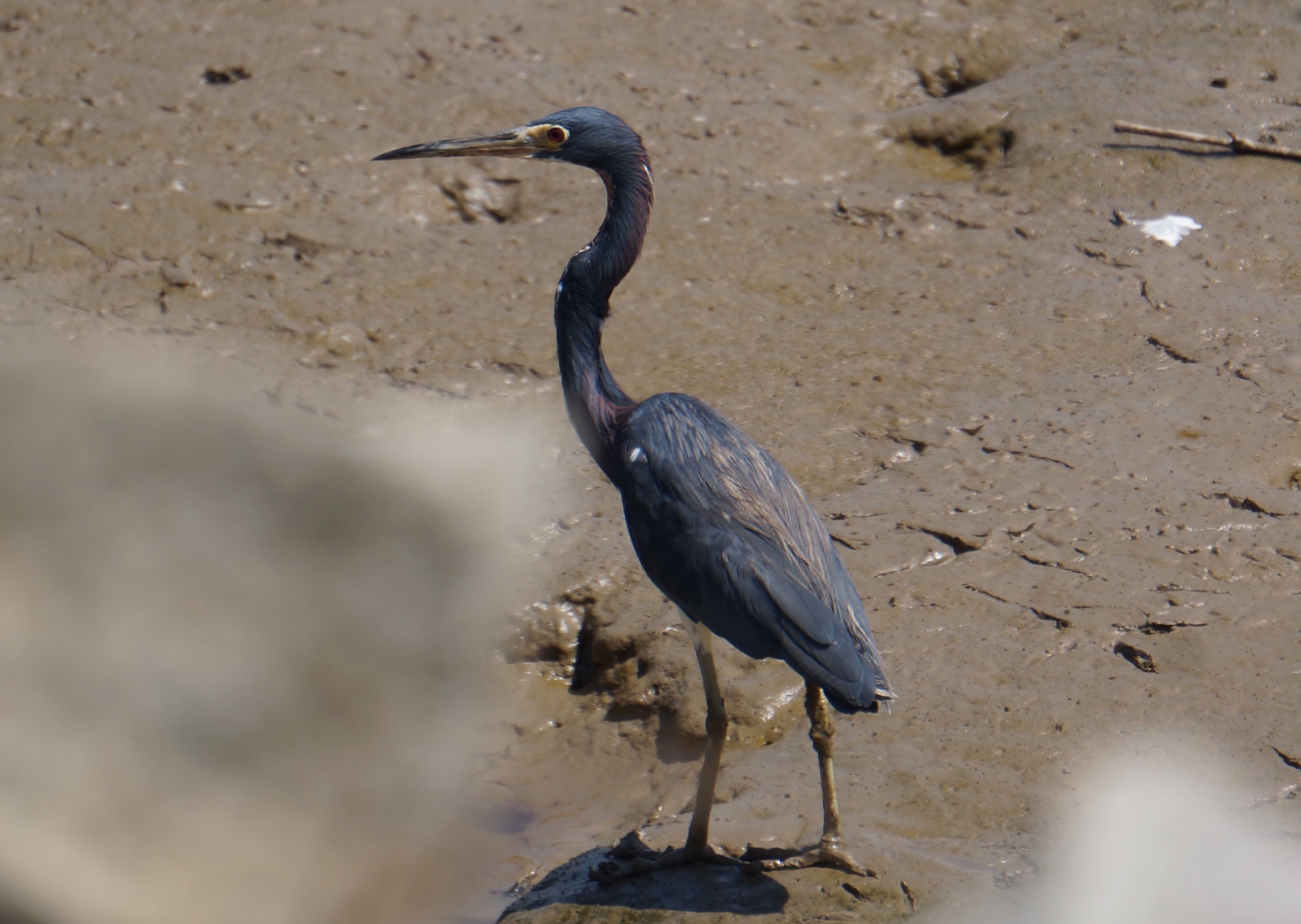
A heron... mmm... perhaps it is called a tricoloured heron, or maybe... but definitely not a grey heron 🙂 Photographed by the first mate from her hide on the marina shore
How to Incorporate a Fridge into Life Aboard a Yacht. Option 2
How to Incorporate a Fridge into Life Aboard a Yacht. Option 3. Bonus—a perfectly ordinary household air conditioner
How to Incorporate a Fridge and Air Conditioner into Life Aboard a Yacht. Option 4
A scarlet ibis at low tide, right in the marina
You go left, I’ll go right 🙂
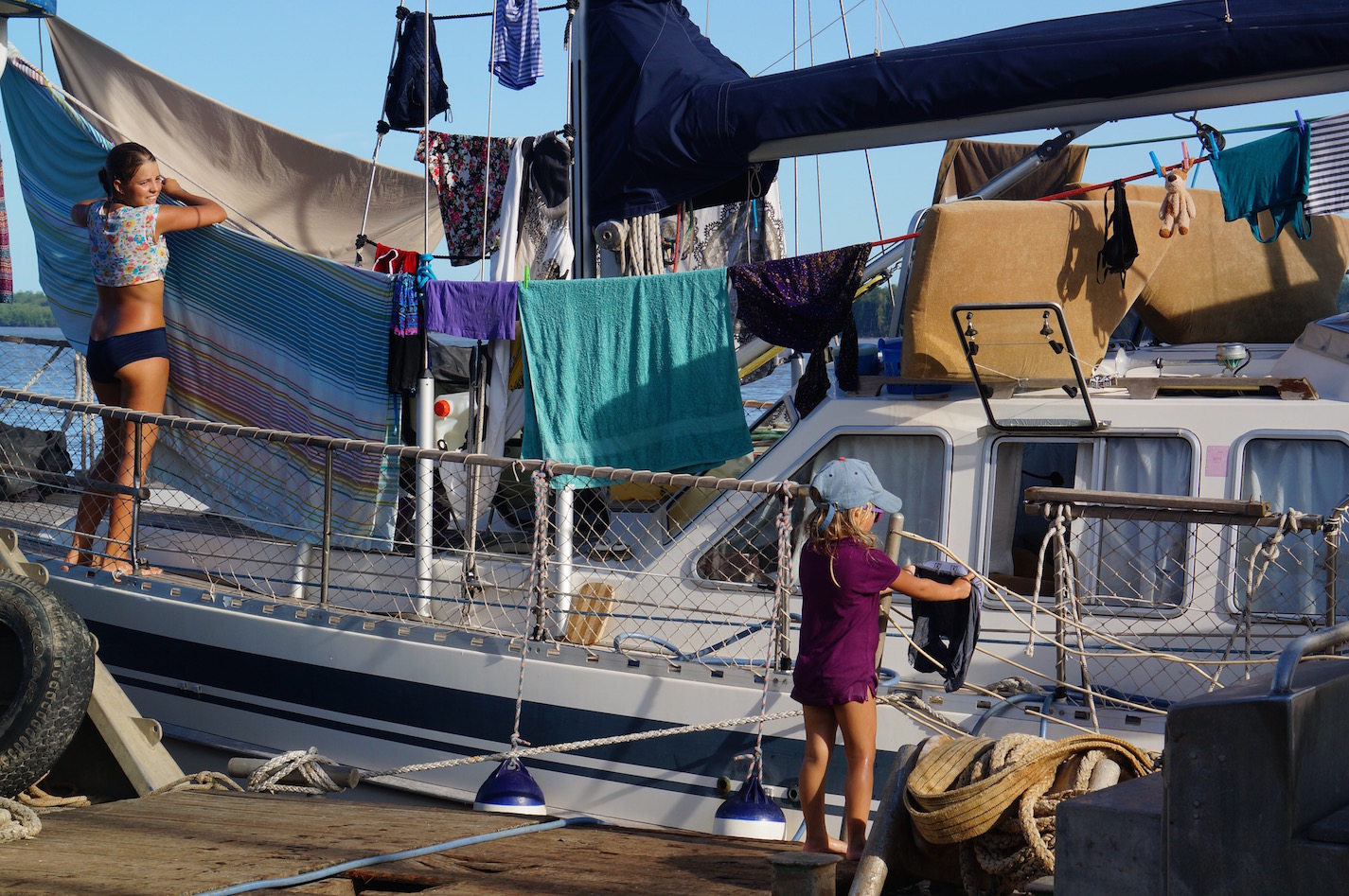
We washed and washed, dried everything in two batches... and still have just as much laundry left 🙂 Washerwomen of South America 🙂
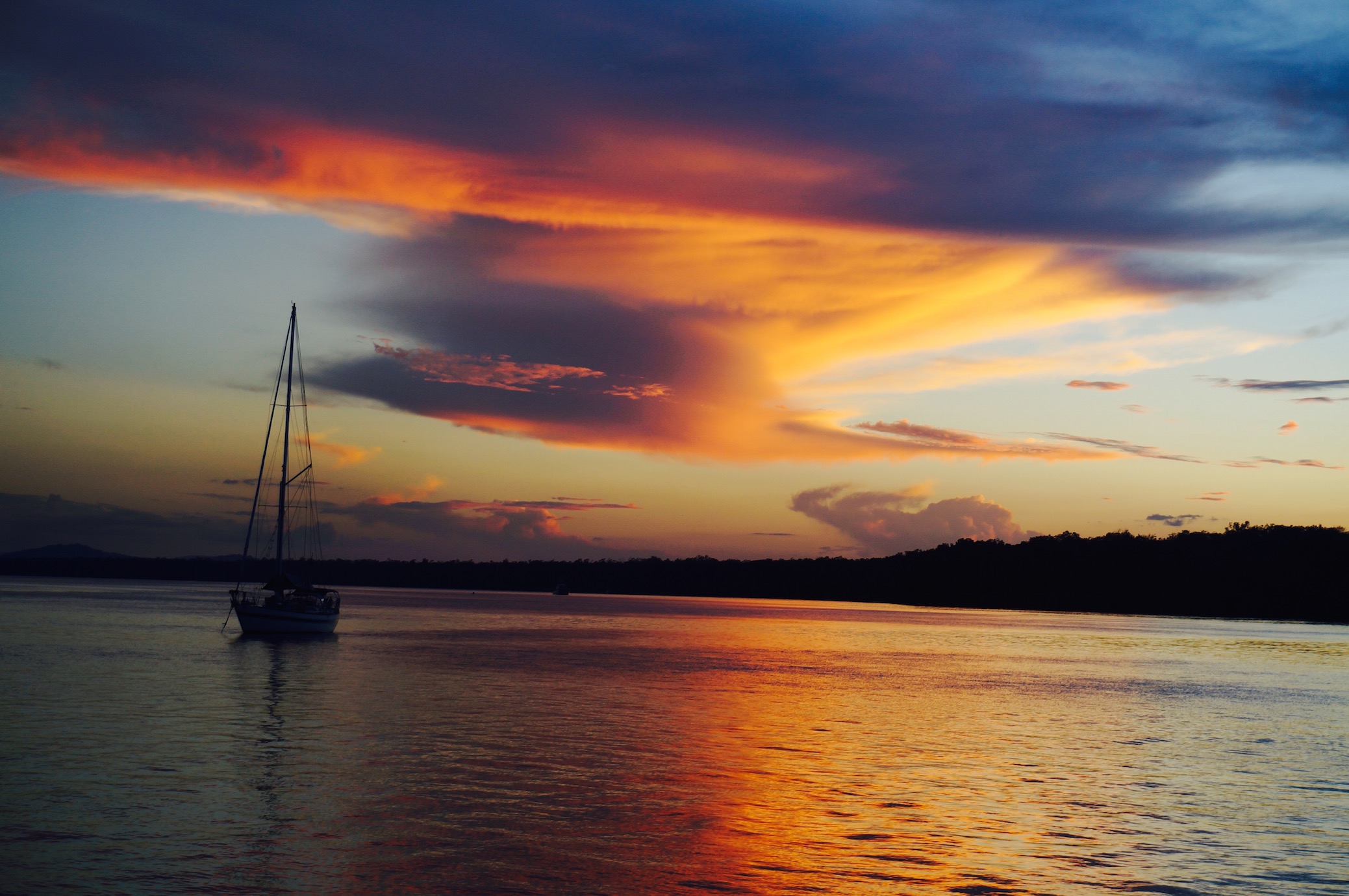
Can you see the enormous bird in the sky, embracing the earth with a fiery wing?—Sunset over the Mahury River
Read about another of our stops—in West Africa—here:
Senegal and the Senegalese—from the Anchorage