
From the Travely-Family archive · Pacific Ocean
Our Last Day on Pitcairn. Fishing, Island-Style.
An original publication from the former Travely-Family website. This English translation was preserved from the technical-site archive without editorial rewriting.
Our last day on Pitcairn. Fishing, island-style. A national holiday—Pitcairn Day and an island-wide fishing trip to Bounty Island.
The sons of Pitcairn and of the deputy mayoress, Jayden and Kimyoro, see us off to the yacht and tell us that tomorrow the island will be celebrating Pitcairn Day. On that very day in 1767, a fifteen-year-old young sailor named Pitcairn spotted a tall island from the ship Swallow. And he was terribly proud when the jungle-covered lump of basalt was given his name. Admittedly, whether from excitement or because of the limitations of the technology, the island was marked on the chart 188.4 miles out of position.
It is thanks to that error that we are now talking to Kimyoro and Jayden, the eighth generation of descendants of the Bounty mutineers. Who knows what would have happened if Captain Carteret had marked that spot correctly on the chart? The British would have found the fugitives, sent all the fathers of the nation to an English prison and the mothers back to Tahiti, and neither Kimyoro nor Jayden nor seven generations of other descendants would ever have been born on the island.
But back to the point: after hearing this, we naturally decide to stay until tomorrow evening—fishing, mmm, communal dinner, mmm. We won’t say which members of the crew enjoy eating more, and which enjoy fishing more ))).
An announcement for everyone comes over the radio: a group fishing trip in the morning, get your tackle ready. And at 5 p.m., there will be a huge communal feast ashore...,,,,,,,,.,,,,,,,,..,,,,,,,,,,..,,,,,,,,,,...,,,,,,,,.,,,,,,,,..,,,,,,,,,,..,,,,,,,,,,...,,,,,,,,.,,,,,,,, Fishing, Pitcairn-Style
On 2 July, at half past eight in the morning, we radioed the island:
“Charlene, when are you heading out fishing?”
“Right now.”
“Oh, we’ll be setting off in seven minutes—will you wait for us?”
“Sure!”
The crew piles into the dinghy, firmly convinced that only the captain is going fishing. We plan to follow the upper village road and see how Ladina’s friends, Adriana and Isabel Christian, who live in the farthest house on a high hill, see the island.
I also have a laptop in my backpack. It wants to get online and upload at least one decent report to the website. But the chances of that are tending towards zero, dragged down by the internet speed and the slim odds of finding a connection in the first place.
The pier is buzzing: about twenty people are busy preparing. The women carry colourful baskets of fishing tackle and snacks. The men roll a huge iron boat down rails from the boatshed; it has a deep hold covered with steel plates. A girl named Kushana is standing there in a life jacket.
“Are you going fishing too?”
“Yes!”
At that instant, our young sailor realises she is absolutely desperate to go as well. The sight of a bench being fitted into the boat sparks the same desire in Nastya. To my own surprise, just before they cast off, I jump into the boat too. Ah, to hell with the laptop—you won’t find any internet anyway. And off we race through the surf around the island, trolling for tuna ))...,,,,,,,,.,,,,,,,,..,,,,,,,,,,..,,,,,,,,,,...,,,,,,,,.,,,,,,,,..,,,,,,,,,,..,,,,,,,,,,...,,,,,,,,.,,,,,,,, There are ten other people in the boat besides us.
Only two rods are trolling from the stern. We roar along under a powerful engine about 500 metres offshore. For a solid hour, nothing shows any interest in the silicone squid trailing behind us. Yet very close by, fish are leaping out of the water straight into the beaks of circling boobies and frigatebirds. Several times we plough through a veritable fish soup with our engine, but the catch stubbornly refuses to swallow the metal.
We resume our circular course around the island, when suddenly the boat slows sharply and the mayor starts reeling in fast. There it is, the first one, alongside. A deft sweep of the gaff in Kimyoro’s hands and—wham!—a fat tuna lands in the fish box.
The boat picks up speed, and we race on enthusiastically through the salt spray. Soon two more tuna of the same size splash into the box. Time for the second part of the performance—reef fishing.
The boat comes very, very close to the rock on the southern side of the island, and everyone fishes for small fry using pieces of belly cut from the tuna we caught, baited onto hooks. Reel, line, sinker. Ladunya manages to borrow a spare reel from a fisherman named Dave and almost immediately catches her first fish.
“Hooray!” We all rejoice: now we’ve earned our festive dinner.
The ones with the magic touch are elderly Dave and the mayor, Sean Christian, a direct descendant of the very Fletcher who started all this 219 years ago.
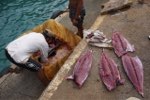
A couple of hours later, we fly back into the bay, and half the country cheerfully settles around tables to clean the catch. The younger men deftly fillet the tuna; the women and elders take over the second table and twist the heads off the fish amid a rustle of scales.
Now, until 5 o’clock, the cooks will be off frying, steaming and marinating everything, and then everyone will gather around a communal table in the main square.
Before the festive dinner, which is opened by Deputy Mayor Charlene, we present the Pitcairners with Laduska’s oil painting of Lady Mary against the sunset. She daubed it beautifully—bright and blazing:). In the week since it was painted, the landscape has almost dried, and will most likely go up on the wall of the local club, where gifts from the crews of various vessels have been hanging since the 1960s.
Kelvin the tractor driver and an elderly doctor named Jacques, who turns out to be from Romania, come over to us. While we discuss the peculiarities of national politics, I fail to photograph the most hectic action around the buffet table laden with delicacies. Afterwards, however, I thoughtfully fill my plate with food, from bananas boiled in gravy and coconut rice to fish fried every which way and breadfruit chips...,,,,,,,,.,,,,,,,,..,,,,,,,,,,..,,,,,,,,,,...,,,,,,,,.,,,,,,,,..,,,,,,,,,,..,,,,,,,,,,...,,,,,,,,.,,,,,,,, The dinner is so delicious and varied that I regret the finite capacity of my stomach. I didn’t even manage to taste everything.
Ladunya gave her friends keepsakes: she divided a single matryoshka into three parts as a symbol of their eternal friendship—put them all together and you get five little matryoshka sisters.
As we said goodbye, we hugged what seemed like every resident. Everyone wished us a happy flight. We, for our part, promised to send them a postcard to Pitcairn from our holiday in Russia in two years’ time.
Reluctantly, we headed for the pier in the company of four enormous boxes of fruit and vegetables, the mayor and his deputy, her children, mother and cousin, along with their husbands.
The boxes of nature’s bounty ($40 for the lot) would not fit into our dinghy, so they launched a steel high-speed tender with inflatable steel sides—a beast, not a boat )).
We breathe a happy sigh of relief that at least we won’t all have to buck through the darkness in the dinghy—only the captain will. Laduska and I wait for the second run: the guys take Nastya out with the four boxes of provisions and come back for us.
For a long time, we circle within a small patch sheltered from the waves, waiting for the signal.
“Time to go!”
And the iron tender roars up onto a wave.
So Mayor Sean Christian and his distant nephews, Jayden and Kimyoro, are the last Pitcairners to see us.
We transfer aboard the yacht over an extra gunwale between us and Lady Mary, with Andryukha in the dinghy. Everything is bouncing in opposite directions, and amid cries of “Oh, dear God!” we finally scramble over to where we belong.
The guys circle until they are certain the crew is safely aboard, then fly off into the night.
We spend another two hours preparing to depart, stowing the provisions and getting used to the thought that we are leaving forever. That is the saddest part...,,,,,,,,.,,,,,,,,..,,,,,,,,,,..,,,,,,,,,,...,,,,,,,,.,,,,,,,,..,,,,,,,,,,..,,,,,,,,,,...,,,,,,,,.,,,,,,,, Now:
We have covered about 200 miles from Pitcairn. The weather whispers, “Stay home and sleep.” One moment winds gust up to 30 knots—and when they’re on the nose, they’re reeally unpleasant—and the next it goes calm. Yet even in a calm, the waves somehow manage to reach us through the hatches, so it is stuffy and damp below. And now it has started raining too…
The day after tomorrow we will arrive at Mangareva, which seems rather ordinary after Pitcairn. At least, that is all my saved pages from Wikipedia and somewhere else suggest.
Guys, write to us!