
From the Travely-Family archive · Pacific Ocean
Approaching the Tuamotus. “Wind Smack in the Face.” Day Six
An original publication from the former Travely-Family website. This English translation was preserved from the technical-site archive without editorial rewriting.
Approaching the Tuamotus. Wind Smack in the Face. Day Six.
By morning, we had 100 miles left to Kaeuehi Atoll in the Tuamotu Archipelago. So the hardships of bucking into the wind are softened by the anticipation of an imminent stop. Yesterday evening the wind swooped in and started howling, but no sooner had we put the second reef in the mainsail (there are three reefs in all—that’s how you reduce sail area) than the wind almost died. But we bravely resisted going out on deck in the dark to shake out the reef. Firstly out of laziness, and secondly because the weather forecast promised it would strengthen without easing.
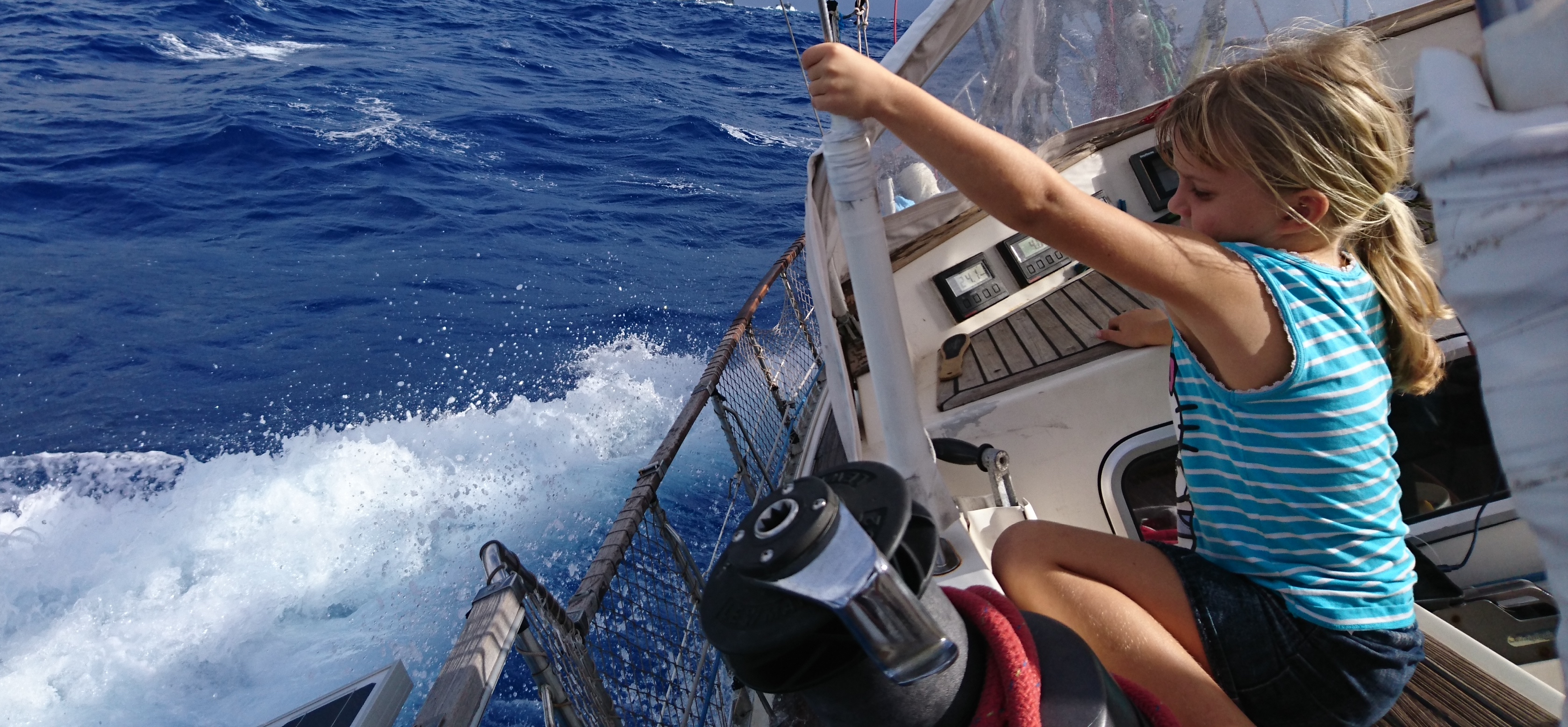
And at around 9 p.m., it began. Twenty-three knots right in the face feels like a very stiff wind. But turn the boat downwind to take the pressure off the largest sail—the genoa—and furl it, and the wind feels as light as a feather. Pity we need to go the other way. So we turn back into the wind and, like old sea wolves defying a storm, Nastya and I clamber onto the coachroof to put in the third reef. Rain, a windbreaker over a half-naked body, and the zips, as is only proper on rarely worn sailing gear, have oxidised and refuse to fasten. The wind tears off my hood and lashes wet hair across my eyes. Lady Mary, hands on hips, flies into the clammy murk. Once again, everyone will have to sleep against a separate wall in a separate berth to avoid crushing whoever shares the bed.
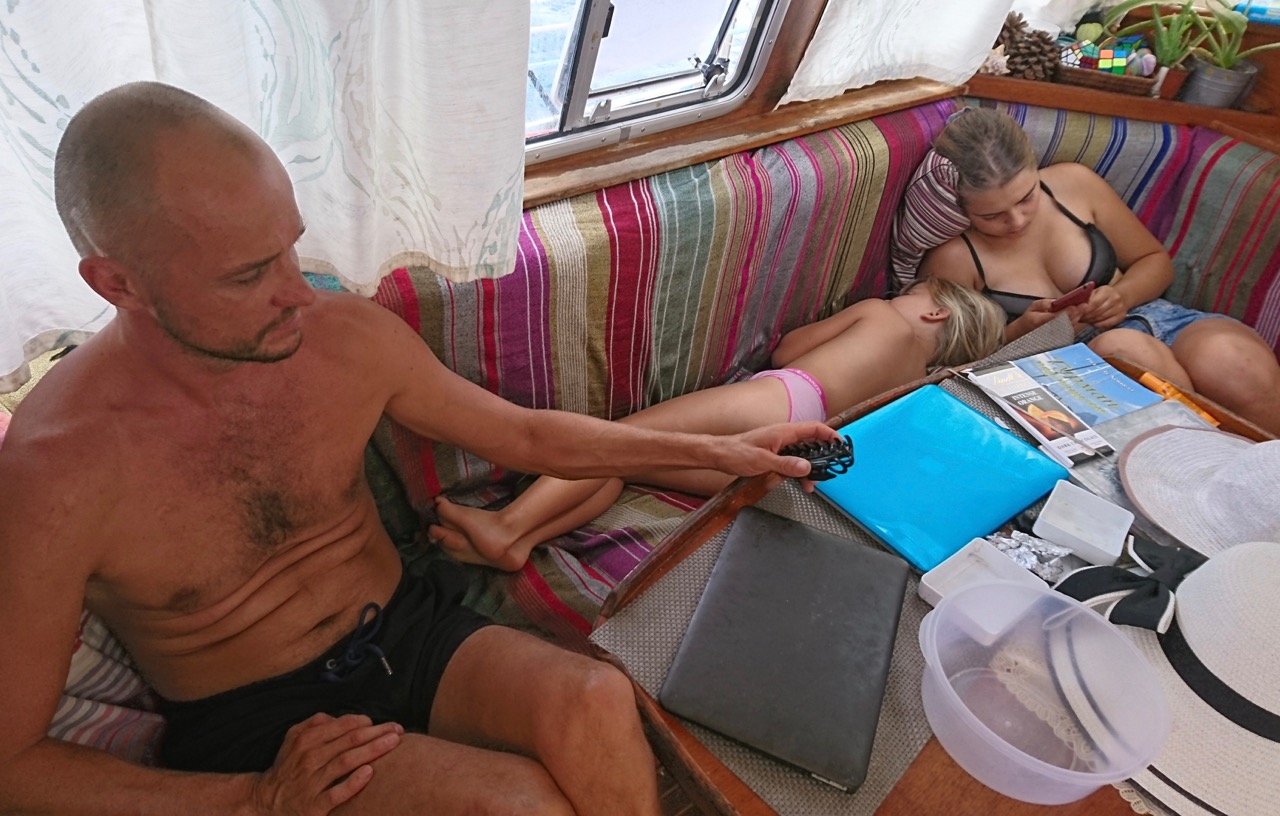
In half a minute the hats and the bowl will go flying.
How the Weather Affects Baking
In the middle of the night, the waves finally built too. By dawn they are rolling in, four metres high, almost straight onto the bow. The stem cleaves the turbulent ocean, and heavy torrents of spray fly onto the coachroof. We can neither crack a hatch open nor go out on deck. With a gloomy look, the first mate forces out: “I hate close-hauled sailing.” We spend almost the entire day like bruised tomatoes in the stuffy crate of a vegetable truck. Which does not stop the young sailor and me from making a batch of breakfast fritters. Braced between the galley walls and the mast, we juggle a spoonful of batter and rejoice if it lands not only on the stove but also in the hot frying pan.
Any fritter that manages to leap straight from the pan onto the plate, bypassing the table and floor, is declared lucky. But after an hour in the galley, we once again have to invoke the headwind and its wicked accomplice, the swell, with indignant grumbling: down below beside the hot stove, the motion sickness is worse. To have breakfast, Ladunya and I took the pressure cooker without its handle and set a bowl of fritters, a glass of honey and some condensed milk inside it. A mug of tea fitted in there too. That was our makeshift serving table. We dragged it onto the saloon settee and blocked it in from the outer edge with a cushion, and from the other two sides with our bottoms. And that was how we had our tea.
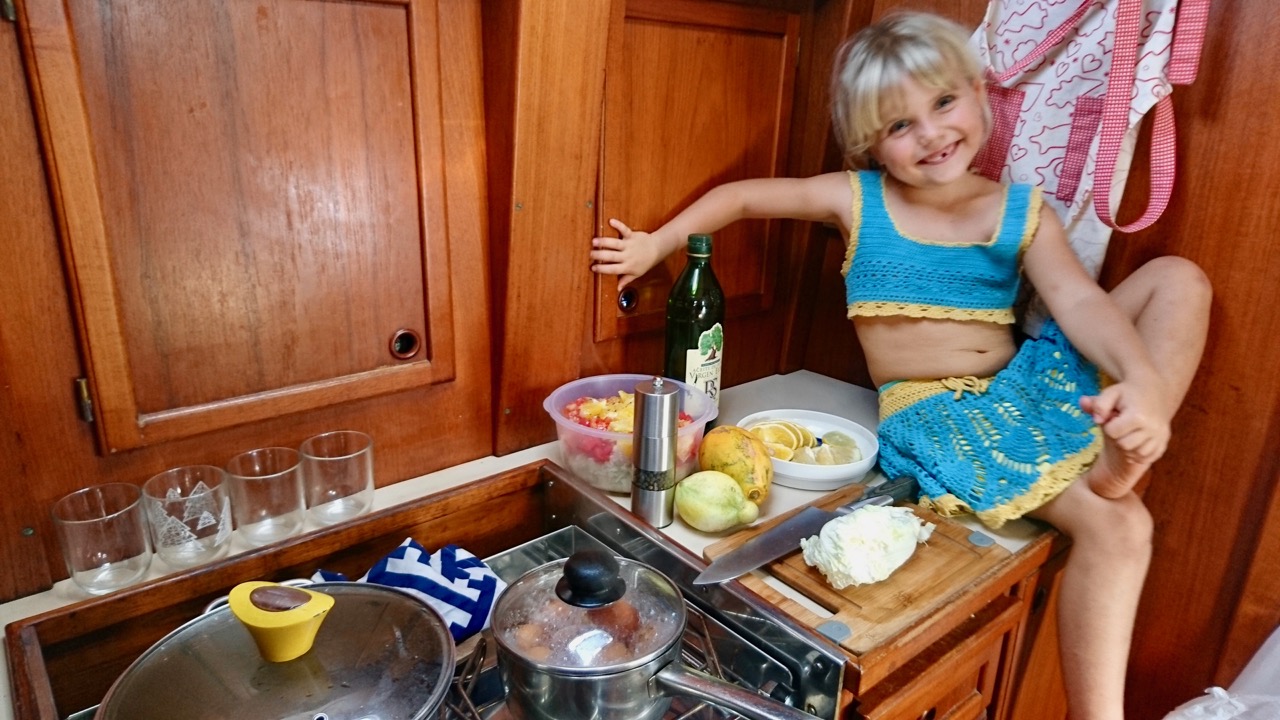
Friends, don’t believe your eyes! This is us letting our hair down after we’d already reached the atoll 🙂
But there are only 60 miles left to Kaeuehi Atoll, which we are going to reach after all. During the night, we somehow have to get around the uninhabited Taiaro Atoll without running onto shoals or reefs. By seven in the morning, we must be at the entrance to our atoll, waiting for the tide. The main thing is not to miss it. The entrance to an atoll is usually narrow, and the current in the pass is very strong. Because although the tidal range is only 20–30 centimetres, in a lagoon covering 300 square kilometres the volume of water in motion is nothing to sneeze at. And all that difference rushes through the narrow pass at speeds of up to 8 miles per hour. Trying to push against the current risks running onto the reefs and losing both boat and crew. So we have to make it through in time.
The full moon gazes into the crumpled mirror of the water and reminds us that at this time the tides are ve-ery big. Tomorrow we’ll see how our entry into the atoll goes, and report back:). Wishing everyone pleasant discoveries.
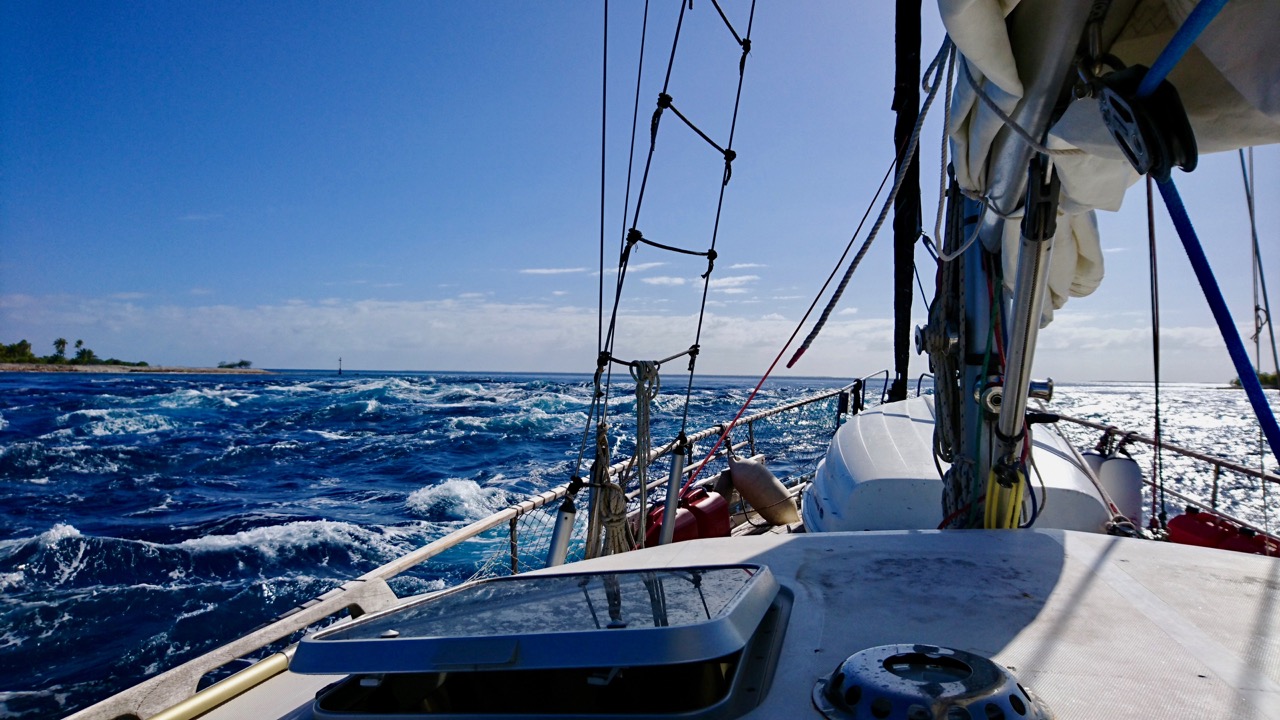
Lady Mary enters the current to reach the atoll lagoon
Our current coordinates: 15° 39′ south latitude and 144° 17′ west longitude.