
From the Travely-Family archive · Cape Horn
Approaching Tristan da Cunha. Day 32
An original publication from the former Travely-Family website. This English translation was preserved from the technical-site archive without editorial rewriting.
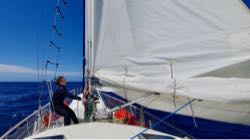
Approaching Tristan da Cunha. Day 32. Repairing the shroud, the first mate’s illness, and emerging from the storm. Sent via satellite...............................................................................................................................................................
Damn, it’s a shame we don’t have a hard hat aboard—a serious oversight.
“And, just in case, I hunch my head down between my shoulders. Picture this: the captain, festooned with bits of metal, dangling from a climbing harness with a four-metre swing above my head, while I hold his safety line and the shroud we repaired in the field. A five-metre beam sea makes the fun unforgettable....... Nastya, hold a broad reach!”
And the sailor at the helm tries to keep the boat as close to the wind as possible, so she rolls and heels less. Otherwise we’ll have to find ourselves a new dad somewhere if this one comes crashing down from the mast...............................................................................................................................................................
Yesterday we wrote that the main forward shroud on the mainmast had snapped. Shrouds are the wires that hold the mast up. Losing a shroud can mean losing the mast. The captain proved himself a rigger sent from heaven: he unscrewed the broken section and dragged it into the saloon with sorcerous intent. He bent the end of the wire into a U-shape, inserted a suitably sized thimble and clamped it in a vice. A thimble is a kind of flat metal loop. He fastened the assembly with two clamps sized to the shroud’s diameter. We attached the intact lower fitting of the shroud up beneath the first spreader.
This is the point in the story where Andrei was dangling from the mast, while I belayed him from below, afraid that first the pliers and then my husband would come crashing down on the top of my head. They didn’t...............................................................................................................................................................
The repaired shroud ended up about 40 centimetres shorter than before. We made up the difference with 8 mm Dyneema, a super-strong line, passed four times through the eye. We tensioned it with a turnbuckle—now we can weather a storm. I’ll just go and ask the captain what exactly a turnbuckle is, because I’ve written down the fancy word and immediately forgotten the explanation. Liberal-arts brain, innit....... Storm number four has safely whistled through us from north to south. In anticipation, we deliberately climbed all the way up to the 35th parallel; now the wind has pushed Lady Mary back down to the 37th, our favourite latitude.
We spent the night and part of the evening hove-to under the mizzen. We don’t need to fly towards Tristan with the storm, or we’ll get there before the calm does. So we settled down to drift. The storm rated about three out of five, with gusts reaching 40 knots. By yesterday morning, the wind had settled to 20 knots. But the post-storm swell did its utmost to entertain the crew, sending any food and plates that had not been barricaded with due care flying. I’m amazed Nastya managed to cook a pot of borscht. Against this stormy backdrop, something happened aboard Lady Mary that answers a question our followers often ask: “What if someone gets ill in the middle of the ocean?”
...............................................................................................................................................................
Either the cyclone brought some kind of magnetic storm with it, or I’d come down with some sort of toxicity, but the first mate bravely endured a splitting headache for a full twenty-four hours. Pills, neck-muscle exercises, rubbing prickly Thai ointment into my temples, meditation, affirmations and autogenic training had no effect. I tried moaning and crying—no joy. I even called for Ichthyander a couple of times, but that brought no relief either. Nor did an intramuscular injection of Baralgin, coupled with some sorcery from the captain.
Wondering whether to start tidying up my affairs now or wait until morning, I resorted to the final remedy: drinking litres of water. By morning, after three litres, it eased off a little—the Baralgin must finally have dissolved. I spent the day lying down with a damp cloth on my forehead. I’m still drinking, meditating, stretching my neck and occasionally putting on a mournful face....... Though how can anyone look mournful when we’re having Olivier salad for dinner today! And there are mandarins on the fruit platter. The boat smells like New Year’s—maybe we should watch The Irony of Fate, just to make it extra convincing?
Oh well, we’ll settle for Ice Age Kids again. A killer show. When we reach Africa, the whole family will sign up for figure skating straight away. Even the captain, I think, is not opposed.................................................................................................................................................................
The sun is preparing to plunge into the ocean, sparkling merrily one last time. In the aft cabin, the children are singing Vysotsky’s “Ballad of the Struggle” to the guitar. Nastya can really play the guitar now! She’ll overtake me soon. The captain is reading, the swell is rolling, and there are whitecaps. It’s blowing 25 knots, gusting to 36. We’ve taken down all the sails except the small jib. While I’ve been writing these lines, the crew have already reefed the jib. Tomorrow at dawn, on day 33 of the voyage, we hope to see the main volcanic peak of Tristan da Cunha.
In theory, the weather will let us approach, but whether we’ll manage to anchor in such a swell is a big question. We’re not even discussing going ashore yet; as of today, the chances are approaching zero. Because there is no sheltered harbour on the island, and we don’t have a working engine for the dinghy. We’ll tell you how it all turns out in the next report. Oh, by the way, you know what’s funny? Exactly three years ago, at this very time in 2016, we were crossing the Atlantic in the north-east trade winds. It was our first transoceanic passage.
Back then it took us 23 days to sail from Cabo Verde to French Guiana, and that felt like a long time. Now, from the vantage point of day 32 of this passage, a 23-day passage feels only moderately arduous...............................................................................................................................................................
We love you, guys! And every one of your comments and letters makes us happy! We can’t reply to everyone personally and straight away, but we’re trying. Big hugs from the middle of the South Atlantic, and we wish you a lovely autumn.................................................................................................................................................................
And a separate, heartfelt thank-you to our shore-based support club! We thank Dmitry P. and Alexander Z. for contributing to the expedition via Paypal.Me/TravelyFamily and Yasobe.ru/na/TravelyFamily! Friends, you help keep our hands—and our wings—from drooping, whatever the situation. Thank you for motivating us to act! May your dreams come true!..............................................................................................................................................................
You can follow the progress of the First Russian Three Great Capes Round-the-World Expedition with Children on our website under the Route tab, where the IRIDIUM track is displayed. The same map, with the track and weather, is available at bit.ly/iridium360