
From the Travely-Family archive · Other Entries
Preparing for the Voyage: News from the Past Month
An original publication from the former Travely-Family website. This English translation was preserved from the technical-site archive without editorial rewriting.
For the preparations for a voyage to go well, you need to recover from the previous voyage. Otherwise, disaster and burnout will come for you, scythe in hand, and there’ll be no strength left for the next big push. So—a few words about the New Year celebration we hadn’t expected.
New Year as a Gift from Fate
Because of the difficulty of obtaining spare parts at the edge of the world and the paperwork involved in clearing out, our departure for the Far East has been delayed until February. Although, while on passage from Tasmania, we had planned to set off before New Year. And we had been preparing—resignedly—to celebrate once again with the ocean separating us from the rest of the world. Admittedly, we could hardly top New Year 2019, but still:).
Our friends—a liveaboard family we befriended on our previous voyage through Polynesia—are now looking after a house and a small farm on a mountain covered in jungle that tumbles down towards the Pacific Ocean. The owners have gone away for the holidays. There are seven cats here, as well as chickens and geese. Avocados hang in clusters on the slopes, and beds of pineapples bristle with spiky leaves. And the pool... it’s a sybarite’s dream. And a millionaire’s.
Our friends invited us to celebrate New Year with them. Though I’m afraid they hadn’t counted on Russians normally celebrating New Year right through to 13 January. We didn’t overdo it, of course. And on 5 January 2022, we returned from our visit to the yacht. Beneath the yacht’s tinsel Christmas tree, hanging from the lamp above the chart table, three wrapped presents were waiting for us.
Father Frost had brought the girls pendants with black Polynesian pearls, and the captain a pair of swim shorts with Polynesian tattoo motifs—to go with the T-shirt he’d been given earlier. As for me, all my presents had already been bestowed upon me on New Year’s morning.
🎄
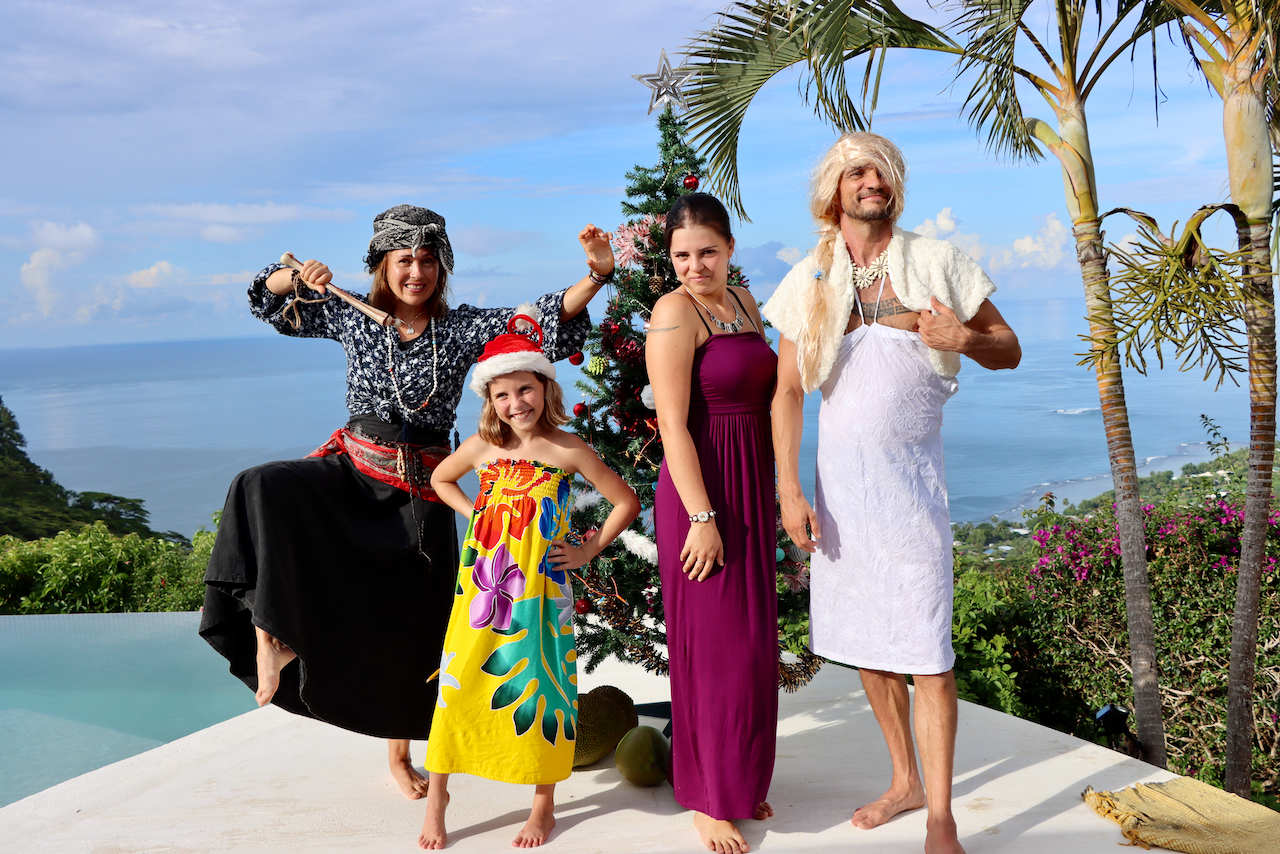
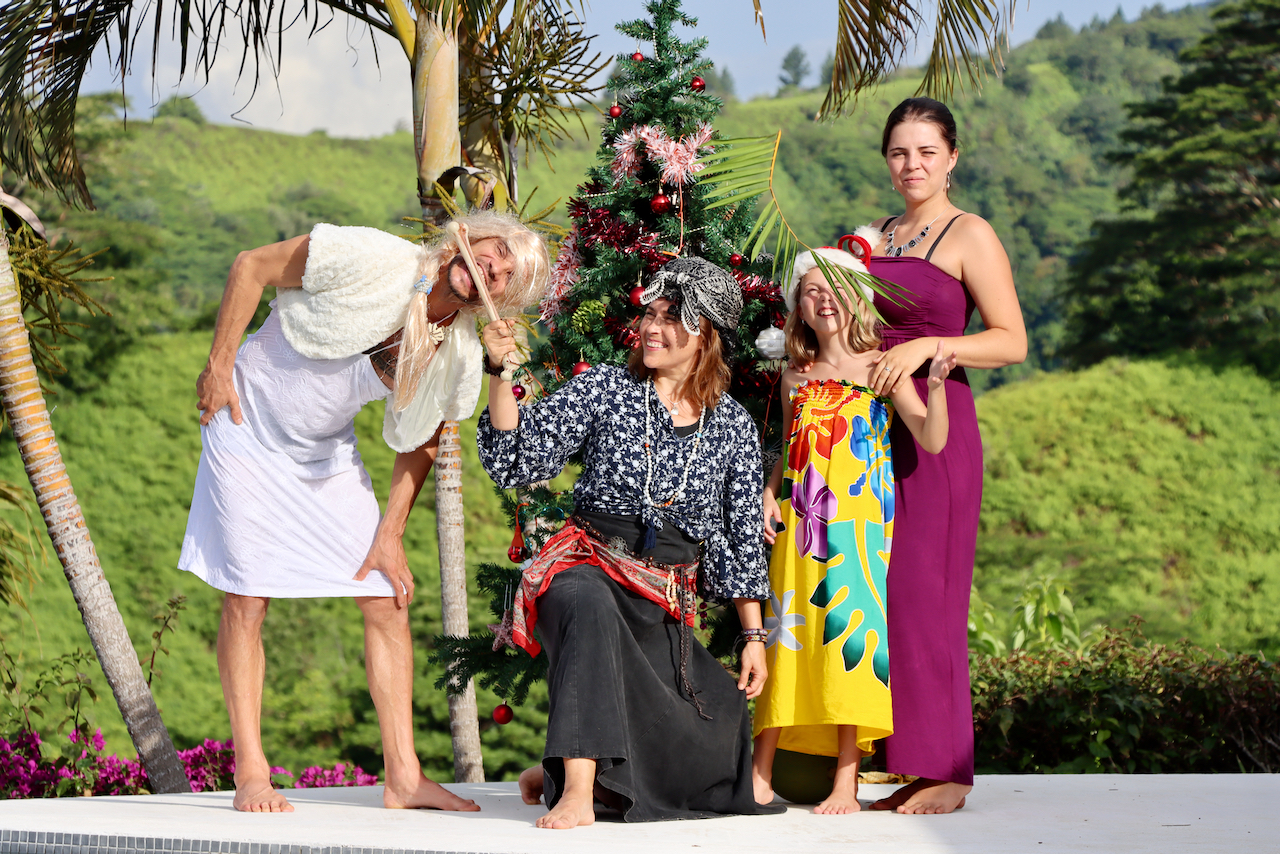
It was possibly our best New Year celebration in the past ten years. There were Gypsies, Baba Yaga, who had put a spell on the New Year, snowflakes, and the intimidating New Zealand haka. An entire Māori tribe cleverly disguised themselves as gnomes and elves—and then they really let rip! Once the bogeywoman and the Māori had run off, the Gypsies arrived and launched a treasure-hunt quest... And then there was a pool disco. I’d only ever seen those on TV.
In the New Year 🌟
In the end, by Christmas Eve, my brain and soul were hovering somewhere between euphoria and a hangover: there was work coming out of our ears, and I was left without a laptop. We’ll only be able to get it repaired when we reach Russia—in other words, in three or four months. The family’s other laptops don’t have Russian keyboards, and it’s awkward to type vast screeds of text on them; besides, their owners are actively using them. So everything has slowed down.
The emotional “hangover” hit Andrei especially hard: we’d spent a long time near land—almost a month and a half—but accomplished little. Nothing but celebrations and spending money.
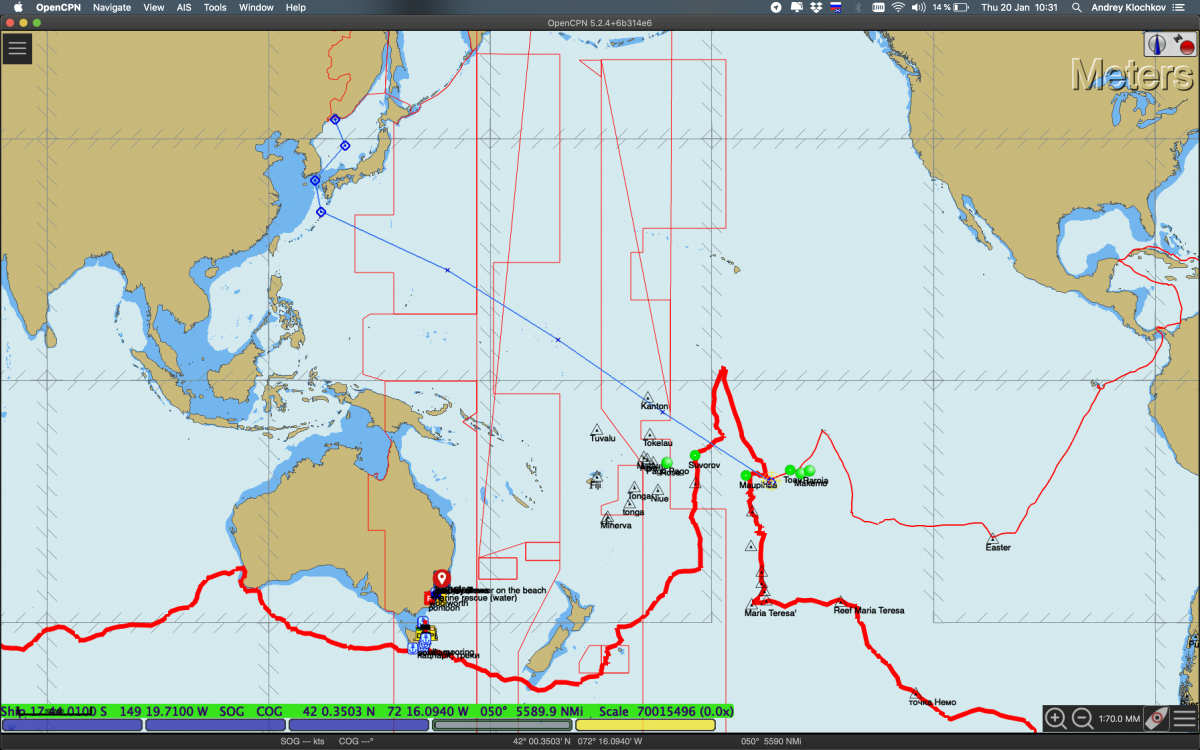
I keep insisting that after three months of sheer hell while travelling—with no spending and no celebrations—a holiday is simply essential. Otherwise, what’s the point of slogging away like this? And I refuse to feel guilty that we were all happy during New Year week. Though the preparations for the voyage won’t move themselves along... But a change is as good as a rest, and life is all about contrasts. And soon we’ll be off again for another three months. Here, in this screenshot from OpenCPN, the vague blue line heading north-west is our tentatively plotted course to Vladivostok.
The thin blue line is Lady Mary’s approximate route home
Hurricane Season Is in Full Swing
It’s been pouring from the sky all January. On 9 January the weather turned thoroughly gloomy and began spitting wind-driven downpours at us. The rain went squint and now falls at an angle to the surface of the sea... The awnings billowed like sails and clamoured to break free and head for the pampas.
“And scraps will go flying into every nook and cranny,” thought the cap, as he furled the awning, which had already torn under the strain.
We are on the edge of the danger zone, and hurricanes usually break up into a series of storms on their approach. The weather map is swirling with fiery and burgundy-black vortices. The blacker they are, the scarier they are, and we’re discussing whether to move closer to the trees so we can tie up to them, or wait and see how events unfold.
Hurricane season in the ocean’s tropical belt comes every summer. By the end of summer, the chances of getting caught in the meat grinder increase. A hurricane is a tropical cyclone. South of the equator in the Pacific Ocean, it moves from west to east, rotating clockwise. In the Northern Hemisphere—including the Atlantic—a hurricane spins anticlockwise and travels from east to west. Also in summer. They occur when the surface of the water warms above +26 degrees Celsius and the water begins to evaporate rapidly. Warm vapour meets cold air in the sky above the ocean and forms a powerful cyclone.
Getting caught in a hurricane means getting into very serious trouble indeed... Once, we sailed along the edge of Hurricane Irma through the Caribbean Sea from Mexico to Colombia. In those days, Irma tore the Caribbean island of Saint Martin to shreds.
There’s a video and a weather map from PredictWind on our
Instagram, travelyfamily.official
(follow us!), with explanations from the captain. This kind of beauty is only available with shore-based internet. The forecasts we receive by satellite in the open ocean aren’t as pretty, but they’re just as accurate.
Yes, the hurricane didn’t reach us: it broke up into a pack of storms, and the next batch is gathering strength. Preparations for the voyage continue despite the weather.
The volcano in Tonga didn’t affect us—not with ash, not with a roar, and not with a tsunami. Against that background, it seems odd that the west coasts of both Americas were practically announcing civilian evacuations. Still, there was one strange thing on the very day the tsunami reached Japan: when we came back from shore that evening, our brave dinghy by the jetty was filled to the absolute brim with dirty seawater. We decided its bow must have been forced under the jetty and that the water had somehow poured in. Though our dinghy is unsinkable, and it’s hard to say what could have caused it.
The Other Day: Teeth and Prices
“A bone has left my body. And in a cruel fashion, too,” the young sailor observed mournfully as she went off to lie down with a film and her mum.
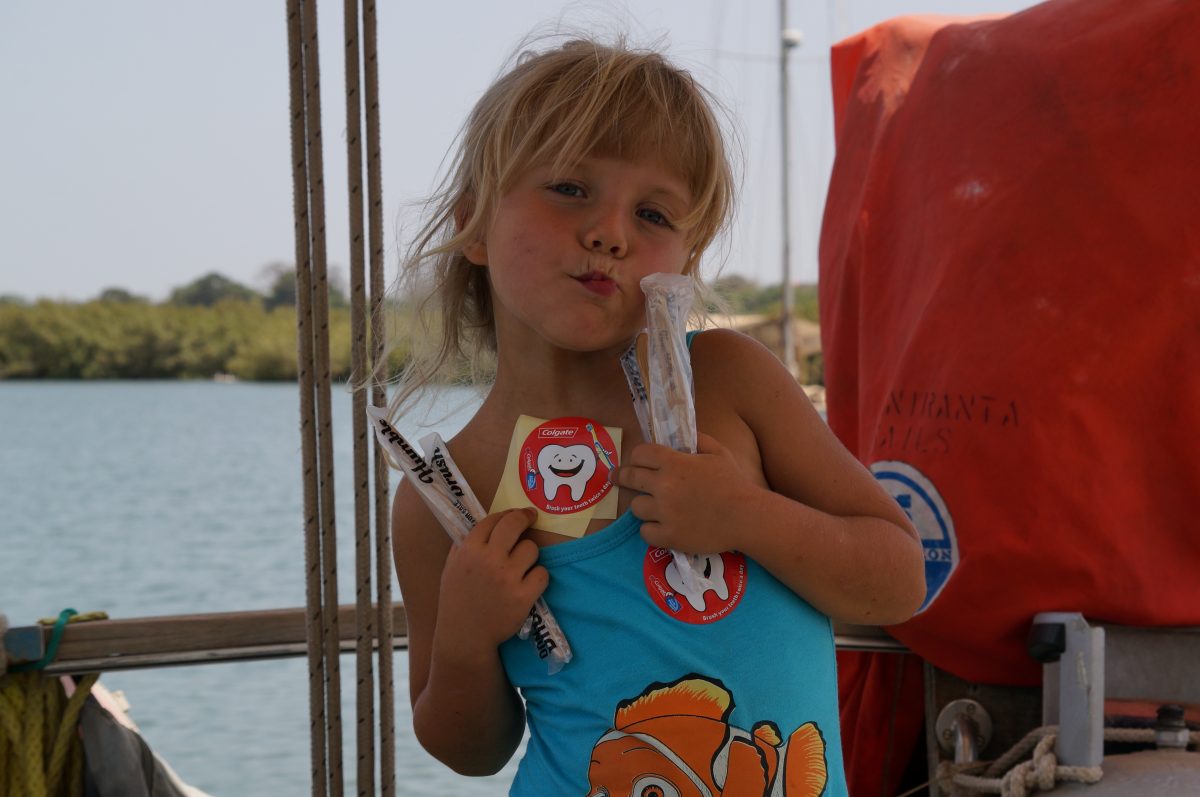
In the photo, five-year-old Lada had her first-ever tooth extracted by her first-ever dentist in The Gambia, West Africa.
Young sailor—2016 in The Gambia—with presents and without a tooth
The girls each had a tooth removed—we are preparing for the voyage, after all )). Nastya had a wisdom tooth out; Lada, just a tooth. Ever since we left Australia, she had periodically complained that she couldn’t chew. But getting the whole family’s teeth treated in Australia would leave you needing treatment for your nerves for the rest of your life. So there we decided to deal only with emergencies—mine and Nastya’s. Extracting one tooth and doing a little work on the neighbouring one cost 700 Australian dollars—with a good friends-and-family discount.
And Nastya’s tooth was treated back then for 1,700 Australian dollars. The exchange rate was 51 roubles to the dollar. So even out here in the back of beyond—on a small island in the middle of the Pacific Ocean—having teeth extracted and treated is several times cheaper. Here, three check-ups, two teeth out, plus two panoramic X-rays, came to 130 US dollars. This isn’t Australia. Though, to be fair, I should say that dental work is the only thing in Polynesia that’s cheaper than in Australia. All the other prices plunge me into depression every time I go to the shop.
And Nastya’s tooth—or rather, the lack of it—hurt horribly for two days. Even now, on 20 January, towards the end of the third day, the swelling still hasn’t gone down and she still needs painkillers.
Preparing for the Voyage: What We’ve Done
The repairs are progressing with the help of the captain’s magic. Most importantly:
Andrei has repaired the watermaker and the heater! We’ll now have water and heat when we reach the Sea of Japan. And another ocean storm should no longer deprive us of that very heat, because it will have a harder time reaching the exhaust outlet now that it has been raised by a metre. Inside, the captain also fitted some clever sort of valve that won’t let seawater enter the heater, but will drain it into the bilge instead.
We still need to replace two shrouds and patch the windvane self-steering rudder with yet another layer of epoxy. It was badly battered by storms in the Southern Ocean after Tasmania.
Another important job is to finish sewing the sail. There’s a mountain of work to do, and after one of its components was repaired, the machine took to snapping the thread. Meanwhile, I’m postponing the moment of truth with all my might and refusing to teleport myself to the sail. The latter is languishing as it waits beneath an awning at our friends’ place ashore.
The rain is coming down in buckets, and we’re short of electricity. The batteries are running down before they can soak up enough solar energy, so we have to start the engine.
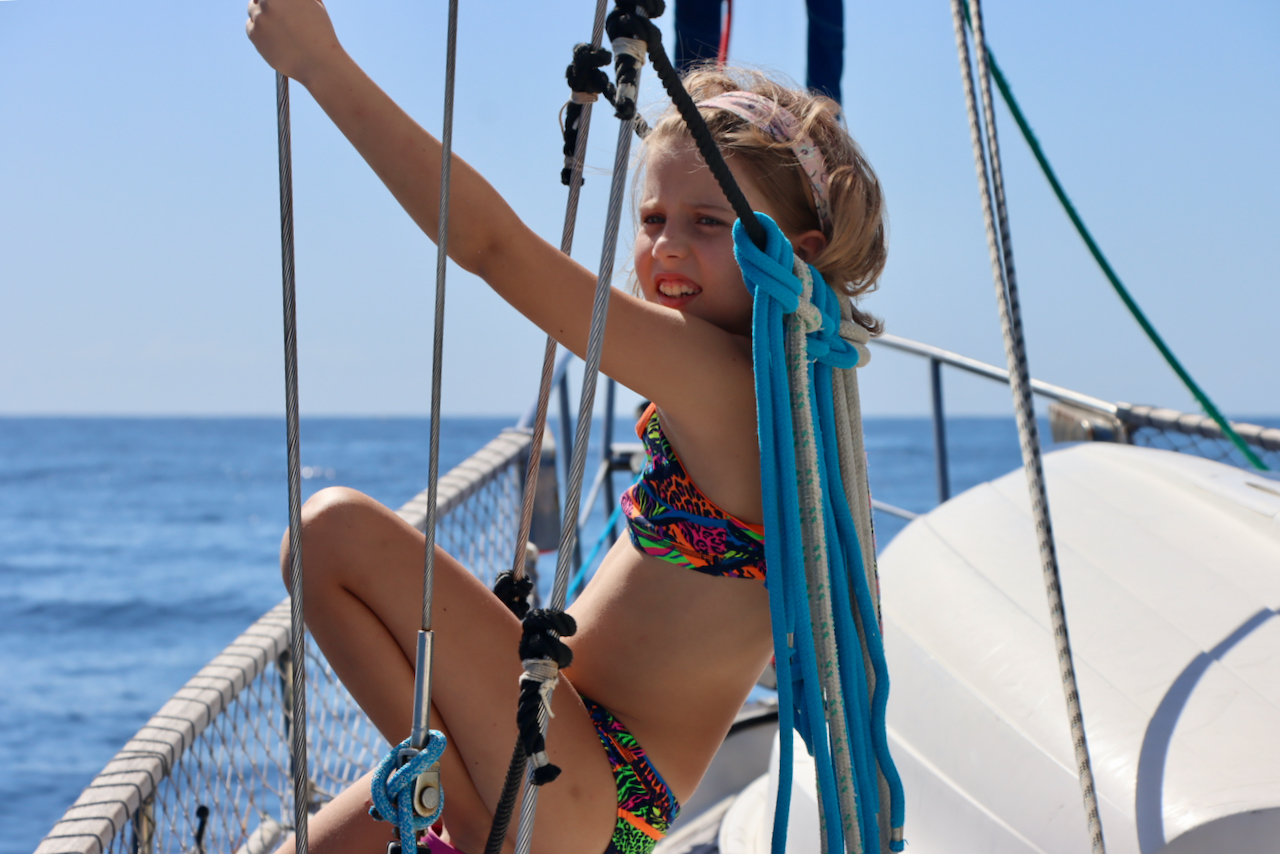
Young sailor approaching the finish of the circumnavigation
Thank You!
A huge thank-you from the entire crew to all the wonderful people supporting the expedition through YooMoney and PayPal —Alexei A., Natalia B., Natalia S., Anatoli S., Pavel Valeryevich I., Nikolai Alexeyevich S., Mikhail Vladimirovich B., Ivanov from St Petersburg, Anton Alexandrovich S., Taisiya N., Alexandre T., Viktor Leonidovich B., Viktor Ivanovich Sh., M Dmitry, Dmitry Sh., Irina Yevgenyevna N., Pavel S., Rytas U., Yevgeny Ivanovich S., OLEG CH., Alexa B.
Thank you to our beloved
Geographical School of the Holy and All-Praised Apostle Andrew the First-Called for the joy our young sailor gets from learning and being taught. Lada is now studying from 8 p.m. until midnight—because the time difference with Moscow is a full thirteen hours—and has no intention whatsoever of giving up live classes. Now that’s motivation!