
From the Travely-Family archive · Other Entries
Escaping the Typhoon. Six Weeks in the Ocean
An original publication from the former Travely-Family website. This English translation was preserved from the technical-site archive without editorial rewriting.
What can we say on the 43rd day of our journey? That if Lady Mary had maintained her speed from the first month, we would already be entering blessed Russian waters—or godforsaken ones, whichever is more accurate. But the fair wind did not last for the whole voyage, and during the first week of April we barely moved, somewhere in the triangle between the Marshall Islands, the Mariana Islands and the first Japanese islands. The latter—that is, the first Japanese ones—seem to be called the Ogasawara Islands and are divided into Mukojima, Chichijima and Hahajima (a loose translation from English).
There are other jimas too. We confirmed their collective existence tonight when we spotted the flashing yellow light of a lighthouse. It is a pity we cannot tell you anything worthwhile about these islands, because we put to sea without having done our homework on this part of the world. Unless our shore team sends us something interesting about them. They are actually quite a long way from Japan—more than a thousand kilometres. We are marking our passage relatively close to land with increased night-time vigilance and yet another repair to the mainsail.
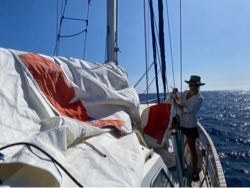
Remember how, a little over three years ago, while crossing the Pacific from Tahiti to Cape Horn, we were forever stitching up the genoa—the largest headsail? Back then it kept tearing along the seams because the thread had not survived its torture by the sun. Now the mainsail is tearing both along the seams and through the cloth. Considering the head-on storms ahead, this is really not very good. If only it will hold together until we reach shore. Then we will have to work out where and how to have new sails made under new and thoroughly unfavourable circumstances.
What about the typhoon?
The typhoon—also known as a hurricane, also known as a cyclone—has veered slightly east, and we will manage to slip past it. Although the weather forecast continues to amaze us with its less-than-crystalline honesty: the calm begins a full day earlier than promised. Yesterday we even motored for about five hours to reach the wind and pass south of those very islands. We had to drop almost a whole degree south, but the wind returned and we are moving again—which, in our case, means we are alive! Yet the journey home feels ever more endless.
It looks as though this time we will break our own record for a non-stop, self-sufficient voyage, because we will definitely be under way for more than 53–55 days. Although there is a chance that before entering the Sea of Japan we will have to wait out a headwind while sheltering behind some rock near the Korea Strait. How desperately we want to be on land already. To be rid of the anxiety of waiting and begin living in this reality and doing what must be done.
Is there any food left?
An inventory of our provisions 42 days after leaving land showed that, in principle, we could comfortably bob around at sea for another couple of months. After that, food would begin to run short, but we have enough grains, flour and pasta for another three months. Half our lockers are still packed with canned food from Australia, which we left on 3 September. Last week we ate the final Australian pumpkin (!!), which had kept in the yacht’s saloon for more than six months, looking as fresh as ever. As of today, our strategic reserve of fresh produce includes almost a crate of apples, a crate of pamplemousses (giant Polynesian grapefruits), a third of a crate of onions and a kilogram of garlic.
And we have enough assorted canned food—from fruit and vegetables to fish—to last a couple of months without being particularly frugal. Three litres of Orangina (our equivalent would be Fanta), nine litres of juice and a bottle of blackcurrant syrup. After that, we will start using jam to make drinks. Among the exotic items, there is a litre of homemade mango jam and a little jar of calafate jam—a wonderful Patagonian berry. Where was it given to us? Tasmania, I think.
Traces of civilisation upon the face of the ocean
This is about rubbish. If only you could see how much of it there is here. Yesterday was a rubbish apocalypse. We were just crossing a current flowing up from the south. This ocean river was carrying all sorts of things from Papua New Guinea and its neighbours: jerry cans overgrown with slime, plastic food trays, cups and bottles encrusted with shells. A block of polystyrene 50–60 cm high and the same in diameter sailed solemnly past. A metre-long stick with a buoy and polystyrene tied to it loitered nearby, along with scraps of netting and heaps of fragments from plastic containers—everything was being swept together by the current into a vast field of rubbish.
Andrey even declared, “Now we’ve seen the garbage islands.” To which our young sailor replied that they were not quite islands yet, because although the rubbish was floating in one place in the open ocean, it still remained scattered. It is so bitter to see how humanity is destroying the planet. How many such fields of rubbish are there in the sea, and how can they be dealt with? That is the question. We treat our own plastic rubbish humanely: we use a screwdriver to pack it into juice bottles; large or rigid pieces are cut into strips and packed in as well. Organic waste, glass and tin cans go to the bottom. As a result, after two months at sea we accumulate only a couple of small rubbish bags..
How is spring treating you, guys? Apart from the terrifying political situation, they say Covid is spreading its wings again?... May everything finally get better, please. Peace and kindness to you all! Thank you to everyone who is with us from afar. Your warm words in the comments give us tremendous strength. From the bottom of our hearts, we thank those wonderful people who support the team’s morale through YooMoney. Our heartfelt thanks to Alexander D., Evgeny, Dmitry, Viktor A., Natalia D. and the owner of card...0732! Now you too are part of our shore team. May your dreams come true!
Sent via satellite link. From our 42nd day in the ocean. Coordinates: 26°23′ N, 141°09′ E. P.S.
You can find our position and a real-time track of our route under the Route tab.. It displays the track from an MVS Telecom RockSTAR Iridium 360 tracker.