
From the Travely-Family archive · Atlantic
Along the Edge of Hurricane Irma—Under Sail. Storm
An original publication from the former Travely-Family website. This English translation was preserved from the technical-site archive without editorial rewriting.
Along the Edge of Hurricane Irma—Under Sail. Day 12. Storm and Arrival in Colombia
The engine coughed
I n the morning we wallowed in the calms, with 40 miles left to Cartagena. If this keeps up, we won’t reach shore by dusk. And we’re already longing to arrive, wash off the salt, and drink tea from crockery that stays put.
While waiting for the strong wind in the forecast, Andryukha decided not to motor for the time being, but to wait and see what came, then act according to circumstances. It is better to meet strong winds well offshore.
B ut by lunchtime we finally talked him into starting the engine. There are three of us and only one of him, the captain.
H ow could he hold out against that? And at last our floating little home began to move in a way that did not involve rolling from side to side.
A t one point the engine gave a puff, sighed, and died, and the cap had to climb down into the hold to warm up. He changed the filters, bled the system, did everything else that needed doing, and an hour later the engine was back in service.
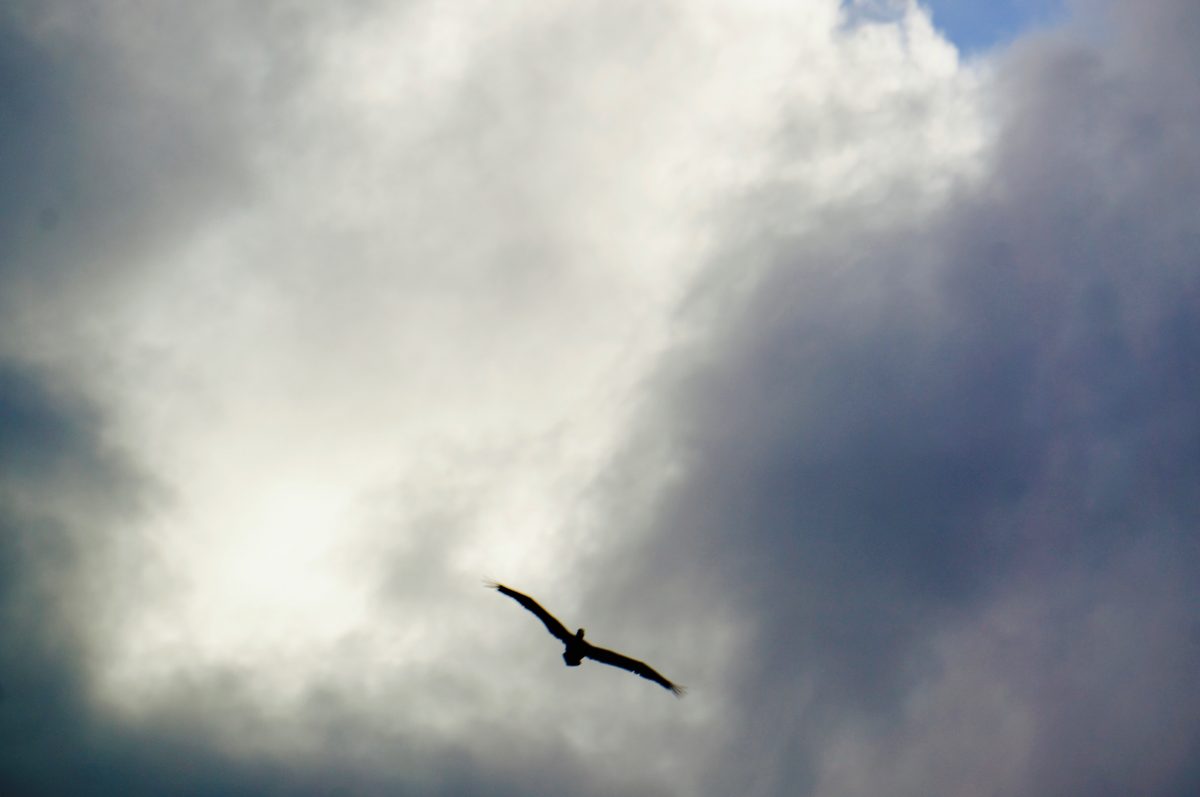
D uring that hour, a vast, terrifying darkness took shape ahead and to port, and with the air completely still, we were clearly about to end up right inside it. The genoa had been furled long ago, which was a good thing.
— Should we reef the mainsail? —...They say that if you look at the sky and think you ought to reef the sails, you are already too late.....
A Local Storm
I n the blink of an eye, the air heaved, the sky gave a howl of animal anguish, and the elements came crashing down upon us.
T he yacht was immediately knocked down to 45 degrees, and the high side scooped up water.
— Drop the main! the captain ordered loudly, trying to hold the boat head to wind.
— I’m scared! I shriek, bounding and crawling towards the mainmast.
I lie against the mast on the port side, hugging it like my own kin as I free the main halyard from the cleat and winch.
Lightweight buckets are flying beautifully astern. Tethered, they look like kites that Nastya is trying to tame.
— On your knees! And Nastya obediently presses herself to the deck.
The sky has merged with the sea—and it’s flashing too!
Ladunka is in charge in the cabin. On the captain’s orders, she puts the laptops and iPad in the oven, switches on the navigation lights, and tucks a towel under the leaking window.
A steady 40 knots of wind, torrential rain, and the bow burying itself in the waves. The mainsail protests against being furled and tries to soar into the lead-grey heights.
W aves fly over the bow, and vicious arrows of rain stab into our bodies.
— Nastya, take the helm! The captain hands the wheel over to the young sailor and rushes to the mast to help me.
W e haul the sail down, and Andrei lashes it to the boom with a rope.
— Tension the halyard! That one is for me.
I am still lying belly-down against the mast as I carry out all the manoeuvres. One heave, another heave, pull it taut, make it fast, crawl back into the cockpit. Ooof, a wave... Brrr—lovely! Not hot. Salty rivulets stream from my hair.
As it sank beneath the surface astern, our fish-filleting bowl gave us one last raspberry-coloured wink.
N astya did not manage to catch it, but she did get a plentiful shower of water from the cooling circuit—exhaust water, in plain terms.
T hanks to her efforts, all the buckets are safe and are now rolling merrily around inside the cabin.
The sprayhood, split along its seams and zips, lashes painfully at our hands—and, well, our mugs too—as we try to tie down its flapping panels.
— Lada, shut down the engine! And the little sailor briskly presses the button, turns the key, and switches over the battery.
A couple of times, the cap saw gusts of 48 and 50 knots.
— Up to Force 10, then...
Fortunately, the shore is no closer than 20 miles as the crow flies, so we can drift in any direction. Under bare poles and a torn sprayhood, we are being carried backwards at 2 knots.
An Hour Later
We are sitting on the cockpit sole, knees tucked under our chins, our teeth chattering with cold. For some reason, we find it all terribly funny.
T he raindrops strike our faces painfully; our knees no longer care.
W aves continue to lash over the coachroof, but the wind is gradually easing.
— When is this finally going to end? Having sorted everything out inside the boat, Lada pokes her little nose into the cockpit and begins to lament. Everything’s flying about in here, and in the aft cabin absolutely everything has fallen down and is rolling around on the floor.
— Never mind, sweetheart, it’s a storm.
W e’ll gather everything up soon. And just look how much important work you’ve done!
And Ladunka, forgetting her hardships, begins listing all the jobs Papa gave her that she carried out during the storm, and how she helped by doing them.
W e rated the elements’ two-hour rampage at Force 8–9, rising to a full Force 10 in the gusts—up to 50 knots of wind.
T he storm brought the first cool weather in six months; Nastya even put on her striped sailor shirt..
We Arrived
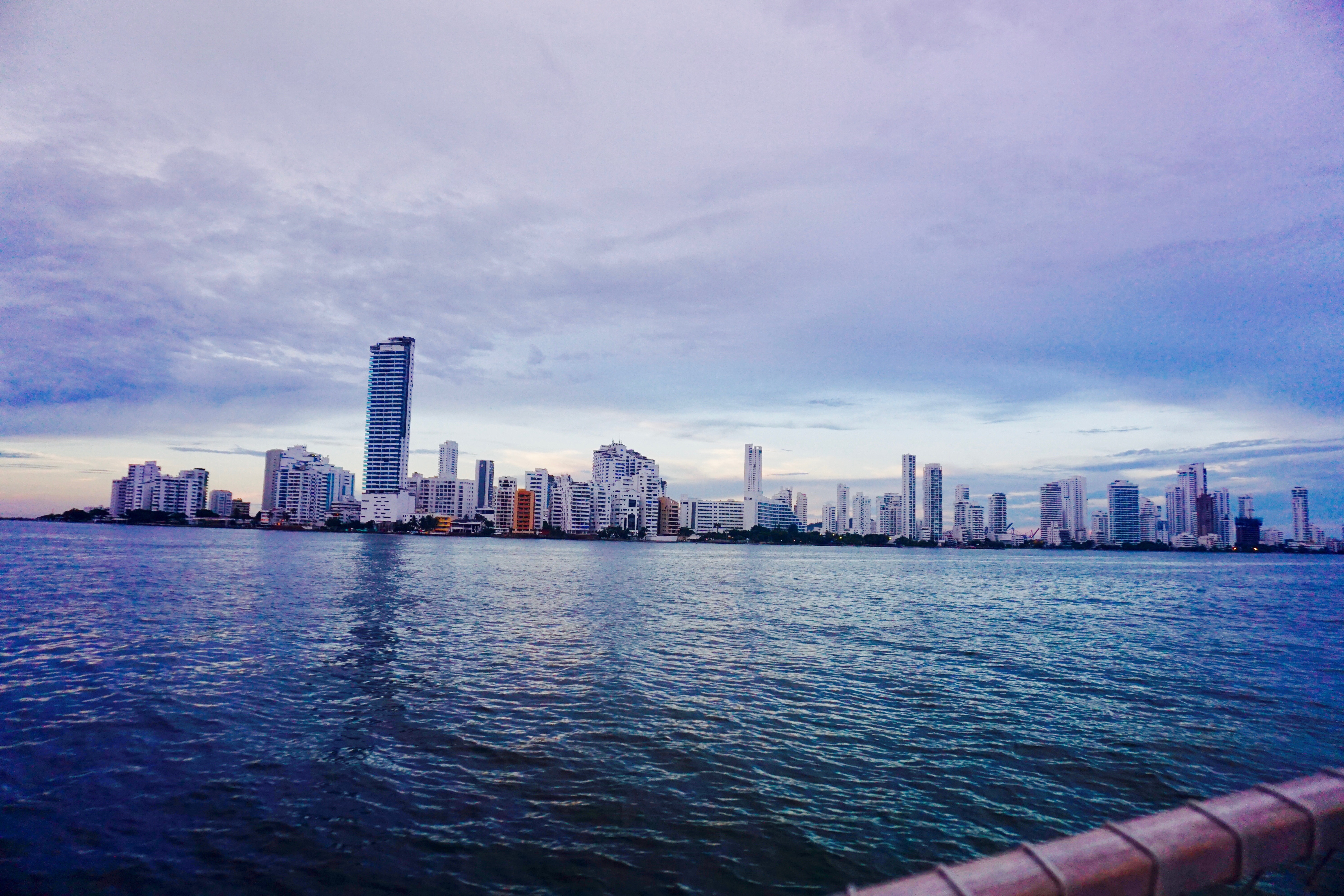
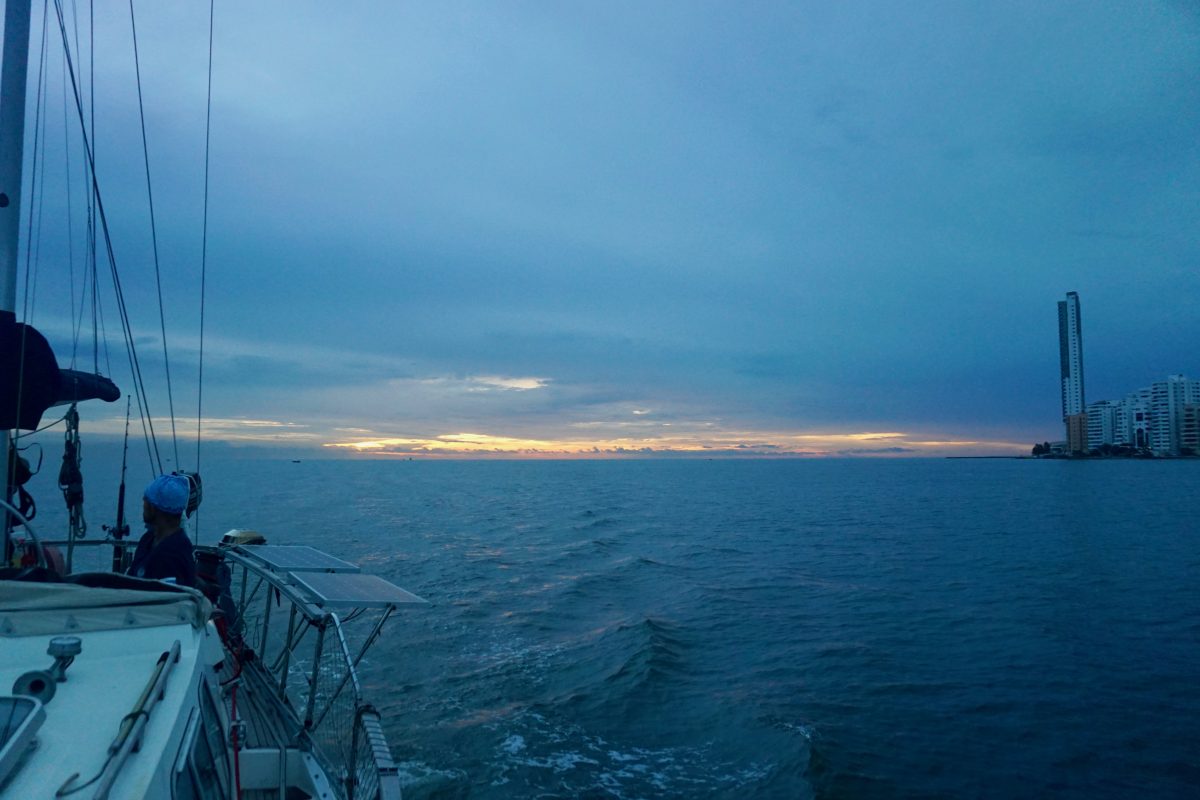
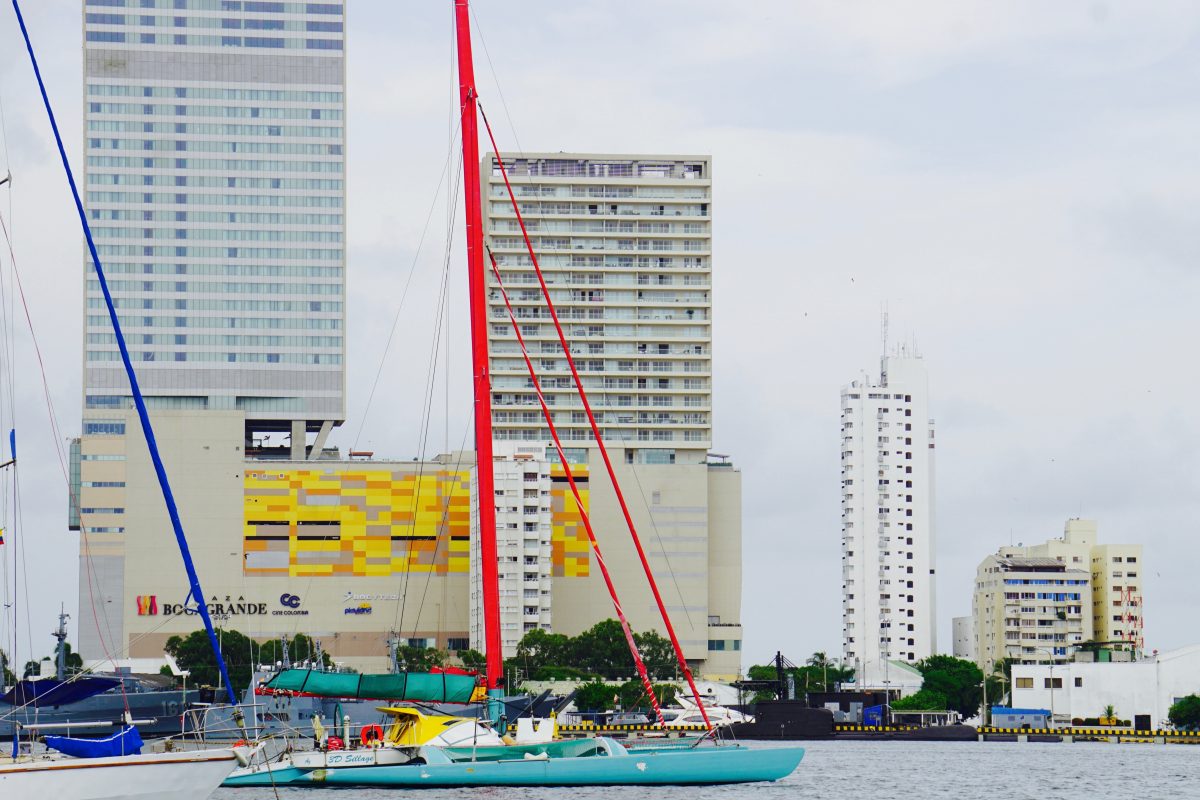
A cross the fairly smooth grey water, Lady Mary calmly approached the Colombian coast and headed along the green hills towards the glassy mass of skyscrapers gleaming in the sunset.
T he natural harbour of this illustrious South American city, sheltered by islands, can be entered through either of two narrow channels.
A t the entrance to the nearer channel, the depth is less than two metres. If we suddenly cannot squeeze through there, we will have to make a 12-mile detour around the island to the wider channel, and then we will not arrive before dark.
R ight in the channel, a motor yacht overtakes us at low level, music playing.
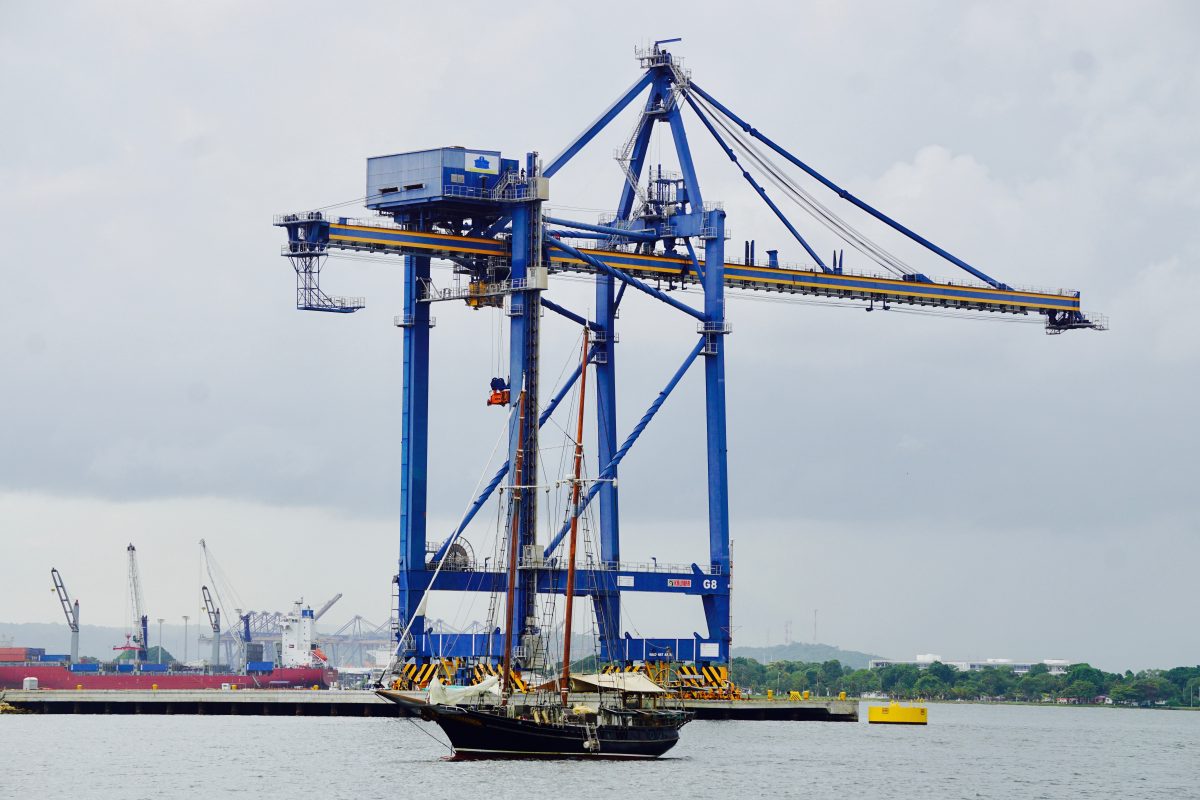
A long the long waterfront beneath the skyscrapers lies almost the entire Colombian navy—eight grey warships and two black submarines. To port, the skeleton of a sunken vessel sticks out of the water. The port’s gigantic gantry cranes tirelessly shift containers—a huge container ship has arrived to unload.
The harbour is packed with yachts.
T he anchor bites on the second attempt.
W e lay out 50 metres of chain in 12 metres of water. They say squalls often sweep through here, and the holding is not reliable everywhere.
Phew. We made it..
T he lights of the skyscrapers glimmer in the harbour’s murky water. The illuminated domes of the old city loom beautifully in the distance.
H ello, fortress city, heroic city, the reason South America does not speak English.
(More about that in the next post.)....
Celebratory arrival tea, showers with soap and a triple ration of water—5 litres instead of one and a half —a change of bedlinen... and we all collapse into bed together.
Thanks to the storm that swept past for the only night that was not hot. We slept like the dead.