
From the Travely-Family archive · Atlantic
Along the Edge of Hurricane Irma—Under Sail. Lightning and... Silence )
An original publication from the former Travely-Family website. This English translation was preserved from the technical-site archive without editorial rewriting.
Along the edge of Hurricane Irma—under sail. Days 8–11. The most terrifying lightning in our seafaring history, dancing on the coachroof, and musings.... What if we got rid of one mast?
Treacherous Irma and Jose have moved north, while a new cyclone has already begun spinning up in the western Atlantic; it will soon be named Maria. The people of the Caribbean islands in its path will have to hang on: there are less than two months left until the end of the dangerous season. The weak trade wind has resumed its rightful place and is gently nudging Lady Mary towards Cartagena, Colombia.
“He runs along amid the waves...”
The crew goes about its ordinary life at sea—now sprawled in the shade of the sails on the coachroof, now editing a film about Mexico and studying A. S. Pushkin’s “The History of Pugachev.” Having been forced to read “The Captain’s Daughter” at school, we had no idea how much preparatory work the author had done, or what sort of historical study it had produced.
I don’t know about anyone else, but long, calm passages personally put me in a contemplative mood. Most often these are memories of childhood and youth, Mum and Dad, friends..., reflections on “what would have happened if” (which is utter nonsense). And when thoughts about eternity and Napoleonic plans start edging sideways into my head, the main thing is to start acting at once—making notes in my journal, drawing diagrams—or else the heat will melt away everything useful, and the foolish “but what if...” thoughts will creep back in.
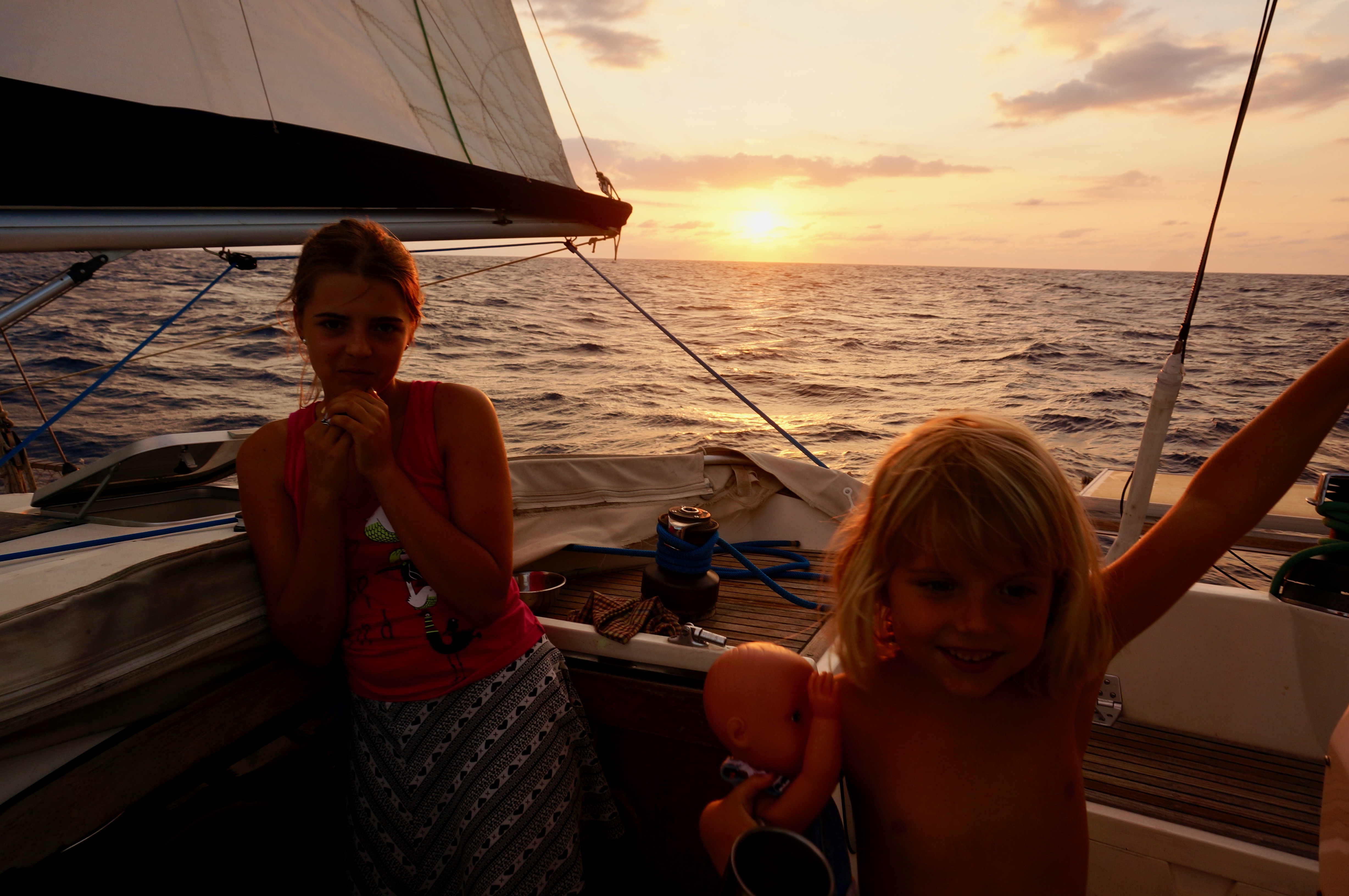
Our cheerful captain brings some variety to the soporific lapping of the sea. A second later, Ladunka and I are dancing right there on the coachroof, bawling out with gusto: “VVV Leningrad, SPb dot ru!!!” — It’s going well—even the flying fish approve and soar more energetically over the water alongside the birds. After “Leningrad,” “Jeanette” came into the port of Cape Town, while Kostya arrived in Odessa with his mullets.... Life at sea is good with music..
About Beggar-My-Neighbour
Ladunya came up with the idea of playing Beggar-My-Neighbour, and we try to catch the cards as they keep attempting to take a dip in the sea. An excellent game when Mum needs to think about her own things without paying much attention. I remember that as a child we had no playing cards at home, only draughts and chess, and it was our neighbour Lyuska who taught me to play “Beggar-My-Neighbour.” We had our own secret Morse code, tapping through the wall, ciphers and passwords—the full works. To our mutual delight, my parents bought a dacha on the same street as theirs.
We wandered through the woods picking mushrooms and berries, climbed trees, sewed clothes for our baby dolls and, in the same breath, made ourselves polyethylene moccasins, then raced around the apartment building entrance in them, whooping like Chingachgook. We haven’t been as close as we were in childhood for about twenty-five years, and we haven’t seen each other for fifteen. The Ural city of our childhood is in the past for both of us; other people have long since been living in our parents’ homes and dachas.... Tomorrow, September 16, is my Lyuska’s birthday, and also my friend Olya’s. I must remember to congratulate them both when we arrive (in the end, I forgot ☹).
Easy There, Horses
We need to arrive in Cartagena no earlier than Sunday, so we can check in on Monday and avoid paying for an out-of-hours arrival. So we are in no hurry. At night we sailed under a reefed mainsail, and we are still slowing ourselves down now, making about 2–3 knots.
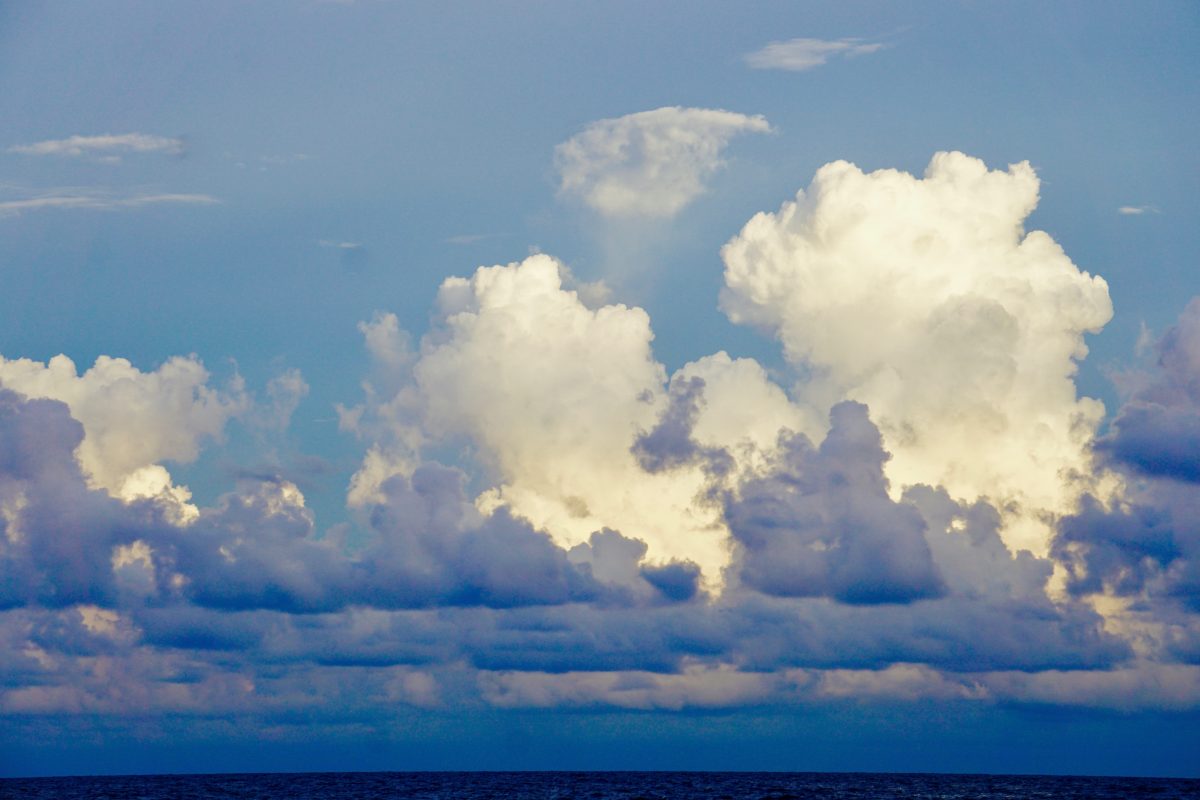
In this photo you can see that the Earth is round 🙂
Of course, I’m trying to convince the captain that we ought to make the most of the wind now and sail a bit faster, because a calm is bound to come later, and we hardly ever motor. If we need to slow down, I say, we can wander around off the coast. But the forecast promises stronger winds on the approach to the mainland, and Andrey wants to meet them about 30 miles offshore. The chaotic shifts in the airflows jumbled up by Irma could also produce an onshore wind, and hurtling towards an unfamiliar coast in strong winds is dangerous.
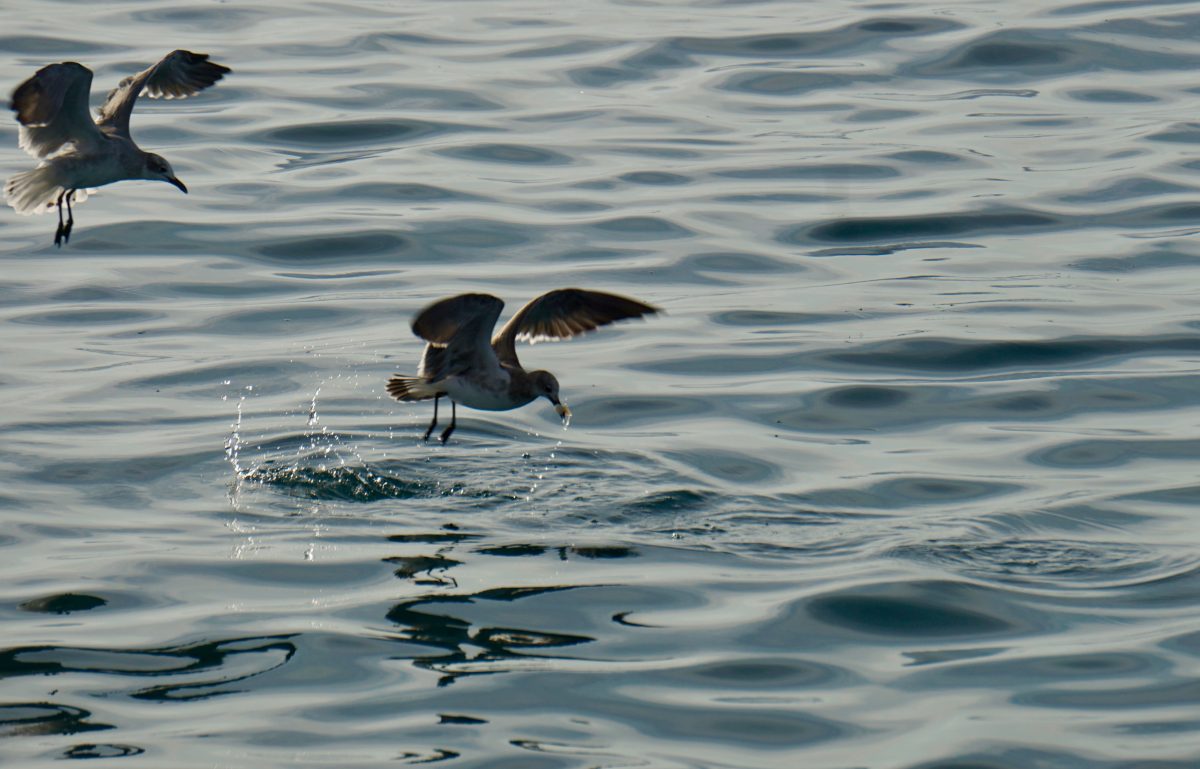
It’s hot and we long for movement, but at least there are no mosquitoes ☺. Greetings from land have begun: now an elegant tropicbird waves the slender quill of its tail, now the coal-black body of a proud frigatebird spreads itself above the mastheads; the little swallow-like birds still visit from morning till evening. On the tenth day, a common Latin American insect settled on the stern, looking like a hunched little Maya the Bee with dragonfly legs and the face of Mukha-Tsokotukha from the cartoon. These creatures come with either yellow or red stripes; back in French Guiana, one tried to move into our aft cabin.
It hauled in clay and built a wasp-like nest under the cornice, but one day, while it was ashore on its daytime excursion, we treacherously weighed anchor. The abandoned nest, discovered a couple of days later, was consigned to the ocean.
Where did this buzzy beetle come from out here, 160 miles from land?!
We whiled away the evening singing to a guitar on deck, by the light of the moon and a bonfire of distant lightning. At night we once again had to open and close the hatches because of the rain. Waves began hitting us broadside, and by morning part of the crew was lying on the teak deck. As we approach the equator, the mean daily temperature hardly drops below 30 degrees. We simply try to endure the time from ten in the morning until five in the evening, as something unavoidable..
About Provisions
We finished the last of the fruit and vegetables. Today we have a quarter of a head of cabbage, onions, garlic, potatoes, sweet potatoes, one apple (which happened to be lurking somewhere), and three equally accidental kiwifruit.
The watermelon did not survive its ordeal by heat, and we tipped most of it overboard, but a few pieces still proved edible.
There are more and more signs that we are approaching land; even the sea is gradually taking on the colour of bottle glass. Which river flows into it here—the Magdalena? I wonder whether the rivers colour the coastal waters everywhere in South America?
Maybe We Should Get Rid of a Mast...
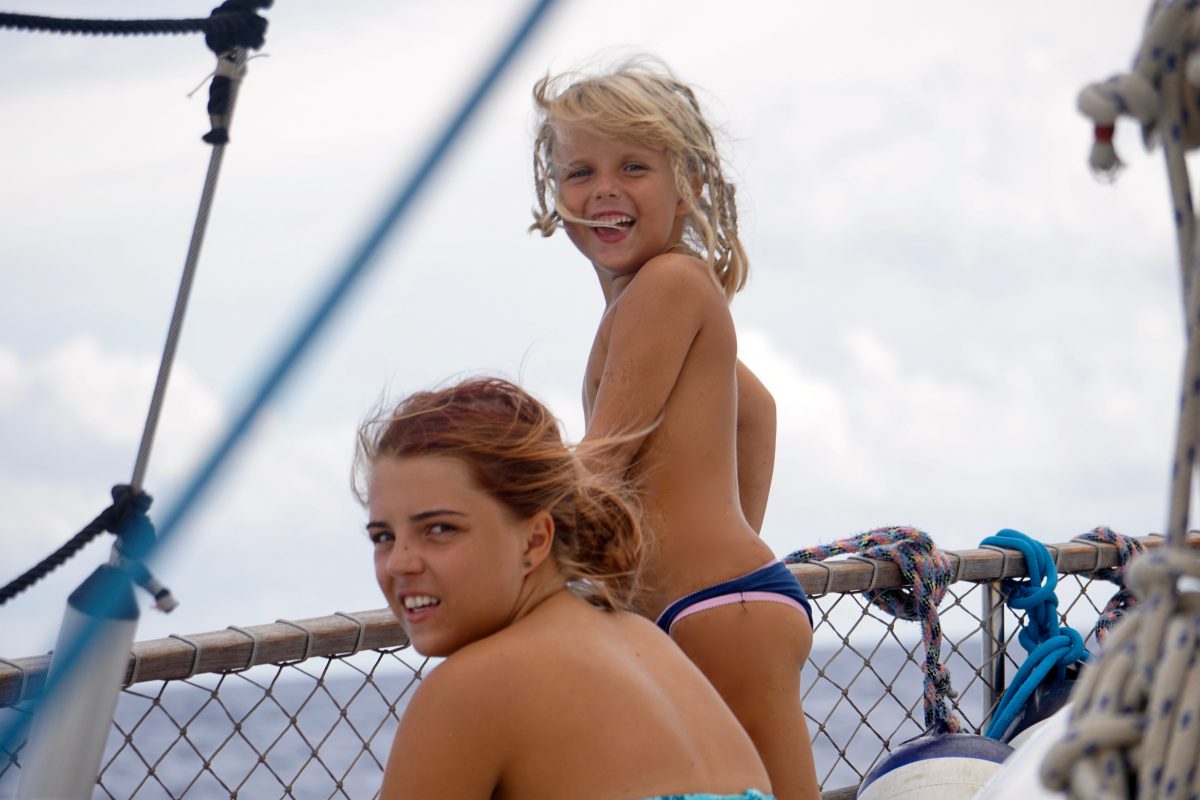
The things that come into your head in this heat and these light winds.... Andryukha has become seriously preoccupied with refitting the boat—he has decided to start by removing the mizzenmast.
That is the dilemma during these long years in the tropics: if you want to survive the heat, you need an awning. But an awning and a working mizzen are almost incompatible. So if the awning is up, we don’t set the mizzen. Of course, no one is denying its advantages, but in this situation it is better to do without the sail than without the awning (...so why is everyone so crazy about ketches, then?)...
And that night, for the first time in our lives, we saw Nikola Tesla’s experiments in action. What else could account for thunderstorms like that?
Lightning Networks
Ever since our anchorages in Mexico, we have grown accustomed to heat lightning blazing somewhere near the horizon—it flashes, but you can’t hear any thunder because it is far away. At least, that is what we used to think: that it was far away. Today we learned the truth.
At first the lightning glowed directly ahead; a couple of hours later, it was all around us and even overhead, still blazing almost soundlessly.
Can you picture a network of blood vessels, or tiny, slender roots branching out from larger ones? Now watch: the entire network, from its base to its finest tips, lights up, branches shooting across the whole sky in several places at once. And that would be all very well, except... there is no thunder. Only a crackling or rustling sound, almost drowned out by the lapping waves.
“Batteries to zero, shut down all power aboard. Electronics—in the oven!”
“Aye, aye, my captain!”
We sailed in the dark by compass and head torch for several hours. All our digital equipment, including the e-readers, trembled with fear inside the oven. At one point, the first mate wished the crew could be put in the oven as well. Andrey managed to film a little of this celestial electricity on the iPad, but the camera records only the brightest flashes and barely notices the whole vascular network.
What can you do? We are, after all, approaching one of the world’s centres of thunderstorm activity, with the most highly electrified air on Earth. The electricity is visible to the naked eye: the hair on the first mate’s and the girls’ heads is standing on end, as if someone had rubbed a balloon against it. This is already the third unusual natural phenomenon of the passage, not counting Irma herself—the most powerful hurricane in recorded history—and the mass die-off of migrating swifts. The first two were a nocturnal lunar rainbow and a waterspout.
We hope to drop anchor in Cartagena tomorrow. We spend half the night watching lightning without thunder, not yet knowing that a fairly severe storm awaits us on the approach to the South American coast.
To be continued!