
From the Travely-Family archive · Patagonia and Tierra del Fuego
A Feast During the Storm
An original publication from the former Travely-Family website. This English translation was preserved from the technical-site archive without editorial rewriting.
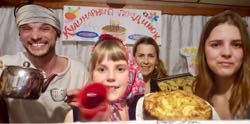
A Feast During the Storm. Our third week without seeing anyone. The crew after a week of storms: holidays, ordinary days, the young sailor’s fears and our shared jokes. Sent via satellite.
“Knock, knock, knock!”
Having pulled a snorkel mask on over my foul-weather gear and hat, I knock on the cover of the fire-screen hatch—our entrance.
“Could I pitch a tent in here?”
“You can,” shout the captain, the sailor and the young sailor.
I climb down out of the blizzard into the wheelhouse, slide the hatch shut and unload my rucksack. We are having a cooking contest. Everyone has prepared a dish and has to present it with a little sketch—a one-actor show.
Lada and I had long been planning that, on some dull evening in the fjords—after all, it gets dark early—we would hold a cooking celebration. The ingredients the young sailor needed for her signature dish—fresh fruit—had run out, so we decided that she would make her fruit desserts another time. For now, it was the perfect opportunity to try packet jelly. It gave off a fabulously raspberry-like aroma, though the taste proved to be pure chemicals. But that’s not the point, is it?
The mood had already turned festive and buoyant the evening before, when we set about preparing our acts, costumes and posters. The art and theatre departments got to work, and the kitchen was busy too. We drew a stove and hung garlic all around the wheelhouse—to ward off vampires while we were at it. You never know with the local ones; perhaps the storm had blown one in. And we were ready for them with our garlic.
Lada was Masha and made fruit jelly; Nastya treated us to charlotte, which, as we recently discovered, was named after a French girl called Charlotte. The captain performed a Chinese tea ceremony, while the first mate initially terrified the audience by announcing that she would make lunch from Fyodor Konyukhov’s dehydrated expedition food, but then transformed into a five-Michelin-star chef and brought in a baking tray of stuffed baked potatoes.
We really do lead a strange life. Weeks on our own, just the four of us, without another living soul in sight. And somehow it’s all right—we live well and have fun.
By the third day, weathering a storm in the same place was getting rather dull. The wheelhouse windows were plastered with wet snow. No one felt like going for a walk. Morning mail—breakfast—debates—lessons—exercise—university video lectures—reading—dinner—film—bed. The sailor grew glum, so we had to organise a disco and make pizza. Spirits began to rise.
In the morning, we finally set off. Our emergency reveille was softened by tea on the go. That means the three of us standing in the wheelhouse in boots and foul-weather gear, sipping boiling-hot tea as we work, while the young sailor, taking advantage of her tender years, finishes her dream. The tea perks up the body and wakes the mind. We happened to have a special tea that had been waiting for its moment for more than two years, ever since Russia. Masala chai, warming tea. We had no need for it in the tropics—it was already so hot there you could hardly breathe. But now it was just the thing.
We launch the dinghy. The oars will not come apart so they can later be reassembled in the rowlocks, because they are frozen solid. The captain climbs down into the dinghy, menacingly brandishing a lit blowtorch.
“Just don’t me-e-elt the oars!” I call after him from the deck.
The oars did, of course, begin to smoke from the flame, but the ice inside them melted. Now we could row over to the trees and untie the lines. Ashore, Nastya discovered that nope, no chance. The ropes had iced up and frozen overnight.
“Tell you what,” I said, “I’ll get a thermos of boiling water ready.”
The captain initially doubted that it would help. Your water will freeze again, he said, while you’re putting the thermos away and reaching for the knots. We tried it. It did not freeze. And that was how we broke the spell on four knots with boiling water.
First, a forest of thick, long seaweed snagged on the anchor as we hauled it up; then a crab pot caught on the chain. A rusty, round metal contraption with netting. Once again, the cap saved everyone. All he had to do was cast it a sidelong glance, and the dear thing dropped off.
It was 24 miles to our next anchorage, Isla Macías. Part of the route ran along the Pacific side, without any islands to shelter us from the ocean. It was at that very spot that I became so thoroughly fed up that I immediately wanted to tell ocean life to go to hell and move to the magnificent Altai Mountains to grow swedes. We would be harvesting them just about now. But no—we were crashing through a wall of snow, into the wind, over two-metre head seas. Well... you get the general idea.
There are days when it is more pleasant to watch the sea from shore. Especially when there is a fire burning at the observation post, ruby wine sparkling in crystal, and a bed caressing you with silk. Mmm... yes.
Back to our sheep.
Fortunately, by the time we anchored, the waves were pounding the western sides of the islands rather than us. All we got was hail, snow and gusty wind. This time, rather unusually, we stopped for the night in a channel overgrown with twenty-metre seaweed, stretching ourselves between a large island and a small one. We ran one line ashore from the bow and another from the stern.
Climbing through loose, polystyrene-like snow to reach a tree was actually fun. Just like in a film. You tie up the dinghy, then carefully climb six metres up. You look down and see the dinghy banging against the coastal rocks, then go back to retie it. Haul it onto a gently sloping rock, secure it with plenty of knots, and then climb back up confidently and quickly. Scrambling up the steep slope was so enjoyable that I rowed back to fetch the young sailor. She is the greatest adventure-lover among us.
While the captain repaired the gas system and the windlass remote, and Nastya made pizza, we went on a hike beneath trees twisted by the wind, which, at the top of the island, turn into dry, creeping snags.
We collected specimens for the herbarium, and then Ladunya hurried towards me from the shore, looking anxious.
“Mum, Mum, quick, quick!”
“What happened?”
“No time for words—I can’t talk now, just give me your hand! Quick! There’s a snakeskin over there, and I’m terribly afraid of such enormous snakes.”
I climb down warily. And indeed, something long, thick, dusted with snow and covered in bumps lies coiled beside a rock. And several more of these things, carelessly discarded by some unknown monster, are also growing out of half a kind of skull. In short, we had to exercise several brain cells before identifying this monster as seaweed. Fleshy, enormous and undoubtedly edible. And the skull turned out to be the holdfast anchoring this underwater tree to the seabed.
For dinner, we calmed ourselves not with the bounty of the sea but with pizza, a glass of celebratory cola and the final of the programme Ice Age: Kids. Such an amaaazing project. Watching it, for the first time in my life, I spent so long regretting that I had given up figure skating and traded it for five years in the ski club.?!? After all, figure skating was the quintessence of everything I enjoyed doing—sport, dance and theatre all rolled into one.
I frightened the children by promising that when they had children of their own, I, their old granny, would take them to figure-skating lessons.
We had a good laugh and went to bed. Guys, did any of you give up a favourite sport in childhood for one you didn’t much like, or was I the only one that original?
And in the morning, another emergency reveille... Incidentally, the night at anchor was so-so. In terms of security, 5.9; in terms of comfort, no more than 5.0, if measured in figure-skating scores. We were tossed in every direction, the ropes jerked, and the anchor chain hummed.
You can follow the expedition in real time on our website under the Route tab, where the Iridium track is displayed. The map with the track and details is also available at bit.ly/iridium360.
We thank our now truly official shore team, Viktor S. and Leonid M., for breathing life into the expedition budget via Paypal.me/TravelyFamily. You are the best!
A huge thank-you to everyone who is with us! Every day we eagerly await your comments and are sooo delighted by the captain’s cry of “Morning mail!” after the communications session.
Joy to you all! We are yours.