
From the Travely-Family archive · Pacific Ocean
Mountain Pass or Abyss? – A Hike on Fatu Hiva
An original publication from the former Travely-Family website. This English translation was preserved from the technical-site archive without editorial rewriting.
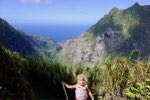
Mountain pass or abyss? A hike on Fatu Hiva. What our young sailor and Thor Heyerdahl have in common. Who gives yachts funny names. Trails, precipices, rain in the dry season, and mountain hikes on Navy Day.
“Smetana! Smetana! This is Lady Mary.”
“Lady Mary, Smetana. Seven Four.”
And we switch to channel 74.
“Guys, we’ll be ten minutes late,” I say, looking out at the rain.
“Okay. We’re ready. See you ashore.”
A week earlier, the young sailor and I had explored the river upstream, and on our way home at dusk we spotted a European-looking guy by the roadside. He was quietly strumming a guitar to himself. Hearing the music, Ladunya started jumping around. Smiling, the guy announced the next number: “This is jumping song.”
Interesting, I thought—is he collecting money or something? But what would be the point? Hardly anyone ever passes by here. Images sprang to mind of cheap hostels with dorm rooms, scraping together a few coins for food… Just then, the young sailor spotted a cap lying on the grass and decided she wanted to put some money in it—she had just found a small pile of coins on the road. But she felt shy, circled around for a while, then changed her mind.
“Oh, come on, just ask him. Ask with your eyes if it’s for money. Or ask him in English?”
“No,” the would-be benefactor dug in her heels.
We debated for a minute or so, until the guy asked in flawless Russian:
“Do you speak Russian?”
“!!! No way!” And we sat down beside him on the roadside.
At the age of six, Ilya moved with his family from Nizhny Novgorod to Toronto. After dutifully working as a mathematician and programmer, he saved up for a yacht and decided that if the flag was going to be Canadian, at least the name ought to be Russian. And he called his boat not Pobeda, not Lastochka, but Smetana.
We had a good laugh and went hiking with him.
There are eight of us altogether: Ilya and his partner Audrey, us, plus an elderly French couple who run marathons, Didier and Chantal. They have four children—the eldest is 36—and six grandchildren, as well as a steel boat painted a cheerful shade of yellow. They sailed here from France.
The wind spits out powerful gusts; overnight, two awnings split at the seams. Naturally, in weather like this, going anywhere is a real drag. We remind the children how every year, on Navy Day, we used to go hiking in the glorious city of Zlatoust. Those in the know are aware that if Moscow is the capital of our Motherland, Zlatoust is its bladder. Three years out of five, the end of July brings sheets of rain and temperatures of +16°C. And you still have to get up at six and head into the mountains.
We set off briskly along the road from the bay. As recently as five years ago, the paved surface ended immediately beyond the village. Now the concrete climbs upwards for a whole kilometre and a half. By the time it runs out, the young sailors and I are already thoroughly tired. And then there is the rain, the wind, and the general murk hanging in tatters from the jagged cliffs.
Ladunya is in the vanguard, and her tireless chatter entertains the whole group for the first six kilometres. But then our ship’s bell rings less and less often, more and more faintly, and by the eighth kilometre of the climb it falls completely silent. Yet she keeps marching bravely onward.
For eight or nine kilometres, the road climbs to the pass, then descends for roughly the same distance. At the pass, we collapse blissfully into the shade of the roofs above neat little tables. On days when cruise ships arrive, tourists are welcomed here with food and island souvenirs.
No, we do not collapse straight away. First we discover wild red guava four metres above the ground and, using every method available to hungry wolves—and monkeys—gather several handfuls. Meanwhile Audrey, who has visited the abandoned village before, disappears into the undergrowth and returns with a full container of tart, sweet-and-sour guavas resembling soft ranetka apples.
From here there are two routes: straight ahead to the main village of Omoa, or left to Ouia. A wet, slippery trail winds there along the edge of a razor-toothed ridge.
When the still rather young Thor Heyerdahl lived on Fatu Hiva, there was not even a dirt road here. The main village, Omoa, was linked to our Hanavave by a trail passable by people and even horses.
It was Fatu Hiva that shifted the focus of Heyerdahl’s interests from zoology to anthropology. Then came the balsa-wood raft Kon-Tiki, the reed boats Ra I and Ra II, and the excavations on Easter Island. Thor and his young wife walked the very same trail to the village that had already been abandoned in the 1930s. Just like us, their hearts must have been in their mouths as they slipped down sheer slopes and came upon abysses where the wind howled.
Can Ladunka manage it? She had planned to carry a backpack, but anticipating that on the difficult stretch one of us would end up lugging her jaunty green pack, we persuaded the young sailor to go without it.
After a snack, we leave the main road and turn onto a trail disappearing into the undergrowth. And what a surprise! For about a kilometre, we walk among guava bushes, whose fruit we devour greedily at first and then stop noticing altogether.
The depths of the rainforest greet us with sombre beards of moss hanging from gigantic trees. Even infant tree ferns stand more than twice a person’s height. I feel like a character in Conan Doyle’s The Lost World and never let go of my camera.
Nastya is now in the vanguard, so only the captain and the young sailor make it into the frame. While I fuss with the camera—taking it out whenever there is a break in the rain and putting it away when the rain returns—the young sailor cries out:
“Oooh! What a trail!”
The bamboo grove has begun. If nobody used the trail, the bright green bamboo poles would long since have formed an impenetrable palisade. But the trail is well trodden, and it is possible to squeeze through the fallen bamboo and the stalks growing at an angle. Red clay squelches underfoot, and the gradient becomes steeper. Giant trees appear less frequently. The captain and the young sailor have agreed to take a two-minute break at every such tree.
Suddenly we emerge towards the light at the end of the green tunnel. In a little sunlit clearing, as if caught in a spotlight, the whole company is waiting for us.
“The difficult descent starts here,” Audrey warns us.
The vanguard gets up and disappears around the rock. We take three steps and, breathless from a blast of wind, freeze at the edge of the abyss.
To be continued!